Komsomolsk-on-Amur

Description

Komsomolsk-on-Amur is a city in Khabarovsk Krai, Russia, located on the left bank of the Amur River in the Russian Far East. It is located on the Baikal-Amur Mainline, 356 km northeast of Khabarovsk. Population: 263,906 (2010).

Geography

The city and its suburbs stretch for over 30 km along the left bank of the Amur River. The river at this point is up to 2.5 km wide.

The distance to Khabarovsk—the administrative center of the krai—is 356 km; to the Pacific Ocean—about 300 km. The nearest other major town is Amursk, about 45 km south.

It is about 3,900 miles (6,300 km) east of Moscow, and lies at the eastern end of the BAM Railway.

History

The future site of Komsomolsk-on-Amur was conquered by Mongols in the 13th century, becoming part of Mongol Empire under the Mongol Yuan Dynasty and later Manchus held until 1858 treaty of Aigun ceded the area to the Russian Empire.

The village of Permskoye (Пе́рмское) was established on the later site of Komsomolsk in 1860 by migrant peasants from what is now Perm Krai.

The government of the Russian SFSR announced in 1931 plans to construct a shipyard on the Amur at the present site of Komsomolsk, with construction beginning in 1932. The town was largely built using volunteer labor from the Communist youth organization Komsomol, thus receiving the name Komsomolsk. However, the construction of the town was aided with the use of penal labour from the prison camps situated in the area. The suffix on Amur was added to differentiate from other towns with the same name. It was granted town status in 1933.

By the end of the 1930s, the shipyards along with facilities for other heavy industry had been completed. The city developed into a regional center for industries such as metallurgy, machinery, oil refining, and shipbuilding.

Layout

Komsomolsk-on-Amur consists of two historical parts: the center, or "city", where the main enterprise - Shipyard, and the so-called Dzemgi - an area that has formed during the construction of an aircraft factory (future KnAAPO). In fact, each of the parts is a separate town, itself a single center in the city.

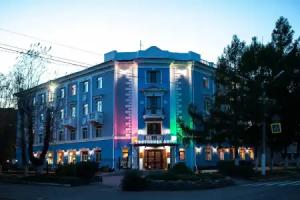
Areas of the city are very different architectural appearance: Center Stalinist buildings dominated the 40-50s (exception - the residential area near the train station), Dzemgi is built up mainly typical panel apartment blocks. The "sleeping" area Dzemgi is not, as the majority of their residents work in enterprises located here.

Economy and infrastructure

Komsomolsk-on-Amur is an important industrial center of Khabarovsk Krai and of the Russian Far East. It has a diversified economy where machine building, metallurgy and timber enterprises dominate.

The city's most notable company is Komsomolsk-on-Amur Aircraft Production Association, Russia's largest aircraft-manufacturing enterprise. It is among Khabarovsk Krai's most successful enterprises, and for years has been the largest taxpayer of the territory. It has manufactured hundreds of civil aircraft and thousands of various-role military aircraft from the first recon aircraft to modern Su- series fighters and light amphibian aeroplanes. The company is hugely important to the city's economy, contributing 45% of all payments into the local budget.

Also based in the city is Amur Shipbuilding Plant, an important producer of ships and submarines.

Two air bases are located near the city, Khurba to the south and Dzemgi to the north.

The city is an important rail junction, situated at the end of a branch line from Khabarovsk to the Baikal-Amur Mainline.

The city is served by the Komsomolsk-on-Amur Airport

Public transport includes 5 tram routes, bus and fixed-taxi (marshrutka).

The first sortie of the Sukhoi PAK FA T-50 Prototype occurred at the Gagarin Factory.

  • Test flight of a Sukhoi Superjet 100 prototype in Komsomolsk-on-Amur

  • Tram

Street view

Reviews

Share your experiences, help others make the right choice!
Think about what you would like to know if you were looking for a review about a place to relax. Please describe in detail what you liked and what you didn't. What would you advise to other guests and to the hotel owner. The more fully you tell about the hotel, the easier it will be for other people to make a choice and they will be very grateful to you!

Map

X