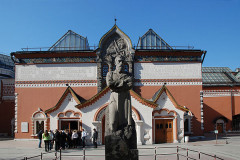
Pushkin Museum in Moscow
Description
The Pushkin State Museum of Fine Arts (Russian: Музей изобразительных искусств им. А.С. Пушкина) is the largest museum of European art in Moscow, located in Volkhonka street, just opposite the Cathedral of Christ the Saviour. The International musical festival Svyatoslav Richter's December nights has been held in the Pushkin museum since 1981.
Etymology
The museum's current name is somewhat misleading, in that it has no direct associations with the famous Russian poet Alexander Pushkin, other than as a posthumous commemoration of his name and fame. The facility was founded by professor Ivan Tsvetaev (father of the poet Marina Tsvetaeva). Tsvetaev persuaded the millionaire and philanthropist Yuriy Nechaev-Maltsov and the fashionable architect Roman Klein of the urgent need to give Moscow a fine arts museum. After going through a number of name-changes, particularly in the transition to the Soviet-era and the return of the Russian capital to Moscow, the museum was finally renamed to honour the memory of Pushkin in 1937, the 100th anniversary of his death.
Building
The Pushkin State Museum of Fine Arts' building was designed by Roman Klein and Vladimir Shukhov and financed primarily by Yury Nechaev-Maltsov. Construction work began in 1898 and continued till 1912. Ivan Rerberg headed structural engineering effort on the museum site for 12 years, till 1909.
In 2008, President Dmitri A. Medvedev announced plans for a $177 million restoration. A Rbn22 billion ($670 million) expansion, developed by Norman Foster in collaboration with local architectural firm Mosproject-5, was confirmed in 2009, but became mired in disputes with officials and preservationists and concern grew that it would not be completed on schedule for 2018. After Moscow’s chief architect Sergei Kuznetsov issued an ultimatum, demanding that Foster take a more active role in the project and prove his commitment by coming to the Russian capital within a month, Norman Foster’s firm resigned from the project in 2013. In 2014, Russian architect Yuri Grigoryan, and his firm Project Meganom, were chosen to take over the project. Grigoryan’s design provides new modern buildings and, following the protest of heritage groups who campaigned to save the pre-revolutionary architecture, preserves the historic 1930s gas station near the Pushkin’s main building inside a glass structure.
Collection
Fine Art Collection
Tsvetaev's dream was realised in May 1912, when the museum opened its doors to the public. The museum was originally named after Alexander III, although the government provided only 200,000 rubles toward its construction, in comparison with over 2 million from Nechaev-Maltsev. Its first exhibits were copies of ancient statuary, thought indispensable for the education of art students. The only genuinely ancient items - Moscow Mathematical Papyrus and Story of Wenamun - had been contributed by Vladimir Golenishchev three years earlier.
After the Russian capital was moved to Moscow in 1918, the Soviet government decided to transfer thousands of works from St Petersburg's Hermitage Museum to the new capital. The entire collection of Western art from the Museum Roumjantsev was added too. These paintings formed a nucleus of the Pushkin museum's collections of Western art. But the most important paintings were added later from the State Museum of New Western Art. These comprised Impressionist and Post-Impressionist artwork, including top works by Van Gogh, Gauguin, Picasso, Dufrénoy, Derain and Matisse. Among them, Van Gogh's "La Vigne Rouge", apparently the only painting sold during the artist's lifetime. In 1937, Pushkin's name was appended to the museum, because the Soviet Union marked the centenary of the poet's death that year.
Archaeological Collection
After the World War II the evacuated Dresden Gallery had been stored in Moscow for 10 years. The Dresden collection was finally returned to East Germany, despite strong opposition from the museum officials, notably Irina Antonova, who has been running the museum since February 1961. The Pushkin Museum is still a main depositary of Troy's the so-called Priam's Treasure gold hoard removed from Troy by the German archaeologist, Heinrich Schliemann and later taken by the Soviet Army (Red Army) from the Pergamon Museum in Berlin; as well as other artifacts taken from Germany during the Soviet occupation at the end of the Second World War.
Numismatic Collection
The Pushkin Museum has a numismatic collection which is unpublished. It includes archaeological material from Central Asia, such as a hoard of Kushano-Sasanian coins acquired in 2002
Street view
Reviews
Rembrandt, Picasso, Antonio Giovanni, Vincent van Gogh, etc. you will love it. After all, there are even sculptures! And paintings that can be touched - for the blind.
But the organizational part of the Museum brings: a huge queue with chaotic approaches to the booths and not less chaotic approach to the wardrobe. I.e. from the first become the last piece of cake.
Grouchy grandmother are included in the ticket price. Well, the strange behavior of the cashiers of one and the same person may one student forgot student ID and showing the SKS, give preferential admission ticket with the words "next time do not forget the student!!!", and the other is easy to deploy and require full amount. Fortunately, the price is not biting - not sorry.
Also, very surprised the closure of the whole of the hall to the entrance for the sake of some fools-bawlers. I.e. to the exhibits to come: all fenced in ribbons, which admit only members of the troupe. Well finally finished off the closure of an entire section without explanation 2 hours before closing time.
Sudsee place on earth, one of the branches of hell! Organization anything was missing as a given. A few hours on the sidewalk, and if the heat in which climb all and Sundry, it is the "culture"! Continue not clear the sale of tickets for the sessions which will be in another hour, i.e. there are no tickets, and why are you standing before it in the queue do not clear... continued "fun" expects, even in the closet where there are no available hangers, ie people allowed without an understanding of the capacity of the Museum... And it's not the end of obtaining pleasure, in the hall you also immediately will not be allowed, because the tickets for the sessions that you have sold for the next session instead of now... ) the Administrator and employees who never meet, and they basically do not care what happens! No arguments and cues do not matter, what more eloquently than book reviews! In General, I wish you a pleasant viewing... I Have personally already lost all desire and mood, about atmosphere and sense of beauty can not speak...
Not talking about some online services, ticket sales via the website (they just never have) and even the slightest automation flow, not heard...
PS I've been to different museums and exhibitions in different parts of the world, but the second not such a mess remember. I would also like something could understand if I paid money for it, or everything was free, but I pay my money and do not understand for what?! Very sad.