Illinois
Description
Illinois is a state in the midwestern region of the United States. It is the 5th most populous state and 25th largest state in terms of land area, and is often noted as a microcosm of the entire country. With Chicago in the northeast, small industrial cities and great agricultural productivity in central and northern Illinois, and natural resources like coal, timber, and petroleum in the south, Illinois has a diverse economic base and is a major transportation hub. The Port of Chicago connects the state to other global ports from the Great Lakes, via the Saint Lawrence Seaway, to the Atlantic Ocean, as well as the Great Lakes to the Mississippi River, via the Illinois River. For decades, O'Hare International Airport has been ranked as one of the world's busiest airports. Illinois has long had a reputation as a bellwether both in social and cultural terms and politics.
Although today the state's largest population center is around Chicago in the northern part of the state, the state's European population grew first in the west, with French Canadians who settled along the Mississippi River, and gave the area the name, Illinois. After the American Revolutionary War established the United States, American settlers began arriving from Kentucky in the 1810s via the Ohio River, and the population grew from south to north. In 1818, Illinois achieved statehood. After construction of the Erie Canal increased traffic and trade through the Great Lakes, Chicago was founded in the 1830s on the banks of the Chicago River, at one of the few natural harbors on southern Lake Michigan. John Deere's invention of the self-scouring steel plow turned Illinois' rich prairie into some of the world's most productive and valuable farmlands, attracting immigrant farmers from Germany and Sweden. Railroads carried immigrants to new homes, as well as being used to ship their commodity crops out to markets.
By 1900, the growth of industrial jobs in the northern cities and coal mining in the central and southern areas attracted immigrants from Eastern and Southern Europe. Illinois was an important manufacturing center during both world wars. The Great Migration from the South established a large community of African Americans in Chicago, who created the city's famous jazz and blues cultures.
Three U.S. presidents have been elected while living in Illinois: Abraham Lincoln, Ulysses S. Grant, and Barack Obama. Additionally, Ronald Reagan, whose political career was based in California, was the only U.S. president born and raised in Illinois. Today, Illinois honors Lincoln with its official state slogan, Land of Lincoln, which has been displayed on its license plates since 1954. The Abraham Lincoln Presidential Library and Museum is located in the state capital of Springfield.
Etymology
"Illinois" is the modern spelling for the early French Catholic missionaries and explorers' name for the Illinois Native Americans, a name that was spelled in many different ways in the early records.
American scholars previously thought the name "Illinois" meant "man" or "men" in the Miami-Illinois language, with the original iliniwek transformed via French into Illinois. This etymology is not supported by the Illinois language, as the word for 'man' is ireniwa and plural 'men' is ireniwaki. The name Illiniwek has also been said to mean "tribe of superior men", which is a false etymology. The name "Illinois" derives from the Miami-Illinois verb irenwe·wa "he speaks the regular way". This was taken into the Ojibwe language, perhaps in the Ottawa dialect, and modified into ilinwe· (pluralized as ilinwe·k). The French borrowed these forms, changing the /we/ ending to spell it as -ois, a transliteration for its pronunciation in French of that time. The current spelling form, Illinois, began to appear in the early 1670s, when French colonists had settled in the western area. The Illinois' name for themselves, as attested in all three of the French missionary-period dictionaries of Illinois, was Inoka, of unknown meaning and unrelated to the other terms.
History
Pre-European
American Indians of successive cultures lived along the waterways of the Illinois area for thousands of years before the arrival of Europeans. The Koster Site has been excavated and demonstrates 7,000 years of continuous habitation. Cahokia, the largest regional chiefdom and urban center of the Pre-Columbian Mississippian culture, was located near present-day Collinsville, Illinois. They built an urban complex of more than 100 platform and burial mounds, a 50 acres (20 ha) plaza larger than 35 football fields, and a woodhenge of sacred cedar, all in a planned design expressing the culture's cosmology. Monks Mound, the center of the site, is the largest Pre-Columbian structure north of the Valley of Mexico. It is 100 feet (30 m) high, 951 feet (290 m) long, 836 feet (255 m) wide and covers 13.8 acres (5.6 ha). It contains about 814,000 cubic yards (622,000 m3) of earth. It was topped by a structure thought to have measured about 105 feet (32 m) in length and 48 feet (15 m) in width, covered an area 5,000 square feet (460 m2), and been as much as 50 feet (15 m) high, making its peak 150 feet (46 m) above the level of the plaza. The finely crafted ornaments and tools recovered by archaeologists at Cahokia include elaborate ceramics, finely sculptured stonework, carefully embossed and engraved copper and mica sheets, and one funeral blanket for an important chief fashioned from 20000 shell beads. These artifacts indicate that Cahokia was truly an urban center, with clustered housing, markets, and specialists in toolmaking, hide dressing, potting, jewelry making, shell engraving, weaving and salt making. The civilization vanished in the 15th century for unknown reasons, but historians and archeologists have speculated that the people depleted the area of resources. Many indigenous tribes engaged in constant warfare. According to Suzanne Austin Alchon, "At one site in the central Illinois River valley, one-third of all adults died as a result of violent injuries." The next major power in the region was the Illinois Confederation or Illini, a political alliance. As the Illini declined during the Beaver Wars era, members of the Algonquian-speaking Potawatomi, Miami, Sauk, and other tribes including the Fox (Mesquakie), Ioway, Kickapoo , Mascouten, Piankashaw, Shawnee, Wea, and Winnebago (Ho-Chunk) came into the area from the east and north around the Great Lakes.
European exploration
French explorers Jacques Marquette and Louis Jolliet explored the Illinois River in 1673. In 1680, other French explorers constructed a fort at the site of present-day Peoria, and in 1682, a fort atop Starved Rock in today's Starved Rock State Park. French Canadians came south to settle particularly along the Mississippi River, and Illinois was part of the French empire of La Louisiane until 1763, when it passed to the British with their defeat of France in the Seven Years' War. The small French settlements continued, although many French migrated west to Ste. Genevieve and St. Louis, Missouri to evade British rule.
A few British soldiers were posted in Illinois, but few British or American settlers moved there, as the Crown made it part of the territory reserved for Indians west of the Appalachians. In 1778, George Rogers Clark claimed Illinois County for Virginia. In a compromise, Virginia ceded the area to the new United States in 1783 and it became part of the Northwest Territory, to be administered by the federal government and later organized as states.
19th century
The Illinois-Wabash Company was an early claimant to much of Illinois. The Illinois Territory was created on February 3, 1809, with its capital at Kaskaskia, an early French settlement.
During the discussions leading up to Illinois' admission to the Union, the proposed northern boundary of the state was moved twice. The original provisions of the Northwest Ordinance had specified a boundary that would have been tangent to the southern tip of Lake Michigan. Such a boundary would have left Illinois with no shoreline on Lake Michigan at all. However, as Indiana had successfully been granted a 10-mile northern extension of its boundary to provide it with a usable lakefront, the original bill for Illinois statehood, submitted to Congress on January 23, 1818, stipulated a northern border at the same latitude as Indiana's, which is defined as 10 miles (16 km) north of the southernmost extremity of Lake Michigan. But the Illinois delegate, Nathaniel Pope, wanted more. Pope lobbied to have the boundary moved further north, and the final bill passed by Congress did just that; it included an amendment to shift the border to 42° 30' north, which is approximately 51 miles (82 km) north of the Indiana northern border. This shift added 8,500 square miles (22,000 km2) to the state, including the lead mining region near Galena. More importantly, it added nearly 50 miles of Lake Michigan shoreline and the Chicago River. Pope and others envisioned a canal that would connect the Chicago and Illinois rivers, and thus, connect the Great Lakes to the Mississippi.
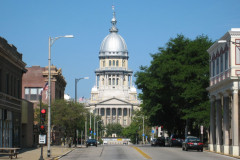
In 1818, Illinois became the 21st U.S. state. The capital remained at Kaskaskia, headquartered in a small building rented by the state. In 1819, Vandalia became the capital, and over the next 18 years, three separate buildings were built to serve successively as the capitol building. In 1837, the state legislators representing Sangamon County, under the leadership of state representative Abraham Lincoln, succeeded in having the capital moved to Springfield, where a fifth capitol building was constructed. A sixth capitol building was erected in 1867, which continues to serve as the Illinois capitol today.
Though it was ostensibly a "free state", there was slavery in Illinois. The ethnic French had owned black slaves as late as the 1820s, and American settlers had already brought slaves into the area from Kentucky. Slavery was nominally banned by the Northwest Ordinance, but that was not enforced for those already holding slaves. When Illinois became a sovereign state in 1818, the Ordinance no longer applied, and about 900 slaves were held in the state. As the southern part of the state, later known as "Egypt"or "Little Egypt", was largely settled by migrants from the South, the section was hostile to free blacks. Settlers were allowed to bring slaves with them for labor but, in 1822, state residents voted against making slavery legal. Still, most residents opposed allowing free blacks as permanent residents. Some settlers brought in slaves seasonally or as house servants. The Illinois Constitution of 1848 was written with a provision for exclusionary laws to be passed. In 1853, John A. Logan helped pass a law to prohibit all African Americans, including freedmen, from settling in the state.
In 1832, the Black Hawk War was fought in Illinois and current-day Wisconsin between the United States and the Sauk, Fox (Meskwaki) and Kickapoo Indian tribes. It represents the end of Indian resistance to white settlement in the Chicago region. The Indians had been forced to leave their homes and move to Iowa in 1831; when they attempted to return, they were attacked and eventually defeated by U.S. militia. The survivors were forced back to Iowa.
The winter of 1830–1831 is called the "Winter of the Deep Snow"; a sudden, deep snowfall blanketed the state, making travel impossible for the rest of the winter, and many travelers perished. Several severe winters followed, including the "Winter of the Sudden Freeze". On December 20, 1836, a fast-moving cold front passed through, freezing puddles in minutes and killing many travelers who could not reach shelter. The adverse weather resulted in crop failures in the northern part of the state. The southern part of the state shipped food north and this may have contributed to its name: "Little Egypt", after the Biblical story of Joseph in Egypt supplying grain to his brothers.
By 1839, the Latter Day Saints had founded a utopian city called Nauvoo. Located in Hancock County along the Mississippi River, Nauvoo flourished and soon rivaled Chicago for the position of the state's largest city. But in 1844, the Latter Day Saint movement founder Joseph Smith was killed in the Carthage Jail, about 30 miles away from Nauvoo. Following a Succession crisis (Latter Day Saints), Brigham Young led most Latter Day Saints out of Illinois in a mass exodus to present-day Utah; after close to six years of rapid development, Nauvoo rapidly declined afterward.
Chicago gained prominence as a Great Lakes port and then as an Illinois and Michigan Canal port after 1848, and as a rail hub soon afterward. By 1857, Chicago was Illinois' largest city. With the tremendous growth of mines and factories in the state in the 19th century, Illinois was the ground for the formation of labor unions in the United States. The Pullman Strike and Haymarket Riot, in particular, greatly influenced the development of the American labor movement. From Sunday, October 8, 1871, until Tuesday, October 10, 1871, the Great Chicago Fire burned in downtown Chicago, destroying 4 square miles (10 km2).
In 1847, after lobbying by Dorothea L. Dix, Illinois became one of the first states to establish a system of state-supported treatment of mental illness and disabilities, replacing local almshouses.
Civil WarDuring the American Civil War, Illinois ranked fourth in men who served (more than 250,000) in the Union Army, a figure surpassed by only New York, Pennsylvania, and Ohio. Beginning with President Abraham Lincoln's first call for troops and continuing throughout the war, Illinois mustered 150 infantry regiments, which were numbered from the 7th to the 156th regiments. Seventeen cavalry regiments were also gathered, as well as two light artillery regiments. The town of Cairo, at the southern tip of the state at the confluence of the Mississippi and Ohio Rivers, served as a strategically important supply base and training center for the Union army. For several months, both General Grant and Admiral Foote had headquarters in Cairo.
20th century
At the turn of the 20th century, Illinois had a population of nearly 5 million. Many people from other parts of the country were attracted to the state by employment caused by the then-expanding industrial base. Whites were 98% of the state's population. Bolstered by continued immigration from southern and eastern Europe, and by the African-American Great Migration from the South, Illinois grew and emerged as one of the most important states in the union. By the end of the century, the population had reached 12.4 million.
The Century of Progress World's Fair was held at Chicago in 1933. Oil strikes in Marion County and Crawford County lead to a boom in 1937, and, by 1939, Illinois ranked fourth in U.S. oil production. Illinois manufactured 6.1 percent of total United States military armaments produced during World War II, ranking seventh among the 48 states. Chicago became an ocean port with the opening of the Saint Lawrence Seaway in 1959. The seaway and the Illinois Waterway connected Chicago to both the Mississippi River and the Atlantic Ocean. In 1960, Ray Kroc opened the first McDonald's franchise in Des Plaines (which still exists as a museum, with a working McDonald's across the street).
Illinois had a prominent role in the emergence of the nuclear age. In 1942, as part of the Manhattan Project, the University of Chicago conducted the first sustained nuclear chain reaction. In 1957, Argonne National Laboratory, near Chicago, activated the first experimental nuclear power generating system in the United States. By 1960, the first privately financed nuclear plant in the United States, Dresden 1, was dedicated near Morris. In 1967, Fermilab, a national nuclear research facility near Batavia, opened a particle accelerator, which was the world's largest for over 40 years. With eleven plants currently operating, Illinois leads all states in the amount of electricity generated from nuclear power.
In 1961, Illinois became the first state in the nation to adopt the recommendation of the American Law Institute and pass a comprehensive criminal code revision that repealed the law against sodomy. The code also abrogated common law crimes and established an age of consent of 18. The state's fourth constitution was adopted in 1970, replacing the 1870 document.
The first Farm Aid concert was held in Champaign to benefit American farmers, in 1985. The worst upper Mississippi River flood of the century, the Great Flood of 1993, inundated many towns and thousands of acres of farmland.
Geography
Illinois is located in the Midwest Region of the United States and is one of the eight states and Canadian Province of Ontario in the bi-national Great Lakes region of North America.
Boundaries
Illinois' eastern border with Indiana consists of a north-south line at 87° 31′ 30″ west longitude in Lake Michigan at the north, to the Wabash River in the south above Post Vincennes. The Wabash River continues as the eastern/southeastern border with Indiana until the Wabash enters the Ohio River. This marks the beginning of Illinois' southern border with Kentucky, which runs along the northern shoreline of the Ohio River. Most of the western border with Missouri and Iowa is the Mississippi River; Kaskaskia is an exclave of Illinois, lying west of the Mississippi and reachable only from Missouri. The state's northern border with Wisconsin is fixed at 42° 30' north latitude. The northeastern border of Illinois lies in Lake Michigan, within which Illinois shares a water boundary with the state of Michigan, as well as Wisconsin and Indiana.
Topography
Though Illinois lies entirely in the Interior Plains, it does have some minor variation in its elevation. In extreme northwestern Illinois, the Driftless Area, a region of unglaciated and therefore higher and more rugged topography, occupies a small part of the state. Charles Mound, located in this region, has the state's highest elevation above sea level at 1,235 feet (376 m). Other highlands include the Shawnee Hills in the south, and there is varying topography along its rivers; the Illinois River bisects the state northeast to southwest. The floodplain on the Mississippi River from Alton to the Kaskaskia River is known as the American Bottom.
Arts and culture
Museums
For a more comprehensive list, see List of museums in Illinois.Illinois has numerous museums; the greatest concentration of these is in Chicago. Several museums in the city of Chicago are considered some of the best in the world. These include the John G. Shedd Aquarium, the Field Museum of Natural History, the Art Institute of Chicago, the Adler Planetarium, and the Museum of Science and Industry.
The modern Abraham Lincoln Presidential Library and Museum in Springfield is the largest and most attended presidential library in the country. The Illinois State Museum boasts a collection of 13.5 million objects that tell the story of Illinois life, land, people, and art. The ISM is among only 5% of the nation's museums that are accredited by the American Alliance of Museums. Other historical museums in the state include the Polish Museum of America in Chicago; Magnolia Manor in Cairo; Easley Pioneer Museum in Ipava; the Elihu Benjamin Washburne; Ulysses S. Grant Homes, both in Galena; and the Chanute Air Museum, located on the former Chanute Air Force Base in Rantoul.
The Chicago metropolitan area also has two zoos: The very large Brookfield Zoo, located approximately 13 miles west of the city center in suburban Brookfield, contains over 2300 animals and covers 216 acres (87 ha). The Lincoln Park Zoo is located in huge Lincoln Park on Chicago's North Side, approximately 3 miles (4.8 km) north of the Loop. The zoo covers over 35 acres (14 ha) within the park.
Music
Illinois is a leader in music education having hosted the Midwest Clinic: An International Band and Orchestra Conference since 1946, as well being home to the Illinois Music Educators Association (IMEA), one of the largest professional music educator's organizations in the country. Each summer since 2004, Southern Illinois University Carbondale has played host to the Southern Illinois Music Festival, which presents dozens of performances throughout the region. Past featured artists include the Eroica Trio and violinist David Kim.
Parks and recreation
For a more comprehensive list, see List of protected areas of Illinois.The Illinois state parks system began in 1908 with what is now Fort Massac State Park, becoming the first park in a system encompassing over 60 parks and about the same number of recreational and wildlife areas.
Areas under the protection and control of the National Park Service include: the Illinois and Michigan Canal National Heritage Corridor near Lockport; the Lewis and Clark National Historic Trail; the Lincoln Home National Historic Site in Springfield; the Mormon Pioneer National Historic Trail; the Trail of Tears National Historic Trail; the American Discovery Trail, and the Pullman National Monument. The Federal government also manages the Shawnee National Forest and the Midewin National Tallgrass Prairie.