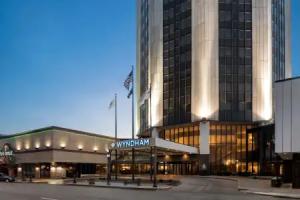
Springfield
Description
Springfield is the capital of the U.S. state of Illinois and the county seat of Sangamon County. The city has a population of 116,250, as of the 2010 U.S. Census, making it the sixth most populated city in the state. It is the largest city in central Illinois. As of 2013, the city's population was estimated to have increased to 117,006, with just over 211,700 residents living in the Springfield Metropolitan Statistical Area, which includes Sangamon County and the adjacent Menard County. Present-day Springfield was first settled by European Americans in the late 1810s, around the time Illinois became a state. The most famous past resident is Abraham Lincoln, who lived in Springfield from 1837 until 1861, when he went to the White House as President. Major tourist attractions include a multitude of historic sites connected with Abraham Lincoln including his presidential museum, his home from 1837 to 1861, his tomb at Oak Ridge Cemetery, and the historical town of New Salem, within a short drive from the city.
The city lies on a mostly flat plain that encompasses much of the surrounding countryside. Hilly terrain lies near the Sangamon River. Lake Springfield, a large artificial lake owned by the City Water, Light & Power company (CWLP), supplies the city with recreation and drinking water. Weather is fairly typical for middle latitude locations, with hot summers and cold winters. Spring and summer weather is like that of most midwestern cities; severe thunderstorms are common. Tornadoes hit the Springfield area in 1957 and 2006.
The city is governed by a mayor–council form of government. The city proper is also the "Capital Township" governmental entity. In addition, the government of the state of Illinois is also based in Springfield. State government entities located in the city include the Illinois General Assembly, the Illinois Supreme Court and the Office of the Governor of Illinois. There are three public and three private high schools in Springfield. Public schools in Springfield are operated by District No. 186. The economy of Springfield is marked by government jobs, and the medical field, which both account for a large percentage of the city's workforce.
Early history and the naming of Springfield
Springfield's original name was Calhoun, after Senator John C. Calhoun of South Carolina. The land that Springfield now occupies was originally settled by trappers and traders who came to the Sangamon River in 1818. The settlement's first cabin was built in 1820, by John Kelly. It was located at what is now the northwest corner of Second Street and Jefferson Street. In 1821, Calhoun became the county seat of Sangamon County due to fertile soil and trading opportunities. Settlers from Kentucky, Virginia, and as far as North Carolina came to the city. By 1832, Senator Calhoun had fallen out of the favor with the public and the town renamed itself Springfield after Springfield, Massachusetts. At that time, Springfield, Massachusetts was comparable to modern-day Silicon Valley—known for industrial innovation, concentrated prosperity, and the celebrated Springfield Armory. Most importantly, it was a city that had built itself up from frontier outpost to national power through ingenuity – an example that the newly named Springfield, Illinois, sought to emulate. Kaskaskia was the first capital of the Illinois Territory from its organization in 1809, continuing through statehood in 1818, and through the first year as a state in 1819. Vandalia was the second state capital of Illinois from 1819 to 1839. Springfield became the third and current capital of Illinois in 1839. The designation was largely due to the efforts of Abraham Lincoln and his associates; nicknamed the "Long Nine" for their combined height of 54 feet (16 m).
The Potawatomi Trail of Death passed through here in 1838.
Lincoln
Lincoln and politicsLincoln arrived in the Springfield area when he was a young man in 1831, though he would not actually live in the city until 1837. He spent the ensuing six years in New Salem where he began his legal studies, joined the state militia and was elected to the Illinois General Assembly. In 1837 Lincoln moved to Springfield and spent the next 24 years as a lawyer and politician. Lincoln delivered his Lyceum address in Springfield. His farewell speech when he left for Washington is a classic in American oratory.
Winkle (1998) examines the historiography concerning the development of the Second Party System (Whigs versus Democrats) and applies these ideas to the study of Springfield, a strong Whig enclave in a Democratic region, mainly by studying poll books for presidential years. The rise of the Whig Party took place in 1836 in opposition to the presidential candidacy of Martin Van Buren and was consolidated in 1840. Springfield Whigs tend to validate several expectations of party characteristics as they were largely native-born, either in New England or Kentucky, professional or agricultural in occupation, and devoted to partisan organization. Abraham Lincoln's career mirrors the Whigs' political rise, but by the 1840s Springfield began to fall into Democratic hands, as immigrants changed the city's political makeup. By the 1860 presidential election, Lincoln was barely able to win his home city.
PopulationWinkle (1992) examines the impact of migration on political participation in Springfield during the 1850s. Widespread migration in the 19th-century United States produced frequent population turnover within Midwestern communities, which influenced patterns of voter turnout and office-holding. Examination of the manuscript census, poll books, and office-holding records reveals the impact of migration on the behavior of 8,000 participants in 10 elections in Springfield. Most voters were short-term residents who participated in only one or two elections during the 1850s, and fewer than 1% of all voters participated in all 10 elections. Instead of producing political instability, however, rapid turnover enhanced the influence of more persistent residents. Migration was selective by age, occupation, wealth, and birthplace. Therefore, more persistent voters were wealthier, more highly skilled, more often native-born, and socially more stable than nonpersisters. Officeholders were particularly persistent and socially and economically advantaged. Persisters represented a small "core community" of economically successful, socially homogeneous, and politically active voters and officeholders who controlled local political affairs while most residents moved in and out of the city. Members of a tightly knit and exclusive "core community", exemplified by Abraham Lincoln, blunted the potentially disruptive impact of migration on local communities. And the population as of 2013 is 117,006
BusinessThe case of John Williams illustrates the important role of the merchant banker in the economic development of central Illinois before the Civil War. Williams began his career as a clerk in frontier stores and saved to begin his own business. Later, in addition to operating retail and wholesale stores, he acted as a local banker and then organized a national bank in Springfield. He was active in railroad promotion and as an agent for farm machinery.
ReligionDuring the mid-19th century the spiritual needs of German Lutherans in the Midwest were not being tended. As a result of the efforts of such missionaries as Friedrich Wyneken, Wilhelm Loehe, and Wilhelm Sihler, this situation was remedied by the deployment of additional Lutheran ministers, the opening of Lutheran schools, and the creation in Ft. Wayne of the Concordia Seminary in 1846. The Seminary moved to St. Louis, Missouri, in 1869, and its practical division moved to Springfield in 1874. Through this seminary, during the last half of the 19th century and the first half of the 20th, the Lutheran Church Missouri Synod succeeded in serving the spiritual needs of Midwestern congregations by establishing additional seminaries, and by developing a viable synodical tradition.
Civil War to 1900
The American Civil War made Springfield a major center of activity. Illinois regiments trained there, the first ones under Ulysses S. Grant, who marched his soldiers to a remarkable series of victories in 1861–62. The city was a political and financial center of support, and new industries, businesses, and railroads were constructed to help support the war effort. The war's first official death was a Springfield resident, Colonel Elmer E. Ellsworth.
Camp Butler, seven miles (11 km) northeast of Springfield, Illinois, opened in August 1861 as a training camp for Illinois soldiers, but also served as a camp for Confederate prisoners of war through 1865. In the beginning, Springfield residents visited the camp to experience the excitement of a military venture, but many reacted sympathetically to mortally wounded and ill prisoners. While the city's businesses prospered from camp traffic, drunken behavior and rowdiness on the part of the soldiers stationed there strained relations as neither civil nor military authorities proved able to control disorderly outbreaks.
After the war ended in 1865, Springfield became a major hub in the Illinois railroad system and besides politics and farming, coal mining was a major industry for Springfield by 1900.
20th century
UtopiaLocal poet Vachel Lindsay's notions of utopia were expressed in his only novel, The Golden Book of Springfield (1920), which draws on ideas of anarchistic socialism in projecting the progress of Lindsay's hometown toward utopia.
The Dana-Thomas House is a Frank Lloyd Wright design built in 1902–03. Wright began work on the house in 1902. Commissioned by Susan Lawrence Dana, a local patron of the arts and public benefactor, Wright designed a house to harmonize with the owner's devotion to the performance of music. Coordinating art glass designs for 250 windows, doors, and panels as well as over 200 light fixtures, Wright enlisted Oak Park artisans. The house is a radical departure from Victorian architectural traditions. Covering 12,000 square feet (1,100 m2), the house contained vaulted ceilings and 16 major spaces. As the nation was changing, so Wright intended this structure to reflect the changes. Creating an organic and natural atmosphere, Wright saw himself as an "architect of democracy" and intended his work to be a monument to America's social landscape.
It is the only historic site later acquired by the state exclusively because of its architectural merit. The structure was opened to the public as a museum house in September 1990; tours are available, 9:00 a.m.–4 p.m. Wednesdays through Sundays.
1908 race riotSparked by the alleged rape of a white woman by a black man and the murder of a white engineer, supposedly also by a black man, in Springfield, and reportedly angered by the high degree of corruption in the city, some white residents took their anxiety and frustration out on blacks. Rioting broke out on August 14, 1908 and continued for three days in a period of violence known as the Springfield Race Riot. Gangs of white youth and blue-collar workers attacked the predominantly black areas of the city known as the Levee district, where most black businesses were located, and the Badlands, where many black residences stood. Two blacks were lynched and four whites were killed by gunfire when black property-owners sought to defend their homes and businesses. The riot ended when the governor sent in more than 3,700 militiamen to patrol the city, but isolated incidents of white violence against blacks continued in Springfield into September.
21st century
On March 12, 2006, two F2 tornadoes hit the city, injuring 24 people, damaging hundreds of buildings, and causing $150 million in damages.
On February 10, 2007, then-senator Barack Obama announced his presidential candidacy in Springfield, standing on the grounds of the Old State Capitol. Senator Obama also used the Old State Capitol in Springfield as a backdrop when he announced Joe Biden as his running mate on August 23, 2008.
Geography
Springfield is located at 39°41′54″N 89°37′11″W / 39.69833°N 89.61972°W / 39.69833; -89.61972 (39.6983146, -89.6195900). The city is at an elevation of 558 feet (170 m) above sea level. Located within the central section of Illinois, Springfield is 90 miles (140 km) northeast of St. Louis. The Champaign/Urbana area is to the east, Peoria is to the north, and Bloomington–Normal is to the northeast. Decatur is 40 miles (64 km) due east.
Topography
According to the 2010 census, Springfield has a total area of 65.764 square miles (170.33 km2), of which 59.48 square miles (154.05 km2) (or 90.44%) is land and 6.284 square miles (16.28 km2) (or 9.56%) is water. The city is located in the Lower Illinois River Basin, in a large area known as Till Plain. Sangamon County, and the city of Springfield, are in the Springfield Plain subsection of Till Plain. The Plain is underlain by glacial till that was deposited by a large continental ice sheet that repeatedly covered the area during the Illinoian Stage.
The majority of the Lower Illinois River Basin is flat, with relief extending no more than 20 feet (6.1 m) in most areas, including the Springfield subsection of the plain. The differences in topography are based on the age of drift. The Springfield and Galesburg Plain subsections represent the oldest drift, Illinoian, while Wisconsinian drift resulted in end moraines on the Bloomington Ridged Plain subsection of Till Plain.
Lake Springfield is a 4,200-acre (1,700 ha) man-made reservoir owned by City Water, Light & Power, the largest municipally owned utility in Illinois. It was built and filled in 1935 by damming Lick Creek, a tributary of the Sangamon River which flows past Springfield's northern outskirts. The lake is used primarily as a source for drinking water for the city of Springfield, also providing cooling water for the condensers at the power plant on the lake. It attracts approximately 600,000 visitors annually and its 57 miles (92 km) of shoreline is home to over 700 lakeside residences and eight public parks.
The term "full pool" describes the lake at 560 feet (170.7 m) above sea level and indicates the level at which the lake begins to flow over the dam's spillway, if no gates are opened. Normal lake levels are generally somewhere below full pool, depending upon the season. During the drought from 1953 to 1955, lake levels dropped to their historical low, 547.44 feet (166.86 m) AMSL. The highest recorded lake levels were in December 1982, when the lake crested at 564 feet (172 m).
Culture
Springfield has been home to a wide array of individuals, who, in one way or another, contributed to the broader American culture. Wandering poet Vachel Lindsay, most famous for his poem "The Congo" and a booklet called "Rhymes to be Traded for Bread", was born in Springfield in 1879. At least two notable people affiliated with American business and industry have called the Illinois state capital home at one time or another. Both John L. Lewis, a labor activist, and Marjorie Merriweather Post, the founder of the General Foods Corporation, lived in the city; Post in particular was a native of Springfield. In addition, astronomer Seth Barnes Nicholson was born in Springfield in 1891.
Literary tradition
Springfield and the Sangamon Valley enjoy a strong literary tradition in Abraham Lincoln, Vachel Lindsay, Edgar Lee Masters, John Hay, William H. Herndon, Benjamin P. Thomas, Paul Angle, Virginia Eiffert, Robert Fitzgerald and William Maxwell, among others. The Illinois State Library's Gwendolyn Brooks Building features the names of 35 Illinois authors etched on its exterior fourth floor frieze. Through the Illinois Center for the Book, a comprehensive resource on authors, illustrators, and other creatives who have published books who have written about Illinois or lived in Illinois is maintained.
Performing arts
The Hoogland Center for the Arts in downtown Springfield is a centerpiece for performing arts, and houses among other organizations the Springfield Theatre Centre, the Springfield Ballet Company, the Illinois Symphony Orchestra and the Springfield Municipal Opera, also known as The Muni, which stages community theatre productions of Broadway musicals outdoors each summer. Before being purchased and renamed, the Hoogland Center was Springfield's Masonic Temple. Prior to the Hoogland, the Springfield Theatre Centre was housed in the nearby Legacy Theatre. Sangamon Auditorium, located on the campus of the University of Illinois at Springfield also serves as a larger venue for musical and performing acts, both touring and local.
A few films have been created or had elements of them created in Springfield. Legally Blonde 2 was filmed in Springfield in 2003.
Musicians Artie Matthews and Morris Day both once called Springfield home. Other performing arts such as music and ballet are also common in Springfield.
Springfield is also home to long running underground all-ages space the Black Sheep Cafe.
Festivals
Springfield is home to the annual Springfield Old Capitol Art Fair, a spring festival held annually in the third weekend in May. Since 2002, Springfield has also hosted the 'Route 66 Film Festival', set to celebrate films routed in, based on, or taking part on the famous Route 66.
Tourism
Springfield is known for some popular food items: the corn dog on a stick is claimed to have been invented in the city under the name "Cozy Dog", although there is some debate to the origin of the snack. The horseshoe sandwich, not well known outside of central Illinois, also originated in Springfield. Springfield was once the site of the Reisch Beer brewery, which operated for 117 years under the same name and family from 1849 to 1966.
The Maid-Rite Sandwich Shop in Springfield still operates what it claims as the first U.S. drive-thru window. The city is also known for its chili, or "chilli", as it is known in many chili shops throughout Sangamon County. The unique spelling is said to have begun with the founder of the Dew Chilli Parlor in 1909, due to a spelling error in its sign. Another interpretation is that the misspelling represented the "Ill" in the word Illinois. In 1993, the Illinois state legislature adopted a resolution proclaiming Springfield the "Chilli Capital of the Civilized World."
Springfield is dotted with sites associated with U.S. President Abraham Lincoln, who started his political career there. These include the Lincoln Home National Historic Site, a National Historical Park that includes the preserved surrounding neighborhood; the Lincoln-Herndon Law Offices State Historic Site, the Lincoln Tomb State Historic Site, the Old State Capitol State Historic Site, the Lincoln Depot, from which Abraham Lincoln departed Springfield to be inaugurated in Washington, D.C.; the Elijah Iles House, Edwards Place and the Abraham Lincoln Presidential Library and Museum. Near the village of Petersburg, is New Salem State Park, a restored hamlet of log cabins. This is a reconstruction of the town where Lincoln lived as a young man. With the opening of the Presidential Library and Museum in 2004, the city has attracted numerous prominent visitors, including Presidents George W. Bush and Barack Obama, the actor Liam Neeson, and the Emir of Qatar.
The Donner Party, a group of pioneers who resorted to cannibalism while snowbound during a winter in the Sierra Nevada Mountains, began their journey West from Springfield. Springfield's Dana-Thomas House is among the best preserved and most complete of Frank Lloyd Wright's early "Prairie" houses. It was built in 1902–1904 and has many of the furnishings Wright designed for it. Springfield's Washington Park is home to Thomas Rees Memorial Carillon and the site of a carillon festival, held annually since 1962. In August, the city is the site of the Illinois State Fair.
Although not born in Springfield, Lincoln is the city's most famous resident. He lived there for 24 years. The only home he ever owned is open to the public, seven days a week, free of charge, and operated by the National Park Service.
Springfield has the area's largest amusement park, Knight's Action Park and Caribbean Water Park, which is open from May to September. The park also features and operates the city's only remaining drive-in theater, the Route 66 Twin Drive-In.
NOAA Weather Radio
NOAA Weather Radio station WXJ75 transmits from Mechanicsburg and is licensed to NOAA's National Weather Service Central Illinois Weather Forecast Office at Lincoln, broadcasting on a frequency of 162.400 mHz (channel 1 on most newer weather radios, and most SAME weather radios). The station activates the SAME tone alarm feature and a 1050 Hz tone activating older radios (except for AMBER Alerts, using the SAME feature only) for hazardous weather and non-weather warnings and emergencies, along with selected weather watches, for the Illinois counties of Cass, Christian, DeWitt, Logan, Macon, Macoupin, Mason, Menard, Montgomery, Morgan, and Sangamon. Weather permitting, a tone alarm test of both the SAME and 1050 Hz tone features are conducted every Wednesday between 11 AM and Noon.
Infrastructure
Health systems
There are two Springfield hospitals, Memorial Medical Center and St. John's Hospital. A third hospital, named Doctor's Hospital operated on Springfield's south side until 2003. Kindred Healthcare opened a long term acute care hospital in Springfield in 2010, however, the facility was purchased by Vibra Healthcare in 2013, and is now operated by Vibra under the name Vibra Hospital of Springfield.
St. John's Hospital is home to the Prairie Heart Institute, which performs more cardiovascular procedures than any other hospital in Illinois. The dominant health care provider in the area is Springfield Clinic. The major medical education concern in the area is the Southern Illinois University School of Medicine.
Parks
The Springfield Park District operates more than 30 parks throughout the city. The two best-known are Carpenter Park, an Illinois Nature Preserve on the banks of the Sangamon River, and Washington Park and Botanical Garden on the city's southwest side and adjacent to some of Springfield's most beautiful and architecturally interesting homes. Washington Park has also been home to the Thomas Rees Memorial Carillon since its dedication in 1962. Lincoln Park, located next to Oak Ridge Cemetery where President Lincoln's tomb is located, is home to the Nelson Recreation Center, which boasts a public swimming pool, tennis courts, and the city's only public ice rink, home of the Springfield Jr. Blues, a minor league hockey team. Centennial Park, which rests on the outskirts of Springfield's southwest limits, holds the city's only public skatepark, as well as several ball fields, tennis courts, and a manmade hill for cardio exercises and sledding in winter months.
In addition to the public-sector parks operated by the Springfield Park District, two significant privately operated tree gardens/arboretums operate within city limits: the Abraham Lincoln Memorial Garden on Lake Springfield south of the city, and the Adams Wildlife Sanctuary on Springfield's east side.
Public utilities
The owner of Lake Springfield, City Water, Light & Power, supplies electric power generated from the Dallman Power Plants for the city of Springfield and eight surrounding communities, the company also provides the cities and towns with water from the lake. In 2005, ground was broken for a third municipally owned power plant. This Power Plant has been completed and came online in 2009. Natural gas is provided via AmerenCILCO, formerly Central Illinois Light Company (CILCO).
Transportation
Interstate 55 runs from north to south past Springfield, while I-72, which is concurrent with US 36 from the Missouri state line to Decatur, runs from east to west. Springfield is also served by Amtrak passenger trains, which operate between Chicago and St. Louis and stop at the former Gulf, Mobile & Ohio station. Springfield is also served by Greyhound lines at a station on North Dirksen Parkway. Local mass transportation needs are met by a bus service. The Springfield Mass Transit District (SMTD) operates Springfield's bus system. The city also lies along historic Route 66.
Border thoroughfare traffic is handled by Veterans Parkway and J. David Jones Parkway on the west side, Everett M. Dirksen Parkway on the east side, Sangamon Avenue on the north end, and Wabash Avenue, Stanford Avenue, and Adlai Stevenson Drive on the south end. The far south corridor is served by Toronto and Woodside Roads. Thoroughfare traffic through the heart of the city is provided by a series of one-way streets. Fifth and Sixth Streets serve the bulk of the north–south traffic, with Fourth and Seventh Streets serving additional traffic between North Grand and South Grand Avenues. East-west traffic is handled by Jefferson Street, entering Springfield on the west side from IL 97, and then splitting into a pair of one-way streets at Amos Avenue (Madison eastbound and Jefferson westbound).The two converge again after Eleventh Street to become Clearlake Avenue, which in turn converges into I-72 eastbound just past Dirksen Parkway. Additional east–west one-way streets run through the downtown areas of Springfield, including Monroe, Adams, Washington, and Cook Streets, as well as a stretch of Lawrence Avenue.
Abraham Lincoln Capital Airport serves the capital city with scheduled passenger jet service to Chicago/O'Hare, Dallas-Fort Worth, Fort Myers (via the Punta Gorda Airport) and Orlando (via the Sanford Airport).
Springfield and the surrounding metropolitan area has constructed bike trails and bike lanes on a number of streets. Currently four main trails exist; two significant paved trails, the Interurban Trail and the Lost Bridge Trail, serve Springfield and its suburbs of Chatham, Illinois and Rochester, Illinois respectively. The Lost Bridge Trail has been extended further into Springfield by the Bunn to Lost Bridge Trail, which follows a stretch of Ash Street and Taylor Avenue. Plans are to extend it further still to Stanford Avenue. A third trail, the Wabash Trail, extends westward from the northern end of the Interurban Trail toward Parkway Pointe, a regional shopping destination.
The fourth trail is a section, opened in July 2011, of the Sangamon Valley Trail spanning north to south through the west central part of Sangamon County. The section open as of 2011 extends northward from Centennial Park to Stuart Park. This trail, if completed in its entirety, will reuse the entire Sangamon County portion of the abandoned St. Louis, Peoria and North Western Railway railroad line as a trail that will extend from Girard, Illinois, to Athens, Illinois.