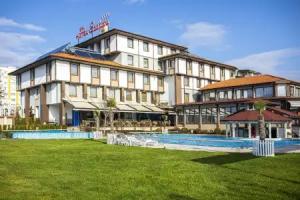
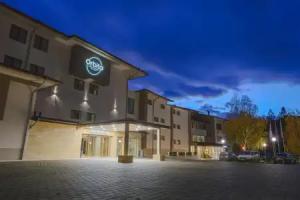
Blagoevgrad
Description
Blagoevgrad is а city in southwestern Bulgaria, the administrative centre of Blagoevgrad Municipality and of Blagoevgrad Province, with a population of 70,881 inhabitants (as of 2011). It lies on the banks of the Blagoevgradska Bistritsa River.
The city is the economic and cultural centre of southwestern Bulgaria. It is located in the valley of the Struma River at the foot of the Rila and Pirin Mountains, 101 kilometres (63 miles) south of Sofia, close to Republic of Macedonia border. Blagoevgrad features a pedestrian downtown with preserved 19th-century architecture and numerous restaurants, cafes, coffee shops, and boutiques.
Blagoevgrad is home to two universities, the South-West University "Neofit Rilski" and the American University in Bulgaria. The city hosts also the "Sts. Cyril and Methodius National Humanitarian High School", the former Bulgarian Men's High School of Thessaloniki moved from Thessaloniki to Blagoevgrad (then Gorna Dzhumaya) in 1913. Attractions in the surrounding area include the resort Bodrost.
Name
The name Blagoevgrad is a recent construct from Blagoev + the Slavic suffix -grad, "Blagoev's city". Blagoev is from the Bulgarian personal name Blagoy, from blag, "sweet, figuratively- gentle and kind". Named after Bulgarian Socialist Party founder Dimitar Blagoev, a refugee from Aegean Macedonia.
History
Petition to Roman Emperor Gordian III from the inhabitants of ancient ScaptoparaAn ancient Thracian settlement called Scaptopara (market town in Thracian, Σκαπτοπαρα in Greek) emerged on the site around 300 BC and was later conquered by the Roman Empire. The settlement was known for the hot springs in the vicinity. Although the history of the settlement in the Middle Ages is unknown, during the Ottoman rule of the Balkans it became a Muslim-majority town called Cuma-ı Bala, meaning Upper Juma in Persian and Ottoman Turkish. A Bulgarian quarter called Varosha was formed during the Bulgarian National Revival, with many of its typical houses and the Church of the Presentation of the Mother of God from 1844 being preserved to this day. A chitalishte was founded in 1866 and the Balkan Wars of 1912-1913 saw the liberation of the area from Ottoman rule and its integration in the Bulgarian state. Before the Balkan Wars, Cuma-ı Bala was bounded as kaza to Serez sandjak in Selanik vilayet.
In 1900, according to Vasil Kanchov the population of the town numbers 6440 people, of whom 1250 Bulgarians, 4500 Turks, 250 Vlachs, 200 Gypsies, 180 Jews and 60 Greeks. During that time most of the Turks were in the city and the Bulgarians in the surrounding villages. Many refugees from Aegean and Vardar Macedonia arrived in the town in the subsequent decades as the town, then known as Gorna Dzhumaya (a partial translation of the Ottoman name), continued to grow in size and importance. The name Gorna Dzhumaya ( Горна Джумая; "Upper Dzhumaya") contrasts the town from Dolna Dzhumaya (Долна Джумая; "Lower Dzhumaya", "Cuma-i Zir" in Turkish) to the south, today called Irakleia in Serres regional unit, Macedonia, Greece.
The town was renamed Blagoevgrad in 1950.
Population
Ethnic linguistic and religious composition
According to the latest 2011 census data, the individuals declared their ethnic identity were distributed as follows:
- Bulgarians: 62,674 (95.6%)
- Gypsies: 1,813 (2.8%)
- Turks: 123 (0.2%)
- Others: 684 (1.0%)
- Indefinable: 271 (0.4%)
- Undeclared: 5,316 (7.5%)
Total: 70,881
The ethnic composition of Blagoevgrad Municipality is 68,702 Bulgarians and 1,836 Gypsies, among others.
Football
Blagoevgrad has given the Bulgaria and world football talents such as Dimitar Berbatov and regularly feeds the wealthy football clubs. Local team investment is lacking.
At present there are four in Blagoevgrad acting male clubs, three of which bear the name "Pirin". The "A" group is PFC Pirin Blagoevgrad. Pirin Authentic, then discard it in "B" group in 2005 due to obligations to Social Security, was usurped by a group of businessmen D15, and then failed to return to professional football during the 2008/09 season and will play in the Western B Group . Pirin 2001 - the team owned by former international Ivaylo Andonov, competed in the Southwestern 'B' group. In the championship of the Blagoevgrad District League (zone "Bistriţa") features one Blagoevgrad football team - FC Athletic.
Women's football is represented by the football club Sportika - a participant in the National Championship for Women
Main Sights
- Drama Theatre "N. Vaptsarov"
- Blagoevgrad History Museum
- Blagoevgrad Opera House
- Historic House Museum "Georgi Izmirliev"
- Renaissance Neighborhood "Varosha"
- Park "Bachinovo"
- Park "Skaptopara"
- Aqua park Blagoevgrad
- Blagoevgrad zoo
Honours
Blagoevgrad Peninsula in Graham Land, Antarctica is named after the city, and Skaptopara Cove in Greenwich Island in the South Shetland Islands, Antarctica is named after its ancient ancestor Skaptopara.