
Tatarstan
Description
The Republic of Tatarstan is a federal subject of Russia (a republic) located in the Volga Federal District. Its capital is the city of Kazan. The republic borders with Kirov, Ulyanovsk, Samara, and Orenburg Oblasts, and with the Mari El, Udmurt, and Chuvash Republics, as well as with the Republic of Bashkortostan. The unofficial Tatarstan motto is: Bez Buldırabız! (We can!). As of the 2010 Census the population of Tatarstan was 3,786,488.
The state has strong ties with its eastern neighbor the Republic of Bashkortostan.
Terminology
“Tatarstan” derives from the name of the ethnic group—the Tatars—and the Persian suffix -stan (an ending common to many Eurasian countries). Another version of the Russian name is “Тата́рия” (Tatariya), which was official along with “Tatar ASSR” during the Soviet rule.
Geography
Map of the Republic of Tatarstan
The republic is located in the center of the East European Plain, approximately 800 km east of Moscow. It lies between the Volga River and the Kama River (a tributary of the Volga), and extends east to the Ural mountains.
- Borders:
- internal: Kirov Oblast (N), Udmurt Republic (N/NE), Republic of Bashkortostan (E/SE), Orenburg Oblast (SE), Samara Oblast (S), Ulyanovsk Oblast (S/SW), Chuvash Republic (W), Mari El Republic (W/NW).
- Highest point: 343 m (1,125 ft)
- Maximum N->S distance: 290 km (180 mi)
- Maximum E->W distance: 460 km (290 mi)
Rivers
View of the Volga River in the confluence with the Kama River View on the Taima River from Devil's Tower in Yelabuga
Major rivers include (Tatar names are given in parentheses):
- Azevka River
- Belaya River (Ağidel)
- Ik River (Iq)
- Kama River (Çulman)
- Volga River (İdel)
- Vyatka River (Noqrat)
- Kazanka River (Qazansu)
Lakes
Major reservoirs of the republic include (Tatar names are given in parentheses):
- Kuybyshev Reservoir (Kuybışev)
- Lower Kama Reservoir (Tübän Kama)
The biggest lake is Qaban. The biggest swamp is Kulyagash.
Hills
- Bugulma-Belebey Upland
- Volga Upland
- Vyatskie Uvaly
Natural resources
Major natural resources of Tatarstan include oil, natural gas, gypsum, and more. It is estimated that the Republic has over one billion tons of oil deposits.
Climate
- Average January temperature: −16 °C (3 °F)
- Average July temperature: +19 °C (66 °F)
- Average annual precipitation: up to 500 mm (20 in)
History
Part of a series on the History of Tatarstan
- Great Bulgaria
- Khazars
- Volga Bulgaria
- Kipchaks
- Mongol invasion
- Golden Horde
- Khanate of Kazan
- Muscovy
- Kazan Governorate
- Idel-Ural State
- Tatar ASSR
- Republic of Tatarstan
Middle Ages
An ancient mosque in Bolgar
The earliest known organized state within the boundaries of Tatarstan was Volga Bulgaria (c. 700–1238 CE). The Volga Bulgars had an advanced mercantile state with trade contacts throughout Inner Eurasia, the Middle East and the Baltic, which maintained its independence despite pressure by such nations as the Khazars, the Kievan Rus and the Cuman-Kipchaks. Islam was introduced by missionaries from Baghdad around the time of ibn Fadlan's journey in 922.
Volga Bulgaria finally fell to the armies of the Mongol prince Batu Khan in the late 1230s (see Mongol invasion of Volga Bulgaria.) The inhabitants, mixing with the Golden Horde's Kipchak-speaking people, became known as the "Volga Tatars." Another theory postulates that there were no ethnic changes in that period, and Bulgars simply switched to the Kipchak-based Tatar language. In the 1430s, the region again became independent as the base of the Khanate of Kazan, a capital having been established in Kazan, 170 km up the Volga from the ruined capital of the Bulgars.
The Khanate of Kazan was conquered by the troops of Tsar Ivan the Terrible in the 1550s, with Kazan being taken in 1552. A large number of Tatars were killed and forcibly converted to Christianity and were culturally Russified. Cathedrals were built in Kazan; by 1593 all mosques in the area were destroyed. The Russian government forbade the construction of mosques, a prohibition that was not lifted until the 18th century by Catherine the Great. The first mosque to be rebuilt under Catherine's auspices was constructed in 1766-1770.
19th century
In the 19th century Tatarstan became a center of Jadidism, an Islamic movement that preached tolerance of other religions. Under the influence of local Jadidist theologians, the Tatars were renowned for their friendly relations with other peoples of the Russian Empire. However, after the October Revolution religion was largely outlawed and all theologians were repressed.
During the Civil War of 1918–1920 Tatar nationalists attempted to establish an independent republic (the Idel-Ural State). They were, however, put down by the Bolsheviks and the Tatar Autonomous Soviet Socialist Republic was established on May 27, 1920. There was a famine in the Tatar Autonomous Soviet Socialist Republic in 1921 to 1922 as a result of war communist policy. The boundaries of the republic did not include majority of the Volga Tatars. The Tatar Union of the Godless were persecuted in Stalin's 1928 purges.
1921–1922 famine
The famine deaths of 2 million Tatars in Tatar ASSR and in Volga-Ural region in 1921-1922 was catastrophic as half of Volga Tatar population in USSR died. This famine is also known as "terror-famine" and "famine-genocide" in Tatarstan. The Soviets settled ethnic Russians after the famine in Tatar ASSR and in Volga-Ural region causing the Tatar share of the population to decline to less than 50%. All-Russian Tatar Social Center (VTOTs) has asked the United Nations to condemn the 1921 Tatarstan famine as Genocide of Muslim Tatars. The 1921–1922 famine in Tatarstan has been compared to Holodomor in Ukraine.
Modern times
On August 30, 1990, Tatarstan announced its sovereignty with the Declaration on the State Sovereignty of the Tatar Soviet Socialist Republic and in 1992 Tatarstan held a referendum on the new constitution, and 62 percent of those who took part voted in favor of the constitution. In the 1992 Tatarstan Constitution, Tatarstan is defined as a Sovereign State. However the referendum and constitution were declared unconstitutional by the Russian Constitutional Court. However, articles 1 and 3 of the constitution, as introduced in 2002 define Tatarstan as a part of the Russian Federation.
On February 15, 1994, the Treaty On Delimitation of Jurisdictional Subjects and Mutual Delegation of Authority between the State Bodies of the Russian Federation and the State Bodies of the Republic of Tatarstan and Agreement between the Government of the Russian Federation and the Government of the Republic of Tatarstan (On Delimitation of Authority in the Sphere of Foreign Economic Relations) were signed.
On December 20, 2008, in response to Russia recognizing Abkhazia and South Ossetia, the Milli Mejlis of the Tatar People declared Tatarstan independent and asked for United Nations recognition. However this declaration was ignored both by United Nations and Russian government.
Demographics
Population density
Population: 3,786,488 (2010).
Ethnic groups
There are about 2 million ethnic Tatars and 1.5 million ethnic Russians, along with significant numbers of Chuvash, Mari, and Udmurts, some of whom are Tatar-speaking. The Ukrainian, Mordvin, and Bashkir minorities are also significant. Most Tatars are Sunni Muslims, but a small minority known as Keräşen Tatars are Orthodox and some of them regard themselves as being different from other Tatars even though most Keräşen dialects differ only slightly from the Central Dialect of the Tatar language. There is a fair degree of speculation as to the early origins of the different groups of Tatars, but most Tatars no longer view religious identity as being as important as it once was, and the religious and linguistic subgroups have intermingled considerably. Nevertheless, despite many decades of assimilation and intermingling, some Keräşen demanded, and were awarded, the option of being specifically enumerated in 2002. This has provoked great controversy however, as many intellectuals have sought to portray the Tatars as homogeneous and indivisible. Although listed separately below, the Keräşen are still included in the grand total for the Tatars. Another unique ethnic group, living in Tatarstan only are the Qaratay Mordvins. When it comes to religion, Sunni Islam is the most common faith in Tatarstan, as 55% of the estimated 3.8 million population is Muslim while remaining population is mostly Russian Orthodox Christian.
Languages
In accordance with the Constitution of the Republic of Tatarstan the two state languages of the republic are Tatar and Russian. According to the 2002 Russian Federal Law (On Languages of Peoples of the Russian Federation), the official script is Cyrillic. Linguistic anthropologist Dr. Suzanne Wertheim, notes that "some men signal ideological devotion to the Tatar cause by refusing to accommodate to Russian-dominant public space or Russian speakers", whilst women, in promoting "the Tatar state and Tatar national culture, index their pro-Tatar ideological stances more diplomatically, and with linguistic practices situated only within the Tatar-speaking community ... in keeping with normative gender roles within the Tatar republic."
Religion
A Mosque in Mendeleyevsk Orthodox Church in the Kazan Kremlin
Established in 922, the first Muslim state within the boundaries of modern Russia was Volga Bulgaria from which the Tatars inherited Islam. Islam was introduced by missionaries from Baghdad around the time of Ibn Fadlan's journey in 922. Islam's long presence in Russia also extends at least as far back as the conquest of the Khanate of Kazan in 1552, which brought the Tatars and Bashkirs on the Middle Volga into Russia.
In the 1430s, the region became independent as the base of the Khanate of Kazan, a capital having been established in Kazan, 170 km up the Volga from the ruined capital of the Bulgars. The Khanate of Kazan was conquered by the troops of Tsar Ivan IV the Terrible in the 1550s, with Kazan being taken in 1552. Some Tatars were forcibly converted to Christianity and cathedrals were built in Kazan; by 1593, mosques in the area were destroyed. The Russian government forbade the construction of mosques, a prohibition that was not lifted until the 18th century by Catherine II.
In 1990, there were only 100 mosques but the number, as of 2004, rose to well over 1,000. As of January 1, 2008, as many as 1,398 religious organizations were registered in Tatarstan, of which 1,055 were Muslim. Today, Sunni Islam is the most common faith in Tatarstan, as 55% of the population is Muslim. In September 2010, Eid al fitr as well May 21, the day the Volga Bulgars embraced Islam, were made public holidays. Tatarstan also hosted an international Muslim film festival which screened over 70 films from 28 countries including Jordan, Afghanistan and Egypt.
The Russian Orthodox Church is the second largest active religion in Tatarstan, and has been so for more than 150 years, with an estimated 1.6 million followers made up of ethnic Russians, Mordvins, Armenians, Belarusians, Mari people, Georgians, Chuvash and a number of Orthodox Tatars which together constitute 45% of the 3.8 million population of Tatarstan. On the 23rd of August 2010 the “Orthodox monuments of Tatarstan” exhibition was held in Kazan by the Tatarstan Ministry of Culture and the Kazan Eparchy. At all public events an Orthodox Priest is called upon along with an Islamic Mufti.
The Muslim Religious Board of Tatarstan frequently organizes activities, like the 'Islamic graffiti Contest' which was held on November 20, 2011.
Economy
An area in Kazan with a mosque in the background
Tatarstan is one of the most economically developed regions of Russia. The republic is highly industrialized, and ranks second only to Samara Oblast in terms of industrial production per km2. Tatarstan's GDP per capita was USD 12,325 in 2004, with GDP in 2008 at about 930 billion rubles.
The region's main source of wealth is oil. Tatarstan produces 32 million tonnes of crude oil per year and has estimated oil reserves of more than 1 billion tons. Industrial production constitutes 45% of the Republic's gross regional domestic product. The most developed manufacturing industries are petrochemical industry and machine building. The truck-maker KamAZ is the region's largest enterprise and employs about 1/5 of Tatarstan's work force. Kazanorgsintez, based in Kazan, is one of Russia's largest chemical companies. Tatarstan's aviation industry produces Tu-214 passenger airplanes and helicopters. The Kazan Helicopter Plant is one of the largest helicopter manufacturers in the world. Engineering, textiles, clothing, wood processing, and food industries are also of key significance in Tatarstan.
Tatarstan consists of three distinguished industrial regions. The northwestern part is an old industrial region where engineering, chemical and light industry dominate. In the new industrial Northeast region with its core in the Naberezhnye Chelny-Nizhnekamsk agglomeration, major industries are automobile construction, chemical industry, and power engineering. The Southeast region has oil production with engineering under development. The North, Central, South, and Southwest parts of the Republic are rural regions. The Republic has huge water resources - annual flow of rivers of the Republic exceeds 240 billion cu. m. Soils are very diverse, the best fertile soils covering 1/3 of the territory. Due to high development of agriculture in Tatarstan(it contributes 5,1% of total revenue of republic), forests occupy only 16% of its territory. The agricultural sector of economy are represented mostly by large companies as "Ak Bars Holding" and "Krasniy Vostok Agro".
The republic has a highly developed transport network. It mainly comprises highways, railway lines, four navigable rivers — Volga (İdel), Kama (Çulman), Vyatka (Noqrat) and Belaya (Ağidel), and oil pipelines and airlines. The territory of Tatarstan is crossed by the main gas pipelines carrying natural gas from Urengoy and Yamburg to the west and the major oil pipelines supplying oil to various cities in the European part of Russia.
Culture
All Religions Temple. A building and cultural center built by the local artist Ildar Khanov
Major libraries include the Science Library of Kazan State University and the National Library of the Republic of Tatarstan. There are two museums of republican significance, as well as 90 museums of local importance. In the past several years new museums appeared throughout the Republic.
There are twelve theatrical institutions in Tatarstan. The state orchestra is the National Tatarstan Orchestra.
Education
The most important facilities of higher education include Kazan State University, Kazan State Medical University, Kazan State Technological University, World Information Distributed University, Kazan State Technical University, Kazan State Finance and Economics Institute and Russian Islamic University, all located in the capital Kazan.
Towns
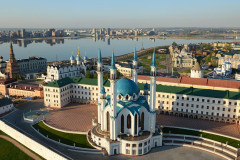
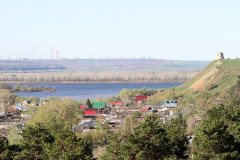
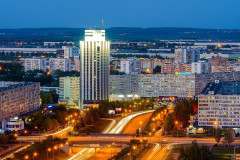


All accomodation types
Hotels
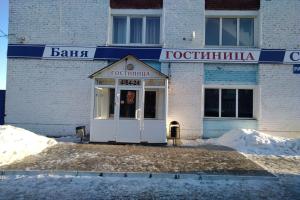 Gostinichnyy kompleks Hotel
 Gostinichny kompleks Hotel
 from 26 USDNeftyanik Hotel
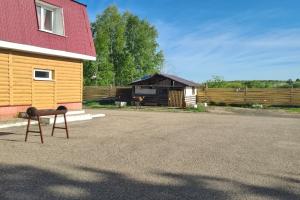 Ostrovok Hotel
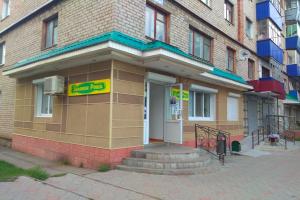 Zelenaya roshcha Hotel
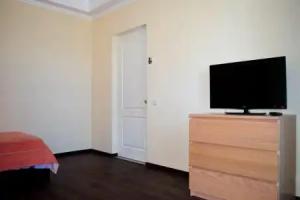 High ratingfrom 15 USDVoyazh Hotel