
Kazan
Description
Kazan is the capital and largest city of the Republic of Tatarstan, Russia. With a population of 1,143,535, it is the eighth most populous city in Russia. Kazan lies at the confluence of the Volga and Kazanka Rivers in European Russia.
The Kazan Kremlin is a World Heritage Site. In 2005, the Medal "In Commemoration of the 1000th Anniversary of Kazan" was established by Russia to denote this landmark event. The multi-ethnic city is honored by UNESCO and famous for Muslims and Christians living side-by-side in peace.
In April 2009, the Russian Patent Office granted Kazan the right to brand itself as the "Third Capital" of Russia. In 2009 it was chosen as the "Sports capital of Russia" and it still is referred to as such. The city hosted the 2013 Summer Universiade, 2014 World Fencing Championships and the 2015 World Aquatics Championships, and will host the 2018 FIFA World Cup.
Etymology
The origin of the name Kazan is uncertain. The most accepted legends derive it from the Bulgar (and also modern Tatar) word qazan, which means 'boiler' or 'cauldron'. One legend claims that the city was named after the river Kazanka, which was named after the son of a Bulgar governor dropped a copper cauldron into it. Other local legends claim that the city was named for the resemblance of the hill on which it sits to an upturned cauldron.
History
Middle Ages
There is a long-running dispute as to whether Kazan was founded by the Volga Bulgars in the early Middle Ages or by the Tatars of the Golden Horde in the mid-15th century, as written records before the latter period are sparse. If there was a Bulgar city on the site, estimates of the date of its foundation range from the early 11th century to the late 13th century (see Iske Qazan). It was a border post between Volga Bulgaria and two Finnic tribes, the Mari and the Udmurt. Another vexatious question is where the citadel was built originally. Archaeological explorations have produced evidence of urban settlement in three parts of the modern city: in the Kremlin; in Bişbalta at the site of the modern Zilantaw monastery; and near the Qaban lake. The oldest of these seems to be the Kremlin.
If Kazan existed in the 11th and 12th centuries, it could have been a stop on a Volga trade route from Scandinavia to Baghdad. It was a trade center, and possibly a major city for Bulgar settlers in the Kazan region, although their capital was further south at the city of Bolğar.
After the Mongols devastated the Bolğar and Bilär areas in the 13th century, either the surviving Bulgars recuperated in numbers and were assimilated by a small number of Kipchaks from whom they adopted their language (a position known as Bulgarism), or Kipchaks and Bulgars intermixed to create the modern Kazan Tatar population. Kazan became a center of a duchy which was a dependency of the Golden Horde. Two centuries later, in the 1430s, Kipchak descendants of Genghis Khan, such as Ghiasetdin of Kazan), usurped power from its Bolghar dynasty.
Some Tatars also went to Lithuania, brought by Vytautas the Great.
In 1438, after the destruction of the Golden Horde, Kazan became the capital of the powerful Khanate of Kazan. The city bazaar, Taş Ayaq (Stone Leg) became the most important trade center in the region, especially for furniture. Craft-based manufacturing also thrived, as the city gained a reputation for its leather and gold goods, as well as for the opulence of its palaces and mosques. The citadel and Bolaq channel were reconstructed, giving the city a strong defensive capacity. The Russians managed to occupy the city briefly several times.
Russian Tsardom period
As a result of the Siege of Kazan, Russia under Ivan the Terrible conquered the city and massacred the majority of the population . During the governorship of Alexander Gorbatyi-Shuisky, most of the khanate's Tatar residents were killed or forcibly Christianized (see Kerashen Tatars).Mosques and palaces were ruined. The surviving Tatar population was moved to a place 50 km away from the city and this place was forcibly settled by Russian farmers and soldiers. Tatars in the Russian service were settled in the Tatar Bistäse settlement near the city's wall. Later Tatar merchants and handicraft masters also settled there. During this period, Kazan was largely destroyed as a result of several great fires. After one of them in 1579, the icon Our Lady of Kazan was discovered in the city.
In the early 17th century, at the beginning of the Time of Troubles in Russia, the Tsardom of Kazan declared independence with the help of the Russian population, but this independence was suppressed by Kuzma Minin in 1612.
Russian Empire period
In 1708, the Tsardom of Kazan was abolished, and Kazan became the seat of Kazan Governorate. After Peter the Great's visit, the city became a center of shipbuilding for the Caspian fleet. The major Russian poet Gavrila Derzhavin was born in Kazan in 1743, the son of a poor country squire of Tatar ancestry though himself having a thoroughly Russian identity.
Kazan was largely destroyed in 1774 as a result of the Pugachev revolt (1774–1776), an uprising by border troops and peasants led by the Don Cossack ataman (Captain) Yemelyan Pugachev, but the city, formerly largely of timber construction, was soon afterwards rebuilt, using stone and according to a grid pattern plan, during the reign of Catherine the Great. Catherine also decreed that mosques could again be built in Kazan, the first being Marjani Mosque.
At the beginning of the 19th century Kazan State University and printing press were founded by Alexander I. It became an important center for Oriental Studies in Russia. The Qur'an was first printed in Kazan in 1801. Kazan became an industrial center and peasants migrated there to join its industrial workforce. In 1875, a horse tramway appeared; 1899 saw the installation of a tramway. After the Russian Revolution of 1905, Tatars were allowed to revive Kazan as a Tatar cultural center. The first Tatar theater and the first Tatar newspaper appeared.
Soviet period
In 1917 Kazan became one of the revolution centers. In 1918, Kazan was the capital of the Idel-Ural State, which was suppressed by the Bolshevist government. In the Kazan Operation of August 1918, it was briefly occupied by Czechoslovak Legions. In 1920 Kazan became the center of Tatar Autonomous Soviet Socialist Republic. In the 1920s and 1930s, most of the city's mosques and churches were destroyed, as occurred elsewhere in the USSR. During World War II, many industrial plants and factories to the west were relocated in Kazan, making the city a center of the military industry, producing tanks and planes. After the war Kazan consolidated as an industrial and scientific center. In 1979, the city's population reached one million.
Modern period
In the late 1980s and in the 1990s, after the dissolution of the Soviet Union, Kazan again became the center of Tatar culture and identity, and separatist tendencies intensified. With the return of capitalism, Kazan became one of the most important centers of the Russian Federation. The city went from 10th to 8th position in population ranking of Russian cities. In the late 2000s, the city earned the right to host both the 2013 Summer Universiade and 2018 FIFA World Cup.
Millennium of Kazan
Since 2000, the city has been undergoing a total renovation. The historical center, including its Kremlin, has been rebuilt, however a large number of the city's historical districts was completely demolished in the process. Kazan celebrated its millennium in 2005, after a city-organized historical commission settled on 1005 as the official year of the city's founding. During the millennium celebrations, one of the largest mosque in Russia, Qolsharif, was dedicated in the Kazan Kremlin, the holiest copy of Our Lady of Kazan was returned to the city, the "Millennium Bridge" was inaugurated that year, and the Kazan Metro began operation. The government of the Russian Federation released the Medal "In Commemoration of the 1000th Anniversary of Kazan". In 2010, for the preparations to the 2013 Universiade, Kazan began even more renovation by modernizing its airport, fixing up the streets, enhancing public transports, and adopting Russian, English, and Tatar languages in all transportation, large stores, and shopping centers.
Administrative and municipal status
Kazan is the capital of the republic. Within the framework of administrative divisions, it is incorporated as the city of republic significance of Kazan—an administrative unit with the status equal to that of the districts. As a municipal division, the city of republic significance of Kazan is incorporated as Kazan Urban Okrug.
Central Kazan
Kremlin
The city has a citadel, which was declared a World Heritage Site in 2000. Major monuments in the kremlin are the five-domed six-columned Annunciation Cathedral (1561–62) and the mysterious leaning Soyembika Tower, named after the last queen of Kazan and regarded as the city's most conspicuous landmark.
Also of interest are the towers and walls, erected in the 16th and 17th centuries but later reconstructed; the Qol-Şarif mosque, which is already rebuilt inside the citadel; remains of the Saviour Monastery (its splendid 16th-century cathedral having been demolished by the Bolsheviks) with the Spasskaya Tower; and the Governor's House (1843–53), designed by Konstantin Thon, now the Palace of the President of Tatarstan.
Next door, the ornate baroque Sts-Peter-and-Paul's Cathedral on Qawi Nacmi Street and Marcani mosque on Qayum Nasiri Street date back to the 18th century.
Bistä, or Posad
Central Kazan is divided into two districts by the Bolaq canal and Lake Qaban. The first district (Qazan Bistäse or Kazanskiy Posad), historically Russian, is situated on the hill, the second (İske Tatar Bistäse or Staro-Tatarskaya Sloboda), historically Tatar, is situated between the Bolaq and the Volga. Mosques, such as Nurullah, Soltan, Bornay, Apanay, Äcem, Märcani, İske Taş, Zäñgär are in the Tatar district. Churches, such as Blagoveschenskaya, Varvarinskaya, Nikol'skaya, Tikhvinskaya, are mostly in the Russian part of the city. The main city-centre streets are Bauman, Kremlyovskaya, Dzerzhinsky, Tuqay, Puşkin, Butlerov, Gorkiy, Karl Marx and Märcani.
An old legend says that in 1552, before the Russian invasion, wealthy Tatars (baylar) hid gold and silver in Lake Qaban.
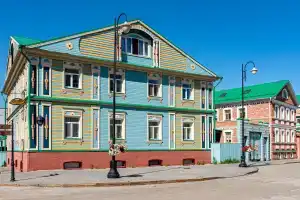
Wooden Kazan
In the beginning of the 1900s most of Central Kazan was covered by wooden buildings, usually consisting of two floors. There was a historical environment of Kazan citizens, but not the best place to live in. During the Republican program "The liquidation of ramshackle apartments" most of them (unlike other Russian cities), especially in Central Kazan, where the land is not cheap, were destroyed and their population was moved to new areas at the suburb of the city (Azino, Azino-2, Quartal 39). Nearly 100,000 citizens resettled by this programme.
Other major buildings
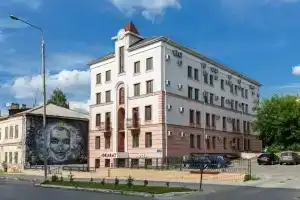
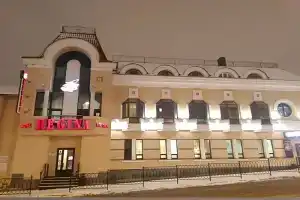
Another significant building in central Kazan is the former "Smolentzev and Shmelev" tea house and hotel, now the Shalyapin Palace Hotel. It is located at 7/80 Universitetskaya Street, at the corner of Universitetskaya and Bauman. A major landmark of late-19th and early-20th century commercial architecture, it consists of two portions. The original portion, built for a merchant named Usmanov in the 1860s, was bought by the inter-related families of Efim Smolentzev and Pavel and Nikolai Shmelev in 1899. They operated a store selling, among other things, tea. In 1910, the Smolentevs and Shmelevs constructed another portion, designed by architect Vasili Trifonov, and operated a hotel there. After the Russian Revolution, the building eventually became the Hotel Soviet and after 2000 it was heavily renovated to reopen as the Shalyapin Palace Hotel.


