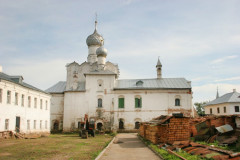
Rostov Kremlin
Description
Rostov Kremlin (Metropolitan yard) — the former residence of the Metropolitan of Rostov diocese located in the centre of Rostov on the shore of lake Nero. For the Metropolitan yard called "the Kremlin", although it is controversial.
During the construction Rostov did not have any defensive value, and therefore fortifications of the Kremlin have some architectural simplifications that would have had to remove in the event of a military threat — wide entrance gate, no plantar loop-holes in the towers line the top of battle towers continue windows with architraves and others. However, the Kremlin built in the tradition of Russian defense building of earlier period and is a monument of Russian military architecture of the pre-Peter-the-Great time.
The history of the Kremlin
Rostov Kremlin was built in 1670-1683 on a single basic idea of the customer — the Metropolitan Jonah. This plan suggested the creation of Paradise in full accordance with the biblical description: surrounded by walls with towers the garden of Eden with the mirror pond in the center.
Once in 1787 was decided to transfer of the Episcopal chair from Rostov to Yaroslavl, Rostov Metropolitan court has lost its function, was neglected and gradually decayed. The buildings of the ensemble were engaged in various departments for storage. Worship services in the temples of the ensemble were not held. The bishops were willing to sell the ensemble to be scrapped. However, thanks to the enlightened Rostov merchants the architectural complex was restored.
By the initiative of A. A. Titov, I. A. Shlyakov in October, 1883, in the White chamber of the Kremlin was opened in Rostov Museum of Church antiquities. In 1886, the Kremlin took under his wing the heir of the Imperial throne, the future Tsar Nicholas II. In 1910 the State Duma legislated national status of the Museum, having decided to let go of money from Treasury for its maintenance.
Many of the monuments of the ensemble were damaged by a tornado on August 23, 1953. Later they were restored.
In 2010, a public organization, the Fund named after Saint Gregory the Theologian, with the support of Patriarch Kirill sought to transfer the complex of the Rostov Kremlin to Russian Orthodox Church. In October 2010 the Governor of Yaroslavl Region Vahrukov has issued a statement on the transfer of the Museum-reserve "Rostov Kremlin" to the Church, with the eviction of the Museum collections to a new building, and the creation in the premises of the Kremlin, the Episcopal residence and "all-Russia centre of wedding and baptism". This project, however, caused as criticism from experts on the protection and study of objects of art and mass protest of citizens. The project was rejected.
In 2013, the Rostov Kremlin was included in the top ten "Symbols of Russia".
The architectural ensemble of the Kremlin
The Kremlin is well located near the shore of lake Nero. The Kremlin has eleven towers.
Architectural monuments of the Kremlin:
- The assumption Cathedral (1508-1512)
- The assumption Cathedral belfry (1682-1687)
- Holy gate
- Gate Church of Resurrection (1670)
- Judgment order (1650-1660)
- Church Of St. John The Theologian (1683)
- Church Of God (1693)
- Church of the Savior on the Porch (of the Saviour) (1675)
- The Church Of St. Gregory The Theologian (1680)
- Red chamber (1670-1680)
- "House on the cellars" (XVII century)
- Samuilov case
- White (Dining) chamber
- The towers of the Kremlin
The Cathedral of the assumption
The assumption Cathedral (1508-1512) stands on the site of the white stone of its predecessors XII—XIII centuries, the Cathedral is largely similar to the eponymous Moscow Uspensky Cathedral. This monumental five-domed building made in a simple and noble forms. The height of the Cathedral with a cross of 60 m. the Cathedral is made of brick, and the plinth and strongly protruding blades of white stone.
Numerous decorative elements: arcature-columnar zone, the horizontal thrust panels, etc. give the appearance of the temple a special plastic expressiveness, beauty and stability until now.
In 1991, the Cathedral and the belfry were transferred to the Russian Orthodox Church.
The belfry of the assumption Cathedral
The assumption Cathedral belfry (1682-1687) constructed to the Southeast of the assumption Cathedral, consists of two volumes and is crowned with four heads. By order of Metropolitan Jonah 13 bells were originally cast the bell "Polieleyny" (1000 pounds) and the bell "Swan" (500 pounds), was soon cast the largest bell "Sysoy" weighing 2000 pounds. Bell had its own tone and could make the right musical harmonic chimes.
The bell tower is completely preserved set of 15 bells.
Church of the Savior on the Porch
Church of the Savior on the Porch was built in 1675. It was the home Church, Metropolitan Jonah. This Church is remarkable in that its architecture used features, Cathedral of the assumption of Mother of God, but only in a more simple and austere design.
Hodegetria Church
Church of the Hodegetria, one of the churches in the Rostov Archbishop's court (Kremlin). Built in the years 1692-1693, a little later than other buildings of the ensemble of the Archbishop's court, when Jonah's successor Metropolitan Joasaph. Is representative of the style of Moscow Baroque. The most recent independent construction of the Archbishop's court.
The Church Of St. John The Evangelist
Church of St. John the Evangelist was built in 1683. This gateway Church is one of the last temples of the period of Metropolitan Jonah. Researchers have noted that this monument of history and architecture looks more elegant than the other churches of the Kremlin.
The Kremlin in the culture
- In the early 1970-ies in the Rostov Kremlin were shooting the episodes of the old Moscow for the film "Ivan Vasilyevich changes occupation". In 2010, the Rostov Kremlin once again played the role of Moscow — for the TV series "Split".
Video (2)
Street view
Reviews
Come! Warm up your souls!