
Ukraine
Hotels
Regions (24)
Towns (15)


Places





Description
Ukraine is a country in Eastern Europe, bordered by Russia to the east and northeast, Belarus to the northwest, Poland and Slovakia to the west, Hungary, Romania, and Moldova to the southwest, and the Black Sea and Sea of Azov to the south and southeast, respectively. It has an area of 603,628 km2 (233,062 sq mi), making it the largest country entirely within Europe and the 46th largest country in the world. With a population of about 44.5 million, Ukraine is the 32nd most populous country in the world.
The territory of modern Ukraine has been inhabited since 32,000 BC. During the Middle Ages, the area was a key centre of East Slavic culture, with the powerful state of Kievan Rus' forming the basis of Ukrainian identity. Following its fragmentation in the 13th century, the territory was contested, ruled and divided by a variety of powers, including Lithuania, Poland, the Ottoman Empire, Austria-Hungary, and Russia. A Cossack republic emerged and prospered during the 17th and 18th centuries, but its territory was eventually split between Poland and the Russian Empire, and later submerged fully into Russia. Two brief periods of independence occurred during the 20th century, once near the end of World War I and another during World War II, but both occasions would ultimately see Ukraine's territories conquered and consolidated into a Soviet republic, a situation that persisted until 1991, when Ukraine gained her independence from the Soviet Union in the aftermath of its dissolution at the end of the Cold War.
Following independence, Ukraine declared itself a neutral state. but nonetheless formed a limited military partnership with the Russian Federation, other CIS countries and a partnership with NATO since 1994. In the 2000s, the government began leaning towards NATO, and a deeper cooperation with the alliance was set by the NATO-Ukraine Action Plan signed in 2002. It was later agreed that the question of joining NATO should be answered by a national referendum at some point in the future. Recently deposed President Viktor Yanukovych considered the current level of co-operation between Ukraine and NATO sufficient, and was against Ukraine joining NATO. In 2013, protests against the government of President Yanukovych broke out in downtown Kiev after the government made the decision to suspend the Ukraine-European Union Association Agreement and seek closer economic ties with Russia, this began a several months long wave of demonstrations and protests known as the Euromaidan, of which later escalated into a full on revolution that ultimately resulted in the overthrowing of Yanukovych and the establishment of a new government. These events precipitated the breakout of the Crimean Crisis with Russia in February 2014, and the War in Donbass in March 2014; both are still ongoing as of September 2015.
Ukraine has long been a global breadbasket because of its extensive, fertile farmlands, and it remains one of the world's largest grain exporters. The diversified economy of Ukraine includes a large heavy industry sector, particularly in aerospace and industrial equipment.
Ukraine is a unitary republic under a semi-presidential system with separate powers: legislative, executive, and judicial branches. Its capital and largest city is Kiev. Ukraine maintains the second-largest military in Europe, after that of Russia, when reserves and paramilitary personnel are taken into account. The country is home to 45.4 million people (including Crimea), 77.8% of whom are Ukrainians by ethnicity, followed by a sizeable minority of Russians (17%) as well as Romanians/Moldovans, Belarusians, Crimean Tatars, and Hungarians. Ukrainian is the official language of Ukraine; its alphabet is Cyrillic. The dominant religion in the country is Eastern Orthodoxy, which has strongly influenced Ukrainian architecture, literature and music.
Etymology
There are different hypotheses as to the etymology of the name Ukraine. According to the older and most widespread hypothesis, it means "borderland", while more recently some linguistic studies claim a different meaning: "homeland" or "region, country". "The Ukraine" was once the usual form in English but since the Declaration of Independence of Ukraine, "the Ukraine" has become much less common in the English-speaking world, and style-guides largely recommend not using the definite article.
History
Early history
Neanderthal settlement in Ukraine is seen in the Molodova archaeological sites (43,000–45,000 BC) which include a mammoth bone dwelling. The territory is also considered to be the likely location for the human domestication of the horse.
Modern human settlement in Ukraine and its vicinity dates back to 32,000 BC, with evidence of the Gravettian culture in the Crimean Mountains. By 4,500 BC, the Neolithic Cucuteni-Trypillian Culture flourished in a wide area that included parts of modern Ukraine including Trypillia and the entire Dnieper-Dniester region. During the Iron Age, the land was inhabited by Cimmerians, Scythians, and Sarmatians. Between 700 BC and 200 BC it was part of the Scythian Kingdom, or Scythia.
Later, colonies of Ancient Greece, Ancient Rome and the Byzantine Empire, such as Tyras, Olbia and Chersonesus, were founded, beginning in the 6th century BC, on the northeastern shore of the Black Sea, and thrived well into the 6th century AD. The Goths stayed in the area but came under the sway of the Huns from the 370s AD. In the 7th century AD, the territory of eastern Ukraine was the centre of Old Great Bulgaria. At the end of the century, the majority of Bulgar tribes migrated in different directions, and the Khazars took over much of the land.
Golden Age of Kiev
The Kievan Rus' was founded by the Rus' people, who settled around Ladoga and Novgorod, then gradually moved southward eventually reaching Kiev about 880. Kievan Rus' included the western part of modern Ukraine, and Belarus. The larger part was on the territory of the modern Russian Federation. According to the Primary Chronicle the Rus' elite initially consisted of Varangians from Scandinavia.
During the 10th and 11th centuries, it became the largest and most powerful state in Europe. It laid the foundation for the national identity of Ukrainians and Russians. Kiev, the capital of modern Ukraine, became the most important city of the Rus'.
The Varangians later assimilated into the Slavic population and became part of the first Rus' dynasty, the Rurik Dynasty. Kievan Rus' was composed of several principalities ruled by the interrelated Rurikid knyazes ("princes"), who often fought each other for possession of Kiev.
The Golden Age of Kievan Rus' began with the reign of Vladimir the Great (980–1015), who turned Rus' toward Byzantine Christianity. During the reign of his son, Yaroslav the Wise (1019–1054), Kievan Rus' reached the zenith of its cultural development and military power. The state soon fragmented as the relative importance of regional powers rose again. After a final resurgence under the rule of Vladimir II Monomakh (1113–1125) and his son Mstislav (1125–1132), Kievan Rus' finally disintegrated into separate principalities following Mstislav's death.
The 13th century Mongol invasion devastated Kievan Rus'. Kiev was totally destroyed in 1240. On today's Ukrainian territory, the principalities of Halych and Volodymyr-Volynskyi arose, and were merged into the state of Galicia-Volhynia.
Danylo Romanovych (Daniel I of Galicia or Danylo Halytskyi) son of Roman Mstyslavych, re-united all of south-western Rus', including Volhynia, Galicia and Rus' ancient capital of Kiev. Danylo was crowned by the papal archbishop in Dorohychyn 1253 as the first King of all Rus'. Under Danylo's reign, the Kingdom of Galicia–Volhynia was one of the most powerful states in east central Europe.
Foreign domination
Following the Mongol invasion, much of Ukraine was controlled by Lithuania (from the 14th century on) and after the Union of Lublin (1569) was included in the Polish–Lithuanian Commonwealth, illustrated here in 1619.In the mid-14th century, upon the death of Bolesław Jerzy II of Mazovia, king Casimir III of Poland initiated campaigns (1340–1366) to take Galicia-Volhynia. Meanwhile, the heartland of Rus', including Kiev, became the territory of the Grand Duchy of Lithuania, ruled by Gediminas and his successors, after the Battle on the Irpen' River. Following the 1386 Union of Krewo, a dynastic union between Poland and Lithuania, much of what became northern Ukraine was ruled by the increasingly Slavicised local Lithuanian nobles as part of the Grand Duchy of Lithuania, and by 1392 the so-called Galicia–Volhynia Wars ended. Polish colonisers of depopulated lands in northern and central Ukraine founded or re-founded many towns. In 1430 Podolia was incorporated under the Crown of the Kingdom of Poland as Podolian Voivodeship. In 1441, in the southern Ukraine, especially Crimea and surrounding steppes, Genghisid prince Haci I Giray founded the Crimean Khanate.
In 1569 the Union of Lublin established the Polish–Lithuanian Commonwealth, and much Ukrainian territory was transferred from Lithuania to the Crown of the Kingdom of Poland, becoming Polish territory de jure. Under the demographic, cultural and political pressure of Polonisation begun already in the late 14th century, many landed gentry of Polish Ruthenia (another name for the land of Rus) converted to Catholicism and became indistinguishable from the Polish nobility. Deprived of native protectors among Rus nobility, the commoners (peasants and townspeople) began turning for protection to the emerging Zaporozhian Cossacks, who by the 17th century became devoutly Orthodox. The Cossacks did not shy from taking up arms against those they perceived as enemies, including the Polish state and its local representatives.
Formed from Golden Horde territory conquered after the Mongol invasion the Crimean Khanate was one of the strongest powers in Eastern Europe until the 18th century; in 1571 it even captured and devastated Moscow. The borderlands suffered annual Tatar invasions. From the beginning of the 16th century until the end of the 17th century, Crimean Tatar slave raiding bands exported about 2 million slaves from Russia and Ukraine. According to Orest Subtelny, "from 1450 to 1586, eighty-six Tatar raids were recorded, and from 1600 to 1647, seventy." In 1688, Tatars captured a record number of 60,000 Ukrainians. The Tatar raids took a heavy toll, discouraging settlement in more southerly regions where the soil was better and the growing season was longer. The last remnant of the Crimean Khanate was finally conquered by the Russian Empire in 1783. The Taurida Governorate was formed to govern this territory.
The Cossack Hetmanate is considered as a direct ancestor of today's Ukraine.In the mid-17th century, a Cossack military quasi-state, the Zaporozhian Host, was formed by Dnieper Cossacks and by Ruthenian peasants who had fled Polish serfdom. Poland exercised little real control over this population, but found the Cossacks to be a useful opposing force to the Turks and Tatars, and at times the two were allies in military campaigns. However the continued harsh enserfment of peasantry by Polish nobility and especially the suppression of the Orthodox Church alienated the Cossacks.
The Cossacks sought representation in the Polish Sejm, recognition of Orthodox traditions, and the gradual expansion of the Cossack Registry. These were rejected by the Polish nobility, who dominated the Sejm.
In 1648, Bohdan Khmelnytsky and Petro Doroshenko led the largest of the Cossack uprisings against the Commonwealth and the Polish king John II Casimir.
The Ruin
In 1657–1686 came "The Ruin", a devastating 30-year war amongst Russia, Poland, Turks and Cossacks for control of Ukraine, which occurred at about the same time as the Deluge of Poland. Khmelnytsky, deserted by his Tatar allies, suffered a crushing defeat at Berestechko, and turned to the Russian tsar for help. In 1654, Khmelnytsky signed the Treaty of Pereyaslav, forming a military and political alliance with Russia that acknowledged loyalty to the tsar. The wars escalated in intensity with hundreds of thousands of deaths. Defeat came in 1686 as the "Eternal Peace" between Russia and Poland divided the Ukrainian lands between them.
In 1709, Cossack Hetman Ivan Mazepa (1639–1709) defected to Sweden against Russia in the Great Northern War (1700–1721). Eventually Peter recognized that to consolidate and modernize Russia's political and economic power it was necessary to do away with the hetmanate and Ukrainian and Cossack aspirations to autonomy. Mazepa died in exile after fleeing from the Battle of Poltava (1709), where the Swedes and their Cossack allies suffered a catastrophic defeat.
The first page of the Bendery Constitution. This copy in Latin was probably penned by Hetman Pylyp Orlyk. The original is kept in the National Archives of Sweden.The Constitution of Pylyp Orlyk or Pacts and Constitutions of Rights and Freedoms of the Zaporizhian Host was a 1710 constitutional document written by Hetman Pylyp Orlyk, a Cossack of Ukraine, then within the Polish-Lithuanian Commonwealth. It established a standard for the separation of powers in government between the legislative, executive, and judiciary branches, well before the publication of Montesquieu's Spirit of the Laws. The Constitution limited the executive authority of the hetman, and established a democratically elected Cossack parliament called the General Council. Pylyp Orlyk's Constitution was unique for its historic period, and was one of the first state constitutions in Europe.
The hetmanate was abolished in 1764; the Zaporizhska Sich abolished in 1775, as Russia centralised control over its lands. As part of the partitioning of Poland in 1772, 1793 and 1795, the Ukrainian lands west of the Dnieper were divided between Russia and Austria. From 1737 to 1834, expansion into the northern Black Sea littoral and the eastern Danube valley was a cornerstone of Russian foreign policy.
Lithuanians and Poles controlled vast estates in Ukraine, and were a law unto themselves. Judicial rulings from Cracow were routinely flouted, while peasants were heavily taxed and practically tied to the land as serfs. Occasionally the landowners battled each other using armies of Ukrainian peasants. The Poles and Lithuanians were Roman Catholics and tried with some success to convert the Orthodox lesser nobility. In 1596, they set up the "Greek-Catholic" or Uniate Church; it dominates western Ukraine to this day. Religious differentiation left the Ukrainian Orthodox peasants leaderless, as they were reluctant to follow the Ukrainian nobles.
Cossacks led an uprising, called Koliivshchyna, starting in the Ukrainian borderlands of the Polish–Lithuanian Commonwealth in 1768. Ethnicity was one root cause of this revolt, which included Ukrainian violence that killed tens of thousands of Poles and Jews. Religious warfare also broke out among Ukrainian groups. Increasing conflict between Uniate and Orthodox parishes along the newly reinforced Polish-Russian border on the Dnieper River in the time of Catherine II set the stage for the uprising. As Uniate religious practices had become more Latinized, Orthodoxy in this region drew even closer into dependence on the Russian Orthodox Church. Confessional tensions also reflected opposing Polish and Russian political allegiances.
After the Annexation of Crimea by the Russian Empire in 1783, New Russia was settled by Ukrainians and Russians. Despite promises in the Treaty of Pereyaslav, the Ukrainian elite and the Cossacks never received the freedoms and the autonomy they were expecting. However, within the Empire, Ukrainians rose to the highest Russian state and church offices. At a later period, tsarists established a policy of Russification, suppressing the use of the Ukrainian language in print and in public.
19th century, World War I and revolution
In the 19th century, Ukraine was a rural area largely ignored by Russia and Austria. With growing urbanization and modernization, and a cultural trend toward romantic nationalism, a Ukrainian intelligentsia committed to national rebirth and social justice emerged. The serf-turned-national-poet Taras Shevchenko (1814–1861) and the political theorist Mykhailo Drahomanov (1841–1895) led the growing nationalist movement.
After the Russo-Turkish War (1768–1774), Catherine the Great and her immediate successors encouraged German immigration into Ukraine and especially into Crimea, to thin the previously dominant Turk population and encourage agriculture.
Beginning in the 19th century, there was migration from Ukraine to distant areas of the Russian Empire. According to the 1897 census, there were 223,000 ethnic Ukrainians in Siberia and 102,000 in Central Asia. An additional 1.6 million emigrated to the east in the ten years after the opening of the Trans-Siberian Railway in 1906.
Nationalist and socialist parties developed in the late 19th century. Austrian Galicia, under the relatively lenient rule of the Habsburgs, became the centre of the nationalist movement.
Ukrainians entered World War I on the side of both the Central Powers, under Austria, and the Triple Entente, under Russia. 3.5 million Ukrainians fought with the Imperial Russian Army, while 250,000 fought for the Austro-Hungarian Army. Austro-Hungarian authorities established the Ukrainian Legion to fight against the Russian Empire. This became the Ukrainian Galician Army that fought against the Bolsheviks and Poles in the post-World War I period (1919–23). Those suspected of Russophile sentiments in Austria were treated harshly.
World War I destroyed both empires. The Russian Revolution of 1917 led to the founding of the Soviet Union under the Bolsheviks, and subsequent civil war in Russia. A Ukrainian national movement for self-determination re-emerged, with heavy Communist and Socialist influence. Several Ukrainian states briefly emerged: the internationally recognized Ukrainian People's Republic (UNR, the predecessor of modern Ukraine, was declared on 23 June 1917 proclaimed at first as a part of the Russian Republic; after the Bolshevik Revolution, the Ukrainian People's Republic proclaimed its independence on 25 January 1918), the Hetmanate, the Directorate and the pro-Bolshevik Ukrainian Soviet Socialist Republic (or Soviet Ukraine) successively established territories in the former Russian Empire; while the West Ukrainian People's Republic and the Hutsul Republic emerged briefly in the Ukrainian lands of former Austro-Hungarian territory.
Act Zluky (Unification Act) was an agreement signed on January 22, 1919 by the Ukrainian People's Republic and the West Ukrainian People's Republic on the St. Sophia Square in Kiev.
This led to civil war, and an anarchist movement called the Black Army developed in Southern Ukraine.
Poland defeated Western Ukraine in the Polish-Ukrainian War, but failed against the Bolsheviks in an offensive against Kiev. According to the Peace of Riga, western Ukraine was incorporated into Poland, which in turn recognised the Ukrainian Soviet Socialist Republic in March 1919. With establishment of the Soviet power, Ukraine lost half of its territory to Poland, Belarus and Russia, while on the left bank of Dniester River was created Moldavian autonomy. Ukraine became a founding member of the Union of Soviet Socialist Republics in December 1922.
Western Ukraine, Carpathian Ruthenia and Bukovina
The war in Ukraine continued for another two years; by 1921, however, most of Ukraine had been taken over by the Soviet Union, while Galicia and Volhynia (West Ukraine) were incorporated into independent Poland. Bukovina was annexed by Romania and Carpathian Ruthenia was admitted to the Czechoslovak Republic as an autonomy.
A powerful underground Ukrainian nationalist movement arose in Poland in the 1920s and 1930s due to Polish national policies, which was led by the Ukrainian Military Organization and the Organisation of Ukrainian Nationalists (OUN). The movement attracted a militant following among students. Hostilities between Polish state authorities and the popular movement led to a substantial number of fatalities, and the autonomy which had been promised was never implemented. A number of Ukrainian parties, the Ukrainian Catholic Church, an active press, and a business sector existed in Poland. Economic conditions improved in the 1920s, but the region suffered from the Great Depression in the 1930s.
Inter-war Soviet Ukraine
The Russian Civil War devastated the whole Russian Empire including Ukraine. It left over 1.5 million people dead and hundreds of thousands homeless in the former Russian Empire territory. Soviet Ukraine also faced the Russian famine of 1921 (primarily affecting the Russian Volga-Ural region). During the 1920s, under the Ukrainisation policy pursued by the national Communist leadership of Mykola Skrypnyk, Soviet leadership encouraged a national renaissance in the Ukrainian culture and language. Ukrainisation was part of the Soviet-wide policy of Korenisation (literally indigenisation). The Bolsheviks were also committed to universal health care, education and social-security benefits, as well as the right to work and housing. Women's rights were greatly increased through new laws. Most of these policies were sharply reversed by the early 1930s after Joseph Stalin became the de facto communist party leader.
Dnieper Hydroelectric Station under construction circa 1930.Starting from the late 1920s, Ukraine was involved in Soviet industrialisation and the republic's industrial output quadrupled during the 1930s. The peasantry suffered from the programme of collectivisation of agriculture enforced by regular troops and secret police. Those who resisted were arrested and deported and agricultural productivity greatly declined. As members of the collective farms were not allowed to receive any grain until sometimes unrealistic quotas were met, millions starved to death in a famine known as Holodomor or "Great Famine".
Scholars are divided as to whether this famine fits the definition of genocide, but the Ukrainian parliament and other countries have declared it as such.
The Communist leadership perceived famine as a means of class struggle and used starvation as a punishment tool to force peasants into collective farms.
Largely the same groups were responsible for the mass killing operations during the civil war, collectivisation, and the Great Terror. These groups were associated with Yefim Yevdokimov (1891–1939) and operated in the Secret Operational Division within General State Political Administration (OGPU) in 1929–31. Evdokimov transferred into Communist Party administration in 1934, when he became Party secretary for North Caucasus Krai. He appears to have continued advising Joseph Stalin and Nikolai Yezhov on security matters, and the latter relied on Evdokimov's former colleagues to carry out the mass killing operations that are known as the Great Terror in 1937–38.
On 13 January 2010, Kiev Appellate Court posthumously found Stalin, Kaganovich and other Soviet Communist Party functionaries guilty of genocide against Ukrainians during the Holodomor famine.
World War II
Following the Invasion of Poland in September 1939, German and Soviet troops divided the territory of Poland. Thus, Eastern Galicia and Volhynia with their Ukrainian population became reunited with the rest of Ukraine. For the first time in history, the nation was united.
In 1940, the Soviets annexed Bessarabia and northern Bukovina. The Ukrainian SSR incorporated northern and southern districts of Bessarabia, northern Bukovina, and the Hertsa region. But it ceded the western part of the Moldavian Autonomous Soviet Socialist Republic to the newly created Moldavian Soviet Socialist Republic. These territorial gains of the USSR were internationally recognized by the Paris peace treaties of 1947.
German armies invaded the Soviet Union on 22 June 1941, initiating four years of total war. The Axis allies initially advanced against desperate but unsuccessful efforts of the Red Army. In the encirclement battle of Kiev, the city was acclaimed as a "Hero City", because of its fierce resistance. More than 600,000 Soviet soldiers (or one-quarter of the Soviet Western Front) were killed or taken captive there, with many suffering severe mistreatment.
Although the majority of Ukrainians fought in or alongside the Red Army and Soviet resistance, in Western Ukraine an independent Ukrainian Insurgent Army movement arose (UPA, 1942). Created as forces of Ukrainian Government in exile, it fell under the influence of the underground (Organization of Ukrainian Nationalists, OUN) which had developed in interwar Poland as a radical reaction to Polish policies towards the Ukrainian minority. Both supported the goal of an independent Ukrainian state on the territory with Ukrainian ethnic majority. Although this brought conflict with Nazi Germany, at times the Melnyk-wing of OUN allied with the Nazi forces. Some UPA divisions also carried out the massacres of ethnic Poles, which brought reprisals. After the war UPA continued to fight the USSR till the 1950s. At the same time, the Ukrainian Liberation Army, another nationalist movement, fought alongside the Nazis.
In total, the number of ethnic Ukrainians who fought in the ranks of the Soviet Army is estimated from 4.5 million to 7 million. The pro-Soviet partisan guerrilla resistance in Ukraine is estimated to number at 47,800 from the start of occupation to 500,000 at its peak in 1944; with about 50% being ethnic Ukrainians. Generally, the Ukrainian Insurgent Army's figures are unreliable, with figures ranging anywhere from 15,000 to as many as 100,000 fighters.
Most of the Ukrainian SSR was organised within the Reichskommissariat Ukraine, with the intention of exploiting its resources and eventual German settlement. Some western Ukrainians, who had only joined the Soviet Union in 1939, hailed the Germans as liberators. Brutal German rule eventually turned their supporters against the Nazi administrators, who made little attempt to exploit dissatisfaction with Stalinist policies. Instead, the Nazis preserved the collective-farm system, carried out genocidal policies against Jews, deported millions of people to work in Germany, and began a depopulation program to prepare for German colonisation. They blockaded the transport of food on the Kiev River.
The vast majority of the fighting in World War II took place on the Eastern Front. By some estimates, 93% of all German casualties took place there. The total losses inflicted upon the Ukrainian population during the war are estimated between 5 and 8 million, including an estimated one and a half million Jews killed by the Einsatzgruppen, sometimes with the help of local collaborators. Of the estimated 8.7 million Soviet troops who fell in battle against the Nazis, 1.4 million were ethnic Ukrainians. Victory Day is celebrated as one of ten Ukrainian national holidays.
Post-World War II
The republic was heavily damaged by the war, and it required significant efforts to recover. More than 700 cities and towns and 28,000 villages were destroyed. The situation was worsened by a famine in 1946–47, which was caused by a drought and the wartime destruction of infrastructure. The death toll of this famine varies, with even the lowest estimate in the tens of thousands. In 1945, the Ukrainian SSR became one of the founding members of the United Nations organization, part of a special agreement at the Yalta Conference.
Post-war ethnic cleansing occurred in the newly expanded Soviet Union. As of 1 January 1953, Ukrainians were second only to Russians among adult "special deportees", comprising 20% of the total. In addition, over 450,000 ethnic Germans from Ukraine and more than 200,000 Crimean Tatars were victims of forced deportations.
Following the death of Stalin in 1953, Nikita Khrushchev became the new leader of the USSR. Having served as First Secretary of the Communist Party of Ukrainian SSR in 1938–49, Khrushchev was intimately familiar with the republic; after taking power union-wide, he began to emphasize the friendship between the Ukrainian and Russian nations. In 1954, the 300th anniversary of the Treaty of Pereyaslav was widely celebrated. Crimea was transferred from the Russian SFSR to the Ukrainian SSR.
By 1950, the republic had fully surpassed pre-war levels of industry and production. During the 1946–1950 five-year plan, nearly 20% of the Soviet budget was invested in Soviet Ukraine, a 5% increase from pre-war plans. As a result, the Ukrainian workforce rose 33.2% from 1940 to 1955 while industrial output grew 2.2 times in that same period.
Soviet Ukraine soon became a European leader in industrial production, and an important centre of the Soviet arms industry and high-tech research. Such an important role resulted in a major influence of the local elite. Many members of the Soviet leadership came from Ukraine, most notably Leonid Brezhnev. He later ousted Khrushchev and became the Soviet leader from 1964 to 1982. Many prominent Soviet sports players, scientists, and artists came from Ukraine.
On 26 April 1986, a reactor in the Chernobyl Nuclear Power Plant exploded, resulting in the Chernobyl disaster, the worst nuclear reactor accident in history. This was the only accident to receive the highest possible rating of 7 by the International Nuclear Event Scale, indicating a "major accident", until the Fukushima Daiichi nuclear disaster in March 2011. At the time of the accident, 7 million people lived in the contaminated territories, including 2.2 million in Ukraine.
After the accident, the new city of Slavutych was built outside the exclusion zone to house and support the employees of the plant, which was decommissioned in 2000. A report prepared by the International Atomic Energy Agency and World Health Organization attributed 56 direct deaths to the accident and estimated that there may have been 4,000 extra cancer deaths.
Independence
On 16 July 1990, the new parliament adopted the Declaration of State Sovereignty of Ukraine. This established the principles of the self-determination, democracy, independence, and the priority of Ukrainian law over Soviet law. A month earlier, a similar declaration was adopted by the parliament of the Russian SFSR. This started a period of confrontation with the central Soviet authorities. In August 1991, a conservative faction among the Communist leaders of the Soviet Union attempted a coup to remove Mikhail Gorbachev and to restore the Communist party's power. After it failed, on 24 August 1991 the Ukrainian parliament adopted the Act of Independence.
A referendum and the first presidential elections took place on 1 December 1991. More than 90% of the electorate expressed their support for the Act of Independence, and they elected the chairman of the parliament, Leonid Kravchuk as the first President of Ukraine. At the meeting in Brest, Belarus on 8 December, followed by the Alma Ata meeting on 21 December, the leaders of Belarus, Russia, and Ukraine formally dissolved the Soviet Union and formed the Commonwealth of Independent States (CIS).
Ukraine was initially viewed as having favourable economic conditions in comparison to the other regions of the Soviet Union. However, the country experienced deeper economic slowdown than some of the other former Soviet Republics. During the recession, Ukraine lost 60% of its GDP from 1991 to 1999, and suffered five-digit inflation rates. Dissatisfied with the economic conditions, as well as the amounts of crime and corruption in Ukraine, Ukrainians protested and organized strikes.
The Ukrainian economy stabilized by the end of the 1990s. A new currency, the hryvnia, was introduced in 1996. After 2000, the country enjoyed steady real economic growth averaging about seven percent annually. A new Constitution of Ukraine was adopted under second President Leonid Kuchma in 1996, which turned Ukraine into a semi-presidential republic and established a stable political system. Kuchma was, however, criticised by opponents for corruption, electoral fraud, discouraging free speech and concentrating too much power in his office. Ukraine also pursued full nuclear disarmament, giving up the third largest nuclear weapons stockpile in the world and dismantling or removing all strategic bombers on its territory.
Orange Revolution
In 2004, Viktor Yanukovych, then Prime Minister, was declared the winner of the presidential elections, which had been largely rigged, as the Supreme Court of Ukraine later ruled. The results caused a public outcry in support of the opposition candidate, Viktor Yushchenko, who challenged the outcome. This resulted in the peaceful Orange Revolution, bringing Viktor Yushchenko and Yulia Tymoshenko to power, while casting Viktor Yanukovych in opposition.
Activists of the Orange Revolution were funded and trained in tactics of political organisation and nonviolent resistance by Western pollsters[clarification needed] and professional consultants[who?] who were partly funded by Western government and non-government agencies but received most of their funding from domestic sources. According to The Guardian, the foreign donors included the U.S. State Department and USAID along with the National Democratic Institute for International Affairs, the International Republican Institute, the NGO Freedom House and George Soros's Open Society Institute. The National Endowment for Democracy has supported democracy-building efforts in Ukraine since 1988. Writings on nonviolent struggle by Gene Sharp contributed in forming the strategic basis of the student campaigns.
Russian authorities provided support through advisers such as Gleb Pavlovsky, consulting on blackening the image of Yushchenko through the state media, pressuring state-dependent voters to vote for Yanukovich and on vote-rigging https://en.wikipedia.org/w/index.php?title=Ukraine&action=edit§ion=13techniques such as multiple 'carousel voting' and 'dead souls' voting.
Yanukovych returned to power in 2006 as Prime Minister in the Alliance of National Unity, until snap elections in September 2007 made Tymoshenko Prime Minister again. Amid the 2008–09 Ukrainian financial crisis the Ukrainian economy plunged by 15%. Disputes with Russia briefly stopped all gas supplies to Ukraine in 2006 and again in 2009, leading to gas shortages in other countries. Viktor Yanukovych was elected President in 2010 with 48% of votes.
Euromaidan and 2014 revolution
The Euromaidan (Ukrainian: Євромайдан, literally "Eurosquare") protests started in November 2013 after the president, Viktor Yanukovych, began shying away from an association agreement that had been in the works with the European Union and instead chose to establish closer ties with the Russian Federation. Some Ukrainians took to the streets to show their support for closer ties with Europe. Meanwhile, in the predominantly Russian-speaking east, a large portion of the population opposed the Euromaidan protests, instead supporting the Yanukovych government. Over time, Euromaidan came to describe a wave of demonstrations and civil unrest in Ukraine, the scope of which evolved to include calls for the resignation of President Yanukovych and his government.
Violence escalated after 16 January 2014 when the government accepted new Anti-Protest Laws. Anti-government demonstrators occupied buildings in the centre of Kiev, including the Justice Ministry building, and riots left 98 dead with approximately fifteen thousand injured and 100 considered missing from 18 to 20 February. Owing to violent protests on 22 February 2014, Members of Parliament found the president unable to fulfill his duties and exercised "constitutional powers" to set an election for 25 May to select his replacement. Petro Poroshenko, running on a pro-European Union platform, won with over fifty percent of the vote, therefore not requiring a run-off election. Upon his election, Poroshenko announced that his immediate priorities would be to take action in the civil unrest in Eastern Ukraine and mend ties with Russian Federation. Poroshenko was inaugurated as president on 7 June 2014, as previously announced by his spokeswoman Irina Friz in a low-key ceremony without a celebration on Kiev's Maidan Nezalezhnosti square (the center of the Euromaidan protests) for the ceremony. In October 2014, Ukrainians voted to keep Poroshenko in power.
Annexation of Crimea by the Russian Federation
The fall of Yanukovich prompted Vladimir Putin to begin preparations to annex Crimea on 23 February 2014. Using the Russian naval base at Sevastopol as cover, Putin directed Russian troops and intelligence agents to disarm Ukrainian forces and take control of Crimea. After the troops entered Crimea, a referendum was held on 16 March 2014 and a majority voted to join Russia. The UN general assembly responded by passing a resolution that the referendum was invalid.
On 18 March 2014, Russia and Crimea signed a treaty of accession of the Republic of Crimea and Sevastopol in the Russian Federation.
War in Donbass
In several cities in the Donetsk and Luhansk regions armed men, declaring themselves as local militia, seized government buildings, police and special police stations in several cities of the regions, and held unrecognised status referendums. Later it was uncovered that the insurgency was led by Russian intelligence agents such as Igor Girkin and Alexander Borodai as well as various militants from Russia such as Arseny Pavlov.
OSCE SMM monitoring the movement of heavy weaponry in eastern Ukraine, 4 March 2015Talks in Geneva between the EU, Russia, Ukraine and USA yielded a Joint Diplomatic Statement referred to as the 2014 Geneva Pact in which the parties requested that all unlawful militias lay down the arms and vacate seized government buildings, and also establish a political dialogue that could lead to more autonomy for Ukraine's regions. When Petro Poroshenko won the presidential election held on 25 May 2014, he vowed to continue the military operations by the Ukrainian government forces to end the armed insurgency. More than 6,000 people have been killed in the military campaign. According to the United Nations, 730,000 Ukrainian refugees have fled to Russia since the beginning of 2014 and 117,000 have fled to other parts of Ukraine. As president-elect, Poroshenko promised to pursue the return of Crimea to Ukrainian sovereignty.
In August 2014, a bi-lateral commission of leading scholars from the United States and Russia issued the Boisto Agenda indicating a 24-step plan to resolve the crisis in Ukraine. The Boisto Agenda was organized into five imperative categories for addressing the crisis requiring stabilization identified as: (1) Elements of an Enduring, Verifiable Ceasefire; (2) Economic Relations; (3) Social and Cultural Issues; (4) Crimea; and, (5) International Status of Ukraine. In late 2014, Ukraine ratified the Ukraine–European Union Association Agreement, which Poroshenko described as Ukraine's "first but most decisive step" towards EU membership. Poroshenko also set 2020 as target for EU membership application.
In February 2015, after a summit hosted in Belarus, Poroshenko negotiated a ceasefire with the separatist troops. This included conditions such as the withdrawal of heavy weaponry from the front line and decentralisation of rebel regions by the end of 2015. It also included conditions such as the Ukrainian control of the border with Russia in 2015 and the withdrawal of all foreign troops from the Ukrainian territory. The ceasefire began at midnight on 15 February 2015. Participants in this ceasefire also agreed to attend regular meetings to ensure that the agreement is respected.
Historical maps of states
Several states have existed on the territory of present-day Ukraine since its foundation. Most of these territories have been located within Eastern Europe. However, as depicted in the maps here, they have at times extended well into Eurasia and Southeastern Europe. At other times there has been no distinct Ukrainian state, its territories having been annexed by its more powerful neighbours.
-
Territory of Slavic peoples (6th century).
-
Historical map of Kievan Rus', last 20 years of the state (1220–1240).
-
The Kingdom of Galicia–Volhynia or Kingdom of Halych-Volynia (1245–1349).
-
Historical map of Grand Duchy of Lithuania, Rus' and Samogitia until 1434.
-
Proposed Polish–Lithuanian–Ruthenian Commonwealth or Commonwealth of Three Nations (1658).
-
Historical map of Ukrainian Cossack Hetmanate and territory of Zaporozhian Cossacks under rule of Russian Empire (1751).
Geography
At 603,628 square kilometres (233,062 sq mi) and with a coastline of 2,782 kilometres (1,729 mi), Ukraine is the world's 46th-largest country (after South Sudan, before Madagascar). It is the largest wholly European country and the second largest country in Europe (after the European part of Russia, before metropolitan France). It lies between latitudes 44° and 53° N, and longitudes 22° and 41° E.
The landscape of Ukraine consists mostly of fertile plains (or steppes) and plateaus, crossed by rivers such as the Dnieper (Dnipro), Seversky Donets, Dniester and the Southern Buh as they flow south into the Black Sea and the smaller Sea of Azov. To the southwest, the delta of the Danube forms the border with Romania. Its various regions have diverse geographic features ranging from the highlands to the lowlands. The country's only mountains are the Carpathian Mountains in the west, of which the highest is the Hora Hoverla at 2,061 metres (6,762 ft), and the Crimean Mountains on Crimea, in the extreme south along the coast. However Ukraine also has a number of highland regions such as the Volyn-Podillia Upland (in the west) and the Near-Dnipro Upland (on the right bank of Dnieper); to the east there are the south-western spurs of the Central Russian Uplands over which runs the border with Russian Federation. Near the Sea of Azov can be found the Donets Ridge and the Near Azov Upland. The snow melt from the mountains feeds the rivers, and natural changes in altitude form a sudden drop in elevation and create many opportunities to form waterfalls.
View of Carpathian National Park from Hoverla at 2,061 metres (6,762 ft), the highest mountain in Ukraine. Lake Vorozheske View of Carpathian National Park. Typical agricultural landscape of Ukraine, Kherson Oblast View of "Tykhaya Bay" near Koktebel on Crimea's Black Sea coast The Ai-Petri's peak is 1,234.2 metres (4,049 ft) above mean sea level. Balkhovitin, Zuivskyi regional landscape park, Donetsk OblastSignificant natural resources in Ukraine include iron ore, coal, manganese, natural gas, oil, salt, sulphur, graphite, titanium, magnesium, kaolin, nickel, mercury, timber and an abundance of arable land. Despite this, the country faces a number of major environmental issues such as inadequate supplies of potable water; air and water pollution and deforestation, as well as radiation contamination in the north-east from the 1986 accident at the Chernobyl Nuclear Power Plant. Recycling toxic household waste is still in its infancy in Ukraine.
Biodiversity
Ukraine is home to a very wide range of animals, fungi, micro-organisms and plants.
Animals The speckled ground squirrel is a native of the east Ukrainian steppes White storks are native to south-western and north-western UkraineUkraine is divided into two main zoological areas. One of these areas, in the west of the country, is made up of the borderlands of Europe, where there are species typical of mixed forests, the other is located in eastern Ukraine, where steppe-dwelling species thrive. In the forested areas of the country it is not uncommon to find lynxes, wolves, wild boar and martens, as well as many other similar species; this is especially true of the Carpathian Mountains, where a large number of predatory mammals make their home, as well as a contingent of brown bears. Around Ukraine's lakes and rivers beavers, otters and mink make their home, whilst within, carp, bream and catfish are the most commonly found species of fish. In the central and eastern parts of the country, rodents such as hamsters and gophers are found in large numbers.
FungiMore than 6,600 species of fungi (including lichen-forming species) have been recorded from Ukraine, but this number is far from complete. The true total number of fungal species occurring in Ukraine, including species not yet recorded, is likely to be far higher, given the generally accepted estimate that only about 7% of all fungi worldwide have so far been discovered. Although the amount of available information is still very small, a first effort has been made to estimate the number of fungal species endemic to Ukraine, and 2217 such species have been tentatively identified.
Culture
Ukrainian customs are heavily influenced by Christianity, the dominant religion in the country. Gender roles also tend to be more traditional, and grandparents play a greater role in bringing up children, than in the West. The culture of Ukraine has also been influenced by its eastern and western neighbours, reflected in its architecture, music and art.
The Communist era had quite a strong effect on the art and writing of Ukraine. In 1932, Stalin made socialist realism state policy in the Soviet Union when he promulgated the decree "On the Reconstruction of Literary and Art Organisations". This greatly stifled creativity. During the 1980s glasnost (openness) was introduced and Soviet artists and writers again became free to express themselves as they wanted.
The tradition of the Easter egg, known as pysanky, has long roots in Ukraine. These eggs were drawn on with wax to create a pattern; then, the dye was applied to give the eggs their pleasant colours, the dye did not affect the previously wax-coated parts of the egg. After the entire egg was dyed, the wax was removed leaving only the colourful pattern. This tradition is thousands of years old, and precedes the arrival of Christianity to Ukraine. In the city of Kolomyia near the foothills of the Carpathian Mountains in 2000 was built the museum of Pysanka which won a nomination as the monument of modern Ukraine in 2007, part of the Seven Wonders of Ukraine action.
Weaving and embroidery
Artisan textile arts play an important role in Ukrainian culture, especially in Ukrainian wedding traditions. Ukrainian embroidery, weaving and lace-making are used in traditional folk dress and in traditional celebrations. Ukrainian embroidery varies depending on the region of origin and the designs have a long history of motifs, compositions, choice of colours and types of stitches. Use of colour is very important and has roots in Ukrainian folklore. Embroidery motifs found in different parts of Ukraine are preserved in the Rushnyk Museum in Pereiaslav-Khmelnytskyi.
National dress is woven and highly decorated. Weaving with handmade looms is still practised in the village of Krupove, situated in Rivne Oblast. The village is the birthplace of two famous personalities in the scene of national crafts fabrication. Nina Myhailivna and Uliana Petrivna with international recognition. To preserve this traditional knowledge the village is planning to open a local weaving centre, a museum and weaving school.
Architecture
Ukrainian architecture is a term that describes the motifs and styles that are found in structures built in modern Ukraine, and by Ukrainians worldwide. These include initial roots which were established in the Eastern Slavic state of Kievan Rus'. After the 12th century, the distinct architectural history continued in the principalities of Galicia-Volhynia. During the epoch of the Zaporozhian Cossacks, a new style unique to Ukraine was developed under the western influences of the Polish–Lithuanian Commonwealth. After the union with the Tsardom of Russia, many structures in the larger eastern, Russian-ruled area were built in the styles of Russian architecture of that period, whilst the western Galicia was developed under Austro-Hungarian architectural influences. Ukrainian national motifs would finally be used during the period of the Soviet Union and in modern independent Ukraine.
The great churches of the Rus', built after the adoption of Christianity in 988, were the first examples of monumental architecture in the East Slavic lands. The architectural style of the Kievan state was strongly influenced by the Byzantine. Early Eastern Orthodox churches were mainly made of wood, with the simplest form of church becoming known as a cell church. Major cathedrals often featured scores of small domes, which led some art historians to take this as an indication of the appearance of pre-Christian pagan Slavic temples.
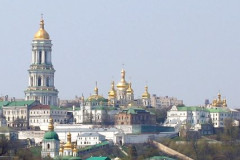
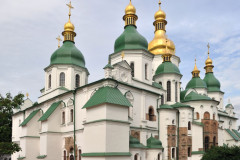
Several examples of these churches survive; however, during the 16th, 17th and 18th centuries, many were externally rebuilt in the Ukrainian Baroque style (see below). Examples include the grand St. Sophia of Kiev – the year 1017 is the earliest record of foundation laid, Church of the Saviour at Berestove – built from 1113 to 1125 and St. Cyril's Church, circa 12th-century. All can still be found in the Ukrainian capital. Several buildings were reconstructed during the late-19th century, including the Assumption Cathedral in Volodymyr-Volynskyi, built in 1160 and reconstructed in 1896–1900, the Paraskevi church in Chernihiv, built in 1201 with reconstruction done in the late 1940s, and the Golden gates in Kiev, built in 1037 and reconstructed in 1982. The latter's reconstruction was criticised by some art and architecture historians as a revivalist fantasy. Unfortunately little secular or vernacular architecture of Kievan Rus' has survived.
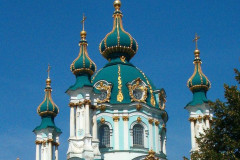
As Ukraine became increasingly integrated into the Russian Empire, Russian architects had the opportunity to realise their projects in the picturesque landscape that many Ukrainian cities and regions offered. St. Andrew's Church of Kiev (1747–1754), built by Bartolomeo Rastrelli, is a notable example of Baroque architecture, and its location on top of the Kievan mountain made it a recognisable monument of the city. An equally notable contribution of Rasetrelli was the Mariyinsky Palace, which was built to be a summer residence to Russian Empress Elizabeth. During the reign of the last Hetman of Ukraine, Kirill Razumovsky, many of the Cossack Hetmanate's towns such as Hlukhiv, Baturyn and Koselets had grandiose projects built by Andrey Kvasov. Russia eventually conquered the south of Ukraine and Crimea, and renamed them as New Russia. New cities such as Nikolayev, Odessa, Kherson and Sevastopol were founded. These would contain notable examples of Imperial Russian architecture.
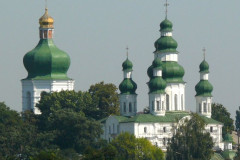
The Transfiguration Cathedral in Chernihiv dates to Kievan Rus. 1030. Kamianets-Podilskyi Castle – one of the Seven Wonders of Ukraine. St Andrew's Church in Kiev an example of Baroque. Lviv's Old Town; architecture there is much influenced by its history as part of Austria-Hungary and Poland. Vorontsov Palace, at the foot of the Crimean Mountains, an example of Gothic/Moorish Revival architecture. St. Michael's Golden-Domed Cathedral in Kiev, an example of Ukrainian Baroque. Central Department store in Kiev, Stalinist architecture example.In 1934, the capital of Soviet Ukraine moved from Kharkiv to Kiev. Previously, the city was seen as only a regional centre, hence received little attention. All of that was to change, at great price. The first examples of Stalinist architecture were already showing, and, in light of the official policy, a new city was to be built on top of the old one. This meant that much-admired examples such as the St. Michael's Golden-Domed Monastery were destroyed. Even the St. Sophia Cathedral was under threat. Also, the Second World War contributed to the wreckage. After the war, a new project for the reconstruction of central Kiev transformed Khreshchatyk avenue into a notable example of Stalinism in Architecture. However, by 1955, the new politics of architecture once again stopped the project from fully being realised.
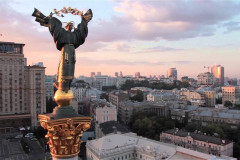
The task for modern Ukrainian architecture is diverse application of modern aesthetics, the search for an architect's own artistic style and inclusion of the existing historico-cultural environment. An example of modern Ukrainian architecture is the reconstruction and renewal of the Maidan Nezalezhnosti in central Kiev. Despite the limit set by narrow space within the plaza, the engineers were able to blend together the uneven landscape, and use underground space for a new shopping centre.
A major project, which may take up most of the 21st century, is the construction of the Kiev City-Centre on the Rybalskyi Peninsula, which, when finished, will include a dense skyscraper park amid the picturesque landscape of the Dnieper.
Music
Music is a major part of Ukrainian culture, with a long history and many influences. From traditional folk music, to classical and modern rock, Ukraine has produced several internationally recognised musicians including Kirill Karabits, Okean Elzy and Ruslana. Elements from traditional Ukrainian folk music made their way into Western music and even into modern jazz.
Mykola Lysenko is widely considered to be the father of Ukrainian classical musicUkrainian music sometimes presents a perplexing mix of exotic melismatic singing with chordal harmony. The most striking general characteristic of authentic ethnic Ukrainian folk music is the wide use of minor modes or keys which incorporate augmented 2nd intervals.
During the Baroque period, music was an important discipline for those that had received a higher education in Ukraine. It had a place of considerable importance in the curriculum of the Kyiv-Mohyla Academy. Much of the nobility was well versed in music with many Ukrainian Cossack leaders such as (Mazepa, Paliy, Holovatyj, Sirko) being accomplished players of the kobza, bandura or torban.
The first dedicated musical academy was set up in Hlukhiv, Ukraine in 1738 and students were taught to sing, play violin and bandura from manuscripts. As a result, many of the earliest composers and performers within the Russian empire were ethnically Ukrainian, having been born or educated in Hlukhiv, or had been closely associated with this music school. See: Dmytro Bortniansky, Maksym Berezovsky and Artemiy Vedel.
Ukrainian classical music falls into three distinct categories defined by whether the composer was of Ukrainian ethnicity living in Ukraine, a composer of non-Ukrainian ethnicity who was born or at some time was a citizen of Ukraine, or an ethnic Ukrainian living outside of Ukraine within the Ukrainian diaspora. The music of these three groups differs considerably, as do the audiences for whom they cater.
Since the mid-1960s, Western-influenced pop music has been growing in popularity in Ukraine. Folk singer and harmonium player Mariana Sadovska is prominent. Ukrainian pop and folk music arose with the international popularity of groups and performers like Vopli Vidoplyasova, Dakh Daughters, Ivan Dorn and Okean Elzy.
Cinema
Ukraine has had an influence on the history of the cinema. Ukrainian directors Alexander Dovzhenko, often cited as one of the most important early Soviet filmmakers, as well as being a pioneer of Soviet montage theory, Dovzhenko Film Studios, and Sergei Parajanov, Armenian film director and artist who made significant contributions to Ukrainian, Armenian and Georgian cinema. He invented his own cinematic style, Ukrainian poetic cinema, which was totally out of step with the guiding principles of socialist realism.
Other important directors including Kira Muratova, Larisa Shepitko, Sergei Bondarchuk, Leonid Bykov, Yuri Ilyenko, Leonid Osyka, Ihor Podolchak with his Delirium and Maryna Vroda. Many Ukrainian actors have achieved international fame and critical success, including: Vera Kholodnaya, Bohdan Stupka, Milla Jovovich, Olga Kurylenko, Mila Kunis.
Despite a history of important and successful productions, the industry has often been characterised by a debate about its identity and the level of Russian and European influence. Ukrainian producers are active in international co-productions and Ukrainian actors, directors and crew feature regularly in Russian (Soviet in past) films. Also successful films have been based on Ukrainian people, stories or events, including Battleship Potemkin, Man with a Movie Camera, Everything Is Illuminated.
Ukrainian State Film Agency owns National Oleksandr Dovzhenko Film Centre, film copying laboratory and archive, takes part in hosting of the Odessa International Film Festival, and Molodist is the only one FIAPF accredited International Film Festival held in Ukraine; competition program is devoted to student, first short and first full feature films from all over the world. Held annually in October.
Cuisine
The traditional Ukrainian diet includes chicken, pork, beef, fish and mushrooms. Ukrainians also tend to eat a lot of potatoes, grains, fresh, boiled or pickled vegetables. Popular traditional dishes include varenyky (boiled dumplings with mushrooms, potatoes, sauerkraut, cottage cheese, cherries or berries), nalysnyky (pancakes with cottage cheese, poppy seeds, mushrooms, caviar or meat), kapuśniak (soup made with meat, potatoes, carrots, onions, cabbage, millet, tomato paste, spices and fresh herbs), borsch (soup made of beets, cabbage and mushrooms or meat), holubtsy (stuffed cabbage rolls filled with rice, carrots, onion and minced meat) and pierogi (dumplings filled with boiled potatoes and cheese or meat). Ukrainian specialties also include Chicken Kiev and Kiev Cake. Ukrainians drink stewed fruit, juices, milk, buttermilk (they make cottage cheese from this), mineral water, tea and coffee, beer, wine and horilka.