Saint Sofia Church
Description
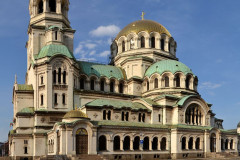
The Saint Sofia Church (Bulgarian: църква „Света София“, tsyrkva „Sveta Sofia“) is the second oldest church in the Bulgarian capital Sofia, dating to the 6th century. In the predecessor building took place the Council of Serdica held most probably in 343 and attended by 316 bishops. In the 14th century, the church gave its name to the city, previously known as Sredets (Средец).
History and architecture
The church was built on the site of several earlier churches and places of worship dating back to the days when it was the necropolis of the Roman town of Serdica. In the 2nd century, it was the location of a Roman theatre. Over the next few centuries, several other churches were constructed, only to be destroyed by invading forces such as the Goths and the Huns. The basic cross design of the present basilica, with its two east towers and one tower-cupola, is believed to be the fifth structure to be constructed on the site and was built during the reign of Byzantine Emperor Justinian I in the middle of the 6th century (527-565). It is thus a contemporary of the better-known Hagia Sophia church in Constantinople.
During the Second Bulgarian Empire (spanning the 12th to 14th centuries), the structure acquired the status of a metropolitan church. In the 14th century, the church gave its name to the city. In the 16th century, during Ottoman rule, the church was converted into a mosque: the original 12th-century frescoes were destroyed and minarets were added. In the 19th century two earthquakes destroyed one of the minarets and the mosque was abandoned. Restoration work was begun after 1900.
The Saint Sofia Church is now one of the most valuable pieces of Early Christian architecture in Southeastern Europe. The present building is a cross basilica with three altars. The floor of the church is covered with complex Early Christian ornamental or flora and fauna-themed mosaics. The Saint Sofia Church stands in the middle of an ancient necropolis and many tombs have been unearthed both under and near the church. Some of the tombs even feature frescoes.
Because Saint Sophia represents the Divine Wisdom along with a historical saint (Sophia the Martyr), icons within the church depict Sophia as Christ Emmanuel, a young figure of Christ seated on a rainbow. The church also displays icons of historical saints, including St. George and St. Vladimir. In modern times it is mistakenly considered by some that the church is named in honour of the 2nd-century Roman saint Sophia the Martyr, who has in recent years even become the city's patron saint, and not after the Divine Wisdom (Hagia Sophia).
According to popular lore, Saint Sophia's miraculous powers protected the building over the centuries, warding off human invasions and natural disasters to keep the church as an example of the elegant, austere, and symmetrical architecture of the age.
Street view
Reviews
Worth every penny and every second spent down there exploring the excavations.
Anyway it is a key part of Sofia's history and definitely worth a visit. Do not miss the necropolis underneath - an interesting archaeological site.