Sofia
Description
Sofia is the capital and largest city of Bulgaria. Sofia is the 15th largest city in the European Union with population of more than 1.2 million people. The city is located at the foot of Vitosha Mountain in the western part of the country, within less than 50 kilometres (31 mi) drive from the Serbian border. Its location in the centre of the Balkan peninsula means that it is the midway between the Black Sea and the Adriatic Sea, whereas the Aegean Sea is the closest to it.
Sofia has been an area of human habitation since at least 7000 BCE. Many of the major universities, cultural institutions and commercial companies of Bulgaria are concentrated in Sofia. Sofia is one of the top 10 best places for start-up business in the world, especially in IT technologies. Sofia is Europe's most affordable capital to visit as of 2013.
Names
The feast day of Saint Sofia on September 17 is the official public holiday of the city.
For the longest time the city possessed a Thracian name, derived from the tribe Serdi, who were either of Thracian, Celtic, or mixed Thracian-Celtic origin. The Serdi and the name of emperor Marcus Ulpius Traianus (53 – 117 AD) prompted the Romans to give the city the combinative name of Ulpia Serdica; Ulpia is derived from an Umbrian cognate of the Latin word lupus, meaning "wolf." It seems that the first written mention of Serdica was made during his reign and the last mention was in the 19th century in a Bulgarian text (Сардакіи, Sardaki). During the Romans civitas Serdenisium was mentioned the "brightest city of the Serdi" in official inscriptions. The city was major throughout the past ever since Antiquity, when Roman emperor Constantine the Great referred to it as "my Rome", and it nearly became his capital.
Other names given to Sofia, such as Serdonpolis (Σερδών πόλις, "City of the Serdi") and Triaditza (Τριάδιτζα, "Trinity"), were mentioned by Byzantine Greek sources or coins. The Slavic name Sredets (Срѣдецъ), which is related to "middle" (среда, "sreda") and to the city's earliest name, first appeared on paper in an 11th-century text. The city was called Atralissa by the Arab traveler Idrisi and Strelisa, Stralitsa or Stralitsion by the Crusaders.
The first seal of the city from 1878 which calls it Sredets
The name Sofia comes from the Saint Sofia Church, as opposed to the prevailing Slavic etymology among Bulgarian cities and towns. It is ultimately derived from the Egyptian Kemetic word sbÅ ( ), meaning "star, door, teaching and wisdom" and attested first in the 20th century BC in the tomb of Intef I. This was a tradition of collection of wise literature, shared between Mediterranean cultures, which was called sophia (σοφία) in Greek. The earliest works where this latest name is registered are the duplicate of the Gospel of Serdica, in a dialog between two salesmen from Dubrovnik around 1359, in the 14th-century Vitosha Charter of Bulgarian tsar Ivan Shishman and in a Ragusan merchant's notes of 1376. In these documents the city is called Sofia, but at the same time the region and the city's inhabitants are still called Sredecheski (срѣдечьскои, "of Sredets"), which continued until the 20th century. The city became somehow popular to the Ottomans by the name Sofya (صوفيا). In 1879 there was a dispute about what the name of the new Bulgarian capital should be, when the citizens created a committee of famous people, insisting for the Slavic name. Gradually, a compromise arose, officialisation of Sofia for the nationwide institutions, while legitimating the title Sredets for the administrative and church institutions, before the latter was abandoned through the years.
The city's name is pronounced by Bulgarians with a stress on the 'o', in contrast with the tendency of foreigners to place the stress on 'i'. The female given name "Sofia" is pronounced by Bulgarians with a stress on the 'i'.
Geography
The skyline of Sofia, Bulgaria, with the Vitosha mountain in the background during winter
Sofia has an area of 492 km2, while Sofia City Province has an area of 1344 km2. Sofia's development as a significant settlement owes much to its central position in the Balkans. It is situated in western Bulgaria, at the northern foot of the Vitosha mountain, in the Sofia Valley that is surrounded by the Balkan mountains to the north. The valley has an average altitude of 550 metres (1,800 ft). Unlike most European capitals, Sofia does not have any large rivers or bridges, but is surrounded by comparatively high mountains on all sides. Three mountain passes lead to the city, which have been key roads since antiquity, Vitosha being the watershed between Black and Aegean Seas. A number of low rivers cross the city, including the Vladayska and the Perlovska. The Iskar River in its upper course flows near eastern Sofia. The city is known for its 49 mineral and thermal springs. Artificial and dam lakes were built in the twentieth century. The 1818 Sofia earthquake was a 6,0-7,2 Medvedev–Sponheuer–Karnik Scale earthquake, the 1858 earthquake was an 6,6 same scale earthquake though reaching up to 10 in parts such as Boyana, this was followed by a 7-8 MSK Sofia earthquake in 1917 and finally by the 2012 Pernik earthquake which was a 5.6 Mw (or 5.8 ML) magnitude earthquake. The 2014 Aegean Sea earthquake was also noticed in the city.
A problem of air pollution of Sofia is its location in the Sofia valley which is surrounded by mountains on the sides and this reduces the ability of the air to self-clean. The air is polluted mostly by particulate matters and nitrogen oxides. Sofia is the capital with most polluted air in the EU.
History
Prehistory and antiquity
Sofia has been an area of continuous human habitation since at least the 8th millennium BC, but others have inhabited the area 30,000 years ago. The city has a history of nearly 7000 years and it is the second oldest city in Europe according to the city's official website and other sources, though the meaning of the claim is unclear as in the world there were hardly any cities at the time. In the context, certainly the neolithic village in Slatina, dating to the 5th-6th millennium BC, is described. However, the motto of the city is "grows, but does not age". Remains from another neolihic settlement around the National Art Gallery are traced to the 3rd-4th millennium BC, which has been the traditional center of the city ever since and is not changed today. The earliest tribes who settled were the Thracians. According to some sources, it got first an official mention in the 7th/8th century BCE when the Serdi (Sardi) as a Thracian tribe established a settlement. Other sources suppose that the Serdi's Celtic origin is convincingly evidenced through linguistic and archeological clues but that their presence is not evidenced before the 1st century BC, whereas others assume their mixed Thracian-Celtic origin or relation to the Sards. The earliest evidence of Celtic presence in the Sofia area (Pernik) can be from the 3rd century BC. Some clues lead to the conclusion that the area of the settlement was between TZUM, Sheraton Hotel and the Presidency. In the 500s BC, the area became part of a Thracian tribal union, called the Odrysian kingdom, when another Thracian tribe appeared in the town, the Odrysses. For a short period the Thracian rule was possibly interrupted by the Achaemenid Empire. In 339 BC Philip II of Macedon destroyed and ravaged the town which was its first time.
Around BC 29, Serdica was conquered by the Romans, gradually becoming the most important Roman city of the region. It became a municipium during the reign of Emperor Trajan (98–117). Serdica expanded, as turrets, protective walls, public baths, administrative and cult buildings, a civic basilica, an amphitheatre, a circus, the City Council (Boulé), a large forum, a big circus (theatre), etc. were built. Serdica was a significant midway city on the Roman road Via Militaris, connecting Singidunum and Byzantium. In the 3rd century, it became the capital of Dacia Aureliana, and when Emperor Diocletian divided the province of Dacia Aureliana into Dacia Ripensis (at the banks of the Danube) and Dacia Mediterranea, Serdica became the capital of the latter. Serdica's citizens of Thracian descent were referred to as Illyrians probably because it was at some time the capital of Eastern Illyria (Second Illyria). For future emperors Serdica was their residence form where they ruled Rome.
The fortification of Serdica
Roman emperors Aurelian (215-275) and Galerius (260-311) were from Serdica. The city subsequently expanded for a century and a half, it became a significant political and economical centre, more so — it became one of the first Roman cities where Christianity was recognized as an official religion (under Galerius). The Edict of Toleration by Galerius was issued in 311 in Serdica by the Roman emperor Galerius, officially ending the Diocletianic persecution of Christianity. The Edict implicitly granted Christianity the status of "religio licita", a worship recognized and accepted by the Roman Empire. It was the first edict legalizing Christianity, preceding the Edict of Milan by two years. For Constantine the Great it was 'Sardica mea Roma est' (Serdica is my Rome). He considered making Serdica the capital of the Byzantine Empire instead of Constantinople. which was already not dissimilar to a tetrarchic capital of the Roman Empire. In 343 AD, the Council of Sardica was held in the city, in a church located where the current 6th century Church of Saint Sophia was later built.
The city was destroyed in the 447 invasion of the Huns and the city laid in ruins for a century It was rebuilt by Byzantine Emperor Justinian I. During the reign of Justinian it flourished, being surrounded with great fortress walls whose remnants can still be seen today.
Middle Ages, Renaissance and early modern history
The city first became part of the First Bulgarian Empire during the reign of Khan Krum in 809, after a long siege. Afterwаrds, it grew into an important fortress and administrative centre when Khan Omurtag made it a center of Sredets province (Sredetski komitat, Средецки комитат). After the conquest of the Bulgarian capital Preslav by Sviatoslav I of Kiev and John I Tzimiskes' armies in 970-971, the Bulgarian Patriarch Damyan chose Sofia for his seat in the next year and the capital of Bulgaria was first moved to Sredets. In the second half of 10th century the city was ruled by Komit Nikola and his sons, popular as "Komitopuli". One of them is Samuil, who became an Emperor of Bulgaria in 997. After a number of unsuccessful sieges, the city fell to the Byzantine Empire in 1018, but once again was incorporated into the restored Bulgarian Empire at the time of Tsar Ivan Asen I.
In 1382, Sofia was seized by the Ottoman Empire in the course of the Bulgarian-Ottoman Wars after a long siege. Around 1393 it became the seat of newly established Sanjak of Sofia.
The city was occupied by Hungarian forces for a short time in 1443. After the failed crusade of Władysław III of Poland in 1443 towards Sofia, the city's Christian elite was annihilated and the city became the capital of the Ottoman province (beylerbeylik) of Rumelia for more than four centuries. In the 16th century, Sofia's urban layout and appearance began to exhibit a clear Ottoman style.
There were fountains, hamams (bathhouses), prominent churches such as Saint Sofia were converted into mosques and in total there were 11 big and over 100 small mosques by the 17th century, of which only the Banya Bashi remains as a mosque today. During that time the town had a population of around 7,000.
The town was seized for several weeks by Bulgarian hajduks in 1599. In 1610 the Vatican established the See of Sofia for Catholics of Rumelia, which existed until 1715 when most Catholics had emigrated. The town was the center of Sofia Eyalet (1826–1864). 4). Nedelya Petkova created the first Bulgarian school for women in the city. The Ottomans hanged in Sofia the most honored Bulgarian revolutionary of all time Levski in 1873.
Modern and contemporary history
During the Russo-Turkish War of 1877–78, Suleiman Pasha was going to burn the city, unless the foreign councils Leandre Legay, Vito Positano, Rabbi Gabriel Almosnino and Josef Valdhart interceded for the salvation of the city. However this salvation did not apply to the Bulgarian citizens who faced executions. Sofia was liberated from Ottoman rule by Russian forces under Gen. Iosif Gurko on 4 January 1878. It was proposed as a capital by Marin Drinov and was accepted as such on 3 April 1879. By the time of its liberation the population of the city was 11,649. For a few decades after the liberation the city experienced large population growth mainly from other regions of the country. In 1900 the first electric bulb in the city was turned on.
In the Second Balkan War Bulgaria was warring alone against five neighboring countries and the Romanian Army entered Vrazhdebna in 1913, then a village seven miles from Sofia, now a suburb, which prompted Bulgaria to capitulate. In the following wars, Sofia was invaded by an at least nominally peaceful Soviet Red Army and was bombed by Allied US and UK aircraft in late 1943 and early 1944. Then 40,000 editions of books were destroyed along with the Capital Library and 12,656 more buildings, additionally over 2000 people died.
In 1925 a terrorist act of ultra-leftists failed their attempted assassination of the king but resulted in the destruction of a church and many victims. It took 20 years to 1945 when the communist Fatherland Front took power and executed several thousand people. The transformations of Bulgaria into the People's Republic of Bulgaria in 1946 and into the Republic of Bulgaria in 1990 marked significant changes in the city's appearance. The population of Sofia expanded rapidly due to migration from the country. Whole new residential areas were built in the outskirts of the city, like Druzhba, Mladost and Lyulin. The Georgi Dimitrov Mausoleum, where Dimitrov's body had been preserved in a similar way to the Lenin mausoleum, was detonated in 1999.
Culture
Arts and entertainment
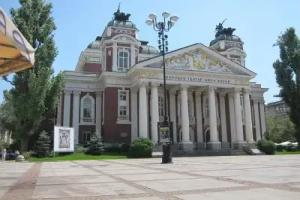
Sofia concentrates the majority of Bulgaria's leading performing arts troupes. Theatre is by far the most popular form of performing art, and theatrical venues are among the most visited, second only to cinemas. The oldest such institution is the Ivan Vazov National Theatre, which performs mainly classical plays and is situated in the very centre of the city.
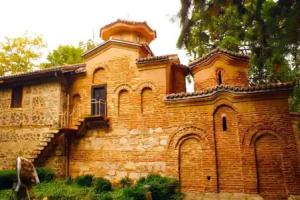
The National Opera and Ballet of Bulgaria is a combined opera and ballet collective, established in 1891. However, it did not begin performances on a regular basis until 1909. Some of Bulgaria's most famous operatic singers, such as Nicolai Ghiaurov and Ghena Dimitrova, have made their first appearances on the stage of the National Opera and Ballet. The National Palace of Culture regularly hold classical concerts. Bulgaria's largest art museums are located in the central areas of the city. The National Art Gallery holds a collection of works mostly by Bulgarian authors, while the National Gallery for Foreign Art displays exclusively foreign art, mostly from India, Africa, China and Europe. Its collections encompass diverse cultural items such as Ashanti Empire sculptures, Buddhist art, Dutch Golden Age painting, works by Albrecht Dürer, Jean-Baptiste Greuze and Auguste Rodin, among others. The crypt of the Alexander Nevsky cathedral holds a collection of Eastern Orthodox icons from the 9th to the 19th century. Other museums are the National Historical Museum with a collection of more than 600,000 items; the National Polytechnical Museum with more than 1,000 technological items on display; the National Archaeological Museum and the Museum of Natural History. The SS. Cyril and Methodius National Library houses the largest national collection of books and documents (1,714,211 books and some 6 million other documents) and is Bulgaria's oldest cultural institute. The Boyana Church, a UNESCO World Heritage site, contains realistic frescoes, depicting more than 240 human images and a total 89 scenes, were painted. With their vital, humanistic realism they are a Renaissance phenomenon at its culmination phase in the context of the common-European art. Muzeiko is a new museum opened in 2015. It is a space with over 130 interactive games created for children and curious adults. The entire content of the museum is designed to inspire children to learn, discover and explore the sciences, while helping children, their families and educators spend time together actively and effectively.
Vitosha Blvd., the main shopping street in the city.
Cinema is the most popular form of entertainment. In recent years, cinematic venues have been concentrated in trade centres and malls, and independent halls have been closed. Mall of Sofia holds one of the largest IMAX cinemas in Europe. Most films are American productions, although European and domestic films are increasingly shown. Odeon (not part of the Odeon Cinemas chain) shows exclusively European and independent American films, as well as 20th century classics. Bulgaria's once thriving film industry, concentrated in the Boyana Film studios, has suffered a period of decay after 1990. A relative revival of the industry began after 2001. After the acquisition of Boyana Film by Nu Image, several moderately successful productions have been shot in and around Sofia, such as The Contract, The Black Dahlia, Hitman and Conan the Barbarian and Spartacus. The Nu Boyana Film studios have also hosted some of the scenes for The Expendables 2.
The city houses many cultural institutes such as the Russian Cultural Institute, the Polish Cultural Institute, the Hungarian Institute, the Czech and the Slovak Cultural Institutes, the Italian Cultural Institute, the French Cultural Institute, Goethe Institut, British Council, Instituto Cervantes, and the Open Society Institute, which regularly organise temporary expositions of visual, sound and literary works by artists from their respective countries.
Some of the biggest telecommunications companies, TV and radio stations, newspapers, magazines, and web portals are based in Sofia, including the Bulgarian National Television, bTV and Nova TV. Top-circulation newspapers include 24 Chasa and Trud.
Tourism
Sofia is one of the most visited tourist destinations in Bulgaria alongside coastal and mountain resorts. Among its highlights is the Alexander Nevsky Cathedral, one of the symbols of Bulgaria, constructed in the late 19th century. It occupies an area of 3,170 square metres (34,100 sq ft) and can hold 10,000 people.
Sofia holds Bulgaria's largest museum collections, which attract tourists and students for practical studies. The National Historical Museum in Boyana district has a vast collection of more than 650,000 historical items dating from Prehistory to the modern era, although only 10,000 of them are permanently displayed due to the lack of space. Smaller collections of items related mostly to the history of Sofia are in the National Archaeological Museum, a former mosque located between the edifices of the National Bank and the Presidency. Two natural sciences museums — the Natural History Museum and the Earth and Man — display minerals, animal species (alive and taxidermic) and rare materials. The Ethnographic Museum and the National Museum of Military History are other places of interest, holding large collections of Bulgarian folk costumes and armaments, respectively.
Vitosha Boulevard, also called Vitoshka, is a pedestrian zone with numerous cafes, restaurants, fashion boutiques, and luxury goods stores. Sofia's geographic location, in the foothills of the weekend retreat Vitosha mountain, further adds to the city's specific atmosphere.
Transport and infrastructure
With its developing infrastructure and strategic location, Sofia is a major hub for international railway and automobile transport. Three of the ten Pan-European Transport Corridors cross the city: IV, VIII and X. All major types of transport (except water) are represented in the city. The Central Railway Station is the primary hub for domestic and international rail transport. Sofia has 186 kilometres of railway lines. Sofia Airport handled 3,815,158 passengers in 2014.
Public transport is well-developed with bus (2,380 km (1,479 mi) network), tram (308 km (191 mi)) network, and trolleybus (193 km (120 mi) network), lines running in all areas of the city, although some of the vehicles are in a poor condition. The Sofia Metro became operational in 1998, and now has two lines and 34 stations. As of 2012, the system has 39 km (24 mi) of track. Six new stations were opened in 2009, two more in April 2012, and eleven more in August 2012. Construction works on the extension of the first line are underway and it is expected to reach the airport by 2014. A third line is currently in the late stages of planning and it is expected that its construction starts in 2014. This line will complete the proposed subway system of three lines with about 65 km (40 mi) of lines. The master plan for the Sofia Metro includes three lines with a total of 63 stations. In recent years the marshrutka, a private passenger van, began serving fixed routes and proved an efficient and popular means of transport by being faster than public transport but cheaper than taxis. As of 2005 these vans numbered 368 and serviced 48 lines around the city and suburbs. There are around 13,000 taxi cabs operating in the city. Low fares in comparison with other European countries, make taxis affordable and popular among a big part of the city population.
Tsarigradsko shose, one of the busiest boulevards in Sofia
Private automobile ownership has grown rapidly in the 1990s; more than 1,000,000 cars were registered in Sofia after 2002. The city has the 4th-highest number of automobiles per capita in the European Union at 546.4 vehicles per 1,000 people. The municipality was known for minor and cosmetic repairs and many streets are in a poor condition. This is noticeably changing in the past years. There are different boulevards and streets in the city with a higher amount of traffic than others. These include Tsarigradsko shose, Cherni Vrah, Bulgaria, Slivnitsa and Todor Aleksandrov boulevards, as well as the city's ring road, where long chains of cars are formed at peak hours and traffic jams occur regularly. Consequently, traffic and air pollution problems have become more severe and receive regular criticism in local media. The extension of the underground system is hoped to alleviate the city's immense traffic problems.
Sofia has an extensive district heating system based around four combined heat and power (CHP) plants and boiler stations. Virtually the entire city (900,000 households and 5,900 companies) is centrally heated, using residual heat from electricity generation (3,000 MW) and gas- and oil-fired heating furnaces; total heat capacity is 4,640 MW. The heat distribution piping network is 900 km (559 mi) long and comprises 14,000 substations and 10,000 heated buildings.
Honour
Serdica Peak on Livingston Island in the South Shetland Islands, Antarctica is named after Serdica.