Chennai

Description

Chennai is the capital of the Indian state of Tamil Nadu. Located on the Coromandel Coast off the Bay of Bengal, it is one of the biggest cultural, economic and educational centres in South India. According to the 2011 Indian census, it is the fourth-largest city and fourth-most populous urban agglomeration in India. The city together with the adjoining regions constitute the Chennai Metropolitan Area, which is the 36th-largest urban area by population in the world. Chennai is one of the Indian cities most visited by foreign tourists, and is the 47th most visited city in the world. The Quality of Living Survey rated Chennai as the safest city in India. Chennai attracts 45 percent of health tourists visiting India, and 30 to 40 percent of domestic health tourists. As such, it is termed "India's health capital". As a growing metropolitan city in a developing country, Chennai confronts substantial pollution and other logistical and socio-economic problems

Chennai has the third-largest expatriate population in India at 35,000 in 2009, 82,790 in 2011 and estimated at over 100,000 by 2016. Tourism guide publisher Lonely Planet named Chennai as one of the top ten cities in the world to visit in 2015. Chennai is ranked as a beta-level city in the Global Cities Index and was ranked the best city in India by India Today in the 2014 annual Indian city survey. In 2015 Chennai was named the "hottest" city (worth visiting, and worth living in for long term) by the BBC, citing the mixture of both modern and traditional values. National Geographic ranked Chennai's food as second best in the world; it was the only Indian city to feature in the list. Chennai was also named the ninth-best cosmopolitan city in the world by Lonely Planet.

In January 2015 the Chennai Metropolitan Area was ranked as the third-largest economy in India, with the third-highest GDP per capita. Chennai has been selected as one of the 100 Indian cities to be developed as a smart city under PM Narendra Modi's flagship Smart Cities Mission.

Etymology

The nativity of 'Madras' of being Tamil origin and 'Chennai' of being Telugu origin has been clearly proven and documented after various researches done by renowned scholars and historians.

The name Madras originated even before the British presence was established in India. The name Madras is said to have originated from a Portuguese phrase " mae de Deus " which means "mother of god", due to Portuguese influence on the port city. According to some sources, Madras was derived from Madraspattinam, a fishing-village north of Fort St George. However, it is uncertain whether the name was in use before the arrival of Europeans. The British military mapmakers believed Madras was originally Mundir-raj or Mundiraj. Madras might have also been derived from the word Madhuras (Sanskrit: मधुरस) meaning "juice of honey" or "sugarcane" in Sanskrit. A Vijayanagar-era inscription dated to the year 1367 that mentions the port of Maadarasanpattanam, along with other small ports on the east coast was discovered in 2015 and it was theorised that the aforementioned port is the fishing port of Royapuram.

There are two different theories for the origin of the name Chennai. The first theory is that it was derived from the name of a Telugu ruler Damarla Chennappa Nayakudu, father of Damarla Venkatapathy Nayak, a Nayak ruler who served as a general under Venkata III of the Vijayanagar Empire from whom the British acquired the town in 1639. The first official use of the name Chennai is said to be in a sale deed, dated 8 August 1639, to Francis Day of the East India Company. The second theory states that it was named after the Chenna Kesava Perumal Temple; the temple regarded as the face of the city.

In 1996, the Government of Tamil Nadu officially changed the name from Madras to Chennai. At that time many Indian cities underwent a change of name. However, the name Madras continues in occasional use for the city, as well as for places named after the city such as University of Madras, IIT Madras, Madras Institute of Technology, Madras Medical College, Madras Christian College.

History

Stone age implements have been found near Pallavaram in Chennai. According to the Archaeological Survey of India (ASI), Pallavaram was a megalithic cultural establishment, and pre-historic communities resided in the settlement.

The region around Chennai has served as an important administrative, military, and economic centre for many centuries. During 1st century CE, a poet and weaver named Thiruvalluvar lived in the town of Mylapore (a neighbourhood of present Chennai). From the 1st–12th century the region of present Tamil Nadu and parts of South India was ruled by the Cholas.

The Pallavas of Kanchi built the areas of Mahabalipuram and Pallavaram during the reign of Mahendravarman I. They also defeated several kingdoms including the Cheras, Cholas and Pandyas who ruled over the area before their arrival. Sculpted caves and paintings have been identified from that period. Ancient coins dating to around 500 BC have also been unearthed from the city and its surrounding areas. A portion of these findings belonged to the Vijayanagara Empire, which ruled the region during the medieval period.

The Portuguese first arrived in 1522 and built a port called São Tomé after the Christian apostle, St. Thomas, who is believed to have preached in the area between 52 and 70 CE. In 1612, the Dutch established themselves near Pulicat, north of Chennai.

On 22 August 1639, which is referred to as Madras Day, the English East India Company under Francis Day bought a small strip of land stretching 3 miles on the Coromandel Coast. They got a license to build a fort and a castle in the contracted region. The ruler Damarla Chennappa Nayakudu, the Nayaka of Chandragiri, granted the English permission to build a factory and warehouse for their trading enterprises. The region was then primarily a fishing village known as "Madraspatnam". A year later, the English built Fort St. George, the first major English settlement in India, which became the nucleus of the growing colonial city and urban Chennai, grew around this Fort. Post independence the fort housed the Tamil Nadu Assembly until the new Secretariat building was opened in 2010, but shortly afterwards it was again moved back to Fort St. George, due to a change in the Government.

In 1746, Fort St. George and Madras were captured by the French under General La Bourdonnais, the Governor of Mauritius, who plundered the town and its outlying villages. The British regained control in 1749 through the Treaty of Aix-la-Chapelle and strengthened the town's fortress wall to withstand further attacks from the French and Hyder Ali, the Sultan of Mysore. They resisted a French siege attempt in 1759 under the leadership of Eyre Coote. In 1769 the city was threatened by Mysore and the British were defeated by Hyder Ali, after which the Treaty of Madras ended the war. By the 18th century, the British had conquered most of the region around Tamil Nadu and the northern modern–day states of Andhra Pradesh and Karnataka, establishing the Madras Presidency with Madras as the capital.

Gradually, the city grew into a major naval base and became the central administrative centre for the British in South India. With the advent of railways in India in the 19th century, the thriving urban centre was connected to other important cities such as Bombay and Calcutta, promoting increased communication and trade with the hinterland. Sir Arthur Lawley was Governor of Madras from 1906 to 1911 and promoted modern agriculture, industry, railways, education, the arts and more democratic governance. The Governor lived in Government House, Fort St George, and had a country home at Guindy, with access to a golf course, hockey pitches, riding stables and the Guindy Horse Racing Track. In the First World War as Red Cross Commissioner in Mesopotamia, he looked after the welfare of Indian soldiers. Madras was the only Indian city to be attacked by the Central Powers during World War I, when an oil depot was shelled by the German light cruiser SMS Emden on 22 September 1914, as it raided shipping lanes in the Indian Ocean, causing disruption to shipping.

After India gained its independence in 1947, the city became the capital of Madras State, which was renamed as Tamil Nadu in 1969. The violent agitations of 1965 against the compulsory imposition of Hindi and in support of English in India in the state marked a major shift in the political dynamics of the city and eventually it had a big impact on the whole state. Because of Madras and its people, English now exists in India, otherwise Hindi might have been made the sole official language in India. On 17 July 1996, the city known as Madras was officially renamed Chennai, in line with what was then a nationwide trend to using less Anglicised names. On 26 December 2004, an Indian Ocean tsunami lashed the shores of Chennai, killing 206 people in Chennai and permanently altering the coastline. The 2015 Chennai Floods submerged major portions of the city, killing 269 people and resulting in damages of ₹86.4 billion (US$1 billion).

Environment

Geography

Chennai, sometimes referred to as the "Gateway to South India," is located on the south–eastern coast of India in the north–eastern part of Tamil Nadu on a flat coastal plain known as the Eastern Coastal Plains. Its average elevation is around 6.7 metres (22 ft), and its highest point is 60 m (200 ft). Two major rivers flow through Chennai, the Cooum River (or Koovam) through the centre and the Adyar River to the south. A third river, the Kortalaiyar, travels through the northern fringes of the city before draining into the Bay of Bengal, at Ennore. The estuary of this river is heavily polluted with effluents released by the industries in the region. Adyar and Cooum rivers are heavily polluted with effluents and waste from domestic and commercial sources, the Coumm being so heavily polluted it is regarded as the city's eyesore. A protected estuary on the Adyar forms a natural habitat for several species of birds and animals. The Buckingham Canal, 4 km (2.5 mi) inland, runs parallel to the coast, linking the two rivers. The Otteri Nullah, an east–west stream, runs through north Chennai and meets the Buckingham Canal at Basin Bridge. Several lakes of varying size are located on the western fringes of the city. Some areas of the city have the problem of excess iron content in groundwater.

Chennai's soil is mostly clay, shale and sandstone. Clay underlies most of the city, chiefly Manali, Kolathur, Maduravoyal, K. K. Nagar, Tambaram, Mudichur, Pallavaram Semmencherry, Alapakkam, Vyasarpadi and Anna Nagar. Sandy areas are found along the river banks and coasts, and include areas such as Tiruvottiyur, George Town, Madhavaram, New Washermanpet, Chepauk, Mylapore, Porur, Adyar, Besant Nagar and Uthandi. In these areas, rainwater runoff percolates quickly through the soil. Areas having hard rock surface include Guindy, Nanganallur, Pallikaranai, Alandur, Jaladampet, Velachery, Adambakkam and a part of Saidapet and Perungudi. The ground water table in Chennai is at 4-5m below ground in most of the areas, which was considerably improved and maintained through the mandatory rain water harvesting system.

Geology

Chennai is classified as being in Seismic Zone III, indicating a moderate risk of damage from earthquakes. Owing to the geotectonic zone the city falls in, the city is considered a potential geothermal energy site. The crust has granite rocks indicating volcanic activities in the past. It is expected that temperatures of around 200 to 300 C° will be available if the ground were drilled 4 to 5 km deep. The region has the oldest rocks in the country dating back to nearly a billion years.

Flora and fauna

The southern stretch of Chennai's coast from Tiruvanmiyur to Neelangarai are favoured by the endangered Olive Ridley sea turtles to lay eggs every winter. A large number of cattle egrets, pond herons and other waterbirds can be seen in the rivers of Cooum and Adyar. About 75,000 birds migrate to Chennai every year. Marshy wetlands such as Pallikaranai also play host to a number of migratory birds during the monsoon and winter. Over 300 species of birds have been recorded in the city and its neighbourhood by members of Madras Naturalists' Society since its inception in 1978.

Guindy National Park is a protected area within the city limits. Wildlife conservation and research activities take place at Arignar Anna Zoological Park including Olive ridley sea turtle conservation. Madras Crocodile Bank Trust is a herpetology research station, located 40 kilometres (25 mi) south of Chennai. It is India's leading institution for herpeto faunal conservation and the first crocodile breeding centre in Asia.

Environment conservation

Chennai has three rivers and many lakes spread across the city. Urbanization has led to shrinkage of water bodies and wetlands. The quantity of wetlands in the city has decreased from 650 to only 27 currently. The Chennai River Restoration trust set up by the government is working on the restoration of Adyar river. Environmentalist Foundation of India is a volunteering group working towards wildlife conservation and habitat restoration.

Architecture

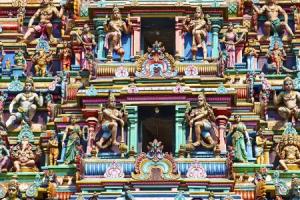
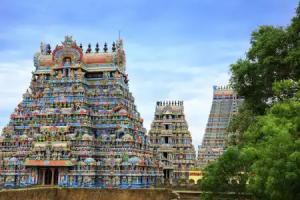
With the history of many neighbourhoods of the city such as Mylapore and Triplicane antedating that of the city, the architecture of Chennai ranges in a wide chronology. The oldest buildings in the city dates from the 7th and 8th centuries CE, which include the Kapaleeshwarar Temple in Mylapore and the Parthasarathy Temple in Triplicane, built in the Dravidian architecture. This architecture includes various styles, such as those of the Pallavas, the Cholas, and the Vijayanagara empires. The associated Agraharam architecture, which consists of traditional row houses surrounding a temple, can still be seen in these areas. The heritage temples at Mamallapuram at the outskirts of the city are some of the examples of the Pallava architecture. Chennai ranks second to Kolkata of Indian heritage buildings.

With the advent of the Mugals and the British, the city saw a rise in a blend of Hindu, Islamic and Gothic revival styles, resulting in the distinct Indo-Saracenic style. The architecture for several early institutions such as banking and commerce, railways, press and education, chiefly through the colonial rule, followed the earlier directions of the Neo-Classical and the Indo-Saracenic. The Chepauk Palace in the city, designed by Paul Benfield, is said to be the first Indo-Saracenic building in India. Since then, many of the colonial-era buildings in the city were designed in this style of architecture, which is most apparent around the Fort St. George built in 1640. Most of these were designed by English architects Robert Fellowes Chisholm and Henry Irwin. The best examples of this style include the Madras High Court (built in 1892), Southern Railway headquarters, Ripon Building, Government Museum, Senate House of the University of Madras, Amir Mahal, Bharat Insurance Building, Victoria Public Hall and the College of Engineering.

The Triumph of Labour, also known as the Labour statue, is a statue at the Marina Beach, Chennai, India. Erected at the northern end of the beach at the Anna Square opposite University of Madras, it is an important landmark of Chennai.The statue shows four men toiling to move a rock, depicting the hard work of the labouring class.It was sculpted by Debi Prasad Roy Chowdhry.

The construction of the National Art Gallery in Madras was completed in 1909. The new building, with a stunning façade, was built of pink sandstone brought from Sathyavedu, and formed part of the Madras Museum campus. It was opened, on 23 January 1909, by the Governor of Fort St. George, Sir Arthur Lawley, and called the Victoria Memorial Hall after the Queen-Empress Victoria. The residential architecture in the city was based on the bungalow or the continuous row house prototypes. Gothic revival style buildings include the Chennai Central and Chennai Egmore railway stations. The Santhome Church, which was originally built by the Portuguese in 1523 and is believed to house the remains of the apostle St. Thomas, was rebuilt in 1893 in neo-Gothic style.

By the early 20th century, the art deco too made its entry upon the city's urban landscape. From the 1930s onwards, many buildings in George Town were built in this style, including the United India building (presently housing LIC) and the Burma Shell building (presently the Chennai House), both built in the 1930s, and the Dare House, built in 1940. Other examples include the Bombay Mutual building (presently housing LIC) and the South Indian Chamber of Commerce building. After Independence, the city witnessed a rise in the Modernism style of architecture. The completion of the LIC Building in 1959, the tallest building in the country at that time, marked the transition from lime-and-brick construction to concrete columns in the region. The presence of the weather radar at the Chennai Port, however, prohibited the construction of buildings taller than 60 m around a radius of 10 km. In addition, the floor-area ratio (FAR) in the central business district is also 1.5, much less than that of smaller cities of the country. This resulted in the city expanding horizontally, unlike other metropolitan cities where vertical growth is prominent. On the contrary, the peripheral regions, especially on the southern and south-western sides, are experiencing vertical growth with the construction of buildings up to 60 floors.

Housing

In a 2013 survey titled 'Emerging trends in real estate in Asia Pacific 2014', Chennai emerged in the top 25 real estate destinations list in the Asia Pacific region. The city ranked 22nd in the list. There are about 1,240 slums in Chennai home to about 9 lakh people.

Per 2011 census, there are 1.1 million households in the city and the residential housing stock available is 1,150,000 – a surplus of about 50,000 houses. About 43,700 of them are kept vacant. In the suburbs of Chennai located in Tiruvallur and Kancheepuram districts, the figures of vacant houses 56,000 and 71,000, respectively. Of the existing housing stock in the city, about 200,000 houses are not in good condition, necessitating either to rebuild or build new units. About 26,000 households live in houses without any room and another 427,000 families (with an average size of five members) live in small dwelling units with only one room. An earlier estimate shows that there is a need to generate about 420,000 units for low-income groups by 2016.

As of 2012, an estimated population of 11,116 (0.16 percent) were homeless. Per Supreme Court guidelines, the city needs 65 shelters for the homeless. However, it has only 15, of which 8 are functioning and two are under renovation.

Arts and culture

Museums and art galleries

Chennai is home to many museums, galleries, and other institutions, many of which are free of admission charges and are major tourist attractions as well as playing a research role. The city also has one of the oldest Museum and Art Gallery in the country- Government Museum, Chennai and The National Art Gallery (Chennai), established in the early 18th century. The city also hosts two art festivals annually. The "Fort Museum" inside the premises of Fort St. George is an important museum having a noteworthy collection of objects of the British era in its collection. The museum is managed by the Archaeological Survey of India and has in its possession, the first Flag of India hoisted at Fort St George after the declaration of India's Independence on 15 August 1947.

Music and performing arts

Chennai is a major centre for music, art and culture in India. The city is known for its classical dance shows. In 1930, for the first time in India, Madras University introduced a course of music, as part of the Bachelor of Arts curriculum. The Madras Music Season, initiated by Madras Music Academy in 1927, is celebrated every year during the month of December. It features performances of traditional Carnatic music by many artists in and around the city.

An arts festival called the Chennai Sangamam, which showcases not only various arts of Tamil Nadu but also from the neighbouring states, like kalari (from Kerala), which is a major attraction, is held in January every year. The Speciality of Chennai Sangamam is that the various programmes are held near or at the various famous landmarks in the city so that everyone in the city has access to the programmes and there is no fee charged for entry for any of the programmes. Pookolam, a form of art that uses coloured flour to create patterns and designs, comes from Kerala, but can be seen in abundance at the time of Onam.

The city has a diverse theatre scene and is one of the important centres for Bharata Natyam, a classical dance form that originated in Tamil Nadu and is the oldest dance of India. An important cultural centre for Bharata Natyam is Kalakshetra, on the beach in the south of the city. In 2012, a group of five Bharatha Natyam dancers from Chennai performed at the India Campaign during the 2012 Summer Olympics. Chennai is also home to some choirs, who during the Christmas season stage various carol performances across the city in Tamil and English.

Transport

Chennai International Airport Chennai Central Station Chennai Metro Rail Cloverleaf interchange at Kathipara Junction Chennai Mofussil Bus Terminus A bus on Route 21G operated by MTC Chennai Port view from the Marina Beach

Air

Chennai International Airport, comprising the Anna international terminal and the Kamaraj domestic terminal with a total passenger movements of 1.52 crore and aircraft movements of 124,712 in 2013–2014, Chennai is the fourth busiest airport in India after Delhi, Mumbai and Bengaluru and in terms of international passengers Chennai is the third busiest airport behind Delhi and Mumbai. Chennai handles 400 flights a day, again placing it fourth among Indian airports. The city is connected to major hubs across Asia, Europe, and North America through more than 30 national and international carriers.

The existing airport is undergoing further modernisation and expansion with an addition of 1,069.99 acres (433.01 ha), while a new greenfield airport is to be constructed at an estimated cost of ₹ 2,000 crore in Sriperumbudur on 4,200 acres (17 km2) of land. The new airport is said to be likely to handle cargo spillover traffic from the existing one.

Rail

Chennai hosts the headquarters of the Southern Railway. The city has two main railway terminals. Chennai Central station, the city's largest, provides access to other major cities as well as many other smaller towns across India, whereas Chennai Egmore provides access to destinations primarily within Tamil Nadu; however, it also handles a few inter–state trains. The Chennai suburban railway network, one of the oldest in the country, facilitates transportation within the city. It consists of four broad gauge sectors terminating at two locations in the city, namely Chennai Central and Chennai Beach. While three sectors are operated on-grade, the fourth sector is majorly an elevated corridor, which links Chennai Beach to Velachery and is interlinked with the remaining rail network. Construction is underway for an underground and elevated Rapid Transit System locally known as Chennai Metro Rail. The metro line first phase from Alandur to Koyambedu was inaugurated on 29 June 2015.

Road

Chennai is one of the cities in India that is connected by the Golden Quadrilateral system of National Highways. It is connected to other Indian cities by four major National Highways (NH) that originate in the city. They are NH 4 to Mumbai (via Bengaluru, Pune), NH 5 to Kolkata (linked via NH 6) (via Visakhapatnam, Bhubaneswar), NH 45 to Theni (via Villupuram, Tiruchirapalli, Dindigul) and NH 205 to Madanapalle (via Tirupati). Chennai is connected to other parts of the state and the Union Territory of Puducherry by state highways.

The government has constructed grade separators and flyovers at major intersections, and built Inner Ring Road and Outer Ring Road. The Gemini flyover, built in 1973 crosses over the arterial road, and eases the traffic movements towards Anna Salai and towards the Kathipara Flyover. As of 2011, according to the Transport Department, there were 25.8 lakh two–wheelers and 5.6 lakh four–wheelers in the city, and the Metropolitan Transport Corporation (MTC) bus fleet were 3,421, which was 0.1% of the total vehicular population of the city.

When opened, the Chennai Mofussil Bus Terminus (CMBT) was the largest bus station in Asia. It is the main intercity bus station of Chennai, administered by 7 government-owned transport corporations, which operate intercity and interstate bus services. There are many private bus companies that provide similar transport services. The MTC provides an exclusive intracity bus service, consisting of 3,421 buses on 724 routes, which provides transportation to 55.2 lakh passengers daily. The Tamil Nadu State Transport Corporation operates Volvo air-conditioned services from Chennai to nearby cities like Pondicherry, Vellore, Hosur and Trichy.

The other means of road transport in the city include vans, regionally known as Maxi Cabs, auto rickshaws, on-call metered taxis and tourist taxis.

Chennai outer ring road is 62.3 km long connecting NH 45 (GST Road) at Perungalathur, NH 4 (GWT Road) at Nazarathpet, NH 205 (CTH Road) at Nemilicherry(Thiruninravur), NH 5 (GNT Road) at Nallur and TPP road at Minjur under the process by Chennai Metropolitan Area.

Sea

The city is served by two major ports, Chennai Port, one of the largest artificial ports in India, and Ennore Port. The Chennai port is the largest in Bay of Bengal, with an annual cargo tonnage of 6.146 crore (2010–2011), and second largest containerise hub in India, with an annual container volume of 15.23 lakh TEUs (2010–2011). The port handles transportation of automobiles, motorcycles and general industrial cargo. The Ennore Port with an annual cargo tonnage of 1.101 crore (2010–2011) handles cargo such as coal, ore and other bulk and rock mineral products. Royapuram fishing harbour is used by fishing boats and Kattupalli Shipyard near Ennore Port was inaugurated in January 2013.

Tourist attractions

Street view

Hotels

2 guests
Adults2+
Children under 170+
Age7+
Age7+
Age7+
Age7+
Age7+
Age7+
Age7+
Age7+
Age7+
Age7+
Search hotel

Reviews

Share your experiences, help others make the right choice!
Think about what you would like to know if you were looking for a review about a place to relax. Please describe in detail what you liked and what you didn't. What would you advise to other guests and to the hotel owner. The more fully you tell about the hotel, the easier it will be for other people to make a choice and they will be very grateful to you!

Map

X