Castel Nuovo in Naples
Description
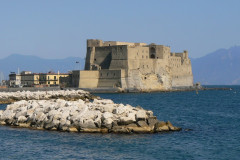
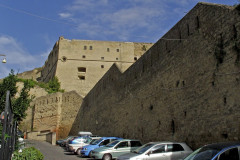
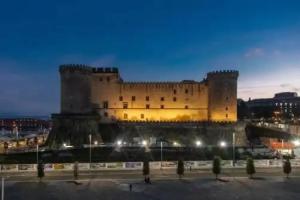
Castel Nuovo , often called Maschio Angioino (Italian: "Angevin Keep"), is a medieval castle located in front of Piazza Municipio and the city hall (Palazzo San Giacomo) in central Naples, Italy. Its scenic location and imposing size makes the castle, first erected in 1279, one of the main architectural landmarks of the city.
History
Before the accession of Charles I of Naples (Charles of Anjou) to the throne in 1266, the capital of the Kingdom of Naples was Palermo. There was a royal residence in Naples, at the Castel Capuano. However, when the capital was moved to Naples, Charles ordered a new castle, not far from the sea, built to house the court. Works, directed by French architects, began in 1279 and were completed three years later.
Due to the War of the Sicilian Vespers, the new fortress remained uninhabited until 1285, when Charles died and was succeeded by his son, Charles II. Castel Nuovo soon became the nucleus of the historical center of the city, and was often the site of famous events. For example, on December 13, 1294, Pope Celestine V resigned as pope in a hall of the castle. Eleven days later, Boniface VIII was elected pope here by the cardinal collegium and immediately moved to Rome to avoid the Angevin authority.
Under king Robert (reigned from 1309), the castle was enlarged and embellished, becoming a centre of patronage of art. In 1347 Castel Nuovo was sacked by the army of Louis I of Hungary, and had to be heavily restored after the return of queen Joanna I. The new works permitted the queen to resist the Hungarian siege during Louis' second expedition. The castle was besieged numerous times in the following years, and was the official residence of King Ladislaus from 1399. It decayed under his sister Joanna II.
Under the Aragonese dynasty, begun by Alfonso V in 1442, the fortress was updated to resist the new artillery. A famous triumphal arch, designed by Francesco Laurana, was added to the main gate to celebrate Alfonso's entrance in Naples. The decoration was executed by the sculptors Pere Johan and Guillem Sagrera, called by Alfonso from Catalonia.
In a hall of the castle the famous Barons conspiracy against King Ferdinand I, Alfonso's son, occurred. The King had invited the barons for a feast; but, at a certain point, he had the garrison close all the hall's doors and all the barons were arrested and later executed. The Barons' Hall was the seat of the Council of the commune of Naples until 2006.
After the fierce sack of Naples by Charles VIII of France's soldiers in 1494, the Kingdom was annexed by Spain, and the castle was reduced from residence to an important military fortress. It was the temporary residence of the Spanish kings during their visits in the city, such as that of Charles V in 1535. The castle was again used as a residence by Charles III and later on by Duke Stefano Di Conza. The last restoration of Castel Nuovo occurred in 1823.
Triumphal Arch
The imposing single-sided white marble triumphal arch, built in 1470, commemorates Alfonso of Aragon's entry to Naples in 1443. It stands between two western Towers of the Angevin castle. The overall design had been attributed to Pietro di Martina, a Milanese architect, or, according to Vasari, to Giuliano da Maiano. Modern authors attribute the design to Francesco Laurana.
It is 35 meters tall and has been elongated into two stacked arches. Some reports claim that the arches had originally been planned as two face to a free standing arch for the Piazza del Duomo, but that an officer in the service of Alfonso, Niccolo Bozzuto, whose house was to be razed to make room for the monument, induced the king to alter the site to the Castel Nuovo.
The flanking corinthian columns flank the entrance, but the first level sculpture depicts a triumphal quadriga leading Alfonso parading. The sculptors included Isaia da Pisa, Merliano, Domenico Gagini, Andrea Fiorentino, a pupil of Donatello, and Silvestro dell'Aquila. Sculptors from Aragon also contributed to the work. The center has a shield with the symbols of Aragon. The Frieze below reads: ALFONSVS REX HISPANVS SICULVS ITALICUS PIVS CLEMENS INVICTUS Above it reads: ALFONSVS REGUM PRINCEPS HANC CONDIDIT ARCEM
The second upper arch is surmounted by Lions and four niches with statues depicting the virtues of Alfonso. Above this is a rounded lintel with two genii with horns of plenty surmounted by Alfonso in attire of a warrior. This cornice was meant for an equestrian statue. The three statues of St Michael, St Anthony the Abbot, and St Sebastian, and the two recumbent ones, on the summit of the arch, are by Giovanni da Nola.
Passing under this arch we enter the piazza by the Bronze Gates, executed by the monk Guglielmo of Naples, and representing in various compartments the victories of Ferdinand I over the Duke of Anjou and the rebellious barons.
Street view
Reviews
They recently began offering English language tours and the tour I got from Enza was superb.
DON'T VISIT HERE. The collection of museum is really bad and you can't go watch tower also. Enterance fee is 6 euros. for what???
Don't bother looking for the toilets no toilet paper, no lavatory seat nothing to dry your hands and the ladies' had been out of service for so long the out of order sign was dirty and fading. Great however for taking photos of the port and Vesuvius.