Alanya

Description

Alanya , formerly Alaiye, is a beach resort city and a component district of Antalya Province on the southern coast of Turkey, in the country's Mediterranean Region, 138 kilometres (86 mi) east of the city of Antalya. As of Turkey's 2010 Census, the city had a population of 98,627, while the district that includes the city and its built-up region had an area of 1,598.51 km2 and 248,286 inhabitants.

Because of its natural strategic position on a small peninsula into the Mediterranean Sea below the Taurus Mountains, Alanya has been a local stronghold for many Mediterranean-based empires, including the Ptolemaic, Seleucid, Roman, Byzantine, and Ottoman Empires. Alanya's greatest political importance came in the Middle Ages, with the Seljuk Sultanate of Rûm under the rule of Alaeddin Kayqubad I, from whom the city derives its name. His building campaign resulted in many of the city's landmarks, such as the Kızıl Kule (Red Tower), Tersane (Shipyard), and Alanya Castle.

The Mediterranean climate, natural attractions, and historic heritage make Alanya a popular destination for tourism, and responsible for nine percent of Turkey's tourism sector and thirty percent of foreign purchases of real estate in Turkey. Tourism has risen since 1958 to become the dominant industry in the city, resulting in a corresponding increase in city population. Warm-weather sporting events and cultural festivals take place annually in Alanya. In 2014 Mayor Adem Murat Yücel, of the Nationalist Movement Party unseated Hasan Sipahioğlu, of the Justice and Development Party, who had previously led the city since 1999.

Names

The city has changed hands many times over the centuries, and its name has reflected this. Alanya was known in Latin as Coracesium or in Greek as Korakesion from the Luwian Korakassa meaning "point/protruding city". The Roman Catholic Church still recognizes the Latin name as a titular see in its hierarchy. Under the Byzantine Empire it become known as Kalonoros or Kalon Oros, meaning "beautiful/fine mountain" in Greek. The Seljuks renamed the city Alaiye (علائیه), a derivative of the Sultan Alaeddin Kayqubad I's name. In the 13th and 14th centuries, Italian traders called the city Candelore or Cardelloro. In his 1935 visit, Mustafa Kemal Atatürk finalized the name in the new alphabet as Alanya, changing the 'i' and 'e' in Alaiye, reportedly because of a misspelled telegram in 1933.

History

For more details on medieval beylik period, see Alaiye.

Finds in the nearby Karain Cave indicate occupation during the Paleolithic era as far back as 20,000 BC, and archeological evidence shows a port existed at Syedra, south of the modern city, during the Bronze Age around 3,000 BC. A Phoenician language tablet found in the district dates to 625 BC, and the city is specifically mentioned in the 4th-century BC Greek geography manuscript, the periplus of Pseudo-Scylax. The castle rock was likely inhabited under the Hittites and the Achaemenid Empire, and was first fortified in the Hellenistic period following the area's conquest by Alexander the Great. Alexander's successors left the area to one of the competing Macedonian generals, Ptolemy I Soter, after Alexander's death in 323 BC. His dynasty maintained loose control over the mainly Isaurian population, and the port became a popular refuge for Mediterranean pirates. The city resisted Antiochus III the Great of the neighboring Seleucid kingdom in 199 BC, but was loyal to the pirate Diodotus Tryphon when he seized the Seleucid crown from 142 to 138 BC. His rival Antiochus VII Sidetes completed work in 137 BC on a new castle and port, begun under Diodotus.

The Roman Republic fought Cilician pirates in 102 BC, when Marcus Antonius the Orator established a proconsulship in nearby Side, and in 78 BC under Servilius Vatia, who moved to control the Isaurian tribes. The period of piracy in Alanya finally ended after the city's incorporation into the Pamphylia province by Pompey in 67 BC, with the Battle of Korakesion fought in the city's harbor. Isaurian banditry remained an issue under the Romans, and the tribes revolted in the fourth and fifth centuries AD, with the largest rebellion being from 404 to 408.

With the spread of Christianity Coracesium, as it was called, became a bishopric. Its bishop Theodulus took part in the First Council of Constantinople in 381, Matidianus in the Council of Ephesus in 431, Obrimus in the Council of Chalcedon in 451, and Nicephorus (Nicetas) in the Third Council of Constantinople in 680. Coracesium was a suffragan of the metropolitan see of Side, the capital of the Roman province of Pamphylia Prima, to which Coracesium belonged. It continued to be mentioned in the Notitiae Episcopatuum as late as the 12th or 13th century. No longer a residential bishopric, Coracesium is today listed by the Catholic Church as a titular see.

Islam arrived in the 7th century with Arab raids, which led to the construction of new fortifications. The area fell from Byzantine control after the Battle of Manzikert in 1071 to tribes of Seljuk Turks, only to be returned in 1120 by John II Komnenos.

Following the Fourth Crusade's attack on the Byzantines, the Christian Armenian Kingdom of Cilicia periodically held the port, and it was from an Armenian, Kir Fard, that the Turks took lasting control in 1221 when the Anatolian Seljuk Sultan Alaeddin Kayqubad I captured it, assigning the former ruler, whose daughter he married, to the governance of the city of Akşehir. Seljuk rule saw the golden age of the city, and it can be considered the winter capital of their empire. Building projects, including the twin citadel, city walls, arsenal, and Kızıl Kule, made it an important seaport for western Mediterranean trade, particularly with Ayyubid Egypt and the Italian city-states. Alaeddin Kayqubad I also constructed numerous gardens and pavilions outside the walls, and many of his works can still be found in the city. These were likely financed by his own treasury and by the local emirs, and constructed by the contractor Abu 'Ali al-Kattani al-Halabi. Alaeddin Kayqubad I's son, Sultan Gıyaseddin Keyhüsrev II, continued the building campaign with a new cistern in 1240.

At the Battle of Köse Dağ in 1242, the Mongol hordes broke the Seljuk hegemony in Anatolia. Alanya was then subject to a series of invasions from Anatolian beyliks. Lusignans from Cyprus briefly overturned the then ruling Hamidid dynasty in 1371. The Karamanids sold the city in 1427 for 5,000 gold coins to the Mamluks of Egypt for a period before General Gedik Ahmed Pasha in 1471 incorporated it into the growing Ottoman Empire. The city was made a capital of a local sanjak in the eyalet of Içel. The Ottomans extended their rule in 1477 when they brought the main shipping trade, lumber, then mostly done by Venetians, under the government monopoly. On September 6, 1608, the city rebuffed a naval attack by the Order of Saint Stephen from the Republic of Venice.

Trade in the region was negatively impacted by the development of an oceanic route from Europe around Africa to India, and in the tax registers of the late sixteenth century, Alanya failed to qualify as an urban center. In 1571 the Ottomans designated the city as part of the newly conquered province of Cyprus. The conquest further diminished the economic importance of Alanya's port. Traveler Evliya Çelebi visited the city in 1671/1672, and wrote on the preservation of Alanya Castle, but also on the dilapidation of Alanya's suburbs. The city was reassigned in 1864 under Konya, and in 1868 under Antalya, as it is today. During the 18th and 19th centuries numerous villas were built in the city by Ottoman nobility, and civil construction continued under the local dynastic Karamanid authorities. Bandits again became common across Antalya Province in the mid-nineteenth century.

After World War I, Alanya was nominally partitioned in the 1917 Agreement of St.-Jean-de-Maurienne to Italy, before returning to the Turkish Republic in 1923 under the Treaty of Lausanne. Like others in this region, the city suffered heavily following the war and the population exchanges that heralded the Turkish Republic, when many of the city's Christians resettled in Nea Ionia, outside Athens. The Ottoman census of 1893 listed the number of Greeks in the city at 964 out of a total population of 37,914. Tourism in the region started among Turks who came to Alanya in the 1960s for the alleged healing properties of Damlataş Cave, and later the access provided by Antalya Airport in 1998 allowed the town to grow into an international resort. Strong population growth through the 1990s was a result of immigration to the city, and has driven a rapid modernization of the infrastructure.

Geography

Located on the Gulf of Antalya on the Anatolian coastal plain of Pamphylia, the town is situated between the Taurus Mountains to the north and the Mediterranean Sea, and is part of the Turkish riviera, occupying roughly 70 kilometres (43 mi) of coastline. From west to east, the Alanya district is bordered by the Manavgat district along the coast, the mountainous Gündoğmuş inland, Hadim and Taşkent in the Province of Konya, Sarıveliler in the Province of Karaman, and the coastal Gazipaşa district. Manavgat is home to the ancient cities of Side and Selge. East of the city, the Dim River flows from the mountains in Konya on a south-west route into the Mediterranean.

The Pamphylia plain between the sea and the mountains is an isolated example of an Eastern Mediterranean conifer-sclerophyllous-broadleaf forest, which include Lebanon Cedar, evergreen scrub, fig trees, and black pine. The Alanya Massif refers to the area of metamorphic rocks east of Antalya. This formation is divided into three nappes from lowest to highest, the Mahmutlar, the Sugözü, and the Yumrudağ. The similar lithology extends beneath the city in a tectonic window. Bauxite, an aluminum ore, is common to the area north of city, and can be mined.

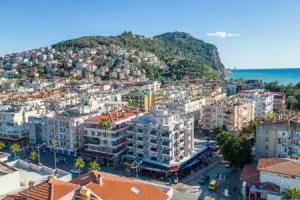
The town is divided east–west by a rocky peninsula, which is the distinctive feature of the city. The harbor, city center, and Keykubat Beach, named after the Sultan Kayqubad I, are on the east side of the peninsula. Damlataş Beach, named for the famous "dripping caves", and Kleopatra Beach are to the west. The name "Cleopatra" possibly derives from either the Ptolemaic princess' visit here or the area's inclusion in her dowry to Mark Antony. Atatürk Bulvarı, the main boulevard, runs parallel to the sea, and divides the southern, much more touristic side of Alanya from the northern, more indigenous side that extends north into the mountains. Çevre Yolu Caddesi, another major road, encircles the main town to the north.

Architecture

On the peninsula stands Alanya Castle, a Seljuk era citadel dating from 1226. Most major landmarks in the city are found inside and around the castle. The current castle was built over existing fortifications and served the double purpose of a palace of local government and as a defensive structure in case of attack. In 2007, the city began renovating various sections of the castle area, including adapting a Byzantine church for use as a Christian community center. Inside the castle is the Süleymaniye mosque and caravanserai, built by Suleiman the Magnificent. The old city walls surround much of the eastern peninsula, and can be walked. Inside the walls are numerous historic villas, well preserved examples of the classical period of Ottoman architecture, most built in the early 19th century.

The Kızıl Kule (Red Tower) is another well-known building in Alanya. The 108-foot (33 m) high brick building stands at the harbor below the castle, and contains the municipal ethnographic museum. Sultan Kayqubad I brought the accomplished architect Ebu Ali from Aleppo, Syria to Alanya to design the building. The last of Alanya Castle's 83 towers, the octagonal structure specifically protected the Tersane (dockyard), it remains one of the finest examples of medieval military architecture. The Tersane, a medieval drydock built by the Seljuk Turks in 1221, 187 by 131 feet (57 by 40 m), is divided into five vaulted bays with equilateral pointed arches. The Alara Castle and caravanserai near Manavgat, also built under Kayqubad's authority, has been converted into a museum and heritage center.

Atatürk's House and Museum, from his short stay in the city on February 18, 1935 is preserved in its historic state and is a good example of the interior of a traditional Ottoman villa, with artifacts from the 1930s. The house was built between 1880 and 1885 in the "karniyarik" (stuffed eggplant) style. Bright colors and red roofs are often mandated by neighborhood councils, and give the modern town a pastel glow. Housed in a 1967 Republican era building, The Alanya Museum is inland from Damlataşh Beach. With its rich architectural heritage, Alanya is a member of the Norwich-based European Association of Historic Towns and Regions. In 2009, city officials filed to include Alanya Castle and Tersane as UNESCO World Heritage Sites, and were named to the 2009 Tentative List.

Panorama from west side of peninsula

Education and health

Further information: Education in Turkey

The city has 95% literacy, with public and private schools, and a roughly 1:24 student-teacher ratio. Rural villages are, however, disadvantaged by the limited number of secondary schools outside the city center. Alantur Primary School, which opened in 1987, was built and is maintained under the Turkish "Build Your Own School" initiative, supported by the foundation of Ayhan Şahenk, the founder of Doğuş Holding.

In 2005, Akdeniz University of Antalya launched the Alanya Faculty of Business, as a satellite campus that focuses on the tourism industry. The school hosts an International Tourism Conference annually in coordination with Buckinghamshire New University. The city also has plans to open a private university in 2012. Georgetown University operates an annual study abroad program for American students known as the McGhee Center for Eastern Mediterranean Studies, named for the United States Ambassador to Turkey from 1952–53 George C. McGhee, and based in his villa. Başkent University Medical and Research Center of Alanya, a teaching hospital run by Başkent University in Ankara is one of nineteen hospitals in Alanya. Other major hospitals include the 300-bed Alanya State Hospital and the 90-bed Private Hayat Hospital.

Culture

Alanya's culture is a subculture of the larger Culture of Turkey. The city's seaside position is central to many annual festivals. These include the Tourism and Arts Festival, which marks the opening of the tourism season from at the end of May or beginning of June. At the opposite end of the season, the Alanya International Culture and Art Festival is held in the last week of May, and is a notable Turkish festival. Other regular festivals include the Alanya Jazz Days, which has been held since 2002 in September or October at the Kızıl Kule, which is otherwise home to the municipal ethnographic museum. The Jazz Festival hosts Turkish and international jazz musicians in a series of five free concerts.

The Alanya Chamber Orchestra, formed of members of the Antalya State Opera and Ballet, gave its inaugural performance on December 7, 2007. The International Alanya Stone Sculpture Symposium, begun is 2004, is held over the month of November. The Alanya Documentary Festival was launched in 2001 by the Alanya Cinémathèque Society and the Association of Documentary Filmmakers in Turkey. Onat Kutlar, Turkish poet and writer, and founder of the Istanbul International Film Festival was born in Alanya, as was actress Sema Önür.

Atatürk's visit to Alanya is also celebrated on its anniversary each February 18, centered on Atatürk's House and Museum. The Alanya Museum is home to archaeology found in and around the city, including a large bronze Hercules statue, ceramics, and Roman limestone ossuaries, as well as historic copies of the Qur'an. European residents of Alanya also often celebrate their national holidays, such as Norwegian Constitution Day, and the city set up a Christmas market in December 2010. Iranians also celebrate the Persian New Year, Nevruz, in Alanya.

Transportation

Further information: Transport in Turkey

The D 400 Highway, the Alanya–Mersin Route, connects Alanya from the east and west, encircling it, and linking through the city center via Atatürk Bulvarı. The D695, the Ankara–Akşehir Route, runs north–south and reaches the sea 41 kilometres (25 mi) west of the city near Side, connecting with the D400. Antalya Airport is 121 kilometres (75 mi) away and connects internationally. The new Antalya Gazipaşa Airport, first begun in 1992, is only 14.5 kilometres (9.0 mi) from the city, and was expected to have its first regular domestic flights on May 22, 2010, although international flights were not expected before the start of the 2011 tourist season. No train routes go to Alanya or Antalya Province, and there are no train stations in the district.

There are bus and dolmuş systems out of Alanya's two bus depots, but buses are usually limited to the major roads, and inside the city transportation is by car, taxi, or foot, as many roads in the old town are closed to vehicle traffic. The harbor includes cruise ship piers, and also seasonal ferries and hydrofoils depart for Kyrenia in the Turkish Republic of Northern Cyprus. Cruise ships docking at Alanya have increased 50% in 2013, with 53 estimated to have brought 56,000 passengers the end of the year. Further west of the city is the Alanya Marina, which started services in 2008 while still under construction, completing its expansion in 2010. The 85-km2 (33-sq-mi) marina allowed Alanya to participate in the 2008 Eastern Mediterranean Yacht Rally. The city is also investing in a community bicycle program with 150 bicycles and twenty terminals.

Street view

Reviews

Share your experiences, help others make the right choice!
Think about what you would like to know if you were looking for a review about a place to relax. Please describe in detail what you liked and what you didn't. What would you advise to other guests and to the hotel owner. The more fully you tell about the hotel, the easier it will be for other people to make a choice and they will be very grateful to you!

Map

X