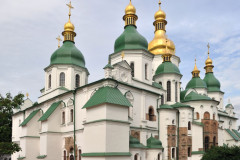
St Andrew's Church in Kiev
Description
The Saint Andrew's Church is a major Baroque church located in Kiev, the capital of Ukraine. The church was constructed in 1747–1754, to a design by the Italian architect Bartolomeo Rastrelli. It is sometimes incorrectly referred to as a cathedral. The church is part of the National Sanctuary "Sophia of Kiev" as a landmark of cultural heritage.
The Saint Andrew's Church overlooks the historic Podil neighborhood, situated on a steep hill to which the church gave its current name—Andriyivska Hill. It is currently one of four architectural landmarks of Ukraine, which were put down on the List of Mankind Treasures of Five Continents by the world society.
As the church sits atop a hill, foundation problems have been one of the main concerns of preservationists. More recently, the foundation below the church has started to shift, causing some concerns that the church's foundation might collapse. Cracks have already appeared in the foundation, and some of the church's falling decor has been found in neighboring areas.
Location
Saint Andrew's prophecy of Kiev depicted in the Radziwiłł Chronicle. A Church stands on the legendary location where St. Andrew erected his cross on Dnieper River's banks.Saint Andrew's Church was built in honor of Saint Andrew who is recognized as the "Apostle of Rus". According to the chronicle The Tale of Bygone Years, Saint Andrew came to the Dnieper (Dnipro) river's slopes in the 1st century AD and erected a cross on the current location of the church. He prophesied that the sparsely inhabited area would become a great city. As he predicted, the site arose to become the city of Kiev, a center of the Eastern Orthodox faith.
In 1086, the Grand Prince of Kiev Vsevolod I constructed a small church, dedicated to the erection of the cross by Saint Andrew. In 1215, Prince Mstyslav of Halych built the Church of the Exaltation of the Cross nearby. However, the church did not survive after the Mongol invasion of Kievan Rus' in 1240. From that point after, wooden churches were constructed in the place where the Church of the Exaltation of the Cross had been located, although, were too destroyed and again replaced with another one.
In 1690, a wooden church consecrated to Saint Andrew was moved from the Brethren's cloister in the Podil to the Andriyivska Hill. It too did not last long, only until 1725, when it was pulled down.
History
Construction
The current structure of the Saint Andrew's Church began when Russian Empress Elizabeth decided to construct a summer residence for herself in Kiev, consisting of a palace and a church. The palace was to be located in the Pechersk neighborhood while the church was to be on the Andriyivska Hill. The commencement of construction took place during an official ceremony on September 9, 1744 which consisted of the Empress laying the first three founding stones herself.
The Petersburg Building Chancellery first hired German architect Johann-Gottfried Schedel and engineer De Bocket to draft out the plans for the church. However, when Schedel presented his project in 1745, the Chancellery rejected it. He was replaced by head architect of the imperial court, Bartolomeo Rastrelli, who worked out a plan which was closely based on a church of a Saint Petersburg institute.
The construction itself was conducted by a team of Ukrainian, Russian, and foreign masters under the direction of architect Ivan Michurin, who was previously successful in replacing the older Church of the Resurrection, on the Women's Market Square (Babiy Torzhok) in Moscow. Michurin was responsible for carrying out all of the engineering and geological researches of the site and found out that a hard subsoil ground lies at a depth of 13–14 meters and above — made grounds penetrated by subterranean waters. With this information, Michurin developed the construction of a stone foundation and connected it with the two-storied building of the Priest's apartments, planned by Rastrelli.
I. Vlasiev and the Kiev Governor-General M. Leontev were placed in charge of hiring masons, carpenters, and carvers from territories now located in Belarus, Lithuania, and Ukraine. White and red bricks for the church were made at the brick fields of the Sophia, Pechersk, and Cyril cloisters. The foundation stone was delivered by the Kiev garrison soldiers from the neighboring towns of Rzhyshchiv and Bucha. The wood came from the nearby Pushcha-Vodytsia forests. Also, infantry regiments from Kiev, Chernihiv, Starodub, and Poltava were involved in the church's construction. Apart from workers from the neighboring villages, the Kiev Pechersk Lavra sent 50 of its best masons to work on the church.
Both the external and internal decoration on the church was carried out at the same time. Cast iron floor slabs were delivered from Moscow. Also, forms were made for the church's windows, doors, walls, and for space under the cupola. The planned iconostasis, designed by Rastrelli, was also added. The wood for the iconostasis, altar canopy, pulpit, and tsar's place were carved out in Saint Petersburg in order to consume time. The iconostasis' icons were carried out by Petersburg artists. For gilding, 1,028 slabs of gold were used in the interior.
The cast iron steps leading up to the church from the Andriyivskyy Descent.Although the exterior work was finished in 1754, interior work and decorations were not finished up until 1767. Alexei Antropov and Ivan Vishnyakov painted the church's icons, and the frescoes were done by Ukrainian masters I. Romenskyi and I. Chaikovskyi. A planned ramp that was to be installed to provide access to the church, was later changed to a wooden staircase due to the steepness of the hill. The wooden ramp was later (in 1844) changed to a cast iron one.
Restoration
As the Empress planned to take personal care of the church, the church has no parish, and there is no bell tower to call the congregation to divine service. But she died before the construction ended, so the church was never cared for by Elizabeth. After her death, the imperial court took no interest in the church, and the church was left without any funding. For some time, the church existed off of private and voluntary funds, from people such as Andrey Muravyov.
Later on, the church was handed down to the Kiev Council in 1768. The Kiev City Duma took control over the church, and later reorganized into the Kiev Council in 1785. In 1815, a strong storm tore off the church's cupolas. After the storm, the church was in need of a full restoration. In the next year, architect Andrey Melensky made a plan of the building's facade and sent them for consideration to Saint Petersburg. In 1825–1828, the Saint Andrew's Church was restored, based on Melensky's plans. The red mission tiles was replaced by metal, resulting in the fact that the cupolas lost some decor and changed their form.
Present use
From 1917 to 1953, many restorations were conducted on the foundations of the Saint Andrew's Church. In addition, the restoration of the church's facade, interior, and decor was also conducted. From the time of the church's opening until 1932, when the Soviet Council ordered that the church be closed down, regular services were held. In 1935, the St. Andrew's Church was included into the Historical and Cultural Conservation "All-Ukraine Museum Area." For some time after 1939, the Kiev Saint Sophia Anti-religious Museum was located within the premises of the church. During World War II, regular church services were restored, only to be closed down again in 1961.
From time to time, the church's stylobate was rented to different organizations up until 1992, when the stylobate was taken up by the Kiev Ecclesiastical Seminary of the Ukrainian Orthodox Church of the Kyivan Patriarchate. On January 10, 1968, the church was included into the State Architectural and Historical Conservation area "Saint Sophia Museum." On September 10 of the same year, the church was opened as a historical and architectural museum.
During the early 1960s, original plans of Rastrelli's baroque cupolas were uncovered in Vienna, Austria. In 1970, the St. Sophia Museum requested photocopies of the originals from the Albertina Museum located in Vienna. In 1978, restorers headed by architect V. Korneyeva restored the church's domes based on drawings by Bartolomeo Rastrelli. Since 1987, the church is included into the National Conservation area "Saint Sophia of Kyiv." Nowadays it is Cathedral of the Ukrainian Autocephalous Orthodox Church. On the 255th anniversary of the construction, the Ukrainian Presidential Administration transferred the ownership of the Saint Andrew's Church from the government to the Ukrainian Autocephalous Orthodox Church.
Architecture and preservation
The Saint Andrew's Church was constructed on a 15 meter foundation-stylobate, which from the eastern side faces downhill and from the western—has a two story construction. The church consists of a single dome and five small decorative spires. From the outside facade, Corinthian columns decorate the church, accompanied by additional decorations. The windows and doors of the church are decorated with ornamental details.
As the church sits atop a hill, foundation problems have been one of the main concerns of preservationists. More recently, the foundation below the church has started to shift, causing some concerns that the church's foundation might collapse. Cracks have already appeared in the church's foundation, resulting with the fact that a special committee was set up by the Minister of Emergency Situations Nestor Shufrich.
According to the Ministry of Emergency Situations, they will conduct research on the building's foundation and its construction with the help of Ministry of Construction, Kiev City Administration, and the division of the Ministry of Emergency Situations in Kiev City.
Video (1)
Street view
Reviews
The Pearl Of Kiev. Very beautiful cathedral, which was built in 1754. Located on the steep right Bank of the Dnieper river, the historic part of the city — Podol. It is situated near the Andriyivskyy descent, which connects two parts of the city. It has very beautiful view during the day and beautiful lighting at night.
(Pavel Egorov, Antler)
Its beauty pristine,
Tossing up over the cliffs up to the sky,
It's like a tower security
The facades of the temple rose.
A graceful manner, a front,
Worth looking at on the Dnieper.
Green, bright and elegant,
It is surrounded by a forest carpet.
I get the pleasure.
May they always enjoy it
Thanks to him, the decision
Often in Kiev to return.
Interesting fact - at the bottom is the exit of the underground passage, which leads from the government buildings of the center.