Sveti Sedmochislenitsi Church in Sofia
Description
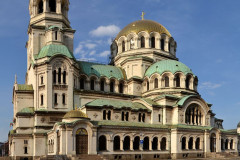
The Sveti Sedmochislenitsi Church is a Bulgarian Orthodox church in Sofia, the capital of Bulgaria. It was created between 1901 and 1902 through the conversion of an abandoned Ottoman mosque, and was inaugurated on 27 July 1903. The church is named after Cyril and Methodius and their five disciples, known in the Orthodox Church collectively as the Sedmochislenitsi.
The so-called Black Mosque (Bulgarian: Черна джамия, Cherna dzhamiya; Turkish: Kara Camii) was built in 1528 on the order of Suleiman the Magnificent with the intention to be more impressive and beautiful than the Christian churches in the city. The mosque is popularly attributed to the famous Ottoman architect Mimar Sinan, although this is uncertain. It was constructed at the place of a former nunnery of the Rila Monastery and an Early Christian temple from the 4th-5th century, the ruins of which were excavated in 1901. An even older construction, a pagan temple of Asclepius from Roman Serdica, was also discovered in the mosque's foundations.
The 25 m-long mosque had a square shape and a large lead-covered dome. The mosque was initially known as the Koca Mehmed Pasha Mosque after Mehmed-paša Sokolović. Another name was the İmaret Mosque after the imaret, a kitchen for the poor located in the vicinity, the ruins of which were found in 1912. A madrasah, a Muslim religious school, was located in what is now the small garden between the modern church and the Count Ignatiev School. The madrasah was later used as a prison after the Liberation of Bulgaria. Other Ottoman constructions nearby included a caravanserai and a hammam.
The mosque received its more popular name, the Black Mosque, after the dark granite from which its minaret was made. The minaret collapsed during an earthquake in the 19th century and the mosque was abandoned by the Ottomans after the Liberation of Bulgaria in 1878 to become used as a military warehouse and prison.
The architect who suggested the conversion of the once Ottoman mosque into a Christian church was the Russian Alexander Pomerantsev, responsible for the Upper Trade Rows on Red Square, among other buildings. The Bulgarian architects Yordan Milanov and Petko Momchilov designed the dome, the narthex and the bell tower in a traditional Bulgarian style, inspired by the movement of Romanticism. Only the central hall and the dome of the former mosque were preserved, with four oval bays, a narthex and an altar section being added.
The construction works took a year, between 27 May 1901 and 6 May 1902, but the complete inner decoration did not finish until 1996. Young artists painted the icons and among the first donors were Tsar Ferdinand (recognized as the primary church donor in 1905) and Ivan Evstratiev Geshov. Famous Bulgarian statesman Petko Karavelov also contributed significantly to the church's construction and was buried nearby in January 1903.
The large candlesticks in front of the altar were cast in 1903 from obsolete police badges from Eastern Rumelia and the Principality of Bulgaria (i.e. before the Unification in 1885). An electric clock, still in use, was created by the noted watchmaker Georgi Hadzhinikolov and fit to the western façade in the 1930s. The small garden and the square close to the church were also built in the period.
In the grounds of the Sveti Sedmochislenitsi is buried alongside his wife Petko Stoichev Karavelov (Bulgarian: Петко Каравелов) (24 March 1843 – 24 January 1903) a leading Bulgarian liberal politician, who served as Prime Minister on four occasions.
Street view
Reviews
Sveti sedmochislenits the park, which has the same name as the church, the business alive all day and night for locals and a nice resting place.
It is about 10 minutes' walk away, in the middle of 'Vasil Levski Metro Station' and 'Sofia University metro station' for those going by public transport
The most important architect in the history of the Ottoman Empire, the mosque of Suleyman by mimar Sinan 600 years ago (Black Cami)made an awesome creation. Ended the reign of the Ottoman Empire in the region after it was converted into a church.
The church is located inside the park during the day and night until sedmochislenits the same name where the locals live and Sveti nice for a recreation area.
Toplutas for they shall go with me, 'Vasil Levski Metro Station' and 'Sofia University almost in the middle at an equal distance from the subway station and walk about 10 minutes