
Kaliningrad region
Description
Kaliningrad Oblast is a federal subject of Russia (an oblast), on the Baltic coast. It is an exclave, with no land connection to the rest of Russia. As of the 2010 Census, it had a population of 941,873.
Kaliningrad Oblast lies in the northern part of historical East Prussia (German: Nord-Ostpreußen). It was once inhabited by the Sambians (speakers of the old Baltic language). They became extinct around 17th century, after they were conquered by the Teutonic Knights and exposed to assimilation and Germanization. Then it was a part of the Prussian state and of Germany until 1945. That year, it was conquered by the Soviet Union and annexed into it under border changes promulgated in the Potsdam Agreement, when it was attached to the Russian Soviet Federative Socialist Republic. Most of its German population were killed or fled westward to what would become West and East Germany during the last months of the war. Others were expelled between 1944 and 1950. Russian settlers inhabited the land, and have been the majority ethnic group since.
The oblast forms the westernmost part of Russia. Surrounded by Poland to the south, Lithuania to the east and north, and the Baltic Sea to the west, Kaliningrad Oblast has no land connection to the rest of Russia. Since its creation after World War II, it has been a Russian exclave, first of the Russian SFSR and then of the Russian Federation. The fall of the Soviet Union, and Poland and Lithuania's subsequent joining the European Union and NATO as well as their entering the Schengen Zone has left Kaliningrad increasingly isolated from the rest of Russia. Visa-free travel to the main part of Russia is only possible by sea or air.
The oblast's largest city and administrative center is Kaliningrad (formerly Königsberg), which has historical significance as both a major city of the historical state of Prussia and the capital of the former German province of East Prussia. After World War II, East Prussia was divided between the USSR and Poland, and Königsberg was renamed after the Soviet head of state Mikhail Kalinin.
Currently, Kaliningrad Oblast is one of Russia's best performing regional economies, bolstered by a low manufacturing tax rate as set by its "Special Economic Zone" (SEZ) status, which was issued by Moscow. As of 2006, one in three televisions in Russia are made in Kaliningrad. The territory's population is one of the few in Russia that is expected to show strong growth during the early 21st century.
Geography
Map of Kaliningrad Oblast Angrapa River, Kaliningrad Oblast
Kaliningrad Oblast is an exclave of Russia surrounded by Poland, Lithuania and the Baltic Sea. Its largest river is the Pregolya. It starts as a confluence of the Instruch and the Angrapa and drains into the Baltic Sea through Vistula Lagoon. Its length under the name of Pregolya is 123 km (76 mi), 292 km (181 mi), including the Angrapa.
Notable geographical features include:
- Curonian Lagoon (shared with Lithuania)
- Vistula Lagoon (shared with Poland)
History
Königsberg Cathedral
Beginnings
The territory of what is now Kaliningrad Oblast was inhabited during the Middle Ages by tribes of Old Prussians (Sambians) in the western part and Lithuanians in the eastern part, divided by the Pregolya and Alna Rivers. The Teutonic Knights conquered the region and established a monastic state. On the foundations of a destroyed Prussian settlement known as Tvanksta, the Order founded the major city of Königsberg (modern Kaliningrad).
East Prussia
Germans resettled the territory and assimilated the indigenous Old Prussians. The Lithuanian-inhabited areas became known as Lithuania Minor. In 1525, Grand Master Albert of Brandenburg secularized the Prussian branch of the Teutonic Order and established himself as the sovereign of the Duchy of Prussia, a Polish fief, later inherited by the Margravate of Brandenburg. Through the periods of Germanization and colonization over the following centuries, German culture became dominant and native Sambians became extinct in the 17th century.
Königsberg was the original capital of Prussia from 1525 until 1701, but as Prussia grew westward, the position of the capital became too peripheral and Berlin became the new Prussian capital city. During the Seven Years' War it was occupied by the Russian Empire. The region was reorganized into the Province of East Prussia within the Kingdom of Prussia in 1773.
German culture and Germanization
East Prussia was an important center of German culture. Many important figures, such as Immanuel Kant and E. T. A. Hoffmann, came from this region. The cities of Kaliningrad Oblast, despite being heavily damaged during World War II and thereafter, still contain some typical German architecture, in styles such as the Jugendstil, showcasing the rich German history and cultural importance of the area. The Lithuanian-speaking community in East Prussia declined due to organic Germanization and cultural assimilation. By the early 20th century Lithuanians made up a majority only in rural parts of the far northeast corner of East Prussia (Memelland and Lithuania Minor). A similar fate befell the Latvian-speaking Kursenieki who had settled the coast of East Prussia between Gdańsk and Klaipėda. The rest of the area, with the exception of the Slavic Masurians in southern Prussia, was overwhelmingly German-speaking.
The Memel Territory (Klaipėda region), formerly part of northeastern East Prussia as well as Lithuania Minor, was annexed by Lithuania in 1923. In 1938, Nazi Germany radically altered about a third of the place names of this area, replacing names of Old Prussian or Lithuanian origin with newly invented German names. Slavic and Jewish populations under Nazi Germany were classified as subhuman and were the target of a campaign of genocide by the German state, with the eventual goal of their extermination.
-
Historical Lithuania Minor comprises a sizeable part of Prussia that is now the Kaliningrad Oblast.
-
In 1649 settlement of the Latvian-speaking Kursenieki spanned from Klaipėda to Gdańsk. Much of this population was Germanized by the onset of World War II.
-
The former East Prussian town of Cranz as it looked ca. 1900. It is now the resort town of Zelenogradsk. Before 1945, it was a famous destination for German artists and intelligentsia.
Soviet Union
Entry of the Red Army
On August 29, 1944, during World War II, Soviet troops reached the border of East Prussia. In January 1945, the Red Army overran all of East Prussia except for the area around Königsberg. Many inhabitants fled west at this time. During the last days of the war, over two million of them were evacuated by sea. The remaining population of some 300,000 Germans was condemned to forced labor.
Potsdam
At the end of the War in 1945, the city became part of the Soviet Union pending the final determination of territorial questions at the peace settlement (as part of the Russian SFSR) as agreed upon by the Allies at the Potsdam Conference:
VI. CITY OF KÖNIGSBERG AND THE ADJACENT AREA
The Conference examined a proposal by the Soviet Government that pending the final determination of territorial questions at the peace settlement the section of the western frontier of the Union of Soviet Socialist Republics which is adjacent to the Baltic Sea should pass from a point on the eastern shore of the Bay of Danzig to the east, north of Braunsberg and Goldap, to the meeting point of the frontiers of Lithuania, the Polish Republic and East Prussia.
The Conference has agreed in principle to the proposal of the Soviet Government concerning the ultimate transfer to the Soviet Union of the city of Koenigsberg and the area adjacent to it as described above, subject to expert examination of the actual frontier.
The President of the United States and the Prime Minister of the United Kingdom have declared that they will support the proposal of the Conference at the forthcoming peace settlement.
Kaliningrad Ruins of Königsberg Castle in the 1950s
Königsberg was renamed Kaliningrad in 1946 after the death of Chairman of the Presidium of the Supreme Soviet of the USSR Mikhail Kalinin, one of the original Bolsheviks. The survivors of the German population were expelled, and the city was repopulated with Soviet citizens, mostly Russians but to a lesser extent by Ukrainians and Belarusians. The German language was replaced with the Russian language.
About 200,000 survivors of the Prussian population were deported to Germany at the end of 1947 and the beginning of 1948. In 1950, there were 1,165,000 inhabitants, which was only half the number of the pre-war population.
The city was rebuilt, and during the Cold War the Kaliningrad Oblast, as the westernmost territory of the Soviet Union, became a strategically important area. The Soviet Baltic Fleet had its headquarters in Kaliningrad during the 1950s. Because of its strategic importance, the city was closed to foreign visitors.
In 1957, an agreement was signed and later came into force which delimited the border between Poland and the Soviet Union.
Incorporation into the Russian SFSR
According to some accounts from the 1950s and 1960s, immediately after the Second World War the Soviet government had planned to make the rest of the area a part of the Lithuanian SSR, as a substantial portion of the oblast consists of Lithuania Minor. The area was administered by the planning committee of the LSSR, although it had its own Communist Party committee. However, the leadership of the Lithuanian SSR (especially Antanas Sniečkus) refused to take the territory, mainly because of its devastation during the war. Some modern nationalistic Lithuanian authors say that the reason for the refusal was the Lithuanians' concern that there might be as many Russians as Lithuanians within the Lithuanian SSR. Instead, the region was added as an exclave to the Russian SFSR and since 1946 it has been known as the Kaliningrad Oblast. According to some historians, Stalin created it as an oblast separate from the LSSR because it further separated the Baltic states from the West. Names of the cities, towns, rivers and other geographical features were changed to newly created Russian names.
Russian Federation
Isolation The Cathedral of Christ the Saviour in Kaliningrad is the largest church of Kaliningrad Oblast. The Russian Orthodox cathedral is 70 meters high, and it is the dominant building of the inner city on Ploshchad Pobedy. The Cathedral of Christ the Saviour in Kaliningrad. The church's architect is Oleg Kopylov, and was completed in September 2006.
Kaliningrad Oblast is an exclave, geographically separated from the rest of Russia. This isolation was enhanced by the collapse of the Soviet Union in 1991 when Lithuania became an independent country and even more when both Poland and Lithuania became members of NATO and subsequently the European Union in 2004. Since the dissolution of the Soviet Union and the independence of the Baltic states, Kaliningrad Oblast has been separated from the rest of Russia by other countries instead of by other Soviet republics. Neighboring nations imposed strict border controls when they joined the European Union. All military and civilian land links between the region and the rest of Russia have to pass through members of NATO and the EU. Russian proposals for visa-free travel between the EU and Kaliningrad have so far been rejected by the EU. Travel arrangements, based on the Facilitated Transit Document (FTD) and Facilitated Rail Transit Document (FRTD). have been made.
The territory's economic situation was badly affected by its geographic isolation and the significant reduction in the size of the Russian military garrison, which had previously been one of the major employers and helped the local economy.
Ethnic rebirth
After 1991, some ethnic Germans began to return to the area, such as Volga Germans from other parts of Russia and Kazakhstan, especially after Germany raised the requirements for people from the former Soviet Union to be accepted as ethnic Germans and have a "right of return." A similar migration by Poles from the lands of the former Soviet Union to the Kaliningrad Oblast occurred at this time as well.
Recently, the situation has begun to change, albeit slowly. Germany, Lithuania, and Poland have renewed contact with Kaliningrad Oblast, through town twinning and other projects. This has helped to promote interest in the history and culture of the East Prussian and Lietuvininkai communities.
21st century
In July 2005, the 750-year jubilee of the city was widely celebrated.
Kaliningrad is the only Russian Baltic Sea port that is ice-free all year round and hence plays an important role in maintenance of the Baltic Fleet.
In July 2007, Russian First Deputy Prime Minister Sergei Ivanov declared that if US-controlled missile defense systems were deployed in Poland, then nuclear weapons might be deployed in Kaliningrad. On November 5, 2008, Russian leader Dmitry Medvedev said that installing missiles in Kaliningrad was almost a certainty. These plans were suspended, however, in January 2009. However, during late 2011, a long range Voronezh-DM radar Voronezh radar was commissioned to monitor missile launches within about 6,000 km. It is situated in the settlement of Pionersky (formerly German Neukuhren) in Kaliningrad Oblast.
Religion
Religious Views in Kaliningrad Oblast (2012)
Spiritual but not religious (34%) Russian Orthodox (30.9%) Atheist (22%) Other and non-religious (11.1%) Unaffiliated Christian (1%) Roman Catholic (1%)
According to a 2012 official survey 34% of the population of Kaliningrad Oblast declare themselves to be "spiritual but not religious", 30.9% adhere to the Russian Orthodox Church, 22% are atheist and 11.1% follow other religions or did not give an answer to the question, 1% are unaffiliated generic Christians and 1% adhere to the Catholic Church.
Until 1945, the region was overwhelmingly Lutheran, with a small number of Catholics and Jews.
Economy
Kaliningrad Oblast's economy is positively influenced by several factors, such as ice-free ports, the world's largest amber deposits and proximity to European countries. The region also has a developed tourist infrastructure, unique museums and monuments, and tourist attractions. One of these is the famous Curonian Spit.
To combat the oblast's economic problems such as high unemployment, in 1996 the Russian authorities granted Kaliningrad special economic status and tax advantages intended to attract investors. The oblast's economy has since benefited substantially and in recent years experienced a boom. A US$45 million airport terminal has been opened and the European Commission provides funds for business projects under its special program for the region. The oblast has begun to see increasing trade with the countries of the EU as well as increasing economic growth and rising industrial output.
According to official statistics, the Gross Regional Product in 2006 was 115 billion roubles. GRP per capita in 2007 was 155,669 roubles.
Industry
Car and truck assembly (GM, BMW, Kia, Yuejin), and production of auto parts, are major industries in Kaliningrad Oblast. There are shipbuilding facilities in Kaliningrad and Sovetsk. Food processing is a mature industry in the region. OKB Fakel, a world leader in the field of Hall thruster development, as well as a leading Russian developer and manufacturer of electric propulsion systems, is based in Neman. The company employs 960 people. General Satellite (GS) is the biggest employer in Gusev city producing satellite receivers, cardboard packaging, nanomaterials etc.
Natural resources
Kaliningrad Oblast possesses more than 90% of the world's amber deposits. Most of the mined amber is processed outside the region, in Russia and in other countries.
There are small oil reservoirs beneath the Baltic Sea not far from Kaliningrad's shore. Small-scale offshore exploration started in 2004 and some Baltic countries (Poland and Lithuania), as well as local NGOs, voiced concerns regarding possible environmental impact.
Fishing
Fishing is an important regional industry, with big fishing ports in Kaliningrad and Pionersky (formerly Neukuhren) and smaller ones in Svetly and Rybachy.
Towns
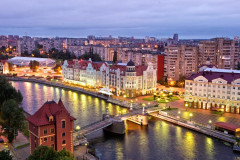

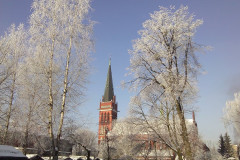
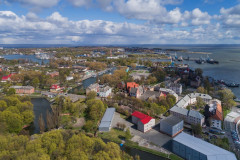
All accomodation types
Hotels
 from 19 USDBanya u Shumka Hotel
 from 28 USDAgata Hotel
 High ratingfrom 34 USD"Chernyahovsk" Hotel
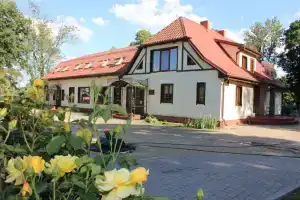 from 36 USDGuesthouse Waldhauzen
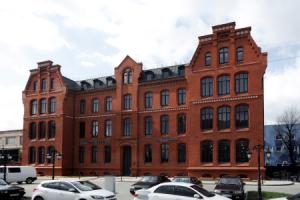 from 77 USD"Frants Lefort" Hotel
