Provence-Alpes-Cote d'Azur
Description
Provence-Alpes-Côte d'Azur or PACA is one of the 18 administrative regions of France. Its capital is Marseille.
The region is roughly coterminous with the former French province of Provence, with the addition of the following adjacent areas:
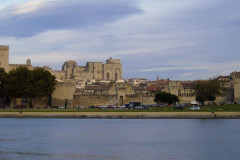
- the former papal territory of Avignon, known as Comtat Venaissin;
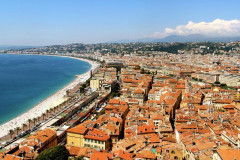
- the former Sardinian-Piedmontese county of Nice, whose coastline is known in English as the French Riviera, and in French as the Côte d'Azur; and
- the southeastern part of the former French province of Dauphiné, in the French Alps.
It encompasses six departments in south-eastern France, bounded to the east by the Italian border, to the south by the Mediterranean Sea and by the principality of Monaco, to the north by Auvergne-Rhône-Alpes, and to the west by Occitanie, with the Rhône river marking its westernmost border. The six departments are:
- Alpes-de-Haute-Provence
- Alpes-Maritimes
- Bouches-du-Rhône
- Hautes-Alpes
- Var
- Vaucluse
The region logo displays the coat of arms created in the 1990s and which combines the coats of arms of the old provinces making up Provence-Alpes-Côte d'Azur.
Economically the region is the third most important in France, just behind Île-de-France and Rhône-Alpes. Its GDP in 2012 was €142.4 billion ($US 183.1 billion) and per capita GDP was €28,861 ($US 37,121).
Geography
This region has a total area of 31,400 km2. It has a wide variety of landscapes, from the Alps mountains to plains and coastal areas like Nice and Marseille, which form the majority of the land area. The region has a Mediterranean coastline, on which the majority of its population lives. It borders Italy (Liguria and Piedmont) to the east, Monaco (Fontvieille, La Colle, La Rousse, Larvotto, Les Moneghetti, Les Révoires, Saint Michel) in the south-east, and the French regions of Auvergne-Rhone-Alpes to the north and Occitanie to the west. The Rhone, Var and Arc rivers run through the region. The borders were untouched by the 2016 re-organization of the French Regions.
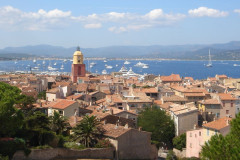
This region is very famous for the Côte d'Azur (French Riviera), which spans the glamorous cities of Nice, Cannes and Saint-Tropez.
Regional government and politics
The Regional Council is the legislative body of the region. The President of the regional council is Christian Estrosi (LR) from 2015.
Transportation
Motorways
The region is in the center of a complex and dense motorways network, in the heart of mediterranean coast. Motorways are operated by ASF, ESCOTA, SMTC, MPM (Marseille Metropolis) and DIR Med (State). In PACA, motorways have the particularity to serve the city centers of big towns, unlike other big cities of France.
- A7 - Autoroute du Soleil "Motorway of the Sun" links the region to the North of France. This motorway starts in downtown Marseille at Porte d'Aix. The way grow to Septèmes Valleys to be connected with A51. After a junction with A55 and connectors highways A517, A551 and A552, the motorway crosses Vitrolles in 2x2x2 lines. It desserves the Marseille Provence Airport and the Aix en Provence TGV high speed train station. After 10 kilometers, the Berre-l'Etang petrochimic complex with a junction with D8 highway and arrives at the A7/A8 junction in La Fare les Oliviers. After the tool of Lançon-Provence, the road is linked with the A54 motorway in Salon de Provence. The motorway continue along Rhône and Durance to Avignon and Orange until Lyons.
- A8 - La Provençale, crosses the region from west to east to Italy. This motorway starts from the A7 at La Fare les Oliviers. The first part of free-road starts and cross Aix-en-Provence to be linked with A51 and N296 motorways. After the Palette Valley, the motorway arrives to the La Barque tool and the junction with the A52 to Aubagne, Marseilles-East, and Toulon. Crossing the Var department with the A8/A57 junction at Le Luc en Provence, the A8 gets a mountain profile to cross the French Riviera : Cannes, Antibes, Nice. A connection is made with A500 motorway at La Turbie to serves the Principauty of Monaco. After Menton, the motorway cross the Italian border until Genoa.
- A50 - This motorway connects the east of Marseilles after the Prado-Carénage tooltunnel to Toulon. After crossing the Huveaune Valley and the South of Aubagne, the motorway goes near the coast to Toulon city center. The motorway crosses the city with a tunnel until the A57. It is a suburban motorway
- A51 - Autoroute du Val de Durance "Motorway of the Durance Valley". The motorway starts with the A7/A51/A517 junction in the north of Marseilles between Plan de Campagne and Septèmes Valleys. 20 kilometers after, the motorway stops at the A8/A516/A51/N296 junction in Southern Aix en Provence. At Aix North, the motorway restarts and goes to rural South Alps after Manosque. It ends near Tallard, at 20 km south from Gap.
- A52 - Grand Contournement de Marseille "Marseilles Bypass". The motorway starts at the A8/A52 junction in the Aix Est (La Barque). It is a mountain 2x2 motorway built at 20 km around Marseilles. After the A52/A520 junction and Pont de l'Etoile, it ends at Aubagne, connected with A501 and A50.
- A54 - Autoroute de la Crau "Crau's Motorway'. This motorway starts at the A7/A54 junction at Salon East and the crossing of Salon de Provence with 4 exits, the motorway arrives at the Crau Plain. It ends at the N569/A54 junction in Saint Martin de Crau. It re-begins at Arles West to Nîmes, Montpellier and Barcelona.
- A55 - Autoroute du Littoral "Coastal Motorway". This motorway starts at Port de Bouc. After the Martigues bridge, the motorway passes at the south of the Berre pond in the Estaque Mountains After the A7/A55/A551/A552 junction at Les Pennes-Mirabeau, it crosses the mountains and arrives at Marseille (Estaque district). After the junction of Grand Littoral, the way crosses the new Euroméditerranée Central Business District with a long bridge of 7 km. Cars enters in the Joliette tunnel, continued by the Vieux-Port tunnel under the sea, and the Prado-Carénage tooltunnel. These three tunnels crosses the Marseilles city center. A55 is connected with A50.
- A57 - Autoroute des Maures "Arabic motorway". This motorways starts at A50/A57 junction after the Toulon tunnel. After the A57/1570 junction at La Valette du Var, the motorway continues along the plain of Maures to Cuers and Le Luc to be link with the A8.
- A500 - Tunnel de Monaco "Monaco Tunnel". This motorway starts at La Turbie (A8) at the West Monaco. The A8 goes over Monaco but A500 goes in Monaco with a 5 km tunnel to the principality.
- A501 - Aubagne bypass, connects A50 to A52.
- A502 - Garlaban motorway. This little motorway connects the A50 from Aubagne to Aubagne East to the Garlaban mountains.
- A515 - Junction from A51 to Gardanne.
- A516 - L'Aixoise. This motorway connects the A51 southern East Junction to Aix city center.
- A517 - Convergent de Septèmes-les-Vallons "Convergent of Septemes Valleys". Link between A7 and 51
- A520 - Autoroute de la Sainte Baume "Ste. Baume motorway". This motorway starts from A52 at Pont de l'Etoile and ends at Auriol East to be connected with N560 to the Sambuc pass and Saint Maximin la Sainte Baume
- A570 - Autoroute de la Côte "Motorway of the Coast". Link between A57 and Hyères. The national road N97 continues after to Saint Tropez
- N113 - Highway in Vitrolles along the A7. Highway of the Crau Plain between Saint Martin de Cray (A54) to Arles West (A54)
- N296 - Aix en Provence bypass.
- N569 - access of Fos-Marseilles Port.
- D6 - highway of Arc Valley from A515 to Rousset-Peynier Technologies center.
- D8 - access of Petrochimical area of Berre.
- D9 - Link between Marseille Provence Airport, Aix TGV high speed train station, the Arbois desert, the Europolis and Aix en Provence.
Trains
High speed servicesThe region is served by 13 high speed trains stations and one more in the Principality of Monaco. Two stations are situated on the HSL LGV Méditerranée opened in 2001: Avignon TGV and Aix en Provence TGV. The others stations served by high speed services are Avignon Centre, Arles, Miramas, Marseille Saint Charles, Toulon, Les Arcs-Draguignan, Saint Raphaël Valescure, Cannes, Antibes, Nice-Ville and Menton.
Services operated by SNCF TGV :
- Paris GDL <> Avignon Centre / Miramas
- Paris GDL <> Marseille <> Toulon <> Nice <> Monaco <> Ventimiglia (Italy)
- Nantes / Rennes <> Marseille
- Strasbourg <> Marseille
- Lille <> Marseille
- Nancy / Metz / Dijon <> Marseille / Nice
- Le Havre <> Marseille
Services operated by SNCF Ouigo :
- Marne la Vallée <> Marseille
- Lyons Perrache <> Marseille
Services operated by SNCB/NMBS TGV :
- Bruxelles Midi/Brussel Zuid (Belgium) <> Marseille <> Nice
Services operated by CFF Lyria :
- Genève (Switzerland) <> Marseille <> Nice
Services operated by DB Alleo :
- Frankfurt am Main (Germany) <> Marseille
Services operated by Renfe AVE :
- Madrid-Atocha (Spain) <> Barcelona (Spain) <> Marseille
Services operated by Eurostar :
- London Saint Pancras Int. (UK) <> Ashford (UK) <> Marseille
Services operated by Thalys (seasonal):
- Amsterdam (Netherlands) <> Brussels (Belgium) <> Marseille
Despite the importance of the region in the national economy and demography, the national services on conventional network are not very high due to the fact of the saturations of the tracks with high speed and regional trains.
Services operated by SNCF Intercités :
- Bordeaux Saint Jean <> Toulouse <> Montpellier <> Marseille Saint Charles <> (Nice)
- Paris Austerlitz <> Marseille Blancarde <> Nice (night train)
- Paris Austerlitz <> Gap <> Briançon (night train)
Services operated by Thello Eurocity :
- Marseille Saint Charles <> Nice <> Monaco <> Ventimiglia <> Genoa <> Milano Centrale (Italy)
All regional trains services are operated by SNCF TER Provence-Alpes Côte d'Azur, except between Nice and Digne-les-Bains, operated by CP, the own-region company. The Regional Council of Provence-Alpes Côte d'Azur is the transport authority and defines the services in all region. An attractive fare permits to transport more than 100,000 passengers every day in 750 trains. In all relations, trains are lilting every 15, 20,30, 60 or 120 minutes with long interruption during 10am and 12am.
With only one big line, the tracks are saturated causing delays or cancellations. The region has to rent other trains from other regions to respond at the offer. In 2016, during the second Council of the Year at the Region Hall in Marseille, in front of politics and the new president of the Regional Council of Provence-Alpes Côte d'Azur, the SNCF CEO, Guillaume Pepy, has announced the impossibility of the company to respond to the demand. The Saint Charles station, the Marseille's main railway station can't support more than 23 trains an hour and the tracks are too old and not enough to accept an average of the capacity.
The project of new line LN Provence Alpes Côte d'Azur in 2030 could permit to increase trains on tracks with a new crossing of Marseille with a tunnel. Two new stations will be created in the territory of the city and a new line between Cannes and Nice Airport.
Services operated by CP :
- Nice CP <> Colomars <> Plan du Var
- Nice CP <> Digne les Bains
Services operated by SNCF are declined with two appellations unlike other regions : TER, normally suburban trains and Intervilles, long-distance regional trains. :
Services operated by SNCF Intervilles :
- Marseille Saint Charles <> Toulon <> Nice <> Monaco
- Marseille Saint Charles <> Gap <> Briançon
- Marseille Saint Charles <> Avignon <> Lyon Part Dieu
- Marseille Saint Charles <> Montpellier <> Narbonne <> Perpignan
- Briançon <> Gap <> Valence TGV <> Valence Ville <> Romans sur Isère
- Avignon Centre <> Montpellier <> Narbonne <> Perpignan
Services operated by SNCF TER :
- Marseille Saint Charles <> Marseille Euroméditerranée <> Port de Bouc <> Miramas
- Marseille Saint Charles <> Vitrolles MP Airport <> Miramas <> Avignon Centre
- Marseille Saint Charles <> Vitrolles MP Airport <> Miramas <> Nîmes <> Montpellier Saint Roch
- Marseille Saint Charles <> Marseille Euroméditerranée <> Vitrolles MP Airport <> Salon <> Avignon Centre <> Avignon TGV
- Marseille Saint Charles <> Saint Antoine <> Aix en Provence <> Pertuis
- Marseille Saint Charles <> Saint Antoine <> Aix en Provence <> Sisteron
- Marseille Saint Charles <> Marseille Blancarde <> Aubagne
- Marseille Saint Charles <> Marseille Blancarde <> Aubagne <> Toulon <> Hyères
- Marseille Saint Charles <> Marseille Blancarde <> Aubagne <> Toulon <> Les Arcs-Draguignan
- Avignon Centre <> Valence <> Lyon Perrache
- Avignon Centre <> Nîmes <> Montpellier <> Narbonne <> Perpignan
- Avignon TGV <> Avignon Centre <> Carpentras
- Les Arcs Draguignan <> Cannes <> Nice <> Monaco <> Menton
- Grasse <> Cannes <> Nice <> Monaco <> Menton <> Ventimiglia (Italy)
- Nice Ville <> Breil sur Roya <> Cuneo (Italy)
- Briançon <> Gap <> Grenoble
Environmental pollution
The mining company Alteo processes bauxite to produce aluminium, resulting in various waste materials such as "boues rouges" (red mud) and arsenic. The dumping of this waste in the marine reserve of Parc National des Calanques (National Park of Marseilles' Creeks) for 6 years has been authorized by the French government in 2015. Company representatives have dismissed environmental concerns as exaggerated and uninformed.
Due to car-traffic, all the urban areas are saturated every day.
In July 2016, during Bastille Day Celebrations in Nice, a terrorist drove a truck through crowds of people at the Promenade des Anglais; He killed many people before police finally stopped him. Many people[quantify] were killed in the attack, with dozens being injured.
Major communities
The largest cities in the region are Marseille (administrative capital city of the region), Nice, Toulon, and Aix-en-Provence, each with a population exceeding 100,000 inhabitants at the 1999 census. Along with Marseille, Nice is the second most important city in the region with a city proper population of about 350,000 and an urban population exceeding 1 million.
Marseille with an urban area of 2 Million inhabitants, is the largest and capital city of Provence-Alpes-Côte d'Azur Region. It is also the second most populated city in France, just behind Paris and the city with the third largest metropolitan population in France, behind Paris and Lyon respectively.
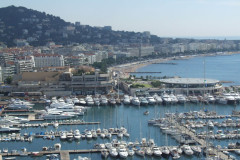
Along with Nice and Marseille the region is also made internationally popular with Cannes which, though not a large city (population of 73,603 in 2012), hosts the annual Cannes Film Festival which has highly popularized the region. Also, Arles has become renowned as the city in which Vincent Van Gogh lived and painted 300 paintings.
Toulon is a large military harbour on the Mediterranean coast, with the French naval base placed there. It is the capital of the Var department in the region.
Also, Aix-en-Provence has long been a university town, and to this day remains the most important educational centre in the region.
Below is a list of the most populated cities in the region along with their population (city proper) according to the most recent census.
- Aix-en-Provence – 142,743
- Antibes (includes Juan-les-Pins) – 76,994
- Arles – 52,729
- Aubagne – 46,423
- Avignon – 90,194
- Cannes – 73,603
- Draguignan – 38,258
- Fréjus – 52,389
- Grasse – 51,580
- Hyères – 56,275
- La Seyne-sur-Mer – 57,553
- Le Cannet – 40,940
- Mandelieu-la-Napoule – 22,714
- Marseille – 850,636
- Martigues – 76,471
- Mougins – 19,703
- Nice – 344,875
- Toulon – 163,974
- Villeneuve-Loubet – 14,427