Argostoli

Description

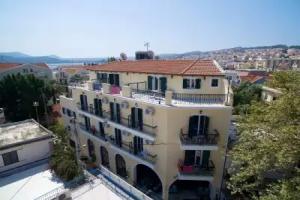
Argostoli is a town and a former municipality on the island of Kefalonia, Ionian Islands, Greece. Since the 2011 local government reform it is part of the municipality Kefalonia, of which it is a municipal unit. It has been the capital and administrative centre of Kefalonia since 1757, following a population shift down from the old capital of Agios Georgios (also known as Kastro) to take advantage of the trading opportunities provided by the sheltered bay upon which Argostoli sits. Argostoli developed into one of the busiest ports in Greece, leading to prosperity and growth. The municipal unit has an area of 157.670 km2. The 2011 census recorded a population of 10,633 in the Argostoli municipal unit. Its largest towns are Argostóli (pop. 9,748), Razata (507), Dilináta (496) and Kompothekráta (449).

Urban landscape

To the east of Argostoli, at the end of the bay, beneath the aforementioned Castle of St. George, sits the Koutavos Lagoon, a feeding ground for the Loggerhead turtles (Caretta caretta). Now a nature reserve, the Koutavos Lagoon was once an almost impassable swamp where mosquitoes and malaria were rife. Under the British governor of the island, General Sir Charles James Napier, a wooden bridge was constructed across the lagoon in 1813 by Colonel Charles Philip de Bosset, a Swiss engineer in the employ of the British army.

Four years later stone arches were added and, after some 26 years, the entire bridge was rebuilt in stone. In continuous use until 2005, this narrow bridge is now closed to traffic, currently undergoing renovation by the Greek Ministry of Culture. Almost halfway along the Drepano Bridge stands a stone column built by the British to celebrate their presence.

The coastal road out of Argostoli to the west was known during the Venetian period as the ‘Piccolo Gyro’. Along the Piccolo Gyro, in the Vlikha area facing Lixouri, lie the ‘Swallow Holes’ of Katovothres, a geological phenomenon. Sea water disappears underground and travels under the island, re-emerging some fourteen days later in the Karavomylos area of Sami, having passed through the nearby, underground Melissani lake. The power of this sea water was harnessed, in 1835, to power a water mill. Further along the Piccolo Gyro is the Agion Theodoron lighthouse, named after the small adjacent church. More commonly known as the Fanari lighthouse, this too was built during the British occupation, in 1829. The original building was destroyed in the earthquake of 1953, the recently restored present structure was rebuilt, complete with Doric-style columns, from the original plans.

Buildings that weren’t shattered by German bombing in 1943 were destroyed in 1953 by the earthquake that razed virtually all of Kefalonia, apart from the Fiskardo area, to the ground.

Opposite the Archaeological Museum of Argostoli are the law courts, originally constructed by the British with stone from the Cyclopean site at nearby Krani. Along Lithostroto, next to the Catholic Church, is a tiny museum (open some mornings and most evenings) dedicated to the soldiers of the Acqui Division. A little further along is the Bell Tower. Rebuilt in 1985 to house the original clock mechanism.

On the Ionian Sea coast southwest of the town centre is the holiday resort town Lassi, which has several small beaches.

Transportation

Between the Koutavos Lagoon and the Drepano Bridge is the new bus station which connects Argostoli with the other towns and some of the villages on the island, as well as with Athens and Patras. The old bus station, just past these market stalls, is likely to accommodate a proposed seaplane service connecting Argostoli with Patras, due to commence Spring 2006. The main ferry port, connecting Argostoli with the mainland (via Kyllini) and Zakynthos (also known as Zante) is next to this building with the Lixouri ferry (once an hour in winter, twice an hour in summer) docking a little further along.

  • Car ferry service to Kyllini (mainland) and Zakynthos (Zante)
  • Car ferry to Lixouri
  • KTEL Bus service to Athens, via Kyllini, Patras and the Corinth Canal bridge
  • Infrequent bus service to Poros, Sami, Skala, Fiskardo and various villages en route
  • Frequent summer service to Lassi
  • NO bus service to Kefalonia Airport
  • Scheduled flights to Zakynthos and Athens, charter flight in summer, via Kefalonia Airport
  • Seaplane service, Argostoli - Patras (due Spring 2006)
  • Taxis from Plateia Valianos and seafront, car and motorcycle/scooter hire

Historical population

Year Town population Municipality population 1981 7,164 - 1991 7,420 9,918 2001 9,522 12,589 2011 9,748 10,633

Street view

Hotels

2 guests
Adults2+
Children under 170+
Age7+
Age7+
Age7+
Age7+
Age7+
Age7+
Age7+
Age7+
Age7+
Age7+
Search hotel

Reviews

Share your experiences, help others make the right choice!
Think about what you would like to know if you were looking for a review about a place to relax. Please describe in detail what you liked and what you didn't. What would you advise to other guests and to the hotel owner. The more fully you tell about the hotel, the easier it will be for other people to make a choice and they will be very grateful to you!

Map

X