Los Angeles

Description

Los Angeles , officially the City of Los Angeles and often known by its initials L.A., is the second-largest city in the United States after New York City, the most populous city in the state of California, and the county seat of Los Angeles County. Situated in Southern California, Los Angeles is known for its mediterranean climate, ethnic diversity, sprawling metropolis, and as a major center of the American entertainment industry. Los Angeles lies in a large coastal basin surrounded on three sides by mountains reaching up to and over 10,000 feet (3,000 m).

Historically home to the Chumash and Tongva, Los Angeles was claimed by Juan Rodríguez Cabrillo for Spain in 1542 along with the rest of what would become Alta California. The city was officially founded on September 4, 1781, by Spanish governor Felipe de Neve. It became a part of Mexico in 1821 following the Mexican War of Independence. In 1848, at the end of the Mexican–American War, Los Angeles and the rest of California were purchased as part of the Treaty of Guadalupe Hidalgo, thereby becoming part of the United States. Los Angeles was incorporated as a municipality on April 4, 1850, five months before California achieved statehood. The city experienced rapid growth with the discovery of oil.

The city is the focal point of the larger Los Angeles metropolitan area and the Greater Los Angeles Area region, which contain 13 million and over 18 million people, respectively, as of 2010, making it one of the most populous metropolitan areas in the world as well as the second-largest in the United States. Los Angeles is the seat of Los Angeles County, the most populated county in the United States. The city's inhabitants are referred to as Angelenos.

Nicknamed the "City of Angels", Los Angeles is a global city with a diverse economy in entertainment, culture, media, fashion, science, sports, technology, education, medicine and research. It has been ranked sixth in the Global Cities Index and 9th Global Economic Power Index. The city is home to renowned institutions covering a broad range of professional and cultural fields and is one of the most substantial economic engines within the United States. The Los Angeles combined statistical area (CSA) has a gross metropolitan product (GMP) of $831 billion (as of 2008), making it the third-largest in the world, after the Greater Tokyo and New York metropolitan areas. Los Angeles includes Hollywood and leads the world in the creation of television productions and recorded music; it is also one of the leaders in motion picture production. Los Angeles hosted the Summer Olympic Games in 1932 and 1984, and is currently bidding for the 2024 Summer Olympics.

History

Historical affiliations

Spanish Empire 1519–1821
First Mexican Empire 1821–1823
United Mexican States 1823–1848
California Republic 1846
United States 1848–present

Pre-colonial period

The Los Angeles coastal area was first settled by the Tongva (Gabrieleños) and Chumash Native American tribes thousands of years ago. A Gabrielino settlement in the area was called iyáangẚ (written Yang-na by the Spanish), meaning "poison oak place".

Juan Rodríguez Cabrillo, a Portuguese-born explorer, claimed the area of southern California for the Spanish Empire of the Kingdom of Spain in 1542, while on an official military exploring expedition moving north along the Pacific coast from earlier colonizing bases of New Spain in Central and South America. Gaspar de Portolà and Franciscan missionary Juan Crespí, reached the present site of Los Angeles on August 2, 1769.

Spanish period

In 1771, Franciscan friar Junípero Serra directed the building of the Mission San Gabriel Arcángel, the first mission in the area. On September 4, 1781, a group of forty-four settlers known as "Los Pobladores" founded the pueblo called "El Pueblo de Nuestra Señora la Reina de los Ángeles del Río de Porciúncula"; in English it is "The Town of Our Lady the Queen of the Angels of the Porciúncula River". The Queen of the Angels is an honorific of the Virgin Mary. Two-thirds of the settlers were mestizo or mulatto with a mixture of African, indigenous and European ancestry. The settlement remained a small ranch town for decades, but by 1820, the population had increased to about 650 residents. Today, the pueblo is commemorated in the historic district of Los Angeles Pueblo Plaza and Olvera Street, the oldest part of Los Angeles.

Mexican period

New Spain achieved its independence from the Spanish Empire in 1821, and the pueblo continued as a part of Mexico. During Mexican rule, Governor Pío Pico made Los Angeles Alta California's regional capital.

American period

Mexican rule ended during the Mexican–American War: Americans took control from the Californios after a series of battles, culminating with the signing of the Treaty of Cahuenga on January 13, 1847.

Railroads arrived with the completion of the Southern Pacific line to Los Angeles in 1876. Oil was discovered in the city and surrounding area in 1892, and by 1923, the discoveries had helped California become the country's largest oil producer, accounting for about one-quarter of the world's petroleum output.

By 1900, the population had grown to more than 102,000, putting pressure on the city's water supply. The completion of the Los Angeles Aqueduct in 1913, under the supervision of William Mulholland, assured the continued growth of the city.

In 1910, Hollywood merged into Los Angeles, with 10 movie companies already operating in the city at the time. By 1921, more than 80 percent of the world's film industry was concentrated in L.A. The money generated by the industry kept the city insulated from much of the economic loss suffered by the rest of the country during the Great Depression. By 1930, the population surpassed one million. In 1932, the city hosted the Summer Olympics.

During World War II, Los Angeles was a major center of wartime manufacturing, such as shipbuilding and aircraft. Calship built hundreds of Liberty Ships and Victory Ships on Terminal Island, and the Los Angeles area was the headquarters of six of the country's major aircraft manufacturers (Douglas Aircraft Company, Hughes Aircraft, Lockheed, North American Aviation, Northrop Corporation, and Vultee). During the war, more aircraft were produced in one year than in all the pre-war years since the Wright brothers flew the first airplane in 1903, combined. Manufacturing in Los Angeles skyrocketed, and as William S. Knudsen, of the National Defense Advisory Commission put it, "We won because we smothered the enemy in an avalanche of production, the like of which he had never seen, nor dreamed possible.

The Richfield Tower, an Art Deco landmark of 1929, was demolished in 1969.

Following the end of World War II, Los Angeles grew more rapidly than ever, sprawling into the San Fernando Valley. The expansion of the Interstate Highway System during the 1950s and 1960s helped propel suburban growth and signaled the demise of the city's electrified rail system, once the world's largest.

The 1960s saw race relations boil-over into the Watts Riots of 1965 which resulted in 34 deaths and over 1,000 injuries. It was the most severe riot in the city's history until the Los Angeles riots of 1992. In 1969, Los Angeles became the birthplace of the Internet, as the first ARPANET transmission was sent from the University of California, Los Angeles (UCLA) to SRI in Menlo Park.

In 1984, the city hosted the Summer Olympic Games for the second time. Despite being boycotted by 14 Communist countries, the 1984 Olympics became more financially successful than any previous, and the second Olympics to turn a profit until then – the other, according to an analysis of contemporary newspaper reports, being the 1932 Summer Olympics, also held in Los Angeles.

Racial tensions erupted on April 29, 1992, with the acquittal by a Simi Valley jury of the police officers captured on videotape beating Rodney King, culminating in large-scale riots. They were the largest riots in US history causing approximately $1.3 billion in damage as well as 53 deaths and over 2,000 injuries.

In 1994, the 6.7 Northridge earthquake shook the city, causing $12.5 billion in damage and 72 deaths. The century ended with the Rampart scandal, one of the most extensive documented cases of police misconduct in American history.

In 2002, voters defeated efforts by the San Fernando Valley and Hollywood to secede from the city.

Geography

Overview

The city's street pattern generally follows a grid plan, with uniform block lengths and occasional roads that cut across blocks. However, this is complicated by rugged terrain, which has necessitated having different grids for each of the valleys that Los Angeles covers. Major streets are designed to move large volumes of traffic through many parts of the city; many of them are extremely long: Sepulveda Boulevard is 43 miles (69 km) long, while Foothill Boulevard is over 60 miles (97 km) long, reaching as far east as San Bernardino. Drivers in Los Angeles suffer from one of the worst rush hour periods in the world, according to an annual traffic index by navigation system maker, TomTom. L.A. drivers spend an additional 92 hours in traffic each year. During the peak rush hour there is 80% congestion, according to the index.

Los Angeles is strongly characterized by the presence of low-rise buildings. Outside of a few centers such as Downtown, Warner Center, Century City, Koreatown, Miracle Mile, Hollywood and Westwood, skyscrapers and high-rise buildings are not common. The few skyscrapers that are built outside of those areas often stand out above the rest of the surrounding landscape. Most construction is done in separate units, rather than wall-to-wall. That being said, downtown Los Angeles itself has many buildings over 30 stories, with fourteen over 50 stories, and two over 70 stories (the tallest buildings west of Chicago-see List of tallest buildings in Los Angeles). Also, Los Angeles is increasingly becoming a city of apartments rather than single family dwellings, especially in the dense inner city and Westside neighborhoods.

Landmarks

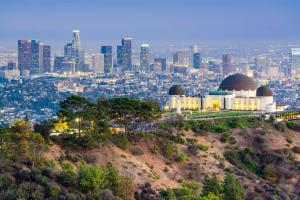
Important landmarks in Los Angeles include the Hollywood Sign, Walt Disney Concert Hall, Capitol Records Building, the Cathedral of Our Lady of the Angels, Angels Flight , TCL Chinese Theatre, Dolby Theatre, Griffith Observatory, Getty Center, Getty Villa, the Los Angeles Memorial Coliseum, the Los Angeles County Museum of Art, the Venice Canal Historic District and boardwalk, Theme Building, Bradbury Building, U.S. Bank Tower, Wilshire Grand Tower, Hollywood Boulevard, Los Angeles City Hall, Hollywood Bowl, Battleship USS Iowa, Watts Towers, Staples Center, Dodger Stadium, and Olvera Street.

  • L.A. Live

  • TCL Chinese Theatre

  • Griffith Observatory

  • Capitol Records Building

  • Angels Flight

  • Downtown Los Angeles at sunset

Topography

The Los Angeles Basin

The city of Los Angeles covers a total area of 502.7 square miles (1,302 km2), comprising 468.7 square miles (1,214 km2) of land and 34.0 square miles (88 km2) of water. The city extends for 44 miles (71 km) longitudinally and for 29 miles (47 km) latitudinally. The perimeter of the city is 342 miles (550 km).

Los Angeles is both flat and hilly. The highest point in the city proper is 5,074 ft (1,547 m) Mount Lukens, located at the northeastern end of the San Fernando Valley. The eastern end of the Santa Monica Mountains stretches from Downtown to the Pacific Ocean and separates the Los Angeles Basin from the San Fernando Valley. Other hilly parts of Los Angeles include the Mt. Washington area north of Downtown, eastern parts such as Boyle Heights, the Crenshaw district around the Baldwin Hills, and the San Pedro district.

Surrounding the city are much higher mountains. Immediately to the north lie the San Gabriel Mountains, which is a popular recreation area for Angelenos. Its high point is Mount San Antonio, locally known as Mount Baldy, which reaches 10,064 feet (3,068 m). Further afield, the highest point in the greater Los Angeles area is San Gorgonio Mountain, with a height of 11,503 feet (3,506 m).

The Los Angeles River, which is largely seasonal, is the primary drainage channel. It was straightened and lined in 51 miles (82 km) of concrete by the Army Corps of Engineers to act as a flood control channel. The river begins in the Canoga Park district of the city, flows east from the San Fernando Valley along the north edge of the Santa Monica Mountains, and turns south through the city center, flowing to its mouth in the Port of Long Beach at the Pacific Ocean. The smaller Ballona Creek flows into the Santa Monica Bay at Playa del Rey.

Flora and fauna

Los Angeles is rich in native plant species partly because of its diversity of habitats, including beaches, wetlands, and mountains. The most prevalent plant communities are coastal sage scrub, chaparral shrubland, and riparian woodland. Native plants include: California poppy, matilija poppy, toyon, Ceanothus, Chamise, Coast Live Oak, sycamore, willow and Giant Wildrye. Many of these native species, such as the Los Angeles sunflower, have become so rare as to be considered endangered. Though it is not native to the area, the official tree of Los Angeles is the Coral Tree (Erythrina caffra) and the official flower of Los Angeles is the Bird of Paradise (Strelitzia reginae). Mexican Fan Palms, Canary Island Palms, Queen Palms, Date Palms, and California Fan Palms are common in the Los Angeles area, although only the last is native.

Geology

Los Angeles is subject to earthquakes because of its location on the Pacific Ring of Fire. The geologic instability has produced numerous faults, which cause approximately 10,000 earthquakes annually in Southern California, though most of them are too small to be felt. The strike-slip San Andreas Fault system is located at the boundary between the Pacific Plate and the North American Plate, and is vulnerable to the "big one", a potentially large and damaging event. The Los Angeles basin and metropolitan area are also at risk from blind thrust earthquakes. Major earthquakes that have hit the Los Angeles area include the 1933 Long Beach, 1971 San Fernando, 1987 Whittier Narrows, and the 1994 Northridge events. Nevertheless, all but a few are of low intensity and are not felt. The USGS has released the UCERF California earthquake forecast which models earthquake occurrence in California. Parts of the city are also vulnerable to tsunamis; harbor areas were damaged by waves from the Valdivia earthquake in 1960.

Environmental issues

A Gabrielino settlement in the area was called iyáangẚ (written Yang-na by the Spanish), which has been translated as "poison oak place". Yang-na has also been translated as "the valley of smoke". Owing to geography, heavy reliance on automobiles, and the Los Angeles/Long Beach port complex, Los Angeles suffers from air pollution in the form of smog. The Los Angeles Basin and the San Fernando Valley are susceptible to atmospheric inversion, which holds in the exhausts from road vehicles, airplanes, locomotives, shipping, manufacturing, and other sources.

The smog season lasts from approximately May to October. While other large cities rely on rain to clear smog, Los Angeles gets only 15 inches (380 mm) of rain each year: pollution accumulates over many consecutive days. Issues of air quality in Los Angeles and other major cities led to the passage of early national environmental legislation, including the Clean Air Act. More recently, the state of California has led the nation in working to limit pollution by mandating low-emission vehicles. Smog is expected to continue to drop in the coming years because of aggressive steps to reduce it, which include electric and hybrid cars, improvements in mass transit, and other measures.

The number of Stage 1 smog alerts in Los Angeles has declined from over 100 per year in the 1970s to almost zero in the new millennium. Despite improvement, the 2006 and 2007 annual reports of the American Lung Association ranked the city as the most polluted in the country with short-term particle pollution and year-round particle pollution. In 2008, the city was ranked the second most polluted and again had the highest year-round particulate pollution. The city met its goal of providing 20 percent of the city's power from renewable sources in 2010. The American Lung Association's 2013 survey ranks the metro area as having the nation's worst smog, and fourth in both short term and year round pollution amounts. The Los Angeles City Council adopted new environmental measures on April 13, 2016 in a groundbreaking attempt to reduce health risks from industrial and traffic pollution in long-suffering neighborhoods. In a unanimous vote, the City Council approved special land-use restrictions for some of its most polluted neighborhoods and citywide requirements for advanced air filters in new developments near freeways.

Climate change has already affected Los Angeles with a 4 degree average temperature rise from 1878 to 2005 with a UCLA study predicting that coastal areas will rise 3 to 4 degrees in temperature and urban areas 4 to 4.5 degrees. In 2014, the fire season never finished in Southern California and studies have predicted that climate change will cause more frequent and larger fires by the end of the century. Climate change is also expected to affect sea levels which are expected to rise 5 to 24 inches from 2000 to 2050 leading to higher storm surge and waves, which could result in more extensive flooding that could threaten critical coastal infrastructure.

Los Angeles is also home to the nation's largest urban oil field. There are more than 700 active oil wells located within 1,500 feet of homes, churches, schools and hospitals in the city, a situation about which the EPA has voiced serious concerns.

Culture

Walt Disney Concert Hall

Los Angeles is often billed as the "Creative Capital of the World", because one in every six of its residents works in a creative industry and there are more artists, writers, filmmakers, actors, dancers and musicians living and working in Los Angeles than any other city at any time in history.

Movies and the performing arts

The city's Hollywood neighborhood has become recognized as the center of the motion picture industry. Los Angeles plays host to the annual Academy Awards and is the site of the USC School of Cinematic Arts, the oldest film school in the United States.

The performing arts play a major role in Los Angeles' cultural identity. According to the USC Stevens Institute for Innovation, "there are more than 1,100 annual theatrical productions and 21 openings every week." The Los Angeles Music Center is "one of the three largest performing arts centers in the nation", with more than 1.3 million visitors per year. The Walt Disney Concert Hall, centerpiece of the Music Center, is home to the prestigious Los Angeles Philharmonic. Notable organizations such as Center Theatre Group, the Los Angeles Master Chorale, and the Los Angeles Opera are also resident companies of the Music Center. Talent is locally cultivated at premier institutions such as the Colburn School and the USC Thornton School of Music.

Museums and galleries

There are 841 museums and art galleries in Los Angeles County. In fact, Los Angeles has more museums per capita than any other city in the world. Some of the notable museums are the Los Angeles County Museum of Art (the largest art museum in the Western United States), the Getty Center (part of the larger J. Paul Getty Trust, the world's wealthiest art institution), the Battleship Iowa, and the Museum of Contemporary Art. A significant number of art galleries are located on Gallery Row, and tens of thousands attend the monthly Downtown Art Walk there.

Transportation

Freeways

The city and the rest of the Los Angeles metropolitan area are served by an extensive network of freeways and highways. The Texas Transportation Institute, which publishes an annual Urban Mobility Report, ranked Los Angeles road traffic as the most congested in the United States in 2005 as measured by annual delay per traveler. The average traveler in Los Angeles experienced 72 hours of traffic delay per year according to the study. Los Angeles was followed by San Francisco/Oakland, Washington, D.C. and Atlanta, (each with 60 hours of delay). Despite the congestion in the city, the mean travel time for commuters in Los Angeles is shorter than other major cities, including New York City, Philadelphia and Chicago. Los Angeles' mean travel time for work commutes in 2006 was 29.2 minutes, similar to those of San Francisco and Washington, D.C.

Among the major highways that connect LA to the rest of the nation include Interstate 5, which runs south through San Diego to Tijuana in Mexico and north through Sacramento, Portland, and Seattle to the Canadian border; Interstate 10, the southernmost east–west, coast-to-coast Interstate Highway in the United States, going to Jacksonville, Florida; and U.S. Route 101, which heads to the California Central Coast, San Francisco, the Redwood Empire, and the Oregon and Washington coasts.

Transit systems

The LA County Metropolitan Transportation Authority and other agencies operate an extensive system of bus lines, as well as subway and light rail lines across Los Angeles County, with a combined monthly ridership (measured in individual boardings) of 38.8 million as of September 2011. The majority of this (30.5 million) is taken up by the city's bus system, the second busiest in the country. The subway and light rail combined average the remaining roughly 8.2 million boardings per month. In 2005, 10.2% of Los Angeles commuters rode some form of public transportation.

The city's subway system is the ninth busiest in the United States and its light rail system is the country's second busiest. The rail system includes the Red and Purple subway lines, as well as the Gold, Blue, Expo, and Green light rail lines. In 2016 the Expo Line will reach the Pacific at Santa Monica. The Metro Orange and Silver lines are bus rapid transit lines with stops and frequency similar to those of light rail. The city is also central to the commuter rail system Metrolink, which links Los Angeles to all neighboring counties as well as many suburbs.

Besides the rail service provided by Metrolink and the Los Angeles County Metropolitan Transportation Authority, Los Angeles is served by inter-city passenger trains from Amtrak. The main rail station in the city is Union Station just north of Downtown.

In addition, the city directly contracts for local and commuter bus service through the Los Angeles Department of Transportation, or LADOT.

Airports

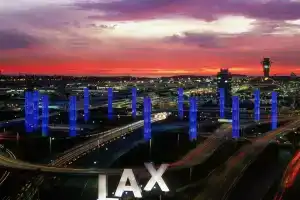
The main international and domestic airport serving Los Angeles is Los Angeles International Airport (IATA: LAX, ICAO: KLAX), commonly referred to by its airport code, LAX. The sixth busiest commercial airport in the world and the third busiest in the United States, LAX handled over 66 million passengers and close to 2 million tons of cargo in 2013.

Other major nearby commercial airports include:

  • (IATA: ONT, ICAO: KONT) LA/Ontario International Airport, owned by the city of Los Angeles; serves the Inland Empire.
  • (IATA: BUR, ICAO: KBUR) Bob Hope Airport, formerly known as Burbank Airport; serves the San Fernando and San Gabriel Valleys
  • (IATA: LGB, ICAO: KLGB) Long Beach Airport, serves the Long Beach/Harbor area
  • (IATA: SNA, ICAO: KSNA) John Wayne Airport of Orange County

One of the world's busiest general-aviation airports is also located in Los Angeles, Van Nuys Airport (IATA: VNY, ICAO: KVNY).

Seaports

The Port of Los Angeles is located in San Pedro Bay in the San Pedro neighborhood, approximately 20 miles (32 km) south of Downtown. Also called Los Angeles Harbor and WORLDPORT LA, the port complex occupies 7,500 acres (30 km2) of land and water along 43 miles (69 km) of waterfront. It adjoins the separate Port of Long Beach.

The sea ports of the Port of Los Angeles and Port of Long Beach together make up the Los Angeles/Long Beach Harbor. Together, both ports are the fifth busiest container port in the world, with a trade volume of over 14.2 million TEU's in 2008. Singly, the Port of Los Angeles is the busiest container port in the United States and the largest cruise ship center on the West Coast of the United States – The Port of Los Angeles' World Cruise Center served about 590,000 passengers in 2014.

There are also smaller, non-industrial harbors along Los Angeles' coastline. The port includes four bridges: the Vincent Thomas Bridge, Henry Ford Bridge, Gerald Desmond Bridge, and Commodore Schuyler F. Heim Bridge. Passenger ferry service from San Pedro to the city of Avalon on Santa Catalina Island is provided by Catalina Express.

Tourist attractions

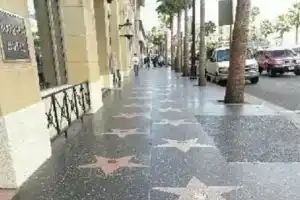
Street view

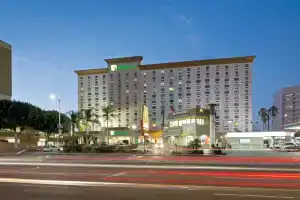
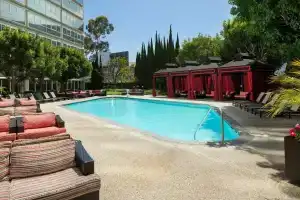
Hotels

2 guests
Adults2+
Children under 170+
Age7+
Age7+
Age7+
Age7+
Age7+
Age7+
Age7+
Age7+
Age7+
Age7+
Search hotel

Reviews

Share your experiences, help others make the right choice!
Think about what you would like to know if you were looking for a review about a place to relax. Please describe in detail what you liked and what you didn't. What would you advise to other guests and to the hotel owner. The more fully you tell about the hotel, the easier it will be for other people to make a choice and they will be very grateful to you!

Map

X