San Jose
Description
San Jose , originally Pueblo de San José de Guadalupe and officially the City of San José, is the third-largest city by population in California, the tenth-largest by population in the United States, and the county seat of Santa Clara County. San Jose is the largest city within the Bay Area and the largest city in Northern California.
Before the arrival of the Spanish, the area around San Jose was inhabited by the Ohlone people. San Jose was founded on November 29, 1777, as San José de Guadalupe, the first civilian town in the Spanish colony of Alta California. The city served as a farming community to support Spanish military installations at San Francisco and Monterey. When California gained statehood in 1850, San Jose served as its first capital.
After more than 150 years as a small farming community, the San Jose area in the mid-20th century contained some of the last undeveloped land near San Francisco Bay. It then began to experience rapid population growth, much of it coming from veterans returning from World War II. San Jose then continued its aggressive expansion during the 1950s and 1960s by annexing more land area. The rapid growth of the high-technology and electronics industries further accelerated the transition from an agricultural center to an urbanized metropolitan area.
By the 1990s, San Jose's location within the booming local high tech industry earned the city the nickname "Capital of Silicon Valley". San Jose is now considered to be a global city, and notable for its affluence and high cost of living. The U.S. Census Bureau estimated the population of the city to be 1,015,785 as of July 1, 2014.
History
Historical affiliations Spanish Empire 1777–1821
First Mexican Empire 1821–1823
United Mexican States 1823–1848
California Republic 1846
United States 1848–present
Prior to European settlement, the area was inhabited by several groups of Ohlone Native Americans. The first lasting European presence began with a series of Franciscan missions established from 1769 by Junípero Serra. On orders from Antonio María de Bucareli y Ursúa, Spanish Viceroy of New Spain, San Jose was founded by Lieutenant José Joaquín Moraga as Pueblo de San José de Guadalupe (in honor of Saint Joseph) on November 29, 1777, to establish a farming community. The town was the first civil settlement in Alta California
In 1797, the pueblo was moved from its original location, near the present-day intersection of Guadalupe Parkway and Taylor Street, to a location in what is now Downtown San Jose. San Jose came under Mexican rule in 1821 after Mexico broke with the Spanish crown. It then became part of the United States, after it capitulated in 1846 and California was annexed.
On March 27, 1850, San Jose became the second incorporated city in the state (after Sacramento), with Josiah Belden its first mayor. San Jose was California's first State capital, and hosted the first and second sessions (1850–1851) of the California Legislature. Today the Circle of Palms Plaza in downtown is the historical marker for the first state capital. The city was a station on the Butterfield Overland Mail route.
In the period 1900 through 1910, San Jose served as a center for pioneering invention, innovation, and impact in both lighter-than-air and heavier-than-air flight. These activities were led principally by Prof. John Montgomery and his peers. The City of San Jose has established Montgomery Park, a Monument at San Felipe and Yerba Buena Roads, and John J. Montgomery Elementary School in his honor. During this period, San Jose also became a center of innovation for the mechanization/industrialization of agricultural and food processing equipment.
Though not affected as severely as San Francisco, San Jose also suffered much damage from the 1906 San Francisco earthquake. Over 100 people died at the Agnews Asylum (later Agnews State Hospital) after its walls and roof collapsed, and the San Jose High School's three-story stone-and-brick building was also destroyed. The period during World War II was a tumultuous time. Japanese Americans primarily from Japantown were sent to internment camps, including the future mayor, Norman Mineta. Following the Los Angeles zoot suit riots, anti-Mexican violence took place during the summer of 1943. In 1940, the Census Bureau reported San Jose's population as 98% white.
As World War II started, the city's economy shifted from agriculture (the Del Monte cannery was the largest employer) to industrial manufacturing with the contracting of the Food Machinery Corporation (later known as FMC Corporation) by the United States War Department to build 1000 Landing Vehicle Tracked. After World War II, FMC (later United Defense, and currently BAE Systems) continued as a defense contractor, with the San Jose facilities designing and manufacturing military platforms such as the M113 Armored Personnel Carrier, the Bradley Fighting Vehicle, and various subsystems of the M1 Abrams battle tank.
IBM established its West Coast headquarters in San Jose in 1943 and opened a downtown research and development facility in 1952. Both would prove to be harbingers for the economy of San Jose, as Reynold Johnson and his team would later invent RAMAC, as well as the Hard disk drive, and the technological side of San Jose's economy grew.
The Ford Motor Company relocated its factory in Richmond to a new location in the suburb of Milpitas, called the San Jose Assembly Plant which was one of the primary locations for manufacturing the Ford Mustang.
During the 1950s and 1960s, City Manager A. P. "Dutch" Hamann led the city in a major growth campaign. The city annexed adjacent areas, such as Alviso and Cambrian Park, providing large areas for suburbs. An anti-growth reaction to the effects of rapid development emerged in the 1970s championed by mayors Norman Mineta and Janet Gray Hayes. Despite establishing an urban growth boundary, development fees, and incorporations of Campbell and Cupertino, development was not slowed, but rather directed into already incorporated areas.
On April 3, 1979, the San Jose City Council adopted San José, with the diacritical mark on the "e", as the spelling of the city name on the city seal, official stationery, office titles and department names. Also, by city council convention, this spelling of San José is used when the name is stated in both upper- and lower-case letters, but not when the name is stated only in upper-case letters. The accent reflects the Spanish version of the name, and the dropping of accents in all-capital writing was typical in Spanish. While San José is commonly spelled both with and without the acute accent over the "e," the City's official guidelines indicate that it should be spelled with the accent most of the time and sets forth narrow exceptions such as when the spelling is in URLs, when the name appears in all capital letters, when the name is used on social media sites where the diacritical mark does not render properly, and where San Jose is part of the proper name of another organization or business, such as San Jose Silicon Valley Chamber of Commerce, that has chosen not to use the accent mark name. The City's name without the accent can still be found in its 1965 Charter document, as amended, which formally chartered the municipality as City of San Jose. Similarly, the City's website appears to use a mixture of both; for example, the "City of San José" in the text uses the mark but the "City of San Jose" logo image does not.
San Jose's position in Silicon Valley triggered further economic and population growth. Results from the 1990 U.S. Census indicated that San Jose surpassed San Francisco as the most populous city in the Bay Area for the first time. This growth led to the highest housing costs increase in the nation, 936% between 1976 and 2001. Efforts to increase density continued into the 1990s when an update of the 1974 urban plan kept the urban growth boundaries intact and voters rejected a ballot measure to ease development restrictions in the foothills. Sixty percent of the housing built in San Jose since 1980 and over three-quarters of the housing built since 2000 have been multifamily structures, reflecting a political propensity toward Smart Growth planning principles.
Geography
San Jose is located at 37°20′07″N 121°53′31″W / 37.335278°N 121.891944°W / 37.335278; -121.891944. According to the United States Census Bureau, the city has a total area of 180.0 sq mi (466 km2), of which 3.4 sq mi (8.8 km2) (1.91%) is water.
San Jose lies between the San Andreas Fault, the source of the 1989 Loma Prieta earthquake, and the Calaveras Fault. San Jose is shaken by moderate earthquakes, above four on the Richter Scale, on average of one to two times a year. These quakes originate just east of the city on the creeping section of the Calaveras Fault, which is a major source of earthquake activity in Northern California. On April 14, 1984, at 1:15 pm, local time a 6.2 magnitude earthquake struck the Calaveras Fault near San Jose's Mount Hamilton. The most serious earthquake, in 1906, damaged many buildings in San Jose as described earlier. Earlier significant quakes rocked the city in 1839, 1851, 1858, 1864, 1865, 1868, and 1891. The Daly City Earthquake of 1957 caused some damage. The Loma Prieta earthquake of 1989 also did some damage to parts of the city. The other faults near San Jose are the Monte Vista Fault and the Hayward Fault Zone.
Topography
The Guadalupe River runs from the Santa Cruz Mountains (which separate the South Bay from the Pacific Coast) flowing north through San Jose, ending in the San Francisco Bay at Alviso. Along the southern part of the river is the neighborhood of Almaden Valley, originally named for the mercury mines which produced mercury needed for gold extraction from quartz during the California Gold Rush as well as mercury fulminate blasting caps and detonators for the U.S. military from 1870 to 1945. East of the Guadalupe River, Coyote Creek also flows to south San Francisco Bay and originates on Mount Sizer near Henry W. Coe State Park and the surrounding hills in the Diablo Range, northeast of Morgan Hill, California.
The lowest point in San Jose is 13 feet (4 m) below sea level at the San Francisco Bay in Alviso; the highest is 2,125 feet. Because of the proximity to Lick Observatory atop Mount Hamilton, San Jose has taken several steps to reduce light pollution, including replacing all street lamps and outdoor lighting in private developments with low pressure sodium lamps. To recognize the city's efforts, the asteroid 6216 San Jose was named after the city.
San Jose lies close to the Pacific Ocean and close to San Francisco Bay (a small portion of its northern border touches the bay). Santa Clara Valley is the population center of the Bay Area, and like the hub and spokes of a wheel, surrounding communities emanate outwards from the valley. This growth in part, has shaped the greater Bay Area as it is today in terms of geographic population distribution and the trend of suburbanization away from the valley.
There are four distinct valleys in the city of San Jose: Almaden Valley, situated on the south-west fringe of the city; Evergreen Valley to the south-east, which is hilly all throughout its interior; Santa Clara Valley, which includes the flat, main urban expanse of the South Bay; and the rural Coyote Valley, to the city's extreme southern fringe.
Arts and architecture
City arts and architecture
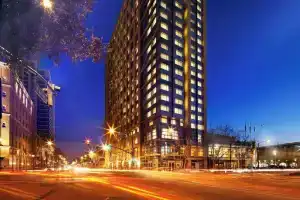
Because the downtown area is in the flight path to nearby Mineta San Jose International Airport (also evidenced in the above panoramic), there is a height limit for buildings in the downtown area, which is under the final approach corridor to the airport. The height limit is dictated by local ordinances, driven by the distance from the runway and a slope defined by Federal Aviation Administration regulations. Core downtown buildings are limited to approximately 300 feet (91 m) but can get taller farther from the airport.
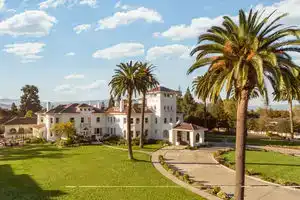
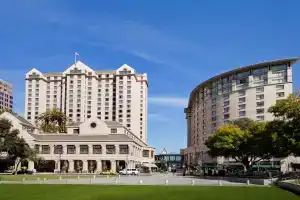
There has been broad criticism over the past few decades of the city's architecture. Citizens have complained that San Jose is lacking in aesthetically pleasing architectural styles. Blame for this lack of architectural "beauty" can be assigned to the re-development of the downtown area from the 1950s onward, in which whole blocks of historic commercial and residential structures were demolished. Exceptions to this include the Downtown Historic District, the Hotel De Anza, and the Hotel Sainte Claire, both of which are listed in the National Register of Historic Places for their architectural and historical significance.
Municipal building projects have experimented more with architectural styles than have most private enterprises. The Children's Discovery Museum, Tech Museum of Innovation, and the San Jose Repertory Theater building have experimented with bold colors and unusual exteriors. The new City Hall, designed by Richard Meier & Partners opened in 2005 and is a notable addition to the growing collection of municipal building projects.
Public art is an evolving attraction in the city. The city was one of the first to adopt a public art ordinance at 2% of capital improvement building project budgets, and the results of this commitment are beginning to affect the visual landscape of the city. There are a considerable number of public art projects throughout the downtown area, and a growing collection in the newer civic locations in neighborhoods including libraries, parks, and fire stations. Of particular note, the Mineta Airport expansion is incorporating a program of Art & Technology into its development.
Within the early efforts at public art, there are notable controversies. Two examples include the statue of Quetzalcoatl (the plumed serpent) in downtown which was controversial in its planning because some religious groups felt that it was pagan, and controversial in its implementation because many felt that the final statue by Robert Graham did not closely resemble a winged serpent, and was more noted for its expense than its aesthetics. This has resulted in locals joking that the statue resembles a pile of feces.
The statue of Thomas Fallon also met strong resistance from those who felt that people like him were largely responsible for the decimation of early native populations and Chicano/Latino activists protested he captured San Jose by violent force in the Mexican-American war (1846) as well "repressed" historic documents of Fallon ordered the expulsion of most of the city's Californio (early Spanish or Mexican) residents. In October 1991 after protests in part of Columbus Day and Dia de la Raza celebrations, the Fallon statue plan was scrapped and the statue was stored in a warehouse in Oakland for more than a decade. The statue was returned to public display in 2002, albeit in a less conspicuous location: Pellier Park, a small triangular patch formed by the merge of West Julian and West St. James streets.
In 2001, the city sponsored SharkByte, an exhibit of decorated sharks, based on the mascot of the hockey team, the San Jose Sharks, and modeled after Chicago's display of decorated cows. Large models of sharks were decorated in a variety of clever, colorful, or creative ways by local artists and were then displayed for months at dozens of locations around the city. Many displays were removed early because of vandalism. After the exhibition, the sharks were auctioned off and the proceeds donated to charity. The sharks can still be found in their new owners' homes and businesses.
In 2006, Adobe Systems commissioned an art installation titled San Jose Semaphore by Ben Rubin, which is located at the top of its headquarters building. Semaphore is composed of four LED discs which "rotate" to transmit a message. The content of the San Jose Semaphore's message remained a mystery until it was deciphered in August 2007. The visual art installation is supplemented with an audio track, transmitted from the building on a low-power AM station. The audio track provides clues to decode the message being transmitted.
The city is home to many performing arts companies, including Opera San Jose, Symphony Silicon Valley, Ballet San Jose Silicon Valley, sjDANCEco, Children's Musical Theater of San Jose (45 years old in 2013), the San Jose Youth Symphony, the San Jose Repertory Theatre, City Lights Theatre Company, The Tabard Theatre Company, San Jose Stage Company, and the now-defunct American Musical Theatre of San Jose which was replaced by Broadway San Jose in partnership with Team San Jose. San Jose also is home to the San Jose Museum of Art, one of the nation's premiere Modern Art museums. The annual Cinequest Film Festival in downtown has grown to over 60,000 attendees per year, becoming an important festival for independent films. The San Francisco Asian American Film Festival is an annual event, which is hosted in San Francisco, Berkeley, and Downtown San Jose. Approximately 30 to 40 films are screened in San Jose each year at the Camera 12 Downtown Cinemas. The San Jose Jazz Festival is another of many great events hosted throughout the year.
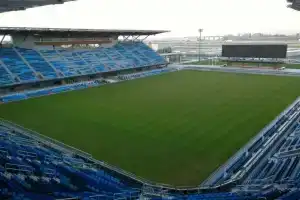
The SAP Center at San Jose is one of the most active venues for events in the world. According to Billboard Magazine and Pollstar, the arena sold the most tickets to non-sporting events of any venue in the United States, and third in the world after the Manchester Evening News Arena in Manchester, England, and the Bell Centre in Montreal, Quebec, Canada, for the period from January 1 – September 30, 2004. Including sporting events, the SAP Center averages 184 events a year, or roughly one event for every two days, which is significantly higher than the average for NHL arenas.
House architecture
San Jose has many examples of houses with fine architecture. Late 19th century and early 20th century styles exist in neighborhoods such as Hanchett Park, Naglee Park, Rose Garden, and Willow Glen (including Palm Haven).
Styles include Craftsman, Mission Revival, Prairie style, and Queen Anne style Victorian.
Notable architects include Frank Delos Wolfe, Theodore Lenzen, Charles McKenzie. and Julia Morgan
Parks, gardens, and other outdoor recreational sites
San Jose possesses about 15,950 acres (6,455 ha) of parkland in its city limits, including a part of the expansive Don Edwards San Francisco Bay National Wildlife Refuge. The city's oldest park is Alum Rock Park, established in 1872. In its 2013 ParkScore ranking, The Trust for Public Land, a national land conservation organization, reported that San Jose was tied with Albuquerque and Omaha for having the 11th best park system among the 50 most populous U.S. cities.
- Almaden Quicksilver County Park, 4,147 acres (16.78 km2) of former mercury mines in South San Jose (operated and maintained by the Santa Clara County Parks and Recreation Department).
- Alum Rock Park, 718 acres (2.91 km2) in East San Jose, the oldest municipal park in California and one of the largest municipal parks in the United States.
- Children's Discovery Museum hosts an outdoor park-like setting, featuring the world's largest permanent Monopoly game, per the Guinness Book of World Records. Caretakers for this attraction include the 501(c)3 non-profit group Monopoly in the Park.
- Circle of Palms Plaza, a ring of palm trees surrounding a California state seal and historical landmark at the site of the first state capitol
- Emma Prusch Farm Park, 43.5 acres (176,000 m²) in East San Jose. Donated by Emma Prusch to demonstrate the valley's agricultural past, it includes a 4-H barn (the largest in San Jose), community gardens, a rare-fruit orchard, demonstration gardens, picnic areas, and expanses of lawn.
- Field Sports Park, Santa Clara County's only publicly owned firing range, located in south San Jose
- Kelley Park, including diverse facilities such as Happy Hollow Park & Zoo (a child-centric amusement park), the Japanese Friendship Garden (Kelley Park), History Park at Kelley Park, and the Portuguese Historical Museum within the history park
- Martial Cottle Park, a former agricultural farm, in South San Jose. Operated by Santa Clara County Parks and Recreation Department
- Overfelt Gardens, including the Chinese Cultural Garden
- Plaza de César Chávez, a small park in Downtown, hosts outdoor concerts and the Christmas in the Park display
- Raging Waters, water park with water slides and other water attractions. This sits within Lake Cunningham Park
- Rosicrucian Park, nearly an entire city block in the Rose Garden neighborhood; the Park offers a setting of Egyptian and Moorish architecture set among lawns, rose gardens, statuary, and fountains, and includes the Rosicrucian Egyptian Museum, Planetarium, Research Library, Peace Garden and Visitors Center
- San Jose Flea Market
- San Jose Municipal Rose Garden, 5 1⁄2 acres (22,000 m2) park in the Rose Garden neighborhood, featuring over 4,000 rose bushes
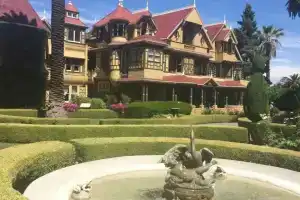
- Winchester Mystery House in San Jose.
Attractions
Habitat and wildlifeEarly written documents record the local presence of migrating salmon in the Rio Guadalupe dating as far back as the 18th century. Both steelhead (Oncorhynchus mykiss) and King salmon are extant in the Guadalupe River, making San Jose the southernmost major U. S. city with known salmon spawning runs, the other cities being Anchorage, Alaska; Seattle, Washington; Portland, Oregon and Sacramento, California. Runs of up to 1,000 Chinook or King Salmon (Oncorhynchus tshawytscha) swam up the Guadalupe River each fall in the 1990s, but have all but vanished in the current decade apparently blocked from access to breeding grounds by impassable culverts, weirs and wide, exposed and flat concrete paved channels installed by the Santa Clara Valley Water District. In 2011 a small number of Chinook salmon were filmed spawning under the Julian Street bridge.
TrailsSan Jose's trail network offers over 53 miles (90 km) of recreational and commute trails throughout the city. The major trails in the network include:
- Coyote Creek Trail
- Guadalupe River Trail
- Los Gatos Creek Trail
- Los Alamitos Creek Trail
- Penitencia Creek Trail
- Silver Creek Valley Trail
This large urban trail network, recognized by Prevention Magazine as the nation's largest, is linked to trails in surrounding jurisdictions and many rural trails in surrounding open space and foothills.
Museums, libraries, and other cultural collections- Children's Discovery Museum of San Jose
- History Park at Kelley Park
- Ira F. Brilliant Center for Beethoven Studies, home of the largest Beethoven collection outside Europe
- Dr. Martin Luther King, Jr. Library, the largest U.S. public library west of Mississippi River
- Mexican Heritage Plaza, a museum and cultural center for Mexican Americans in the area
- Portuguese Historical Museum
- Rosicrucian Egyptian Museum, the largest collection of Egyptian artifacts on display in the western United States, located at Rosicrucian Park
- San Jose Museum of Art
- San Jose East Carnegie Branch Library is notable as it is the last Carnegie library still operating in San Jose, and is on the National Register of Historic Places.
- The Tech Museum of Innovation
- San Jose Steam Railroad Museum, proposed, artifacts and rolling stock are kept at the fairgrounds and Kelley Park
- History San José
- Old Bank of America Building a historic landmark
- San Jose Improv, San Jose's oldest theater, home for the San Jose Improv Comedy Club.
- Cathedral Basilica of St. Joseph, the oldest parish in California
- Lick Observatory, home of what was once the largest telescope in the world
- Sikh Gurdwara - San Jose, the largest Gurdwara (a Sikh temple) in the United States
- Peralta Adobe, a restored adobe home showing the lifestyle of Spanish and Mexican California
- Winchester Mystery House, a sprawling, 160-room Victorian mansion built by Sarah Winchester
- Raging Waters, the largest water park in Northern California with 23 acres (93,000 m2) and millions of gallons of water
Cultural references
- The city is referred to in the popular song "Do You Know the Way to San Jose", with lyrics by Hal David and music by Burt Bacharach. It became a Grammy-winning 1968 hit single (Pop #10, R&B #23) for Dionne Warwick, her version categorized Scepter Records 12216; more than 100 other known recordings exist.
- Michaela Roessner's Vanishing Point, (Tor, New York, 1993, ISBN 0-312-85213-4) a post-apocalyptic novel, is largely set in San Jose. In the book, many South Bay survivors have gathered to live in the Winchester Mystery House and the nearby Century Theatres dome.
- The 2006 independent film Valley Of The Heart's Delight, featuring Pete Postlethwaite as a scheming newspaper publisher, is based on an actual kidnapping, murder, cover up, and mob lynching which took place in San Jose in 1933.
- In a recurring sketch on Saturday Night Live, Wake Up Wakefield! is the name of the morning announcement program for Wakefield Middle School fictionally set in San Jose.