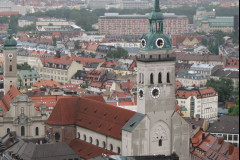
St. Luke's Church in Munich
Description
St. Luke's Church is the largest Protestant church in Munich, southern Germany. It was built in 1893-1896, designed by Albert Schmidt. St. Luke's is the only almost perfectly preserved Lutheran parish church of the historical Munich. St. Luke's is located on the banks of the Isar, between the Steinsdorfstraße and Mariannenplatz. Although the ground belongs to Mariannenplatz (Mariannenplatz 3), the main entrance is found at the Steinsdorfstraße. The two east towers and the almost 64 meter high dome shape the buildings on the western Isarkai. Although St. Luke's is called Dom der Münchner Protestanten (Cathedral of the Munich Protestants), the church is not a seat of a bishop.
History and description
The history of the Protestant church in Munich is rather short. The first Protestant groups early in the 16th century were banned and suppressed. Bavaria was a predominantly Catholic kingdom under the reigning Wittelsbach family from the time of the Reformation, but in 1799 the Wittelsbach head, Prince-elector Max IV Joseph married Friederike Karoline Wilhelmine; a Lutheran princess, and there was suddenly a Protestant presence at court in Munich. 19th century Munich also became a city with a growing number of immigrants from other regions of Germany, many of them Lutherans. In 1826, there were already 6,000 Lutheran parishioners in the city. The first Protestant church, St. Matthew, was inaugurated in 1833. It was demolished in 1938 by the Nazis and rebuilt after the World War II in another location. The second Protestant church, St. Mark's, was inaugurated in 1877. By the last decades of the 19th century, Munich’s Lutherans were in need of a third, and larger church. But the Bavarian royal family was concerned to protect the Catholic character of the city, therefore the Lutherans were given land on the banks of the river Isar to build St. Luke's. The first stone was laid on 29 June 1893 and the church was consecrated on the first Advent, 1896.
Architecture and art
The architect Albert Schmidt has used pre-Reformation styles in order to please the Roman Catholic city rulers: The exterior architecture is built in Romanesque forms, while the interior is reminiscent of the early Rhenish Gothic based on the geometric shape of a Greek cross. In the east there is a three-sided apse, the western facade is seven-sided and has square towers. St. Luke's had some artistically outstanding stained glass windows from 1896-1899. They had been created by the München Mayer'sche Hofkunstanstalt (Mayer's court art workshop Munich) after drafts of the Englishman Charles Dixon, one of the best renowned glass painter of his time. Those windows were destroyed irretrievably during the great air raid of the 6/7 September 1943. The lost windows of the chancel were replaced by new ones by Hermann Kaspar in 1946. The altar painting is a work of the artist Gustav Adolf Goldberg, which is dedicated to the Entombment of Christ.
Organ
The organ was built in 1932 by the G.F. Steinmeyer & Co. (Oettingen).
Street view
Reviews
We performed here several times during the Christmas season of 2001 and later in 2003, with the audiences always responding enthusiastically. The church staff treated us very well. Not to mention, this is another beautiful church...the catering was pretty good too.
The 64 metre high dome is what you notice first when approaching St. Lukas. Two tall towers stick out as well. The exterior of the church is Romanesque in appearance.
You enter the church from the main entrance from the east. Here you find a Neo-Gothic style interior laid out in the manner of a Greek cross. The main body of the church feels immense, particularly with the high ceiling. We enjoyed seeing the detailed stained-glass windows, the decorative altar and pulpit and carved wooden pews.
Overall, we liked our brief visit to St. Lukas even if it is a bit isolated from popular sightseeing areas. Those with limited time in Munich may prefer the high concentration of interesting historical churches around the Old Town. For those with more time on their hands, St. Lukas is a place worth passing by.