Bonn
Description
Bonn ), officially the Federal City of Bonn, is a city on the banks of the Rhine and northwest of the Siebengebirge (Seven Mountains) in the German state of North Rhine-Westphalia, with a population of 311,287 within its administrative limits. Bonn serves alongside the capital Berlin as the seat of government of Germany. The city is the second official seat and second official residence of the President of Germany, the Chancellor of Germany, the Bundesrat, and the first official seat and first official residence of six German federal ministries. Bonn is located in the southernmost part of the Rhine-Ruhr region, the largest metropolitan area of Germany, with over 11 million inhabitants.
Founded in the first century BC as a Roman settlement, Bonn is one of Germany's oldest cities. From 1597 to 1794, Bonn was the capital of the Electorate of Cologne and residence of the Archbishops and Prince-electors of Cologne. In 1949, the Parliamentary Council drafted and adopted the German constitution, the Basic Law for the Federal Republic of Germany in Bonn. Though Berlin was symbolically named the de jure capital, from 1949 to 1990, Bonn was the seat of government and de facto capital of West Germany. In recognition of its former status it holds the name of Federal City (Bundesstadt).
The two DAX-listed corporations Deutsche Post DHL and Deutsche Telekom have headquarters in Bonn. The city is also the location of 19 United Nations institutions and the University of Bonn. Bonn is the birthplace of Ludwig van Beethoven (born 1770).
History
History before 1945
The history of the city dates back to Roman times. In about 11 BC, the Roman army appears to have stationed a small unit in what is presently the historical centre of the city. Even earlier, the army had resettled members of a Germanic tribal group allied with Rome, the Ubii, in Bonn. The Latin name for that settlement, "Bonna", may stem from the original population of this and many other settlements in the area, the Eburoni. The Eburoni were members of a large tribal coalition effectively wiped out during the final phase of Caesar's War in Gaul. After several decades, the army gave up the small camp linked to the Ubii-settlement. During the 1st century AD, the army then chose a site to the north of the emerging town in what is now the section of Bonn-Castell to build a large military installation dubbed Castra Bonnensis, i.e., literally, "Fort Bonn". Initially built from wood, the fort was eventually rebuilt in stone. With additions, changes and new construction, the fort remained in use by the army into the waning days of the Western Roman Empire, possibly the mid-5th century. The structures themselves remained standing well into the Middle Ages, when they were called the Bonnburg. They were used by Frankish kings until they fell into disuse. Eventually, much of the building materials seem to have been re-used in the construction of Bonn's 13th-century city wall. The Sterntor (star gate) in the city centre is a reconstruction using the last remnants of the medieval city wall.
To date, Bonn's Roman fort remains the largest fort of its type known from the ancient world, i.e. a fort built to accommodate a full-strength Imperial Legion and its auxiliaries. The fort covered an area of approximately 250,000 square metres (62 acres). Between its walls it contained a dense grid of streets and a multitude of buildings, ranging from spacious headquarters and large officers' quarters to barracks, stables and a military jail. Among the legions stationed in Bonn, the "1st", i.e. the Prima Legio Minervia, seems to have served here the longest. Units of the Bonn legion were deployed to theatres of war ranging from modern-day Algeria to what is now the Russian republic of Chechnya.
The chief Roman road linking the provincial capitals of Cologne and Mainz cut right through the fort where it joined the fort's main road (now, Römerstraße). Once past the South Gate, the Cologne–Mainz road continued along what are now streets named Belderberg, Adenauerallee et al. On both sides of the road, the local settlement, Bonna, grew into a sizeable Roman town.
In late antiquity, much of the town seems to have been destroyed by marauding invaders. The remaining civilian population then took refuge inside the fort along with the remnants of the troops stationed here. During the final decades of imperial rule, the troops were supplied by Germanic chieftains employed by the Roman administration. When the end came, these troops simply shifted their allegiances to the new barbarian rulers. From the fort, the Bonnburg, as well as from a new medieval settlement to the South centred around what later became the minster, grew the medieval city of Bonn.
Between the 11th and 13th centuries, the Romanesque style Bonn Minster was built, and in 1597 Bonn became the seat of the Archdiocese of Cologne. The city gained more influence and grew considerably. The city was subject to a major bombardment during the Siege of Bonn in 1689. The elector Clemens August (ruled 1723–1761) ordered the construction of a series of Baroque buildings which still give the city its character. Another memorable ruler was Max Franz (ruled 1784–1794), who founded the university and the spa quarter of Bad Godesberg. In addition he was a patron of the young Ludwig van Beethoven, who was born in Bonn in 1770; the elector financed the composer's first journey to Vienna.
In 1794, the city was seized by French troops, becoming a part of the First French Empire. In 1815 following the Napoleonic Wars, Bonn became part of the Kingdom of Prussia. Administered within the Prussian Rhine Province, the city became part of the German Empire in 1871 during the Prussian-led unification of Germany. Bonn was of little relevance in these years.
History since 1945
During World War II, Bonn acquired military significance because of its strategic location on the Rhine River, which formed a natural barrier to easy penetration into the German heartland from the west. The Allied ground advance into Germany reached Bonn on 7 March 1945, and the US 1st Infantry Division captured the city during the battle of 8–9 March 1945.
Following World War II, Bonn was in the British zone of occupation, and in 1949 became the de facto capital of the newly formed Federal Republic of Germany (the de jure capital of the Federal Republic throughout the years of the Cold War division of Germany was always Berlin). Such "provisional" capital cities have been common in history; for example, the "official" capital of the Republic of China is still Nanjing on mainland China, with Taipei considered the provisional capital. The choice of Bonn was made mainly due to the advocacy of West Germany's first chancellor, Konrad Adenauer, a former Cologne Mayor and a native of that area. This was despite the fact that Frankfurt already had most of the required facilities and using Bonn was estimated to be 95 million DM more expensive than using Frankfurt. However, Adenauer and other prominent politicians intended to make Berlin the capital of the reunified Germany, and felt that locating the capital in a major city like Frankfurt or Hamburg would imply a permanent capital and weaken support in West Germany for reunification.
Because of its relatively small size for a capital city, Bonn was sometimes referred to, jokingly, as the Bundeshauptstadt ohne nennenswertes Nachtleben (Federal capital without noteworthy nightlife) or the Bundesdorf (Federal Village). At one point in the post-WWII/Cold War era, the U.S. Embassy in Bonn was America's largest, "comparable, with its thousands of staff, to the [U.S.] Baghdad embassy today".
German reunification in 1990 made Berlin the nominal capital of Germany again. This decision did not mandate that the republic's political institutions would also move. While some argued for the seat of government to move to Berlin, others advocated leaving it in Bonn—a situation roughly analogous to that of the Netherlands, where Amsterdam is the capital but The Hague is the seat of government. Berlin's previous history as united Germany's capital was strongly connected with Imperial Germany, the Weimar Republic and more ominously with Nazi Germany. It was felt that a new peacefully united Germany should not be governed from a city connected to such overtones of war. Additionally, Bonn was closer to Brussels, headquarters of the EU.
The heated debate that resulted was settled by the Bundestag (Germany's parliament) only on 20 June 1991. By a vote of 338–320, the Bundestag voted to move the seat of government to Berlin. The vote broke largely along regional lines, with legislators from the south and west favouring Bonn and legislators from the north and east voting for Berlin. It also broke along generational lines as well; older legislators with memories of Berlin's past glory favoured Berlin, while younger legislators favoured Bonn. Ultimately, the votes of the Ossi legislators tipped the balance in favour of Berlin.
While the government and parliament moved to Berlin, as a compromise, some of the ministries (such as Defence and Agriculture) largely remained in Bonn, with only the top officials based in Berlin. There was no plan to move these departments, and so Bonn remained a second, unofficial capital with the new title "Federal City" (Bundesstadt). Because of the necessary construction work, the move took until 1999 to complete. Over 8,000 of the 18,000 federal officials remain in Bonn.
At present, the private sector plays a major role in Bonn's economy. With five stock listed companies, Bonn has the 4th highest market capitalisation among German cities. With headquarters of DHL, T-Mobile and other renowned companies, managers have replaced the public sector.
View over central BonnMain sites
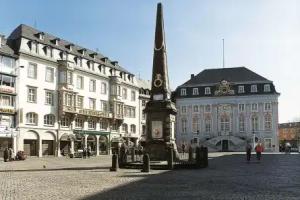
Beethoven's birthplace is located in Bonngasse near the market place. Next to the market place is the Old City Hall, built in 1737 in Rococo style, under the rule of Clemens August of Bavaria. It is used for receptions of guests of the city, and as an office for the mayor. Nearby is the Kurfürstliches Schloss, built as a residence for the prince-elector and now the main building of the University of Bonn.
The Poppelsdorfer Allee is an avenue flanked by chestnut trees which had the first horsecar of the city. It connects the Kurfürstliches Schloss with the Poppelsdorfer Schloss, a palace that was built as a resort for the prince-electors in the first half of the 18th century, and whose grounds are now a botanical garden (the Botanischer Garten Bonn). This axis is interrupted by a railway line and Bonn Hauptbahnhof, a building erected in 1883/84.
The Beethoven Monument stands on the Münsterplatz, which is flanked by the Bonn Minster, one of Germany's oldest churches.
The three highest buildings in the city are the radio mast of WDR in Bonn-Venusberg (180 m), the headquarters of the Deutsche Post called Post Tower (162.5 m) and the former building for the German members of parliament Langer Eugen (114.7 m) now the new location of the UN Campus.
Churches
- Bonn Minster
- Doppelkirche Schwarzrheindorf built in 1151
- Old Cemetery Bonn, one of the best known ones in Germany
- Kreuzbergkirche, built in 1627 with Johann Balthasar Neumann's Heilige Stiege, it is a stairway for Christian pilgrims
Castles and residences
- Godesburg fortress ruins
Modern buildings
- Beethovenhalle
- Bundesviertel (federal quarter) with lots of government structures including
- Post Tower, the tallest building in the state North Rhine-Westphalia, housing the headquarters of Deutsche Post/DHL
- Maritim Bonn, five-star hotel and convention centre
- Schürmann-Bau, headquarters of Deutsche Welle
- Langer Eugen, since 2006 the centre of the United Nations Campus, formerly housing the offices of the members of the German parliament
- Deutsche Telekom headquarters
- T-Mobile headquarters
- Kameha Grand, five-star hotel
Museums
- Museum Mile with
- Kunst- und Ausstellungshalle der Bundesrepublik Deutschland (Art and Exhibition Hall of the Federal Republic of Germany), showing the Guggenheim Collection in 2006–2007
- Kunstmuseum Bonn (Bonn Museum of Modern Art)
- Haus der Geschichte (Museum of the History of the Federal Republic of Germany)
- Museum Koenig where the Parlamentarischer Rat first met
- Beethoven House, birthplace of Ludwig van Beethoven
- Rheinisches Landesmuseum Bonn (Rhinish Regional Museum Bonn)
- Bonn Women's Museum
- August-Macke-Haus, museum dedicated to Expressionist painter August Macke
- Arithmeum
Nature
- Arboretum Park Härle, an arboretum with specimens dating to 1870
- Botanischer Garten (Botanical Garden), where Titan arum set a world record
- Rheinaue (Bonn), a leisure park on the banks of the Rhine
- Kottenforst, a large area of protected woods on the hills west of the city centre
- Rhine promenade and the Alter Zoll (Old Toll Station)
- In the very south of the city, on the border with Wachtberg and Rhineland-Palatinate, is an extinct volcano the Rodderberg
Transport
Bonn is connected to three autobahns (federal motorways) and the German rail network. Some InterCityExpress and most InterCity trains call at Bonn Hauptbahnhof whilst the Siegburg/Bonn railway station is situated on the Cologne–Frankfurt high-speed rail line outside of Bonn and serviced by InterCityExpress trains. Local transport is provided by the Bonn Stadtbahn, which also features two lines to Cologne.
Bonn's international airport is Cologne Bonn Airport.