


Munster

Description

Münster is an independent city in North Rhine-Westphalia, Germany. It is in the northern part of the state and is considered to be the cultural centre of the Westphalia region. It is also capital of the local government region Münsterland. Münster was the location of the Anabaptist rebellion during the Protestant Reformation and the site of the signing of the Treaty of Westphalia ending the Thirty Years' War in 1648. Today it is known as the bicycle capital of Germany.

Münster gained the status of a Großstadt (major city) with more than 100,000 inhabitants in 1915. Currently there are 300,000 people living in the city, with about 55,500 students, only some of whom are recorded in the official population statistics as having their primary residence in Münster.

History

Early history

In 793, Charlemagne sent out Ludger as a missionary to evangelise the Münsterland. In 797, Ludger founded a school that later became the Cathedral School. Gymnasium Paulinum traces its history back to the school. Ludger was ordained as the first bishop of Münster. The first cathedral was completed by 850. The combination of ford and crossroad, market place, episcopal administrative centre, library and school, established Münster as an important centre. In 1040, Heinrich III became the first king of Germany to visit Münster.

Middle Ages and early modern period

In the Middle Ages, the Prince-Bishopric of Münster was a leading member of the Hanseatic League.

In 1534, the Anabaptists led by John of Leiden, took power in the Münster Rebellion and founded a democratic proto-socialistic state. They claimed all property, burned all books except the Bible, and called it the "New Jerusalem". John of Leiden believed he would lead the elect from Münster to capture the entire world and purify it of evil with the sword in preparation for the Second Coming of Christ and the beginning of the Millennium. They went so far as to require all citizens to be naked as preparation for the Second Coming. However, the town was recaptured in 1535; the Anabaptists were tortured to death, their corpses were exhibited in metal baskets (often confused with cages), which can still be seen hanging from the Tower of St. Lambert's steeple.

Part of the signing of the Peace of Westphalia of 1648 was held in Münster. This ended the Thirty Years' War and the Eighty Years' War. It also guaranteed the future of the prince-bishop and the diocese; the area was to be exclusively Roman Catholic.

18th, 19th and early 20th centuries

The last outstanding palace of the German baroque period was created according to plans by Johann Conrad Schlaun. The University of Münster (today called "Westphalian Wilhelms-University", WWU) was established in 1780. Now a major European centre for excellence in education and research with large faculties in the arts, humanities, theology, sciences, business and law. Currently there are about 40,000 undergraduate and postgraduate students enrolled. In 1802 Münster was conquered by Prussia during the Napoleonic Wars. It was also part of the Grand Duchy of Berg between 1806 and 1811 and the Lippe department of the First French Empire between 1811 and 1813, before returning to Prussian rule. It became the capital of the Prussian province of Westphalia. A century later in 1899 the city's harbour started operations when the city was linked to the Dortmund-Ems Canal.

World War II

In the 1940s The Bishop of Münster, Cardinal Clemens August Graf von Galen, was one of the most prominent critics of the Nazi government. In retaliation for his success (The New York Times described Bishop von Galen as "the most obstinate opponent of the National Socialist anti-Christian program"), Münster was heavily garrisoned during World War II, and five large complexes of barracks are still a feature of the city. Münster was the headquarters (Hauptsitz) for the 6th Military District (Wehrkreis) of the German Wehrmacht, under the command of Infantry General (General der Infanterie) Gerhard Glokke. Originally made up of Westphalia and the Rhineland, after the Battle of France it was expanded to include the Eupen - Malmedy district of Belgium. The headquarters controlled military operations in Münster, Essen, Düsseldorf, Wuppertal, Bielefeld, Coesfeld, Paderborn, Herford, Minden, Detmold, Lingen, Osnabrück, Recklinghausen, Gelsenkirchen, and Cologne. Münster was the home station for the VI and XXIII Infantry Corps (Armeekorps), as well as the XXXIII and LVI Panzerkorps. Münster was also the home of the 6th, 16th and 25th Panzer Division; the 16th Panzergrenadier Division; and the 6th, 26th, 69th, 86th, 106th, 126th, 196th, 199th, 211th, 227th, 253rd, 254th, 264th, 306th, 326th, 329th, 336th, 371st, 385th, and 716th Infantry Divisions (Infanterie-division).

A secondary target of the Oil Campaign of World War II, Münster was bombed on October 25, 1944 by 34 diverted B-24 Liberator bombers, during a mission to a nearby primary target, the Scholven/Buer synthetic oil plant at Gelsenkirchen. About 91% of the Old City and 63% of the entire city was destroyed by Allied air raids. The US 17th Airborne Division, employed in a standard infantry role and not in a parachute capacity, attacked Münster with the British 6th Guards Tank Brigade on 2 April 1945 in a ground assault and fought its way into the contested city centre, which was cleared in urban combat on the following day.

Postwar period

From 1946 to 1998, there was a Latvian secondary school in Münster, and in 1947, one of the largest of about 93 Latvian libraries in the West was established in Münster.

In the 1950s the Old City was rebuilt to match its pre-war state, though many of the surrounding buildings were replaced with cheaper modern structures. It was also for several decades a garrison town for the British forces stationed in West Germany.

Post-reunification

In 2003, Münster hosted the Central European Olympiad in Informatics. In 2004, Münster won an honourable distinction: the LivCom-Award for the most livable city in the world with a population between 200,000 and 750,000. Münster is famous and liked for its bicycle friendliness and for the student character of the city that is due to the influence of its university, the Westfälische Wilhelms Universität Münster.

Geography

Geographic position

Münster is situated on the river Aa, approximately 15 kilometres (9 miles) south of its confluence with the Ems in the Westphalian Bight, a landscape studded with dispersed settlements and farms, the so-called "Münsterland". The Wolstonian sediments of the mountain ridge called "Münsterländer Kiessandzug" cross the city from north to south. The highest elevation is the Mühlenberg in the northwest of Münster, 97 metres above sea level. The lowest elevation is at the Ems with 44 m above sea level. The city centre is 60 m above sea level, measured at the Prinzipalmarkt in front of the historic city hall.

The Dutch city of Enschede is about 65 km (40 mi) northwest of Münster. Other major cities nearby include Osnabrück, about 44 km (27 mi) to the north, Dortmund, about 61 km (38 mi) to the south, and Bielefeld, about 62 km (39 mi) to the east.

Münster is one of the 42 agglomeration areas and one of Germany's biggest cities in terms of area. But this includes substantial sparsely populated, rural districts which were formerly separate local government authorities until they were amalgamated in 1975. Thus nearly half the city's area is agricultural, resulting in a low population density of approximately 900 inhabitants per km².

Population density

The city's built-up area is quite extensive. There are no skyscrapers and few high-rise buildings but very many detached houses and mansions. Still the population density reaches about 15,000 inhabitants per km² in the city centre. Calculating the population density based on the actual populated area results in approximately 2890 inhabitants per km². Münster's urban area of 302.91 square kilometres (116.95 sq mi) is distributed into 57.54 square kilometres (22.22 sq mi) covered with buildings while 0.99 km2 (0.38 sq mi) are used for maintenance and 25.73 km2 (9.93 sq mi) for traffic areas, 156.61 km2 (60.47 sq mi) for agriculture and recreation, 8.91 km2 (3.44 sq mi) are covered by water, 56.69 km2 (21.89 sq mi) is forested and 6.23 km2 (2.41 sq mi) is used otherwise. The perimeter has a length of 107 kilometres (66 miles), the largest extend of the urban area in north–south direction is 24.4 km (15.2 mi), in east–west direction 20.6 km (12.8 mi).

Adjacent cities and districts

Münster borders on the following cities and municipalities, named clockwise and beginning in the northwest: Altenberge and Greven (District of Steinfurt), Telgte, Everswinkel, Sendenhorst and Drensteinfurt (District of Warendorf), as well as Ascheberg, Senden and Havixbeck (District of Coesfeld).

City boroughs

The city is divided into six administrative districts or Stadtbezirke: "Mitte" (Middle), "Nord" (North), "Ost" (East), "West", "Süd-Ost" (South-East) and "Hiltrup". Each district is represented by a council of 19 representatives elected in local elections. Heading each council is the district mayor, or Bezirksvorsteher. Every district is subdivided into residential quarters (Wohnbereiche). This official term, however, is not used in common speech, as there are no discrete definitions of the individual quarters. The term "Stadtteil" is used instead, mainly referring to the incorporated communities. The districts are also divided into 45 statistical districts.

The following list names each district with its residential and additional quarters. These are the official names, which partly differ from the usage in common speech.

  • Mitte:
    • Kernbereich (Centre)
  • Nord:
    • Münster-Coerde|Coerde
    • Kinderhaus
    • Sprakel with Sandrup
  • Ost:
    • Dyckburg, consisting of Mariendorf and Sudmühle
    • Gelmer with Gittrup
    • Handorf with Kasewinkel, Kreuzbach, Laer, Dorbaum and Verth on the left bank of the Ems and Werse
    • Mauritz-Ost and Mondstraße, combined better known as St. Mauritz
  • West:
    • Albachten
    • Gievenbeck
    • Mecklenbeck
    • Nienberge with Häger, Schönebeck and Uhlenbrock
    • Roxel with Altenroxel and Oberort
    • Sentruper Höhe
  • Süd-Ost:
    • Angelmodde with Hofkamp
    • Gremmendorf with Loddenheide
    • Wolbeck
  • Hiltrup:
    • Amelsbüren with Sudhoff, Loevelingloh and Wilbrenning
    • Berg Fidel
    • Hiltrup

The centre can be subdivided into historically evolved city districts whose borders are not always strictly defined, such as

  • Aaseestadt
  • Erphoviertel
  • Geistviertel'
  • Hansaviertel
  • Herz-Jesu-Viertel
  • Kreuzviertel
  • Kuhviertel
  • Mauritzviertel
  • Neutor
  • Pluggendorf
  • Rumphorst
  • Schlossviertel
  • Südviertel
  • Uppenberg
  • Zentrum Nord

Main sights

  • St. Paul's Cathedral, built in the 13th century in a mixture of late Romanesque and early Gothic styles. It was completely restored after World War II. It includes an astronomical clock of 1540, adorned with hand-painted zodiac symbols, which traces the movement of the planets, and plays a Glockenspiel tune every noon.
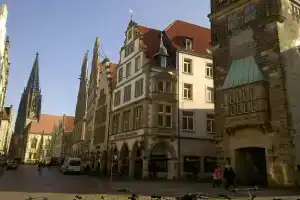
  • The Prinzipalmarkt, the main shopping street in the city centre with the Gothic town hall (14th century) in which the Peace of Westphalia treaty which put an end to the Thirty Years' War was signed in 1648. Immediately north of the Prinzipalmarkt is the Roggenmarkt.
  • St Lambert's Church (1375), with three cages hanging from its tower above the clock face. In 1535 these cages were used to display the corpses of Jan van Leiden and other leaders of the Münster Rebellion, who promoted polygamy and renunciation of all property.
  • The Schloss (palace), built in 1767–87 as residence for the prince-bishops by the Baroque architect Johann Conrad Schlaun and Wilhelm Ferdinand Lipper. Now the administrative centre for the University.
  • The Botanischer Garten Münster, a botanical garden founded in 1803.
  • The Zwinger fortress built in 1528. Used from the 18th to the 20th century as a prison. During World War II, the Gestapo used the Zwinger also for executions.
  • "Krameramtshaus" (1589), an old guild house, which housed the delegation from the Netherlands during the signing of the Peace of Westphalia.
  • Stadthaus (1773)
  • Haus Rüschhaus (1743–49), a country estate situated in Nienberge, built by Johann Conrad Schlaun for himself
  • Erbdrostenhof (1749–53), a Baroque palace, also built by Schlaun, residence of Droste zu Vischering noble family and birthplace of Blessed Mary of the Divine Heart.
  • Clemenskirche (1745–53), a Baroque church, also built by Schlaun
  • Signal-Iduna Building (1961), the first high-rise building in Münster.
  • LVM-Building, high-rise building near the Aasee.
  • LBS-Building, location of Münster's first zoo. Some old structures of the former zoo can be found in the park around the office building. Also the "Tuckesburg", the strange-looking house of the zoo-founder, is still intact.
  • "Münster Arkaden" (2006), new shopping centre between Prinzipalmarkt and the Pablo Picasso Museum of Graphic Art.
  • "Cavete", the oldest academic pub in Münster
  • Westphalian State Museum of Art and Cultural History
  • University Bible museum
  • Town Museum ("Stadtmuseum"), exhibition of a large collection showing the political and cultural history of the city from its beginning up to present, housed by a converted former department store
  • University Mineralogical Museum
  • Westphalian Horse Museum ("Hippomax")
  • Mühlenhof open-air museum, depicting a typical Westphalian village as it looked centuries ago
  • Westphalian Museum for Natural History, state museum and planetarium
  • West Prussian State Museum ("Drostenhof Wolbeck")
  • Museum of Lacquer Art (founded and operated by the company BASF Coatings)
  • Pablo Picasso Museum of Graphic Art, the only museum devoted exclusively to the graphic works of Pablo Picasso
  • Pinkus Müller the only brewery left in Münster of original more than 150.

Transportation

Bicycling

Münster claims to be the bicycle capital of Germany. It states that in 2007, vehicle traffic (36.4%) fell below traffic by bicycle (37.6%), even though it is unclear how such a figure is defined. The city maintains an extensive network for bicycles including the popular "Promenade" which encircles Münster's city centre. While motorised vehicles are banned, there are paths for pedestrians. Additional bicycle paths link all city districts with the inner city and special traffic lights provide signals for bicyclists. Bicycle stations in Münster offer bicycle rentals.

Train

Münster's Central Station is on the Wanne-Eickel–Hamburg railway. The city is connected by Intercity trains to a lot of other German major cities.

British forces

After the Second World War, Münster became a major station within Osnabrück Garrison, part of British Forces Germany. Their presence was gradually reduced, yet there are still many active military bases. The last forces left Münster on 4 July 2013.

Street view

Hotels

2 guests
Adults2+
Children under 170+
Age7+
Age7+
Age7+
Age7+
Age7+
Age7+
Age7+
Age7+
Age7+
Age7+
Search hotel

Reviews

Share your experiences, help others make the right choice!
Think about what you would like to know if you were looking for a review about a place to relax. Please describe in detail what you liked and what you didn't. What would you advise to other guests and to the hotel owner. The more fully you tell about the hotel, the easier it will be for other people to make a choice and they will be very grateful to you!

Map

X