Gallipoli

Description

Gallipoli , meaning "Beautiful City"; Sicilian: Caḍḍìpuli) is a southern Italian town and comune in the province of Lecce, in Apulia. In 2014, it had a population of 31,862.

Geography

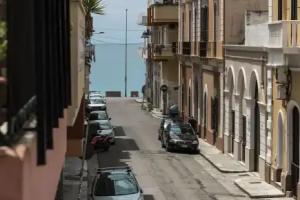
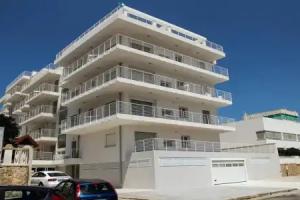
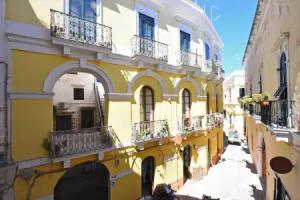
The town is located by the Ionian Sea, on the west coast of the Salentina Peninsula. The town of Gallipoli is divided into two parts, the modern and the old city. The new town includes all the newest buildings including a skyscraper. The old town is located on a limestone island, linked to the mainland by a bridge built in the 16th century.

The municipality borders with Alezio, Galatone, Matino, Sannicola and Taviano. It counts the hamlets (frazioni) of Baia Verde, Lido Conchiglie, Lido San Giovanni, Rivabella and Torre del Pizzo.

History

According to a legend, the city was founded in ancient times by Idomeneus of Crete. Pliny the Elder attributes the foundation to the Senones Gauls, while more likely it was a Messapic settlement. Historically, what is known is that Gallipoli was a city of the Greater Greece, ruling over a large territory including today's Porto Cesareo. In 265 BC it sided with Pyrrhus and Taranto against ancient Rome, suffering a defeat which relegated to a Roman colony (later a municipium).

In the early Middle Ages, it was most likely sacked by the Vandals and the Goths. Rebuilt by the Byzantines, Gallipoli lived an economically and socially flourishing period due to its geographical position. Later it was owned by the Roman Popes, and was a centre of fighting against the Greek monastic orders.

In the 11th century Gallipoli was conquered by the Normans and, in 1268, it was besieged by Charles I of Anjou, causing numerous inhabitants to flee to the nearby Alezio. The city was repopulated around 1300, under the feudal rule of the principality of Taranto. In 1484 the Venetians tried to occupy it, but without results. King Ferdinand I of the Two Sicilies started the construction of the port, which in the 18th century became the largest olive oil market in the Mediterranean.

After the unification of Italy (1861), Gallipoli was capital of a circondario, together with Lecce and Taranto.

Main sights

  • Angevine-Aragonese Castle, built in the 13th century by the Byzantines. It was largely remade under the Angevines and the Aragonese, who added a polygonal wall fortified with round towers. The main additions were carried on by Francesco di Giorgio Martini, who worked for King Alfonso II of Naples. In 1522 an eastern bastion, known as Rivellino, was built which is defended by waters on three sides.
  • 14th century walls (renewed by the Spaniards in the 16th century). Originally they had 12 towers or bastions.
  • Baroque cathedral of Sant'Agata (17th century). It has a richly decorated façade in carparo, a local limestone, with niches featuring statues of saints. The interior is on the Latin cross plan, with Baroque altars, including a polychrome high altar by Cosimo Fanzago.
  • Church of St. Francis of Paola (1621)
  • Church of St. Francis of Assisi, built in the 13th century but renovated several times later. It is home to a stone nativity scene by Stefano da Putignano (late 16th century)
  • Church of San Domenico al Rosario (late 17th century), annexed to a former Dominican convent.
  • Church of the Holy Crucifix (1750)
  • Church of Santa Maria della Purità (1661). The richly decorated interior houses, at the marble high altar, a canvas by Luca Giordano depicting the Madonna della Purità between st. Joseph and St. Francis of Assisi.
  • Greek Fountain (16th century), once believed to date to the 3rd century BC. It has bas-reliefs with mythological figures and, on the other façade, the insignia of Charles III of Spain.
  • Palazzo Pirelli (16th century), with mythological-theme decorations in the vault of former entrance archway which was converted to a pharmacy in the 19th century.
  • Church of San Pietro dei Samari, outside the city. It was built in by a Crusader knight, Ugo di Lusignano in 1148.
  • Spiaggia la Puritate beach under the city walls.

Transportation

Nearest airports are Brindisi, 88 kilometres (55 mi), and Bari, 200 kilometres (120 mi). Gallipoli can be reached from both of them via a modern freeway, the state road 101.

By train, it is connected to Lecce by the Ferrovie Sud-Est.

Street view
Hotels

2 guests
Adults2+
Children under 170+
Age7+
Age7+
Age7+
Age7+
Age7+
Age7+
Age7+
Age7+
Age7+
Age7+
Search hotel

Reviews

Share your experiences, help others make the right choice!
Think about what you would like to know if you were looking for a review about a place to relax. Please describe in detail what you liked and what you didn't. What would you advise to other guests and to the hotel owner. The more fully you tell about the hotel, the easier it will be for other people to make a choice and they will be very grateful to you!

Map

X