New York City

Description

Part of a series on Regions of New York Downstate New York
  • New York City
  • Long Island
  • Hudson Valley (Lower)
Upstate New York
  • Hudson Valley (Upper)
  • Capital District
  • North Country
  • Southern Tier
  • Mohawk Valley
  • Central New York
  • Finger Lakes
  • Western New York
Administrative divisions
  • Counties
  • Cities
  • Towns
  • Indian reservations
  • Villages
  • Census-designated places
  • Places (including hamlets)
Timelines of town creation
  • Downstate New York
  • Hudson Valley
  • Capital District
  • North Country
  • Central New York
  • Southern Tier
  • Western New York
  • v
  • t
  • e

The City of New York, often called New York City, New York, or simply The City, is the most populous city in the United States. Located at the southern tip of the state of New York, the city is the center of the New York metropolitan area, one of the most populous urban agglomerations in the world. With a U.S. Census Bureau-estimated 2015 population of 8,550,405 distributed over a land area of just 305 square miles (790 km2), New York is also the most densely populated major city in the United States. A global power city, New York City exerts a significant impact upon commerce, finance, media, art, fashion, research, technology, education, and entertainment, its fast pace defining the term New York minute. Home to the headquarters of the United Nations, New York is an important center for international diplomacy and has been described as the cultural and financial capital of the world.

Situated on one of the world's largest natural harbors, New York City consists of five boroughs, each of which is a separate county of New York State. The five boroughs – Brooklyn, Queens, Manhattan, The Bronx, and Staten Island – were consolidated into a single city in 1898. The city and its metropolitan area constitute the premier gateway for legal immigration to the United States, and as many as 800 languages are spoken in New York, making it the most linguistically diverse city in the world. By 2015 estimates, the New York City metropolitan region remains by a significant margin the most populous in the United States, as defined by both the Metropolitan Statistical Area (20.2 million residents) and the Combined Statistical Area (23.7 million residents). In 2013, the MSA produced a gross metropolitan product (GMP) of nearly US$1.39 trillion, while in 2012, the CSA generated a GMP of over US$1.55 trillion, both ranking first nationally by a wide margin and behind the GDP of only twelve and eleven countries, respectively.

New York City traces its origin to its 1624 founding in Lower Manhattan as a trading post by colonists of the Dutch Republic and was named New Amsterdam in 1626. The city and its surroundings came under English control in 1664 and were renamed New York after King Charles II of England granted the lands to his brother, the Duke of York. New York served as the capital of the United States from 1785 until 1790. It has been the country's largest city since 1790. The Statue of Liberty greeted millions of immigrants as they came to the Americas by ship in the late 19th and early 20th centuries and is a symbol of the United States and its democracy. In the 21st century, New York has emerged as a global node of creativity and entrepreneurship, social tolerance, and environmental sustainability.

Many districts and landmarks in New York City have become well known, and the city received a record of nearly 60 million tourists in 2015, hosting three of the world's ten most visited tourist attractions in 2013. Several sources have ranked New York the most photographed city in the world. Times Square, iconic as the world's "heart" and its "Crossroads", is the brightly illuminated hub of the Broadway Theater District, one of the world's busiest pedestrian intersections, and a major center of the world's entertainment industry. The names of many of the city's bridges, tapered skyscrapers, and parks are known around the world. Anchored by Wall Street in the Financial District of Lower Manhattan, New York City has been called both the most economically powerful city and the leading financial center of the world, and the city is home to the world's two largest stock exchanges by total market capitalization, the New York Stock Exchange and NASDAQ. Manhattan's real estate market is among the most expensive in the world. Manhattan's Chinatown incorporates the highest concentration of Chinese people in the Western Hemisphere, with multiple signature Chinatowns developing across the city. Providing continuous 24/7 service, the New York City Subway is one of the most extensive metro systems worldwide, with 469 stations in operation. Over 120 colleges and universities are located in New York City, including Columbia University, New York University, and Rockefeller University, which have been ranked among the top 35 in the world.

History

Etymology and early history

During the Wisconsinan glaciation, the New York City region was situated at the edge of a large ice sheet over 1,000 feet in depth. The ice sheet scraped away large amounts of soil, leaving the bedrock that serves as the geologic foundation for much of New York City today. Later on, movement of the ice sheet would contribute to the separation of what are now Long Island and Staten Island.

In the precolonial era, the area of present-day New York City was inhabited by various bands of Algonquian tribes of Native Americans, including the Lenape, whose homeland, known as Lenapehoking, included Staten Island; the western portion of Long Island, including the area that would become Brooklyn and Queens; Manhattan; the Bronx; and the Lower Hudson Valley.

The first documented visit by a European was in 1524 by Giovanni da Verrazzano, a Florentine explorer in the service of the French crown, who sailed his ship La Dauphine into New York Harbor. He claimed the area for France and named it "Nouvelle Angoulême" (New Angoulême).

A Spanish expedition led by captain Estêvão Gomes, a Portuguese sailing for Emperor Charles V, arrived in New York Harbor in January 1525 aboard the purpose-built caravel La Anunciada and charted the mouth of the Hudson River, which he named Rio de San Antonio. Heavy ice kept him from further exploration, and he returned to Spain in August. The Padrón Real of 1527, the first scientific map to show North America's east coast continuously, was informed by Gomes' expedition and labeled the Northeastern U.S. as Tierra de Esteban Gómez in his honor.

In 1609, the English explorer Henry Hudson re-discovered the region when he sailed his ship the Halve Maen ("Half Moon" in Dutch) into New York Harbor while searching for the Northwest Passage to the Orient for the Dutch East India Company. He proceeded to sail up what the Dutch would name the North River (now the Hudson River), named first by Hudson as the Mauritius after Maurice, Prince of Orange. Hudson's first mate described the harbor as "a very good Harbour for all windes" and the river as "a mile broad" and "full of fish." Hudson sailed roughly 150 miles north, past the site of the present-day Albany, in the belief that it might be an oceanic tributary before the river became too shallow to continue. He made a ten-day exploration of the area and claimed the region for the Dutch East India Company. In 1614, the area between Cape Cod and Delaware Bay would be claimed by the Netherlands and called Nieuw-Nederland (New Netherland).

The first non-Native American inhabitant of what would eventually become New York City was Dominican trader Juan Rodriguez (transliterated to Dutch as Jan Rodrigues). Born in Santo Domingo of Portuguese and African descent, he arrived in Manhattan during the winter of 1613–1614, trapping for pelts and trading with the local population as a representative of the Dutch. Broadway, from 159th Street to 218th Street, is named Juan Rodriguez Way in his honor.

A permanent European presence in New Netherland began in 1624 – making New York the 12th oldest continuously occupied European-established settlement in the continental United States – with the founding of a Dutch fur trading settlement on Governors Island. In 1625, construction was started on a citadel and Fort Amsterdam on Manhattan Island, later called New Amsterdam (Nieuw Amsterdam). The colony of New Amsterdam was centered at the site which would eventually become Lower Manhattan. In 1626, the Dutch colonial Director-General Peter Minuit, acting as charged by the Dutch West India Company, purchased the island of Manhattan from the Canarsie, a small Lenape band, for 60 guilders (about $1,000 in 2006). A disproved legend claims that Manhattan was purchased for $24 worth of glass beads.

Following the purchase, New Amsterdam grew slowly. To attract settlers, the Dutch instituted the patroon system in 1628, whereby wealthy Dutchmen ("patroons", or patrons) who brought 50 colonists to New Netherland would be awarded swathes of land in New Netherland, along with local political autonomy and rights to participate in the lucrative fur trade. This program had little success.

Since 1621, the Dutch West India Company had operated as a monopoly in New Netherland, on authority granted by the Dutch States General. In 1639–1640, in an effort to bolster economy growth, the Dutch West India Company relinquished its monopoly over the fur trade in New Netherland, leading to growth in the production and trade of food, timber, tobacco, and slaves (particularly with the Dutch West Indies).

In 1647, Peter Stuyvesant began his tenure as the last Director-General of New Netherland. During his tenure, the population of New Amsterdam grew from 2,000 to 8,000. Stuyvesant has been credited with improving law and order in the colony; however, he also earned a reputation as a despotic leader. He instituted regulations on liquor sales, attempted to assert control over the Dutch Reformed Church, and blocked other religious groups (including Quakers, Jews, and Lutherans) from establishing houses of worship. The Dutch West India Company would eventually attempt to ease tensions between Stuyvesant and residents of New Amsterdam.

In 1664, unable to summon any significant resistance, Stuyvesant surrendered New Amsterdam to English troops led by Colonel Richard Nicolls without bloodshed. The terms of the surrender permitted Dutch residents to remain in the colony and allowed for religious freedom. The English promptly renamed the fledgling city "New York" after the Duke of York (the future King James II of England). The transfer was confirmed in 1667 by the Treaty of Breda, which concluded the Second Anglo-Dutch War.

On August 24, 1673, during the Third Anglo-Dutch War, Dutch captain Anthony Colve seized the colony of New York from England at the behest of Cornelis Evertsen the Youngest and rechristened it "New Orange" after William III, the Prince of Orange. The Dutch would soon return the island to England under the Treaty of Westminster of November 1674.

Several intertribal wars among the Native Americans and some epidemics brought on by contact with the Europeans caused sizable population losses for the Lenape between the years 1660 and 1670. By 1700, the Lenape population had diminished to 200.

New York experienced several yellow fever epidemics in the 18th century, losing ten percent of its population to the disease in 1702.

New York grew in importance as a trading port while under British rule in the early 1700s. It also became a center of slavery, with 42% of households holding slaves by 1730, more than any other city other than Charleston, South Carolina. Most slaveholders held a few or several domestic slaves, but others hired them out to work at labor. Slavery became integrally tied to New York's economy through the labor of slaves throughout the port, and the banks and shipping tied to the American South. Discovery of the African Burying Ground in the 1990s, during construction of a new federal courthouse near Foley Square, revealed that tens of thousands of Africans had been buried in the area in the colonial years.

The 1735 trial and acquittal in Manhattan of John Peter Zenger, who had been accused of seditious libel after criticizing colonial governor William Cosby, helped to establish the freedom of the press in North America. In 1754, Columbia University was founded under charter by King George II as King's College in Lower Manhattan. The Stamp Act Congress met in New York in October 1765 as the Sons of Liberty organized in the city, skirmishing over the next ten years with British troops stationed there.

The Battle of Long Island, the largest battle of the American Revolutionary War, was fought in August 1776 entirely within the modern-day borough of Brooklyn. After the battle, in which the Americans were defeated, the British made the city their military and political base of operations in North America. The city was a haven for Loyalist refugees and escaped slaves who joined the British lines for freedom newly promised by the Crown for all fighters. As many as 10,000 escaped slaves crowded into the city during the British occupation. When the British forces evacuated at the close of the war in 1783, they transported 3,000 freedmen for resettlement in Nova Scotia. They resettled other freedmen in England and the Caribbean.

The only attempt at a peaceful solution to the war took place at the Conference House on Staten Island between American delegates, including Benjamin Franklin, and British general Lord Howe on September 11, 1776. Shortly after the British occupation began, the Great Fire of New York occurred, a large conflagration on the West Side of Lower Manhattan, which destroyed about a quarter of the buildings in the city, including Trinity Church.

In 1785, the assembly of the Congress of the Confederation made New York the national capital shortly after the war. New York was the last capital of the U.S. under the Articles of Confederation and the first capital under the Constitution of the United States. In 1789, the first President of the United States, George Washington, was inaugurated; the first United States Congress and the Supreme Court of the United States each assembled for the first time, and the United States Bill of Rights was drafted, all at Federal Hall on Wall Street. By 1790, New York had surpassed Philadelphia as the largest city in the United States.

Under New York State's gradual abolition act of 1799, children of slave mothers were to be eventually liberated but to be held in indentured servitude until their mid-to-late twenties. Together with slaves freed by their masters after the Revolutionary War and escaped slaves, a significant free-black population gradually developed in Manhattan. Under such influential United States founders as Alexander Hamilton and John Jay, the New York Manumission Society worked for abolition and established the African Free School to educate black children. It was not until 1827 that slavery was completely abolished in the state, and free blacks struggled afterward with discrimination. New York interracial abolitionist activism continued; among its leaders were graduates of the African Free School. The city's black population reached more than 16,000 in 1840.

In the 19th century, the city was transformed by development relating to its status as a trading center, as well as by European immigration. The city adopted the Commissioners' Plan of 1811, which expanded the city street grid to encompass all of Manhattan. The 1825 completion of the Erie Canal through central New York connected the Atlantic port to the agricultural markets and commodities of the North American interior via the Hudson River and the Great Lakes. Local politics became dominated by Tammany Hall, a political machine supported by Irish and German immigrants.

Several prominent American literary figures lived in New York during the 1830s and 1840s, including William Cullen Bryant, Washington Irving, Herman Melville, Rufus Wilmot Griswold, John Keese, Nathaniel Parker Willis, and Edgar Allan Poe. Public-minded members of the contemporaneous business elite lobbied for the establishment of Central Park, which in 1857 became the first landscaped park in an American city.

Modern history

The Great Irish Famine brought a large influx of Irish immigrants. Over 200,000 were living in New York by 1860, upwards of a quarter of the city's population. There was also extensive immigration from the German provinces, where revolutions had disrupted societies, and Germans comprised another 25% of New York's population by 1860.

Democratic Party candidates were consistently elected to local office, increasing the city's ties to the South and its dominant party. In 1861, Mayor Fernando Wood called on the aldermen to declare independence from Albany and the United States after the South seceded, but his proposal was not acted on. Anger at new military conscription laws during the American Civil War (1861–1865), which spared wealthier men who could afford to pay a $300 (equivalent to $5,775 in 2015) commutation fee to hire a substitute, led to the Draft Riots of 1863, whose most visible participants were ethnic Irish working class. The situation deteriorated into attacks on New York's elite, followed by attacks on black New Yorkers and their property after fierce competition for a decade between Irish immigrants and black people for work. Rioters burned the Colored Orphan Asylum to the ground, with more than 200 children escaping harm due to efforts of the New York City Police Department, which was mainly made up of Irish immigrants. According to historian James M. McPherson (2001), at least 120 people were killed. In all, eleven black men were lynched over five days, and the riots forced hundreds of blacks to flee the city for Williamsburg, Brooklyn, and New Jersey; the black population in Manhattan fell below 10,000 by 1865, which it had last been in 1820. The white working class had established dominance. Violence by longshoremen against black men was especially fierce in the docks area. It was one of the worst incidents of civil unrest in American history.

In 1898, the modern City of New York was formed with the consolidation of Brooklyn (until then a separate city), the County of New York (which then included parts of the Bronx), the County of Richmond, and the western portion of the County of Queens. The opening of the subway in 1904, first built as separate private systems, helped bind the new city together. Throughout the first half of the 20th century, the city became a world center for industry, commerce, and communication.

In 1904, the steamship General Slocum caught fire in the East River, killing 1,021 people on board. In 1911, the Triangle Shirtwaist Factory fire, the city's worst industrial disaster, took the lives of 146 garment workers and spurred the growth of the International Ladies' Garment Workers' Union and major improvements in factory safety standards.

New York's non-white population was 36,620 in 1890. New York City was a prime destination in the early twentieth century for African Americans during the Great Migration from the American South, and by 1916, New York City was home to the largest urban African diaspora in North America. The Harlem Renaissance of literary and cultural life flourished during the era of Prohibition. The larger economic boom generated construction of skyscrapers competing in height and creating an identifiable skyline.

New York became the most populous urbanized area in the world in the early 1920s, overtaking London. The metropolitan area surpassed the 10 million mark in the early 1930s, becoming the first megacity in human history. The difficult years of the Great Depression saw the election of reformer Fiorello La Guardia as mayor and the fall of Tammany Hall after eighty years of political dominance.

Returning World War II veterans created a post-war economic boom and the development of large housing tracts in eastern Queens. New York emerged from the war unscathed as the leading city of the world, with Wall Street leading America's place as the world's dominant economic power. The United Nations Headquarters was completed in 1952, solidifying New York's global geopolitical influence, and the rise of abstract expressionism in the city precipitated New York's displacement of Paris as the center of the art world.

The Stonewall riots were a series of spontaneous, violent demonstrations by members of the gay community against a police raid that took place in the early morning hours of June 28, 1969, at the Stonewall Inn in the Greenwich Village neighborhood of Lower Manhattan. They are widely considered to constitute the single most important event leading to the gay liberation movement and the modern fight for LGBT rights in the United States.

In the 1970s, job losses due to industrial restructuring caused New York City to suffer from economic problems and rising crime rates. While a resurgence in the financial industry greatly improved the city's economic health in the 1980s, New York's crime rate continued to increase through that decade and into the beginning of the 1990s. By the mid 1990s, crime rates started to drop dramatically due to revised police strategies, improving economic opportunities, gentrification, and new residents, both American transplants and new immigrants from Asia and Latin America. Important new sectors, such as Silicon Alley, emerged in the city's economy. New York's population reached all-time highs in the 2000 Census and then again in the 2010 Census.

The city and surrounding area suffered the bulk of the economic damage and largest loss of human life in the aftermath of the September 11, 2001 attacks when 10 of the 19 terrorists associated with Al-Qaeda piloted American Airlines Flight 11 into the North Tower of the World Trade Center and United Airlines Flight 175 into the South Tower of the World Trade Center, and later destroyed them, killing 2,192 civilians, 343 firefighters, and 71 law enforcement officers who were in the towers and in the surrounding area. The rebuilding of the area, has created a new One World Trade Center, and a 9/11 memorial and museum along with other new buildings and infrastructure. The World Trade Center PATH station, which opened on July 19, 1909 as the Hudson Terminal, was also destroyed in the attack. A temporary station was built and opened on November 23, 2003. A permanent station, the World Trade Center Transportation Hub, is currently under construction. The new One World Trade Center is the tallest skyscraper in the Western Hemisphere and the fourth-tallest building in the world by pinnacle height, with its spire reaching a symbolic 1,776 feet (541.3 m) in reference to the year of American independence.

The Occupy Wall Street protests in Zuccotti Park in the Financial District of Lower Manhattan began on September 17, 2011, receiving global attention and spawning the Occupy movement against social and economic inequality worldwide.

Geography

New York City is situated in the Northeastern United States, in southeastern New York State, approximately halfway between Washington, D.C. and Boston. The location at the mouth of the Hudson River, which feeds into a naturally sheltered harbor and then into the Atlantic Ocean, has helped the city grow in significance as a trading port. Most of New York City is built on the three islands of Long Island, Manhattan, and Staten Island.

The Hudson River flows through the Hudson Valley into New York Bay. Between New York City and Troy, New York, the river is an estuary. The Hudson River separates the city from the U.S. state of New Jersey. The East River—a tidal strait—flows from Long Island Sound and separates the Bronx and Manhattan from Long Island. The Harlem River, another tidal strait between the East and Hudson Rivers, separates most of Manhattan from the Bronx. The Bronx River, which flows through the Bronx and Westchester County, is the only entirely fresh water river in the city.

The city's land has been altered substantially by human intervention, with considerable land reclamation along the waterfronts since Dutch colonial times; reclamation is most prominent in Lower Manhattan, with developments such as Battery Park City in the 1970s and 1980s. Some of the natural relief in topography has been evened out, especially in Manhattan.

The city's total area is 468.9 square miles (1,214 km2). 164.1 sq mi (425 km2) of this is water and 304.8 sq mi (789 km2) is land. The highest point in the city is Todt Hill on Staten Island, which, at 409.8 feet (124.9 m) above sea level, is the highest point on the Eastern Seaboard south of Maine. The summit of the ridge is mostly covered in woodlands as part of the Staten Island Greenbelt.

Architecture

Further information: Architecture of New York City and List of tallest buildings in New York City

New York has architecturally noteworthy buildings in a wide range of styles and from distinct time periods, from the saltbox style Pieter Claesen Wyckoff House in Brooklyn, the oldest section of which dates to 1656, to the modern One World Trade Center, the skyscraper at Ground Zero in Lower Manhattan and the most expensive office tower in the world by construction cost.

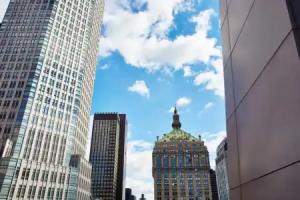
Manhattan's skyline, with its many skyscrapers, is universally recognized, and the city has been home to several of the tallest buildings in the world. As of 2011, New York City had 5,937 high-rise buildings, of which 550 completed structures were at least 330 feet (100 m) high, both second in the world after Hong Kong, with over 50 completed skyscrapers taller than 656 feet (200 m). These include the Woolworth Building (1913), an early gothic revival skyscraper built with massively scaled gothic detailing.

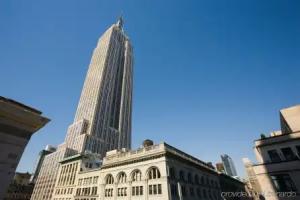
The 1916 Zoning Resolution required setbacks in new buildings and restricted towers to a percentage of the lot size, to allow sunlight to reach the streets below. The Art Deco style of the Chrysler Building (1930) and Empire State Building (1931), with their tapered tops and steel spires, reflected the zoning requirements. The buildings have distinctive ornamentation, such as the eagles at the corners of the 61st floor on the Chrysler Building, and are considered some of the finest examples of the Art Deco style. A highly influential example of the international style in the United States is the Seagram Building (1957), distinctive for its façade using visible bronze-toned I-beams to evoke the building's structure. The Condé Nast Building (2000) is a prominent example of green design in American skyscrapers and has received an award from the American Institute of Architects and AIA New York State for its design.

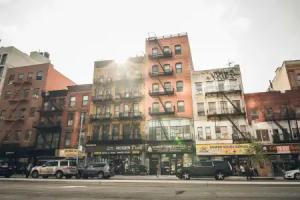
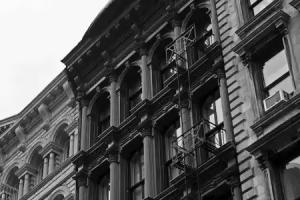
The character of New York's large residential districts is often defined by the elegant brownstone rowhouses and townhouses and shabby tenements that were built during a period of rapid expansion from 1870 to 1930. In contrast, New York City also has neighborhoods that are less densely populated and feature free-standing dwellings. In neighborhoods such as Riverdale (in the Bronx), Ditmas Park (in Brooklyn), and Douglaston (in Queens), large single-family homes are common in various architectural styles such as Tudor Revival and Victorian.

Stone and brick became the city's building materials of choice after the construction of wood-frame houses was limited in the aftermath of the Great Fire of 1835. A distinctive feature of many of the city's buildings is the wooden roof-mounted water towers. In the 1800s, the city required their installation on buildings higher than six stories to prevent the need for excessively high water pressures at lower elevations, which could break municipal water pipes. Garden apartments became popular during the 1920s in outlying areas, such as Jackson Heights.

According to the United States Geological Survey, an updated analysis of seismic hazard in July 2014 revealed a "slightly lower hazard for tall buildings" in New York City than previously assessed. Scientists estimated this lessened risk based upon a lower likelihood than previously thought of slow shaking near the city, which would be more likely to cause damage to taller structures from an earthquake in the vicinity of the city.

Boroughs

New York City's five boroughs
  • v
  • t
  • e
Jurisdiction Population Land area Density Borough County Estimate
(2014) square
miles square
km persons /
sq. mi persons /
sq. km Manhattan New York 1,636,268 23 59 71,672 27,673 The Bronx Bronx 1,438,159 42 109 34,242 13,221 Brooklyn Kings 2,621,793 71 183 36,732 14,182 Queens Queens 2,321,580 109 283 21,333 8,237 Staten Island Richmond 473,279 58 151 8,160 3,151 City of New York 8,491,079 303 786 27,858 10,756 State of New York 19,746,227 47,214 122,284 416 159 Sources: see individual borough articles

New York City is often referred to collectively as the five boroughs, and in turn, there are hundreds of distinct neighborhoods throughout the boroughs, many with a definable history and character to call their own. If the boroughs were each independent cities, four of the boroughs (Brooklyn, Queens, Manhattan, and the Bronx) would be among the ten most populous cities in the United States (Staten island would be ranked 37th) ; these same boroughs are coterminous with the four most densely populated counties in the United States (New York [Manhattan], Kings [Brooklyn], Bronx, and Queens).

  • Manhattan (New York County) is the geographically smallest and most densely populated borough and is home to Central Park and most of the city's skyscrapers. Manhattan's (New York County's) population density of 72,033 people per square mile (27,812/km²) in 2015 makes it the highest of any county in the United States and higher than the density of any individual American city. Manhattan is the cultural, administrative, and financial center of New York City and contains the headquarters of many major multinational corporations, the United Nations Headquarters, Wall Street, and a number of important universities. Manhattan is often described as the financial and cultural center of the world. Most of the borough is situated on Manhattan Island, at the mouth of the Hudson River. Several small islands are also part of the borough of Manhattan, including Randall's Island, Wards Island, and Roosevelt Island in the East River, and Governors Island and Liberty Island to the south in New York Harbor. Manhattan Island is loosely divided into Lower, Midtown, and Uptown regions. Uptown Manhattan is divided by Central Park into the Upper East Side and the Upper West Side, and above the park is Harlem. The borough also includes a small neighborhood on the United States mainland, called Marble Hill, which is contiguous with The Bronx. New York City's remaining four boroughs are collectively referred to as the outer boroughs.
  • Brooklyn (Kings County), on the western tip of Long Island, is the city's most populous borough. Brooklyn is known for its cultural, social, and ethnic diversity, an independent art scene, distinct neighborhoods, and a distinctive architectural heritage. Downtown Brooklyn is the only central core neighborhood in the outer boroughs. The borough has a long beachfront shoreline including Coney Island, established in the 1870s as one of the earliest amusement grounds in the country. Marine Park and Prospect Park are the two largest parks in Brooklyn.
  • Queens (Queens County), on Long Island north and east of Brooklyn, is geographically the largest borough, the most ethnically diverse county in the United States, and the most ethnically diverse urban area in the world. Historically a collection of small towns and villages founded by the Dutch, the borough has since developed both commercial and residential prominence. Queens is the site of Citi Field, the baseball stadium of the New York Mets, and hosts the annual U.S. Open tennis tournament at Flushing Meadows-Corona Park. Additionally, two of the three busiest airports serving the New York metropolitan area, John F. Kennedy International Airport and LaGuardia Airport, are located in Queens. (The third is Newark Liberty International Airport in Newark, New Jersey.)
  • Staten Island (Richmond County) is the most suburban in character of the five boroughs. Staten Island is connected to Brooklyn by the Verrazano-Narrows Bridge and to Manhattan by way of the free Staten Island Ferry, a daily commuter ferry which provides unobstructed views of the Statue of Liberty, Ellis Island, and Lower Manhattan. In central Staten Island, the Staten Island Greenbelt spans approximately 2,500 acres (10 km2), including 28 miles (45 km) of walking trails and one of the last undisturbed forests in the city. Designated in 1984 to protect the island's natural lands, the Greenbelt comprises seven city parks.
  • The Bronx (Bronx County) is New York City's northernmost borough and the only New York City borough with a majority of it a part of the mainland United States. It is the location of Yankee Stadium, the baseball park of the New York Yankees, and home to the largest cooperatively owned housing complex in the United States, Co-op City. It is also home to the Bronx Zoo, the world's largest metropolitan zoo, which spans 265 acres (1.07 km2) and houses over 6,000 animals. The Bronx is also the birthplace of rap and hip hop culture. Pelham Bay Park is the largest park in New York City, at 2,765 acres (1,119 ha).

Parks

The City of New York has a complex park system, with various lands operated by the National Park Service, the New York State Office of Parks, Recreation and Historic Preservation, and the New York City Department of Parks and Recreation.

In its 2013 ParkScore ranking, the Trust for Public Land reported that the park system in New York City was the second best park system among the 50 most populous US cities, behind the park system of Minneapolis. ParkScore ranks urban park systems by a formula that analyzes median park size, park acres as percent of city area, the percent of city residents within a half-mile of a park, spending of park services per resident, and the number of playgrounds per 10,000 residents.

National parks

Gateway National Recreation Area contains over 26,000 acres (10,521.83 ha) in total, most of it surrounded by New York City, including the Jamaica Bay Wildlife Refuge. In Brooklyn and Queens, the park contains over 9,000 acres (36 km2) of salt marsh, wetlands, islands, and water, including most of Jamaica Bay. Also in Queens, the park includes a significant portion of the western Rockaway Peninsula, most notably Jacob Riis Park and Fort Tilden. In Staten Island, Gateway National Recreation Area includes Fort Wadsworth, with historic pre-Civil War era Battery Weed and Fort Tompkins, and Great Kills Park, with beaches, trails, and a marina.

The Statue of Liberty National Monument and Ellis Island Immigration Museum are managed by the National Park Service and are in both the states of New York and New Jersey. They are joined in the harbor by Governors Island National Monument, in New York. Historic sites under federal management on Manhattan Island include Castle Clinton National Monument; Federal Hall National Memorial; Theodore Roosevelt Birthplace National Historic Site; General Grant National Memorial ("Grant's Tomb"); African Burial Ground National Monument; and Hamilton Grange National Memorial. Hundreds of private properties are listed on the National Register of Historic Places or as a National Historic Landmark such as, for example, the Stonewall Inn, part of the Stonewall National Monument in Greenwich Village, as the catalyst of the modern gay rights movement.|

State parks

There are seven state parks within the confines of New York City, including Clay Pit Ponds State Park Preserve, a natural area that includes extensive riding trails, and Riverbank State Park, a 28-acre (110,000 m2) facility that rises 69 feet (21 m) over the Hudson River.

City parks

New York City has over 28,000 acres (110 km2) of municipal parkland and 14 miles (23 km) of public beaches. The largest municipal park in the city is Pelham Bay Park in the Bronx, with 2,765 acres (1,119 ha).

  • Central Park, an 883-acre (3.57 km2) park in middle-upper Manhattan, is the most visited urban park in the United States and one of the most filmed locations in the world, with 40 million visitors in 2013. The park contains a myriad of attractions; there are several lakes and ponds, two ice-skating rinks, the Central Park Zoo, the Central Park Conservatory Garden, and the 106-acre (0.43 km2) Jackie Onassis Reservoir. Indoor attractions include Belvedere Castle with its nature center, the Swedish Cottage Marionette Theater, and the historic Carousel. On October 23, 2012, hedge fund manager John A. Paulson announced a $100 million gift to the Central Park Conservancy, the largest ever monetary donation to New York City's park system.
  • Washington Square Park is a prominent landmark in the Greenwich Village neighborhood of Lower Manhattan. The Washington Square Arch at the northern gateway to the park is an iconic symbol of both New York University and Greenwich Village.
  • Prospect Park in Brooklyn has a 90-acre (360,000 m2) meadow, a lake, and extensive woodlands. Within the park is the historic Battle Pass, prominent in the Battle of Long Island.
  • Flushing Meadows–Corona Park in Queens, the city's third largest park, was the setting for the 1939 World's Fair and the 1964 World's Fair and is host to the annual United States Open Tennis Championships tournament.
  • Over a fifth of the Bronx's area, 7,000 acres (28 km2), is given over to open space and parks, including Pelham Bay Park, Van Cortlandt Park, the Bronx Zoo, and the New York Botanical Gardens.
  • In Staten Island, the Conference House Park contains the historic Conference House, site of the only attempt of a peaceful resolution to the American Revolution, attended by Benjamin Franklin representing the Americans and Lord Howe representing the British Crown. The historic Burial Ridge, the largest Native American burial ground within New York City, is within the park.

Military installations

New York City is home to Fort Hamilton, the U.S. military's only active duty installation within the city. Established in 1825 in Brooklyn on the site of a small battery utilized during the American Revolution, it is one of America's longest serving military forts. Today Fort Hamilton serves as the headquarters of the North Atlantic Division of the United States Army Corps of Engineers and for the New York City Recruiting Battalion. It also houses the 1179th Transportation Brigade, the 722nd Aeromedical Staging Squadron, and a military entrance processing station. Other formerly active military reservations still utilized for National Guard and military training or reserve operations in the city include Fort Wadsworth in Staten Island and Fort Totten in Queens.

Human resources

Education and scholarly activity

Primary and secondary education

The New York City Public Schools system, managed by the New York City Department of Education, is the largest public school system in the United States, serving about 1.1 million students in more than 1,700 separate primary and secondary schools. The city's public school system includes nine specialized high schools to serve academically and artistically gifted students. The city government pays the Pelham Public Schools to educate a very small, detached section of the Bronx.

The New York City Charter School Center assists the setup of new charter schools. There are approximately 900 additional privately run secular and religious schools in the city.

Higher education and research

Over 600,000 students are enrolled in New York City's over 120 higher education institutions, the highest number of any city in the United States, including over half million in the City University of New York (CUNY) system alone in 2014. In 2005, three out of five Manhattan residents were college graduates, and one out of four had a postgraduate degree, forming one of the highest concentrations of highly educated people in any American city. New York City is home to such notable private universities as Barnard College, Columbia University, Cooper Union, Fordham University, New York University, New York Institute of Technology, Pace University, and Yeshiva University. The public CUNY system is one of the largest universities in the nation, comprising 24 institutions across all five boroughs: senior colleges, community colleges, and other graduate/professional schools. The public State University of New York (SUNY) system serves New York City, as well as the rest of the state. The city also has other smaller private colleges and universities, including many religious and special-purpose institutions, such as St. John's University, The Juilliard School, Manhattan College, The College of Mount Saint Vincent, Fashion Institute of Technology, Parsons School of Design, The New School, Pratt Institute, The School of Visual Arts, The King's College, and Wagner College.

Much of the scientific research in the city is done in medicine and the life sciences. New York City has the most post-graduate life sciences degrees awarded annually in the United States, with 127 Nobel laureates having roots in local institutions as of 2005; while in 2012, 43,523 licensed physicians were practicing in New York City. Major biomedical research institutions include Memorial Sloan–Kettering Cancer Center, Rockefeller University, SUNY Downstate Medical Center, Albert Einstein College of Medicine, Mount Sinai School of Medicine, and Weill Cornell Medical College, being joined by the Cornell University/Technion-Israel Institute of Technology venture on Roosevelt Island.

Public library system

The New York Public Library, which has the largest collection of any public library system in the United States, serves Manhattan, the Bronx, and Staten Island. Queens is served by the Queens Borough Public Library, the nation's second largest public library system, while the Brooklyn Public Library serves Brooklyn.

Public health

The New York City Health and Hospitals Corporation (HHC) operates the public hospitals and clinics in New York City. A public benefit corporation with $6.7 billion in annual revenues, HHC is the largest municipal healthcare system in the United States serving 1.4 million patients, including more than 475,000 uninsured city residents. HHC was created in 1969 by the New York State Legislature as a public benefit corporation (Chapter 1016 of the Laws 1969). HHC operates 11 acute care hospitals, five nursing homes, six diagnostic and treatment centers, and more than 70 community-based primary care sites, serving primarily the poor and working class. HHC's MetroPlus Health Plan is one of the New York area's largest providers of government-sponsored health insurance and is the plan of choice for nearly half million New Yorkers.

Each year HHC's facilities provide about 225,000 admissions, one million emergency room visits and five million clinic visits to New Yorkers. HHC facilities treat nearly one-fifth of all general hospital discharges and more than one third of emergency room and hospital-based clinic visits in New York City.

The most well-known hospital in the HHC system is Bellevue Hospital, the oldest public hospital in the United States. Bellevue is the designated hospital for treatment of the President of the United States and other world leaders if they become sick or injured while in New York City. The president of HHC is Ramanathan Raju, MD, a surgeon and former CEO of the Cook County health system in Illinois.

Public safety

Police and law enforcement Further information: Crime in New York City

The New York City Police Department (NYPD) has been the largest police force in the United States by a significant margin, with over 35,000 sworn officers. Members of the NYPD are frequently referred to by politicians, the media, and their own police cars by the nickname, New York's Finest.

In 2014, New York City had the third lowest murder rate among the largest U.S. cities, having become significantly safer after a spike in crime in the 1970s through 1990s. Violent crime in New York City decreased more than 75% from 1993 to 2005, and continued decreasing during periods when the nation as a whole saw increases. By 2002, New York City's crime rate was similar to that of Provo, Utah, and was ranked 197th in crime among the 216 U.S. cities with populations greater than 100,000. In 2005, the homicide rate was at its lowest level since 1966, and in 2007, the city recorded fewer than 500 homicides for the first time ever since crime statistics were first published in 1963. In 2015, 50.5% of New York City misdemeanor assault suspects were black, 33.3% Hispanic, 11.1% white, 4.8% Asian/Pacific Islander and 0.3% Native American. New York City experienced 352 homicides in 2015, its second lowest number on record.

Sociologists and criminologists have not reached consensus on the explanation for the dramatic decrease in the city's crime rate. Some attribute the phenomenon to new tactics used by the NYPD, including its use of CompStat and the broken windows theory. Others cite the end of the crack epidemic and demographic changes, including from immigration. Another theory is that widespread exposure to lead pollution from automobile exhaust, which can lower intelligence and increase aggression levels, incited the initial crime wave in the mid-20th century, most acutely affecting heavily trafficked cities like New York. A strong correlation was found demonstrating that violent crime rates in New York and other big cities began to fall after lead was removed from American gasoline in the 1970s. Another theory cited to explain New York City's falling homicide rate is the inverse correlation between the number of murders and the increasingly wetter climate in the city.

In 2012, the NYPD came under scrutiny for its use of a stop-and-frisk program, which has undergone several policy revisions since then.

Organized crime has long been associated with New York City, beginning with the Forty Thieves and the Roach Guards in the Five Points in the 1820s. The 20th century saw a rise in the Mafia, dominated by the Five Families, as well as in gangs, including the Black Spades. The Mafia and gang presence has declined in the city in the 21st century.

Firefighting

The New York City Fire Department (FDNY), provides fire protection, technical rescue, primary response to biological, chemical, and radioactive hazards, and emergency medical services for the five boroughs of New York City. The New York City Fire Department is the largest municipal fire department in the United States and the second largest in the world after the Tokyo Fire Department. The FDNY employs approximately 11,080 uniformed firefighters and over 3,300 uniformed EMTs and paramedics. The FDNY's motto is New York's Bravest.

The New York City Fire Department faces highly multifaceted firefighting challenges in many ways unique to New York. In addition to responding to building types that range from wood-frame single family homes to high-rise structures, there are many secluded bridges and tunnels, as well as large parks and wooded areas that can give rise to brush fires. New York is also home to one of the largest subway systems in the world, consisting of hundreds of miles of tunnel with electrified track.

The FDNY headquarters is located at 9 MetroTech Center in Downtown Brooklyn, and the FDNY Fire Academy is located on Randalls Island. There are three Bureau of Fire Communications alarm offices which receive and dispatch alarms to appropriate units. One office, at 11 Metrotech Center in Brooklyn, houses Manhattan/Citywide, Brooklyn, and Staten Island Fire Communications. The Bronx and Queens offices are in separate buildings.

Culture and contemporary life

Further information: Culture of New York City and List of people from New York City

New York City has been described as the cultural capital of the world by the diplomatic consulates of Iceland and Latvia and by New York's Baruch College. A book containing a series of essays titled New York, Culture Capital of the World, 1940–1965 has also been published as showcased by the National Library of Australia. In describing New York, author Tom Wolfe said, "Culture just seems to be in the air, like part of the weather."

Numerous major American cultural movements began in the city, such as the Harlem Renaissance, which established the African-American literary canon in the United States. The city was a center of jazz in the 1940s, abstract expressionism in the 1950s, and the birthplace of hip hop in the 1970s. The city's punk and hardcore scenes were influential in the 1970s and 1980s. New York has long had a flourishing scene for Jewish American literature.

The city is the birthplace of many cultural movements, including the Harlem Renaissance in literature and visual art; abstract expressionism (also known as the New York School) in painting; and hip hop, punk, salsa, disco, freestyle, Tin Pan Alley, and jazz in music. New York City has been considered the dance capital of the world. The city is also widely celebrated in popular lore, [clarification needed] frequently the setting for books, movies (see List of films set in New York City), and television programs. New York Fashion Week is one of the world's preeminent fashion events and is afforded extensive coverage by the media. New York has also frequently been ranked the top fashion capital of the world on the annual list compiled by the Global Language Monitor.

Arts

New York City has more than 2,000 arts and cultural organizations and more than 500 art galleries of all sizes. The city government funds the arts with a larger annual budget than the National Endowment for the Arts. Wealthy business magnates in the 19th century built a network of major cultural institutions, such as the famed Carnegie Hall and the Metropolitan Museum of Art, that would become internationally established. The advent of electric lighting led to elaborate theater productions, and in the 1880s, New York City theaters on Broadway and along 42nd Street began featuring a new stage form that became known as the Broadway musical. Strongly influenced by the city's immigrants, productions such as those of Harrigan and Hart, George M. Cohan, and others used song in narratives that often reflected themes of hope and ambition.

Performing arts

Broadway theatre is one of the premier forms of English-language theatre in the world, named after Broadway, the major thoroughfare that crosses Times Square, also sometimes referred to as "The Great White Way". Forty-one venues in Midtown Manhattan's Theatre District, each with at least 500 seats, are classified as Broadway theatres. According to The Broadway League, Broadway shows sold approximately US$1.27 billion worth of tickets in the 2013–2014 season, an 11.4% increase from US$1.139 billion in the 2012–2013 season. Attendance in 2013–2014 stood at 12.21 million, representing a 5.5% increase from the 2012–2013 season's 11.57 million.

Lincoln Center for the Performing Arts, anchoring Lincoln Square on the Upper West Side of Manhattan, is home to numerous influential arts organizations, including the Metropolitan Opera, New York City Opera, New York Philharmonic, and New York City Ballet, as well as the Vivian Beaumont Theater, the Juilliard School, Jazz at Lincoln Center, and Alice Tully Hall. The Lee Strasberg Theatre and Film Institute is in Union Square, and Tisch School of the Arts is based at New York University, while Central Park SummerStage presents performances of free plays and music in Central Park.

In April 2015, New York hosted the annual Cardistry-Con, a three-day cardistry convention and interactive conference for cardists all over the world.

Visual arts

New York City is home to hundreds of cultural institutions and historic sites, many of which are internationally known. Museum Mile is the name for a section of Fifth Avenue running from 82nd to 105th streets on the Upper East Side of Manhattan, in an area sometimes called Upper Carnegie Hill. The Mile, which contains one of the densest displays of culture in the world, is actually three blocks longer than one mile (1.6 km). Ten museums occupy the length of this section of Fifth Avenue. The tenth museum, the Museum for African Art, joined the ensemble in 2009, although its museum at 110th Street, the first new museum constructed on the Mile since the Guggenheim in 1959, opened in late 2012. In addition to other programming, the museums collaborate for the annual Museum Mile Festival, held each year in June, to promote the museums and increase visitation. Many of the world's most lucrative art auctions are held in New York City.

Cuisine

New York City's food culture includes a variety of international cuisines influenced by the city's immigrant history. Central European and Italian immigrants brought bagels, cheesecake, and New York-style pizza into the city, while Chinese and other Asian restaurants, sandwich joints, trattorias, diners, and coffeehouses have become ubiquitous. Some 4,000 mobile food vendors licensed by the city, many immigrant-owned, have made Middle Eastern foods such as falafel and kebabs examples of modern New York street food. The city is home to "nearly one thousand of the finest and most diverse haute cuisine restaurants in the world", according to Michelin. The New York City Department of Health and Mental Hygiene assigns letter grades to the city's 24,000 restaurants based upon their inspection results.

Accent and dialect

The New York area is home to a distinctive regional speech pattern called the New York dialect, alternatively known as Brooklynese or New Yorkese. It has generally been considered one of the most recognizable accents within American English. The classic version of this dialect is centered on middle and working-class people of European descent. The influx of non-European immigrants in recent decades has led to changes in this distinctive dialect, and the traditional form of this speech pattern is no longer as prevalent among general New Yorkers as in the past.

The traditional New York area accent is characterized as non-rhotic, so that the sound [ɹ] does not appear at the end of a syllable or immediately before a consonant; hence the pronunciation of the city name as "New Yawk." There is no [ɹ] in words like park [pɑək] or [pɒək] (with vowel backed and diphthongized due to the low-back chain shift), butter [bʌɾə], or here [hiə]. In another feature called the low back chain shift, the [ɔ] vowel sound of words like talk, law, cross, chocolate, and coffee and the often homophonous [ɔr] in core and more are tensed and usually raised more than in General American. In the most old-fashioned and extreme versions of the New York dialect, the vowel sounds of words like "girl" and of words like "oil" became a diphthong [ɜɪ]. This would often be misperceived by speakers of other accents as a reversal of the er and oy sounds, so that girl is pronounced "goil" and oil is pronounced "erl"; this leads to the caricature of New Yorkers saying things like "Joizey" (Jersey), "Toidy-Toid Street" (33rd St.) and "terlet" (toilet). The character Archie Bunker from the 1970s sitcom All in the Family (played by Carroll O'Connor) was an example of having used this pattern of speech, which continues to fade in its overall presence.

Transportation

New York City's comprehensive transportation system is both complex and extensive.

Rapid transit

Mass transit in New York City, most of which runs 24 hours a day, accounts for one in every three users of mass transit in the United States, and two-thirds of the nation's rail riders live in the New York City Metropolitan Area.

Rail

The iconic New York City Subway system is the largest rapid transit system in the world when measured by stations in operation, with 469, and by length of routes. Nearly all of New York's subway system is open 24 hours a day, in contrast to the overnight shutdown common to systems in most cities, including Hong Kong, London, Paris, Seoul, and Tokyo. The New York City Subway is also the busiest metropolitan rail transit system in the Western Hemisphere, with 1.76 billion passenger rides in 2015, while Grand Central Terminal, also referred to as "Grand Central Station", is the world's largest railway station by number of train platforms.

Public transport is essential in New York City. 54.6% of New Yorkers commuted to work in 2005 using mass transit. This is in contrast to the rest of the United States, where about 90% of commuters drive automobiles to their workplace. According to the New York City Comptroller, workers in New York City area spend an average of 6 hours and 18 minutes getting to work each week, the longest commute time in the nation among large cities. New York is the only US city in which a majority (52%) of households do not have a car; only 22% of Manhattanites own a car. Due to their high usage of mass transit, New Yorkers spend less of their household income on transportation than the national average, saving $19 billion annually on transportation compared to other urban Americans.

New York City's commuter rail network is the largest in North America. The rail network, connecting New York City to its suburbs, consists of the Long Island Rail Road, Metro-North Railroad, and New Jersey Transit. The combined systems converge at Grand Central Terminal and Pennsylvania Station and contain more than 250 stations and 20 rail lines. In Queens, the elevated AirTrain people mover system connects JFK International Airport to the New York City Subway and the Long Island Rail Road; a separate AirTrain system is planned alongside the Grand Central Parkway to connect LaGuardia Airport to these transit systems. For intercity rail, New York City is served by Amtrak, whose busiest station by a significant margin is Pennsylvania Station on the West Side of Manhattan, from which Amtrak provides connections to Boston, Philadelphia, and Washington, D.C. along the Northeast Corridor, and long-distance train service to other North American cities.

The Staten Island Railway rapid transit system solely serves Staten Island, operating 24 hours a day. The Port Authority Trans-Hudson (PATH train) links Midtown and Lower Manhattan to northeastern New Jersey, primarily Hoboken, Jersey City, and Newark. Like the New York City Subway, the PATH operates 24 hours a day; meaning three of the six rapid transit systems in the world which operate on 24-hour schedules are wholly or partly in New York (the others are a portion of the Chicago 'L', the PATCO Speedline serving Philadelphia, and the Copenhagen Metro).

Multibillion US$ heavy-rail transit projects under construction in New York City include the Second Avenue Subway, the East Side Access project, and the 7 Subway Extension.

Buses

New York City's public bus fleet is the largest in North America, and the Port Authority Bus Terminal, the main intercity bus terminal of the city, serves 7,000 buses and 200,000 commuters daily, making it the busiest bus station in the world.

Aviation

New York's airspace is the busiest in the United States and one of the world's busiest air transportation corridors. The three busiest airports in the New York metropolitan area include John F. Kennedy International Airport, Newark Liberty International Airport, and LaGuardia Airport; 109 million travelers used these three airports in 2012, and the city's airspace is the busiest in the nation. JFK and Newark Liberty were the busiest and fourth busiest U.S. gateways for international air passengers, respectively, in 2012; as of 2011, JFK was the busiest airport for international passengers in North America. Plans have advanced to expand passenger volume at a fourth airport, Stewart International Airport near Newburgh, New York, by the Port Authority of New York and New Jersey. Plans were announced in July 2015 to entirely rebuild LaGuardia Airport in a multibillion-dollar project to replace its aging facilities. Other commercial airports in or serving the New York metropolitan area include Long Island MacArthur Airport, Trenton–Mercer Airport and Westchester County Airport. The primary general aviation airport serving the area is Teterboro Airport.

Ferries

The Staten Island Ferry is the world's busiest ferry route, carrying approximately 20 million passengers per year on the 5.2-mile (8.4 km) route between Staten Island and Lower Manhattan and running 24 hours a day. Other ferry systems shuttle commuters between Manhattan and other locales within the city and the metropolitan area.

Citywide Ferry Service, a NYCEDC initiative with routes that are proposed to go to all five boroughs, is expected to start operations in 2017–2018, with a few routes opening in 2017 and the rest in 2018, transporting an anticipated 4.5 million passengers annually. Meanwhile, Seastreak ferry announced construction of a 600-passenger high-speed luxury ferry in September 2016, to shuttle riders between the Jersey Shore and Manhattan, anticipated to start service in 2017; this would be the largest vessel in its class.

Taxis, transport startups, and trams

Other features of the city's transportation infrastructure encompass more than 12,000 yellow taxicabs; various competing startup transportation network companies; and an aerial tramway that transports commuters between Roosevelt Island and Manhattan Island.

Streets and highways

Despite New York's heavy reliance on its vast public transit system, streets are a defining feature of the city. Manhattan's street grid plan greatly influenced the city's physical development. Several of the city's streets and avenues, like Broadway, Wall Street, Madison Avenue, and Seventh Avenue are also used as metonyms for national industries there: the theater, finance, advertising, and fashion organizations, respectively.

New York City also has an extensive web of expressways and parkways, which link the city's boroughs to each other and to northern New Jersey, Westchester County, Long Island, and southwestern Connecticut through various bridges and tunnels. Because these highways serve millions of outer borough and suburban residents who commute into Manhattan, it is quite common for motorists to be stranded for hours in traffic jams that are a daily occurrence, particularly during rush hour.

River crossings

New York City is located on one of the world's largest natural harbors, and the boroughs of Manhattan and Staten Island are (primarily) coterminous with islands of the same names, while Queens and Brooklyn are located at the west end of the larger Long Island, and The Bronx is located at the southern tip of New York State's mainland. This situation of boroughs separated by water led to the development of an extensive infrastructure of bridges and tunnels. Nearly all of the city's major bridges and tunnels are notable, [clarification needed] and several have broken or set records.

The George Washington Bridge is the world's busiest motor vehicle bridge, connecting Manhattan to Bergen County, New Jersey. The Verrazano-Narrows Bridge is the longest suspension bridge in the Americas and one of the world's longest. The Brooklyn Bridge is an icon of the city itself. The towers of the Brooklyn Bridge are built of limestone, granite, and Rosendale cement, and their architectural style is neo-Gothic, with characteristic pointed arches above the passageways through the stone towers. This bridge was also the longest suspension bridge in the world from its opening until 1903, and is the first steel-wire suspension bridge. The Queensboro Bridge is an important piece of cantilever architecture. The Manhattan Bridge, opened in 1909, is considered to be the forerunner of modern suspension bridges, and its design served as the model for many of the long-span suspension bridges around the world; the Manhattan Bridge, Throgs Neck Bridge, Triborough Bridge, and Verrazano-Narrows Bridge are all examples of Structural Expressionism.

Manhattan Island is linked to New York City's outer boroughs and New Jersey by several tunnels as well. The Lincoln Tunnel, which carries 120,000 vehicles a day under the Hudson River between New Jersey and Midtown Manhattan, is the busiest vehicular tunnel in the world. The tunnel was built instead of a bridge to allow unfettered passage of large passenger and cargo ships that sailed through New York Harbor and up the Hudson River to Manhattan's piers. The Holland Tunnel, connecting Lower Manhattan to Jersey City, New Jersey, was the world's first mechanically ventilated vehicular tunnel when it opened in 1927. The Queens-Midtown Tunnel, built to relieve congestion on the bridges connecting Manhattan with Queens and Brooklyn, was the largest non-federal project in its time when it was completed in 1940. President Franklin D. Roosevelt was the first person to drive through it. The Hugh L. Carey Tunnel runs underneath Battery Park and connects the Financial District at the southern tip of Manhattan to Red Hook in Brooklyn.

Environment

Environmental impact reduction

New York City has focused on reducing its environmental impact and carbon footprint. Mass transit use in New York City is the highest in the United States. Also, by 2010, the city had 3,715 hybrid taxis and other clean diesel vehicles, representing around 28% of New York's taxi fleet in service, the most of any city in North America.

New York's high rate of public transit use, over 200,000 daily cyclists as of 2014, and many pedestrian commuters make it the most energy-efficient major city in the United States. Walk and bicycle modes of travel account for 21% of all modes for trips in the city; nationally the rate for metro regions is about 8%. In both its 2011 and 2015 rankings, Walk Score named New York City the most walkable large city in the United States. Citibank sponsored the introduction of 10,000 public bicycles for the city's bike-share project in the summer of 2013. Research conducted by Quinnipiac University showed that a majority of New Yorkers support the initiative. New York City's numerical "in-season cycling indicator" of bicycling in the city hit an all-time high in 2013.

The city government was a petitioner in the landmark Massachusetts v. Environmental Protection Agency Supreme Court case forcing the EPA to regulate greenhouse gases as pollutants. The city is also a leader in the construction of energy-efficient green office buildings, including the Hearst Tower among others. Mayor Bill de Blasio has committed to an 80% reduction in greenhouse gas emissions between 2014 and 2050 to reduce the city's contributions to climate change, beginning with a comprehensive "Green Buildings" plan.

Water purity and availability

New York City is supplied with drinking water by the protected Catskill Mountains watershed. As a result of the watershed's integrity and undisturbed natural water filtration system, New York is one of only four major cities in the United States the majority of whose drinking water is pure enough not to require purification by water treatment plants. The Croton Watershed north of the city is undergoing construction of a US$3.2 billion water purification plant to augment New York City's water supply by an estimated 290 million gallons daily, representing a greater than 20% addition to the city's current availability of water. The ongoing expansion of New York City Water Tunnel No. 3, an integral part of the New York City water supply system, is the largest capital construction project in the city's history, with segments serving Manhattan and The Bronx completed, and with segments serving Brooklyn and Queens planned for construction in 2020.

Environmental revitalization

Newtown Creek, a 3.5-mile (6-kilometer) a long estuary that forms part of the border between the boroughs of Brooklyn and Queens, has been designated a Superfund site for environmental clean-up and remediation of the waterway's recreational and economic resources for many communities. One of the most heavily used bodies of water in the Port of New York and New Jersey, it had been one of the most contaminated industrial sites in the country, containing years of discarded toxins, an estimated 30 million US gallons (110,000 m3) of spilled oil, including the Greenpoint oil spill, raw sewage from New York City's sewer system, and other accumulation.

Global outreach

In 2006, the Sister City Program of the City of New York, Inc. was restructured and renamed New York City Global Partners. New York City has expanded its international outreach via this program to a network of cities worldwide, promoting the exchange of ideas and innovation between their citizenry and policymakers, according to the city's website. New York's historic sister cities are denoted below by the year they joined New York City's partnership network.

New York City Global Partners network Africa
  • Accra, Ghana
  • Addis Ababa, Ethiopia
  • Cairo, Egypt (1982)
  • Cape Town, South Africa
  • Lagos, Nigeria
  • Libreville, Gabon
  • Johannesburg, South Africa (2003)
  • Nairobi, Kenya

Asia

(East)

  • Bangkok, Thailand
  • Beijing, People's Republic of China (1980)
  • Biên Hòa, Vietnam
  • Changwon, South Korea
  • Chongqing, People's Republic of China
  • Guangzhou, People's Republic of China
  • Ho Chi Minh City, Vietnam
  • Hong Kong, People's Republic of China
  • Jakarta, Indonesia
  • Kuala Lumpur, Malaysia
  • Manila, Philippines
  • Seoul, South Korea
  • Shanghai, People's Republic of China
  • Shenyang, People's Republic of China
  • Singapore, Singapore
  • Taipei, Taiwan
  • Tokyo, Japan (1960)

(South)

  • Bangalore, India
  • Delhi, India
  • Dhaka, Bangladesh
  • Karachi, Pakistan
  • Mumbai, India

(West)

  • Dubai, United Arab Emirates
  • Istanbul, Turkey (transcontinental)
  • Jerusalem, Israel (1993)
  • Tel Aviv, Israel

Australia

  • Melbourne, Australia
  • Sydney, Australia

Europe

(East)

  • Bucharest, Romania
  • Budapest, Hungary (1992)
  • Istanbul, Turkey (transcontinental)
  • Kiev, Ukraine
  • Moscow, Russia
  • Prague, Czech Republic
  • St. Petersburg, Russia
  • Vienna, Austria
  • Warsaw, Poland

(Scandinavia)

  • Copenhagen, Denmark
  • Helsinki, Finland
  • Oslo, Norway
  • Stockholm, Sweden

(South)

  • Barcelona, Spain
  • Lisbon, Portugal
  • Madrid, Spain (1982)
  • Milan, Italy
  • Pristina, Kosovo
  • Rome, Italy (1992)

(West)

  • Amsterdam, Netherlands
  • Antwerp, Belgium
  • Belfast, Northern Ireland
  • Berlin, Germany
  • Brussels, Belgium
  • Dublin, Ireland
  • Düsseldorf, Germany
  • Edinburgh, Scotland
  • Geneva, Switzerland
  • Glasgow, Scotland
  • Hamburg, Germany
  • Heidelberg, Germany
  • London, England (2001)
  • Luxembourg City, Luxembourg
  • Lyon, France
  • Munich, Germany
  • Paris, France
  • Rotterdam, Netherlands
  • The Hague, Netherlands

North America

(Canada)

  • Calgary, Alberta, Canada
  • Edmonton, Alberta, Canada
  • Montreal, Quebec, Canada
  • Ottawa, Ontario, Canada
  • Quebec City, Quebec, Canada
  • Toronto, Ontario, Canada
  • Vancouver, British Columbia, Canada
  • Victoria, British Columbia, Canada
  • Winnipeg, Manitoba, Canada

(Mexico, Central America, and Caribbean)

  • Cuernavaca, Morales, Mexico
  • Mexico City, Distrito Federal, Mexico
  • Monterrey, Nuevo León, Mexico
  • Panama City, Panama
  • Santo Domingo, Dominican Republic (1983)

(United States)

  • Baltimore, Maryland, United States
  • Boston, Massachusetts, United States
  • Chicago, Illinois, United States
  • Los Angeles, California, United States
  • Philadelphia, Pennsylvania, United States

South America

  • Bogotá, Colombia
  • Brasilia, Brazil (2004)
  • Buenos Aires, Argentina
  • Caracas, Venezuela
  • Córdoba, Argentina
  • Curitiba, Brazil
  • Lima, Peru
  • Medellín, Colombia
  • Rio de Janeiro, Brazil
  • Santiago, Chile
  • São Paulo, Brazil

Street view

Hotels

2 guests
Adults2+
Children under 170+
Age7+
Age7+
Age7+
Age7+
Age7+
Age7+
Age7+
Age7+
Age7+
Age7+
Search hotel

Reviews

Share your experiences, help others make the right choice!
Think about what you would like to know if you were looking for a review about a place to relax. Please describe in detail what you liked and what you didn't. What would you advise to other guests and to the hotel owner. The more fully you tell about the hotel, the easier it will be for other people to make a choice and they will be very grateful to you!

Map

X