Minsk
Description
Minsk is the capital and largest city of Belarus, situated on the Svislach and Nyamiha rivers. It is the administrative centre of the Commonwealth of Independent States (CIS). As the national capital, Minsk has a special administrative status in Belarus and is the administrative centre of Minsk Region (voblast) and Minsk raion (district). In 2013, it had a population of 2,002,600.
The earliest historical references to Minsk date to the 11th century (1067), when it was noted as a provincial city within the principality of Polotsk. The settlement developed on the rivers. In 1242, Minsk became a part of the Grand Duchy of Lithuania. It received town privileges in 1499.
From 1569, it was a capital of the Minsk Voivodship in the Polish–Lithuanian Commonwealth. It was part of a region annexed by the Russian Empire in 1793, as a consequence of the Second Partition of Poland. From 1919 to 1991, after the Russian Revolution, Minsk was the capital of the Byelorussian Soviet Socialist Republic within the Soviet Union.
Geography
View of the Svislach River and Upper Town of Minsk.Minsk is located on the southeastern slope of the Minsk Hills, a region of rolling hills running from the southwest (upper reaches of the river Nioman) to the northeast – that is, to Lukomskaye Lake in northwestern Belarus. The average altitude above sea level is 220 metres (720 ft). The physical geography of Minsk was shaped over the two most recent ice ages. The Svislach River, which flows across the city from the northwest to the southeast, is in the urstromtal, an ancient river valley formed by water flowing from melting ice sheets at the end of the last Ice Age. There are six smaller rivers within the city limits, all part of the Black Sea basin.
Minsk is in the area of mixed forests typical of most of Belarus. Pinewood and mixed forests border the edge of the city, especially in the north and east. Some of the forests were preserved as parks (for instance, the Chelyuskinites Park) as the city grew.
The city was initially built on the hills, which allowed for defensive fortifications, and the western parts of the city are the most hilly.
History
Early history
The area of today's Minsk was settled by the Early East Slavs by the 9th century AD. The Svislach River valley was the settlement boundary between two Early East Slav tribes – the Krivichs and Dregovichs. By 980, the area was incorporated into the early medieval Principality of Polatsk, one of the earliest East Slav states. Minsk was first mentioned in the name form Měneskъ (Мѣнескъ) in the Primary Chronicle for the year 1067 in association with the Battle on the River Nemiga. 1067 is now widely accepted as the founding year of Minsk. City authorities consider the date of 2 September 1067, to be the exact founding date of the city, though the town (by then fortified by wooden walls) had certainly existed for some time by then. The origin of the name is unknown but there are several theories.
In the early 12th century, the Principality of Polatsk disintegrated into smaller fiefs. The Principality of Minsk was established by one of the Polatsk dynasty princes. In 1129, the Principality of Minsk was annexed by Kiev, the dominant principality of Kievan Rus; however in 1146 the Polatsk dynasty regained control of the principality. By 1150, Minsk rivaled Polatsk as the major city in the former Principality of Polatsk. The princes of Minsk and Polatsk were engaged in years of struggle trying to unite all lands previously under the rule of Polatsk.
Late Middle Ages
Trayetskaye Pradmestsye contains the remains of pre-WWII Minsk on the Svislach bank.Minsk escaped the Mongol invasion of Rus in 1237–1239. In 1242, Minsk became a part of the expanding Grand Duchy of Lithuania. It joined peacefully and local elites enjoyed high rank in the society of the Grand Duchy. In 1413, the Grand Duchy of Lithuania and Kingdom of Poland entered into a union. Minsk became the centre of Minsk Voivodship (province). In 1441, the Polish-Lithuanian prince and future king Casimir IV included Minsk in a list of cities enjoying certain privileges, and in 1499, during the reign of his son, Alexander I Jagiellon, Minsk received town privileges under Magdeburg law. In 1569, after the Union of Lublin, the Grand Duchy of Lithuania and the Kingdom of Poland merged into a single state, the Polish–Lithuanian Commonwealth. Afterwards, a Polish community including government clerks, officers and craftsmen settled in Minsk.
By the middle of the 16th century, Minsk was an important economic and cultural centre in the Polish–Lithuanian Commonwealth. It was also an important centre for the Eastern Orthodox Church. Following the Union of Brest, both the Uniate church and the Roman Catholic Church increased in influence.
In 1655, Minsk was conquered by troops of Tsar Alexei of Russia. Russians governed the city until 1660 when it was regained by John II Casimir, King of Poland. By the end of the Polish-Russian War, Minsk had only about 2,000 residents and just 300 houses. The second wave of devastation occurred during the Great Northern War, when Minsk was occupied in 1708 and 1709 by the army of Charles XII of Sweden and then by the army of Peter the Great. The last decades of the Polish rule involved decline or very slow development, since Minsk had become a small provincial town of little economic or military significance.
Russian rule
Minsk was annexed by Russia in 1793 as a consequence of the Second Partition of Poland. In 1796, it became the centre of the Minsk Governorate. All of the initial street names were replaced by Russian names, though the spelling of the city's name remained unchanged. It was briefly occupied by Grande Armée during French invasion of Russia in 1812.
Throughout the 19th century, the city continued to grow and significantly improve. In the 1830s, major streets and squares of Minsk were cobbled and paved. A first public library was opened in 1836, and a fire brigade was put into operation in 1837. In 1838, the first local newspaper, Minskiye gubernskiye vedomosti (“Minsk province news”) went into circulation. The first theatre was established in 1844. By 1860, Minsk was an important trading city with a population of 27,000. There was a construction boom that led to the building of 2 and 3-story brick and stone houses in Upper Town.
Minsk's development was boosted by improvements in transportation. In 1846, the Moscow-Warsaw road was laid through Minsk. In 1871, a railway link between Moscow and Warsaw ran via Minsk, and in 1873, a new railway from Romny in Ukraine to the Baltic Sea port of Libava (Liepāja) was also constructed. Thus Minsk became an important rail junction and a manufacturing hub. A municipal water supply was introduced in 1872, the telephone in 1890, the horse tram in 1892, and the first power generator in 1894. By 1900, Minsk had 58 factories employing 3,000 workers. The city also boasted theatres, cinemas, newspapers, schools and colleges, as well as numerous monasteries, churches, synagogues, and a mosque. According to the 1897 Russian census, the city had 91,494 inhabitants, with some 47,561 Jews constituting more than half of the city population.
20th century
The Jesuit Collegium in 1912. Railway Station Square, an example of Stalinist Minsk.In the early years of the 20th century, Minsk was a major centre for the worker's movement in Belarus. The 1st Congress of the Russian Social Democratic Labour Party, the forerunner to the Bolsheviks and eventually the CPSU, was held there in 1898. It was also one of the major centres of the Belarusian national revival, alongside Vilnia. However, the First World War affected the development of Minsk tremendously. By 1915, Minsk was a battle-front city. Some factories were closed down, and residents began evacuating to the east. Minsk became the headquarters of the Western Front of the Russian army and also housed military hospitals and military supply bases.
The Russian Revolution had an immediate effect in Minsk. A Workers' Soviet was established in Minsk in October 1917, drawing much of its support from disaffected soldiers and workers. After the Treaty of Brest-Litovsk, German forces occupied Minsk in 21 February 1918. On 25 March 1918, Minsk was proclaimed the capital of the Belarusian People's Republic. The republic was short-lived; in December 1918, Minsk was taken over by the Red Army. In January 1919 Minsk was proclaimed the capital of the Belorussian SSR, though later in 1919 (see Operation Minsk) (and again in 1920, the city was controlled by the Second Polish Republic during the course of the Polish-Bolshevik war between 8 August 1919 and 11 July 1920 and again between 12 October 1920 and 19 March 1921. Under the terms of the Peace of Riga, Minsk was handed back to the Russian SFSR and became the capital of the Belorussian SSR, one of the founding republics of the Union of Soviet Socialist Republics.
A programme of reconstruction and development was begun in 1922. By 1924, there were 29 factories in operation; schools, museums, theatres and libraries were also established. Throughout the 1920s and the 1930s, Minsk saw rapid development with dozens of new factories being built and new schools, colleges, higher education establishments, hospitals, theatres and cinemas being opened. During this period, Minsk was also a centre for the development of Belarusian language and culture.
Before the Second World War, Minsk had had a population of 300,000 people. After Germany invaded the Soviet Union on 22 June 1941, as part of Operation Barbarossa, Minsk immediately came under attack. The city was bombed on the first day of the invasion and came under Wehrmacht control four days later. However, some factories, museums and tens of thousands of civilians had been evacuated to the east. The Germans designated Minsk the administrative centre of Reichskomissariat Ostland. Communists and sympathisers were killed or imprisoned; both locally and after being transported to Germany. Homes were requisitioned to house invading German forces. Thousands starved as food was seized by the German Army and paid work was scarce. Some anti-Soviet residents of Minsk, who hoped that Belarus could regain independence, did support the Germans, especially at the beginning of the occupation, but by 1942, Minsk had become a major centre of the Soviet partisan resistance movement against the invasion, in what is known as the German-Soviet War. For this role, Minsk was awarded the title Hero City in 1974.
Minsk was, however, the site of one of the largest Nazi-run ghettos in the Second World War, temporarily housing over 100,000 Jews (see Minsk Ghetto).
Minsk was recaptured by Soviet troops on 3 July 1944, during Operation Bagration. The city was the centre of German resistance to the Soviet advance and saw heavy fighting during the first half of 1944. Factories, municipal buildings, power stations, bridges, most roads and 80% of the houses were reduced to rubble. In 1944, Minsk's population was reduced to a mere 50,000. After the Second World War, Minsk was rebuilt, but not reconstructed. The historical centre was replaced in the 1940s and 1950s by Stalinist architecture, which favoured grand buildings, broad avenues and wide squares. Subsequently, the city grew rapidly as a result of massive industrialisation. Since the 1960s Minsk's population has also grown apace, reaching 1 million in 1972 and 1.5 million in 1986. Construction of Minsk Metro began on 16 June 1977, and the system was opened to the public on 30 June 1984, becoming the ninth metro system in the Soviet Union. The rapid population growth was primarily driven by mass migration of young, unskilled workers from rural areas of Belarus, as well as by migration of skilled workers from other parts of the Soviet Union. To house the expanding population, Minsk spread beyond its historical boundaries. Its surrounding villages were absorbed and rebuilt as mikroraions, districts of high-density apartment housing.
Recent developments
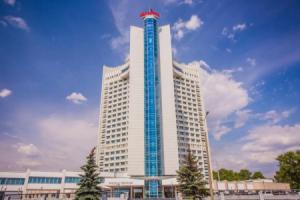
Throughout the 1990s, after the fall of Communism, the city continued to change. As the capital of a newly independent country, Minsk quickly acquired the attributes of a major city. Embassies were opened, and a number of Soviet administrative buildings became government centres. During the early and mid-1990s, Minsk was hit by an economic crisis and many development projects were halted, resulting in high unemployment and underemployment. Since the late 1990s, there have been improvements in transport and infrastructure, and a housing boom has been underway since 2002. On the outskirts of Minsk, new mikroraions of residential development have been built. Metro lines have been extended, and the road system (including the Minsk BeltWay) has been improved. Owing to the small size of the private sector in Belarus, most development has so far been financed by the government. In January 2008, the city government announced several projects on its official website. Among them are the refurbishment of some streets and main avenues, the construction of more up-to-date hotels (one near the Palace of the Republic and Independence Palace on the shore of Lake Komsomolkoye), the demolition of the out-of-date Belarus hotel and the erection in the same premises of a complex consisting of sport facilities, swimming pool, 2 hotel towers and one business centre building with the help of potential foreign investors and the construction of a modern aquatic park in the outskirts of the city. On 8 September 2007, the city of Minsk celebrated 940 years since its founding.
Etymology and historical names
The Old East Slavic name of the town was Мѣньскъ (i.e. Měnsk < Early Proto-Slavic or Late Indo-European Mēnĭskŭ), derived from a river name Měn (< Mēnŭ). The direct continuation of this name in Belarusian is Miensk (pronounced [mʲɛnsk]). The resulting form of the name, Minsk (spelled either Минскъ or Мѣнскъ), was taken over both in Russian (modern spelling: Минск) and Polish (Mińsk), and under the influence especially of Russian it also became official in Belarusian. However, some Belarusian-speakers continue to use Miensk (spelled Менск) as their preferred name for the city.
When Belarus was under Polish rule, the names Mińsk Litewski 'Minsk of the Grand Duchy of Lithuania' and Mińsk Białoruski 'Minsk in Belarus' were used to differentiate this place name from Mińsk Mazowiecki 'Minsk in Masovia'. In modern Polish, Mińsk without an attribute usually refers to the city in Belarus, which is about 50 times bigger than Mińsk Mazowiecki; (cf. Brest-Litovsk and Brześć Kujawski for a similar case).
The Belarusian rock band N.R.M. have recorded a song titled Miensk i Minsk (Miensk and Minsk) on their 2007 album "06".
Transport
Local transport
Minsk has an extensive public transport system. Passengers are served by 8 tramway lines, over 70 trolleybus lines, and over 100 bus lines. Trams were the first public transport used in Minsk (since 1892 – the horse-tram, and since 1929 – the electric tram). Public buses have been used in Minsk since 1924, and trolleybuses since 1952.
All public transport is operated by Minsktrans, a government-owned and -funded transport not-for-profit company. As of January 2008, Minsktrans used 1,420 buses, 1,010 trolleybuses and 153 tramway cars in Minsk.
The Minsk city government in 2003 decreed that local transport provision should be set at a minimum level of 1 vehicle (bus, trolleybus or tram) per 1,500 residents. Currently the number of vehicles in use by Minsktrans is 2.2 times higher than the minimum level.
Public transport fares are controlled by city's executive committee (city council). Single trip ticket for bus, trolleybus, tramway or metro costs 3000 BYR (≈ USD 0.3) and 4300 BYR for express buses. Monthly ticket for one kind of transport costs 135 000 BYR and 243 000 BYR for all four. Commercial marshrutka's prices varies from 6000 to 7000 BYR.
Rapid transit
Minsk is the only city in Belarus with an underground metro system. Construction of the metro began in 1977, soon after the city reached over a million people, and the first line with 8 stations was opened in 1984. Since then it has expanded into two lines: Moskovskaya and Avtozavodskaya, which are 18.1 and 17.3 km (11.2 and 10.7 mi) long with 14 and 14 stations, respectively. On 7 November 2012, three new stations on the Moskovskaya Line were opened; work continues on a 1.8 km (1.1 mi) extension, with one more station slated to open in 2014.
There are plans for a network with three lines totalling (based on present expansion plans) 58.3 km (36.2 mi) of track with 45 stations and three train depots. For this to happen the third line should cut the city on a north–south axis crossing the existing two and thus forming a typical Soviet triangle layout; construction of the third line is expected to begin in 2011 and for the first stage to be delivered in late 2010s. Some layout plans speculate on a possible fourth line running from Vyasnyanka to Serabranka micro-rayons.
As of 2013 Minsk metro had 28 stations and 35.5 kilometres (22 miles) of tracks. Trains use 243 standard Russian metro-cars. On a typical day Minsk metro is used by 800,000 passengers. In 2007 ridership of Minsk metro was 262.1 million passengers, making it the 5th busiest metro network in the former USSR (behind Moscow, St. Petersburg, Kiev and Kharkiv). During peak hours trains run each 2–2.5 minutes. The metro network employs 3,200 staff.
Currently most of the urban transport is being actively renovated and upgraded to modern standards. For instance, all metro stations built since 2001 have passenger lifts from platform to street level, thus enabling the use of the newer stations by disabled passengers.
Railway and intercity bus
Minsk is the largest transport hub in Belarus. Minsk is located at the junction of the Warsaw-Moscow railway (built in 1871) running from the southwest to the northeast of the city and the Liepaja-Romny railway (built in 1873) running from the northwest to the south. The first railway connects Russia with Poland and Germany; the second connects Ukraine with Lithuania and Latvia. They cross at the Minsk-Passazhyrski railway station, the main railway station of Minsk. The station was built in 1873 as Vilenski vakzal. The initial wooden building was demolished in 1890 and rebuilt in stone. During World War II the Minsk railway station was completely destroyed. It was rebuilt in 1945 and 1946 and served until 1991. The new building of the Minsk-Passazhyrski railway station was built during 1991–2002. Its construction was delayed due to financial difficulties; now, however, Minsk boasts one of the most modern and up-to-date railway stations in the CIS. There are plans to move all suburban rail traffic from Minsk-Passazhyrski to the smaller stations, Minsk- Uskhodni (East), Minsk-Paudnyovy (South) and Minsk-Paunochny (North), by 2020.
There are three intercity bus stations that link Minsk with the suburbs and other cities in Belarus and the neighbouring countries. Frequent schedules of bus routes connect Minsk to Moscow, Smolensk, Vilnius, Riga, Kiev and Warsaw.
Airports
Minsk International Airport is located 42 km (26 mi) to the east of the city. It opened in 1982 and the current railway station opened in 1987. It is an international airport with flights to Europe and Middle East.
Minsk-1 opened in 1933 a few kilometres to the south of the historical centre. In 1955 it became an international airport and by 1970 served over 1 million passengers a year.
From 1982 it mainly served domestic routes in Belarus and short-haul routes to Moscow, Kiev and Kaliningrad. Minsk-1 was expected to be closed in 2008 because of the noise pollution in the surrounding residential areas, but in the mid-2010 it is still functioning. The land of the airport is planned to be redeveloped for residential and commercial real estate, currently branded as Minsk-City.
Culture and religion
Minsk is the major cultural centre of Belarus. Its first theatres and libraries were established in the middle of the 19th century. Now it has 11 theatres and 16 museums. There are 20 cinemas and 139 libraries.
Churches
- The Orthodox Cathedral of the Holy Spirit is actually the former church of the Bernardine convent. It was built in the simplified Baroque style in 1642–87 and went through renovations in 1741–46 and 1869.
- The Cathedral of Saint Mary was built by the Jesuits as their monastery church in 1700–10, restored in 1951 and 1997; it overlooks the recently restored 18th-century city hall, located on the other side of the Independence Square;
- Two other historic churches are the cathedral of Saint Joseph, formerly affiliated with the Bernardine monastery, built in 1644–52 and repaired in 1983, and the fortified church of Sts. Peter and Paul, originally built in the 1620s and recently restored, complete with its flanking twin towers.
- The impressive Neo-Romanesque Roman Catholic Red Church (Cathedral of Sts. Simeon and Helene) was built in 1906–10 immediately after religious freedoms were proclaimed in Imperial Russia and the tsar allowed dissidents to build their churches;
- The largest church built in the Russian imperial period of the town's history is dedicated to St. Mary Magdalene;
- Many Orthodox churches were built after the dissolution of the USSR in a variety of styles, although most remain true to the Neo-Russian idiom. A good example is St. Elisabeth's Convent, founded in 1999.
-
Cathedral of the Holy Spirit (Russian Orthodox).
-
Cathedral of Saint Virgin Mary (Roman Catholic).
-
Church of St.Joseph (formerly Uniate, currently used as an archive).
-
Church of Sts. Peter and Paul (Russian Orthodox).
-
The Red Church (Roman Catholic).
-
Church of St. Mary Magdalene (Russian Orthodox).
-
Church of Exaltation of the Holy Cross (Roman Catholic).
-
Church of Holy Trinity (Saint Rochus) (Roman Catholic).
-
Church of All Saints (Russian Orthodox).
-
Church of St.Yevfrosinya of Polotsk (Russian Orthodox).
-
Church of St. Elizabeth Convent (Russian Orthodox)
Cemeteries
- Kalvaryja (Calvary Cemetery) is the oldest surviving cemetery in the city. Many famous people of Belarus are buried here. The cemetery was closed to new burials in the 1960s.
- Military Cemetery
- Eastern Cemetery
- Chizhovka Cemetery
- Northern Cemetery
Theatres
Major theatres are:
- National Academic Grand Opera and Ballet Theatre of the Republic of Belarus
- Belarusian State Musical Theatre (performances in Russian)
- Maxim Gorky National Drama Theatre (performances in Russian)
- Yanka Kupala National Drama Theatre(performances in Belarusian)
Museums
Major museums include:
- Belarusian Great Patriotic War Museum
- Belarusian National Arts Museum
- Belarusian National History and Culture Museum
- Belarusian Nature and Environment Museum
- Maksim Bahdanovič Literary Museum
- Old Belarusian History Museum
- Yanka Kupala Literary Museum
Recreation areas
- Chelyuskinites Park
- Children's Railroad
- Gorky Park (Minsk)
- Yanka Kupala Park
Tourism
There are more than 400 travel agencies in Minsk, about a quarter of them provide agent activity, and most of them are tour operators.


