Saxony
Description
The Free State of Saxony is a landlocked federal state of Germany, bordering the federal states of Brandenburg, Saxony Anhalt, Thuringia, and Bavaria, as well as the countries of Poland and the Czech Republic. Its capital is Dresden, and its largest city is Leipzig.
Saxony is the tenth-largest of Germany's sixteen states, with an area of 18,413 square kilometres (7,109 sq mi), and the sixth most populous, with 4.3 million people.
Located in the middle of a large, formerly all German-speaking part of Europe, the history of the state of Saxony spans more than a millennium. It has been a medieval duchy, an electorate of the Holy Roman Empire, a kingdom, and twice a republic.
The area of the modern state of Saxony should not be confused with Old Saxony, the area inhabited by Saxons. Old Saxony corresponds approximately to the modern German states of Lower Saxony, Saxony-Anhalt and the Westphalian part of North Rhine-Westphalia.
Geography
Largest cities
The largest cities in Saxony according to the 31 December 2013 estimate.
Rank City Population 1 Leipzig 531,582 2 Dresden 530,754 3 Chemnitz 242,022 4 Zwickau 91,564 5 Plauen 63,967 6 Görlitz 54,042 7 Freiberg 40,268 8 Bautzen 39,607 9 Freital 39,276 10 Pirna 37,645-
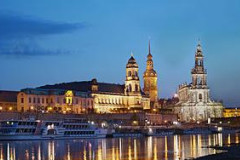
State capital Dresden
-
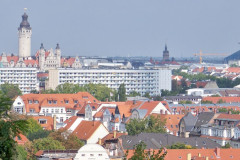
View over Leipzig centre
-
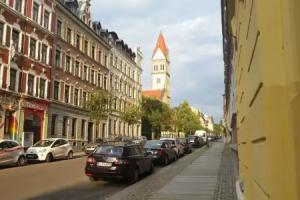
Chemnitz, view over Falkeplatz
-
Zwickau main market
-
Historic town of Görlitz
-
Bautzen
History
Saxony has a long history as a duchy, an electorate of the Holy Roman Empire (the Electorate of Saxony), and finally as a kingdom (the Kingdom of Saxony). In 1918, after Germany's defeat in World War I, its monarchy was overthrown and a republican form of government was established under the current name. The state was broken up into smaller units during communist rule (1949–1989), but was re-established on 3 October 1990 on the reunification of East and West Germany.
Prehistory
In prehistoric times, the territory of Saxony was the site of some of the largest of the ancient central European monumental temples, dating from the 5th century BC. Notable archaeological sites have been discovered in Dresden and the villages of Eythra and Zwenkau near Leipzig. The Slavic and Germanic presence in the territory of today's Saxony is thought to have begun in the 1st century BC.
Parts of Saxony were possibly under the control of the Germanic King Marobod during the Roman era. By the late Roman period, several tribes known as the Saxons emerged, from which the subsequent state(s) draw their name. For the origins of the Saxon tribes, see Saxons.
Duchy of Saxony
The first medieval Duchy of Saxony was a late Early Middle Ages "Carolingian stem duchy", which emerged about the year 700 and grew to include the greater part of Northern Germany, what are now the modern German states of Bremen, Hamburg, Lower Saxony, North Rhine-Westphalia, Schleswig-Holstein and Saxony-Anhalt. The Saxons converted to Christianity during this period.
While the Saxons were facing pressure from Charlemagne's Franks, they were also facing a westward push by Slavs to the east. The territory of the Free State of Saxony was, since the 5th century, populated by Slavs before being conquered by Germans. A legacy of this period is the Sorb population in Saxony. Eastern parts of present Saxony were ruled by Poland between 1002 and 1032.
Holy Roman Empire
The territory of the Free State of Saxony became part of the Holy Roman Empire by the 10th century, when the dukes of Saxony were also kings (or emperors) of the Holy Roman Empire, comprising the Ottonian, or Saxon, Dynasty. Around this time, the Billungs, a Saxon noble family, received extensive fiefs in Saxony. The Emperor eventually gave them the title of Dukes of Saxony. After Duke Magnus died in 1106, causing the extinction of the male line of Billungs, oversight of the duchy was given to Lothar of Supplinburg, who also became Emperor for a short time.
In 1137, control of Saxony passed to the Guelph dynasty, descendants of Wulfhild Billung, eldest daughter of the last Billung duke, and the daughter of Lothar of Supplinburg. In 1180 large portions west of the Weser were ceded to the Bishops of Cologne, while some central parts between the Weser and the Elbe remained with the Guelphs, becoming later the Duchy of Brunswick-Lüneburg. The remaining eastern lands, together with the title of Duke of Saxony, passed to an Ascanian dynasty (descended from Eilika Billung, Wulfhild's younger sister) and were divided in 1260 into the two small states of Saxe-Lauenburg and Saxe-Wittenberg. The former state was also named Lower Saxony, the latter Upper Saxony, thence the later names of the two Imperial Circles Saxe-Lauenburg and Saxe-Wittenberg. Both claimed the Saxon electoral privilege for themselves, but the Golden Bull of 1356 accepted only Wittenberg's claim, with Lauenburg nevertheless continuing to maintain its claim. In 1422, when the Saxon electoral line of the Ascanians became extinct, the Ascanian Eric V of Saxe-Lauenburg tried to reunite the Saxon duchies.
However, Sigismund, King of the Romans, had already granted Margrave Frederick IV the Warlike of Meissen (House of Wettin) an expectancy of the Saxon electorate in order to remunerate his military support. On 1 August 1425 Sigismund enfeoffed the Wettinian Frederick as Prince-Elector of Saxony, despite the protests of Eric V. Thus the Saxon territories remained permanently separated. The Electorate of Saxony was then merged with the much bigger Wettinian Margraviate of Meissen, however using the higher ranking name Electorate of Saxony and even the Ascanian coat-of-arms for the entire monarchy. Thus Saxony came to included Dresden and Meissen. In the 18th and 19th centuries Saxe-Lauenburg was colloquially called the Duchy of Lauenburg, which in 1876 merged with Prussia as the Duchy of Lauenburg district.
Foundation of the second Saxon state
Saxony-Wittenberg, in modern Saxony-Anhalt, became subject to the margravate of Meissen, ruled by the Wettin dynasty in 1423. This established a new and powerful state, occupying large portions of the present Free State of Saxony, Thuringia, and Saxony-Anhalt. Although the centre of this state was far to the southeast of the former Saxony, it came to be referred to as Upper Saxony and then simply Saxony, while the former Saxon territories were now known as Lower Saxony.
In 1485, Saxony was split. A collateral line of the Wettin princes received what later became Thuringia and founded several small states there (see Ernestine duchies). The remaining Saxon state became still more powerful and was known in the 18th century for its cultural achievements, although it was politically weaker than Prussia and Austria, states which oppressed Saxony from the north and south, respectively.
Between 1697 and 1763, the Electors of Saxony were also elected Kings of Poland in personal union.
In 1756, Saxony joined a coalition of Austria, France and Russia against Prussia. Frederick II of Prussia chose to attack preemptively and invaded Saxony in August 1756, precipitating the Seven Years' War. The Prussians quickly defeated Saxony and incorporated the Saxon army into the Prussian army. At the end of the Seven Years' War, Saxony once again became an independent state, although considerably reduced in size.
Saxony in the 19th and 20th centuries
19th CenturyIn 1806, French Emperor Napoleon abolished the Holy Roman Empire and established the Electorate of Saxony as a kingdom in exchange for military support. The Elector Frederick Augustus III accordingly became King Frederick Augustus I of Saxony. Frederick Augustus remained loyal to Napoleon during the wars that swept Europe in the following years; he was taken prisoner and his territories declared forfeit by the allies in 1813, after the defeat of Napoleon. Prussia intended the annexation of Saxony but the opposition of Austria, France, and the United Kingdom to this plan resulted in the restoration of Frederick Augustus to his throne at the Congress of Vienna although he was forced to cede the northern part of the kingdom to Prussia. These lands became the Prussian province of Saxony, now incorporated in the modern state of Saxony-Anhalt except westernmost part around Bad Langensalza now in the one of Thuringia. Also Lower Lusatia became part of Province of Brandenburg and northeastern part of Upper Lusatia became part of Silesia Province. The remnant of the Kingdom of Saxony was roughly identical with the present federal state, albeit slightly smaller.
Meanwhile, in 1815, the southern part of Saxony, now called the "State of Saxony" joined the German Confederation. (This German Confederation should not be confused with the North German Confederation mentioned below.) In the politics of the Confederation, Saxony was overshadowed by Prussia. King Anthony of Saxony came to the throne of Saxony in 1827. Shortly thereafter, liberal pressures in Saxony mounted and broke out in revolt during 1830—a year of revolution in Europe. The revolution in Saxony resulted in a constitution for the State of Saxony that served as the basis for its government until 1918.
During the 1848–49 constitutionalist revolutions in Germany, Saxony became a hotbed of revolutionaries, with anarchists such as Mikhail Bakunin and democrats including Richard Wagner and Gottfried Semper taking part in the May Uprising in Dresden in 1849. (Scenes of Richard Wagner's participation in the May 1849 uprising in Dresden are depicted in the 1983 movie Wagner starring Richard Burton as Richard Wagner.) The May uprising in Dresden forced King Frederick Augustus II of Saxony to concede further reforms to the Saxon government.
In 1854 Frederick Augustus II's brother, King John of Saxony, succeeded to the throne. A scholar, King John translated Dante. King John followed a federalistic and pro-Austrian policy throughout the early 1860s until the outbreak of the Austro-Prussian War. During that war, Prussian troops overran Saxony without resistance and then invaded Austrian (today's Czech) Bohemia. After the war, Saxony was forced to pay an indemnity and to join the North German Confederation in 1867. Under the terms of the North German Confederation, Prussia took over control of the Saxon postal system, railroads, military and foreign affairs. In the Franco-Prussian War of 1870, Saxon troops fought together with Prussian and other German troops against France. In 1871, Saxony joined the newly formed German Empire.
20th CenturyAfter King Frederick Augustus III of Saxony abdicated on 13 November 1918, Saxony, remaining a constituent state of Germany (Weimar Republic), became the Free State of Saxony under a new constitution enacted on 1 November 1920. In October 1923 the federal government under Chancellor Gustav Stresemann overthrew the legally elected SPD-Communist coalition government of Saxony. The state maintained its name and borders during the Nazi era as a Gau, but lost its quasi-autonomous status and its parliamentarian democracy.
As World War II drew to its end, U.S. troops under General George Patton conquered the western part of Saxony in April 1945, while Soviet troops conquered the eastern part. That summer, the entire state was handed over to Soviet forces as agreed in the London Protocol of September 1944. Britain, the USA, and the USSR then negotiated Germany's future at the Potsdam Conference. Under the Potsdam Agreement, all German territory East of the Oder-Neisse line was annexed by Poland and the Soviet Union, and, unlike in the aftermath of World War I, the annexing powers were allowed to expel the inhabitants. During the following three years, Poland and Czechoslovakia forcibly expelled German-speaking people from their territories, and some of these expellees came to Saxony. Only a small area of Saxony lying east of the Neisse River and centred around the town of Reichenau (now called Bogatynia), was annexed by Poland. The Soviet Military Administration in Germany (SVAG) merged that part of the Prussian province of Lower Silesia that remained in Germany with Saxony.
On 20 October 1946, SVAG organised elections for the Saxon state parliament (Landtag), but many people were arbitrarily excluded from candidacy and suffrage, and the Soviet Union openly supported the Socialist Unity Party of Germany (SED). The new minister-president Rudolf Friedrichs (SED), had been a member of the SPD until April 1946. He met his Bavarian counterparts in the U.S. zone of occupation in October 1946 and May 1947, but died suddenly in mysterious circumstances the following month. He was succeeded by Max Seydewitz, a loyal follower of Joseph Stalin.
The German Democratic Republic (East Germany), including Saxony, was established in 1949 out of the Soviet zone of Occupied Germany, becoming a constitutionally socialist state, part of COMECON and the Warsaw Pact, under the leadership of the SED. In 1952 the government abolished the Free State of Saxony, and divided its territory into three Bezirke: Leipzig, Dresden, and Karl-Marx-Stadt (formerly and presently Chemnitz). Also areas around Hoyerswerda was part of Cottbus one.
The Free State of Saxony was reconstituted with slightly altered borders in 1990, following German reunification. Besides the formerly Silesian area of Saxony, which was mostly included in the territory of the new Saxony, the free state gained further areas north of Leipzig that had belonged to Saxony-Anhalt until 1952.
Culture
Religion
Religion in Saxony - 2011 religion percent EKD Protestants 21.4% Roman Catholics 3.8% Evangelische Freikirchen 0.9% Orthodox churches 0.3% Other religions 1.0% Unaffiliated 72.6%Saxony has traditionally been predominantly Protestant (though the monarchs of the Saxon Kingdom themselves were Catholic as an ancestral relic of being Kings of Poland), but after World War II and 40 years of Communist rule, the majority of the population has been irreligious. As of 2011 the 20 Protestant churches collected in the Evangelical Church in Germany represented the largest faith in the state, adhered to by 21.4% of the population. Members of the Catholic Church form a minority of 3.8%. 0.9% of the Saxons belong to Evangelical Free Churches, 0.3% to Orthodox churches and 1% to other religious communities, while 72.6% do not belong to any public-law religious society.
Languages
The most common patois spoken in Saxony are combined in the group of "Thuringian and Upper Saxon dialects". Due to the inexact use of the term "Saxon dialects" in colloquial language, the Upper Saxon attribute has been added to distinguish it from Old Saxon and Low Saxon. Other German dialects spoken in Saxony are the dialects of the Erzgebirge (Ore Mountains), which have been affected by Upper Saxon dialects, and the dialects of the Vogtland, which are more affected by the East Franconian languages.
Upper Sorbian (a Slavic language) is still actively spoken in the parts of Upper Lusatia that are inhabited by the Sorbian minority. The Germans in Upper Lusatia speak distinct dialects of their own (Lusatian dialects).
Geography
Topography of SaxonyTourism
Except for Dresden and Leipzig (and the WWII prison camp of Colditz), Saxony is not a primary destination for foreign tourists. Areas along the border with the Czech Republic, such as the Lusatian Mountains, Ore Mountains, Saxon Switzerland, and Vogtland, attract significant visitors, largely Germans. Saxony has well preserved historic towns such as Meissen, Freiberg, Pirna, Bautzen, and Görlitz.
Results
e • d Summary of the 31 August 2014 Landtag of Saxony elections results< 2009 Next > Party Popular vote Seats Votes % +/– Seats +/– Christian Democratic Union
Christlich Demokratische Union Deutschlands – CDU 645,344 39.4 0.8 59 1 Left
Die Linke 309,568 18.9 1.7 27 2 Social Democratic Party of Germany
Sozialdemokratische Partei Deutschlands – SPD 202,374 12.4 2.0 18 4 Alternative for Germany
Alternative für Deutschland – AfD 159,547 9.7 9.7 14 14 Alliance '90/The Greens
Bündnis 90/Die Grünen 93,852 5.7 0.7 8 1 National Democratic Party of Germany
Nationaldemokratische Partei Deutschlands – NPD 81,060 5.0
(4.95) 0.6 0 8 Free Democratic Party
Freie Demokratische Partei – FDP 61,847 3.8 6.2 0 14 Other parties 83,776 5.1 1.7 0 Valid votes 1,637,364 98.7 0.5 Invalid votes 22,281 1.3 0.5 Totals and voter turnout 1,659,645 49.2 3.0 126 6 Electorate 3,375,734 100.00 — Source: Wahlrecht.de