Izmir
Description
İzmir is a metropolitan city in the western extremity of Anatolia and the third most populous city in Turkey, after Istanbul and Ankara. İzmir's metropolitan area extends along the outlying waters of the Gulf of İzmir and inland to the north across the delta of the Gediz River, to the east along an alluvial plain created by several small streams and to a slightly more rugged terrain in the south. The ancient city was known as Smyrna (Greek: Σμύρνη Smyrni), and the city was generally referred to as Smyrna in English, until the Turkish adoption of Latin alphabet in 1928 made "İzmir" the internationally recognized name.
The city of İzmir is composed of several metropolitan districts. Of these, Konak district corresponds to historical İzmir, this district's area having constituted the "İzmir Municipality" (Turkish: İzmir Belediyesi) area until 1984, Konak until then having been a name for a central neighborhood around Konak Square, still the core of the city. With the constitution of the "Greater İzmir Metropolitan Municipality" (Turkish: İzmir Büyükşehir Belediyesi), the city of İzmir grouped together initially nine, and more recently eleven, metropolitan districts, namely Balçova, Bayraklı, Bornova, Buca, Çiğli, Gaziemir, Güzelbahçe, Karabağlar, Karşıyaka, Konak and Narlıdere. Almost all of these settlements are former separate district centers or neighborhoods, with their own distinct features and temperament. In an ongoing process, the Mayor of İzmir was also vested with authority over the additional district area reaching from Bergama in the north to Selçuk in the south, bringing the number of districts considered as being part of İzmir to twenty-one under the new arrangements, two of these having been only partially administratively included in İzmir.
In 2014, İzmir had a population of 2,847,691, while İzmir Province had a total of 4,113,072.
Main features
İzmir has almost 4,000 years of recorded urban history and possibly even longer as an advanced human settlement. Set in an advantageous location at the head of a gulf in a deep indentation midway along the western Anatolian coast, the city has been one of the principal mercantile cities of the Mediterranean Sea for much of its history. Its port is Turkey's primary port for exports in terms of the freight handled and its free zone, a Turkish-U.S. joint-venture established in 1990, is the leader among the twenty in Turkey. The workforce, and particularly its rising class of young professionals, is concentrated either in the city or in its immediate vicinity (such as in Manisa and Turgutlu), and as either larger companies or SMEs, affirm their names with an increasingly wider global scale and intensity. Politically, Izmir is considered a stronghold of the Republican People's Party.
İzmir hosted the Mediterranean Games in 1971 and more recently the World University Games (Universiade) in 2005. A bid submitted to the BIE to host the Universal Expo 2015, in March 2008, lost to Milan. Modern İzmir also incorporates the nearby ancient cities of Ephesus, Pergamon, Sardis and Klazomenai, and centers of international tourism such as Kuşadası, Çeşme, Mordoğan and Foça.
When the Ottomans took over İzmir in the 15th century, they did not inherit compelling historical memories, unlike the two other key points of the trade network, namely Istanbul and Aleppo. The emergence of Izmir as a major international port by the 17th century was largely a result of the attraction it exercised over foreigners, and the city's European orientation.
Panorama of İzmirNames and etymology
İzmir is a princess with her most beautiful hat.
Victor Hugo, Les OrientalesThe modern name "İzmir" derives from the former Greek name "Smyrna" (Σμύρνη), most probably through the first two syllables of the phrase "is Smirnin" (Greek: "εἰς Σμύρνην"), which means "to Smyrna" in Greek. A similar etymology also applies for other Turkish cities with former Greek names, such as İznik, from the phrase "is Nikaean" meaning "to Nicaea", Isparta, from "is Spartin" ("to Sparta"), and Istanbul, from "is tin Polin" or "(in)to the City". It even seems to apply for the Greek island of Kos, called "İstanköy" (< is tin Ko) in Turkish.
In ancient Anatolia, the name of a locality called Ti-smurna is mentioned in some of the Level II tablets from the Assyrian colony in Kültepe (first half of the 2nd millennium BC), with the prefix ti- identifying a proper name, although it is not established with certainty that this name refers to modern-day İzmir.
A view of central İzmirThe region of İzmir was situated on the southern fringes of the Yortan culture in Anatolia's prehistory, knowledge of which is almost entirely drawn from its cemeteries,. In the second half of the 2nd millennium BC, it was in the western end of the extension of the still largely obscure Arzawa Kingdom, an offshoot and usually a dependency of the Hittites, who themselves spread their direct rule as far as the coast during their Great Kingdom. That the realm of the 13th century BC local Luwian ruler, who is depicted in theKemalpaşa Karabel rock carving at a distance of only 50 km (31 mi) from İzmir was called the Kingdom of Myra may also leave grounds for association with the city's name.
The latest known rendering in Greek of the city's name is the Aeolic Greek Μύρρα Mýrrha, corresponding to the later Ionian and Attic Σμύρνα (Smýrna) or Σμύρνη (Smýrnē), both presumably descendants of a Proto-Greek form *Smúrnā. Some would see in the city's name a reference to the name of an Amazon called Smyrna said to have seduced Theseus, leading him to name the city in her honor. Others link the name to the Myrrha commifera shrub, a plant producing the aromatic resin called myrrh that is indigenous to the Middle East and northeastern Africa, which was the city's chief export in antiquity. The Romans took over this name as Smyrna, which is still the name used in English when referring to the city in pre-Turkish times. In Ottoman Turkish the town's name was إزمير Izmīr.
In English, the city was called Smyrna into the 20th century. Izmir (sometimes İzmir) was adopted in English and most foreign languages after Turkey adapted the Latin alphabet in 1928 and urged other countries to use the city's Turkish name.
History
Ancient times
The city is one of the oldest settlements of the Mediterranean basin. The 2004 discovery of Yeşilova Höyük and the neighboring Yassıtepe, in the small delta of Meles River, now the Bornova plain, reset the starting date of the city's past further back than previously thought. Findings from two seasons of excavations carried out in the Yeşilova Höyük by a team of archaeologists from İzmir's Ege University indicate three levels, two of which are prehistoric. Level 2 bears traces of early to mid-Chalcolithic, and Level 3 of Neolithic settlements. These two levels would have been inhabited by the indigenous peoples of the area, very roughly, between 7th millennium BC to 4th millennium BC. As the seashore receded with time, the site was later used as a cemetery. Several graves containing artifacts dating roughly from 3000 BC, and contemporary with the first city of Troy, were found.
By 1500 BC, the region had fallen under the influence of the Central Anatolian Hittite Empire; several localities near İzmir are mentioned in their records. The first settlement to have commanded the Gulf of İzmir as a whole is recorded, in a semi-legendary manner, as being founded on top of Mount Yamanlar, to the northeast of the inner gulf. In connection with the silt brought by the streams which join the sea along the coastline, the settlement to form later the core of "Old Smyrna" was founded on the slopes of the same mountain, on a hill (then a small peninsula connected to the mainland by a small isthmus) in the present-day quarter of Bayraklı. The Bayraklı settlement is thought to have stretched back in time as far as the 3rd millennium BC. It became one of the most advanced cultures in early Anatolian history and was on a par with Troy. The presence of a vineyard of İzmir's Wine and Beer Factory on this hill, also called Tepekule, prevented the urbanization of the site and facilitated the excavations that started in the 1960s by Ekrem Akurgal.
In the 13th century BC, however, invasions from the Balkans (the so-called sea people) destroyed Troy VII, and Central and Western Anatolia as a whole fell into what is generally called the period of "Anatolian" and "Greek" Dark Ages of the Bronze Age collapse.
Old Smyrna Nearby ancient site of Klazomenai in Urla, slightly outside İzmir urban zone, is associated with some of the oldest known records of trade in olive oil.At the dawn of İzmir's recorded history, Pausanias describes "evident tokens" such as "a port called after the name of Tantalus and a sepulchre of him by no means obscure", corresponding to the city's area and which have been tentatively located to date. The term "Old Smyrna" is used to describe the Archaic Period city located at Tepekule, Bayraklı, to make a distinction with the city of Smyrna rebuilt later on the slopes of Mount Pagos (present-day Kadifekale). The Greek settlement in Old Smyrna is attested by the presence of pottery dating from about 1000 BC onwards. The most ancient ruins preserved to our times date back to 725–700 BC. According to Herodotus the city was founded by Aeolians and later seized by Ionians. The oldest house discovered in Bayraklı has been dated to 925 and 900 BC. The walls of this well-preserved house (2.45 by 4 metres or 8.0 by 13.1 feet), consisting of one small room typical of the Iron Age, were made of sun-dried bricks and the roof of the house was made of reeds. The oldest model of a multiple-roomed house of this period was found in Old Smyrna. Known to be the oldest house having so many rooms under its roof, it was built in the second half of the 7th century BC. The house has two floors and five rooms with a courtyard. Around that time, people started to build thick, protective ramparts made of sun-dried bricks around the city. Smyrna was built on the Hippodamian system, in which streets run north-south and east-west and intersect at right angles, in a pattern familiar in the Near East but the earliest example in a western city. The houses all faced south. The most ancient paved streets in the Ionian civilization have also been discovered in ancient Smyrna.
Homer, referred to as Melesigenes meaning "Child of the Meles Brook", is said to have been born in Smyrna in the 7th or 8th century BC. Combined with written evidence, it is generally admitted that Smyrna and Chios put forth the strongest arguments in claiming Homer and the main belief is that he was born in Ionia. A River Meles, still bearing the same name, is located within the city limits, although associations with the Homeric river is subject to controversy.
From the 7th century onwards, Smyrna achieved the identity of an city-state. About a thousand people lived inside the city walls, with others living in nearby villages, where fields, olive trees, vineyards, and the workshops of potters and stonecutters were located. People generally made their living from agriculture and fishing. The most important sanctuary of Old Smyrna was the Temple of Athena, which dates back to 640–580 BC and is partially restored today. Smyrna, by this point, was no longer a small town, but an urban center taking part in the Mediterranean trade. The city eventually became one of the twelve Ionian cities and was well on its way to becoming a foremost cultural and commercial center in the Mediterranean basin of that period, reaching its peak between 650–545 BC.
Lydian ruleThe city's port position near their capital drew the Lydians to Smyrna. The army of Lydia's Mermnad dynasty conquered the city some time around 610–600 BC and is reported to have burned and destroyed parts of the city, although recent analyses on the remains in Bayraklı demonstrate that the temple has been in continuous use or was very quickly repaired under Lydian rule.
Persian ruleSoon afterwards, an invasion from outside Anatolia by the Persian Empire effectively ended Old Smyrna's history as an urban center of note. The Persian emperor Cyrus the Great attacked the coastal cities of the Aegean after conquering the capital of Lydia. As a result, Old Smyrna was destroyed in 545 BC.
Alexander the GreatAlexander the Great re-founded the city at a new location beyond the Meles River around 340 BC. Alexander had defeated the Persians in several battles and finally the Emperor Darius III himself at Issus in 333 BC. Old Smyrna on a small hill by the sea was large enough only for a few thousand people. Therefore, the slopes of Mount Pagos (Kadifekale) was chosen for the foundation of the new city, for which Alexander is credited, and this act lay the ground for a resurgence in the city's population.
Roman rule Agora of SmyrnaIn 133 BC, when Eumenes III, the last king of the Attalid dynasty of Pergamum, was about to die without an heir. In his will, he bequeathed his kingdom to the Roman Republic, and this included Smyrna. The city thus came under Roman rule as a civil diocese within the Province of Asia and enjoyed a new period of prosperity. Towards the close of the 1st century AD, when Smyrna appeared as one of the seven churches of Asia addressed in the Book of Revelation, Smyrna had a Christian congregation undergoing persecution from the city's Jews (Revelation 2:9). In contrast to several of the other churches, Apostle John had nothing negative to say about this church. He did, however, predict that the persecution would continue and urged them, "Be faithful to the point of death, and I will give you the crown of life" (Revelation 2:10). The persecution of Christians continued into the 2nd century, as documented by the martyrdom of Polycarp, Bishop of Smyrna, in AD 155.
Given the importance the city had achieved, the Roman emperors who came to Anatolia also visited Smyrna. In early AD 124, Emperor Hadrian visited Smyrna on his journeys across the Empire and possibly Caracalla came in 214–215. Smyrna was a fine city with stone-paved streets.
In AD 178, the city was devastated by an earthquake. Considered to be one of the greatest disasters the city has faced in its history, the earthquake razed the town to the ground. The destruction was so great that the support of the Empire for rebuilding was necessary. Emperor Marcus Aurelius contributed greatly to the rebuilding and the city was re-founded again. During this period the state agora was restored. Many of the works of architecture from the city's pre-Turkish period that have lasted until time date from this period.
After the Roman Empire was divided two distinct entities, Smyrna became a territory of the Eastern Roman Empire. The city kept its status as a notable religious center in the early times of the Byzantine Empire. However, the city did decrease in size greatly during Late Antiquity and the Early Middle Ages, never returning to the Roman levels of prosperity.
The Medieval period
Çaka Bey and the Selçuk TurksThe Turks first captured Smyrna under the Seljuk commander Çaka Bey in 1076, along with Klazomenai, Foça and a number of the Aegean Islands. Çaka Bey (known as Tzachas among the Byzantines) used İzmir as a base for his naval operations. After his death in 1102, the city and the neighboring region was recaptured by the Byzantine Empire. The port city was then captured by the Knights of St John when Constantinople was conquered by the Crusaders during the Fourth Crusade in 1204, but the Nicaean Empire would reclaim possession of the city soon afterwards, albeit by according vast concessions to their Genoese allies who kept one of the city's castles.
The sons of AydınSmyrna was captured again by the Turks in the early 14th century. Umur Bey, the son of the founder of the Beylik of Aydın, took first the upper fort of Mount Pagos (thereafter called Kadifekale), and then the lower port castle of Neon Kastron (called St. Peter by the Genoese and as "Ok Kalesi" by the Turks). As Tzachas had done two centuries before, Umur Bey used the city as a base for naval raids. In 1344, a coalition of forces coordinated by Pope Clement VI took back the lower castle in a surprise attack in the Smyrniote crusades. A sixty-year period of uneasy cohabitation between the two powers, the Turks holding the upper castle and the Knights the lower, followed Umur Bey's death.
Ottoman rule The port of İzmir, from an 1883 encyclopedia.The upper city of İzmir was captured from its Aydinid rulers by the Ottomans for the first time in 1389 during the reign of Bayezid I, who led his armies toward the five Western Anatolian Beyliks in the winter of the same year he had come to the throne. The Ottoman takeover took place virtually without conflict. In 1402, however, Timur (Tamerlane) won the Battle of Ankara against the Ottomans, putting a serious check on the Ottoman state for the two following decades and handing back the territories of most of the Beyliks to their former ruling dynasties. He came in person to İzmir and took the port castle from the Genoese, giving it to the briefly reinstated Aydinids. In 1415, Mehmet I took back İzmir for the Ottomans for the second time. With the death of the last bey of Aydın, İzmiroğlu Cüneyd Bey, in 1426 the city passed fully under Ottoman control. İzmir's first Ottoman governor was a converted son of the Bulgarian Shishman dynasty. During the campaigns against Cüneyd, the Ottomans were assisted by the forces of the Knights Hospitaller who pressed the Sultan to return the port castle to them. However, the sultan refused to make this concession, despite the resulting tensions between the two camps, and he gave the Hospitallers permission to build a castle (the present-day Bodrum Castle) in Petronium (Bodrum) instead.
In a landward-looking arrangement somewhat against its nature, the city and its present-day dependencies became an Ottoman sanjak (sub-province) either inside the larger vilayet (province) of Aydın part of the eyalet of Anatolia, with its capital in Kütahya or in "Cezayir" (i.e. "Islands" referring to "the Aegean Islands"). In the 15th century, two notable events for the city were a surprise Venetian raid in 1475 and the arrival of Sephardic Jews from Spain after 1492; they later made İzmir one of their principal urban centers in Ottoman lands. İzmir may have been a rather sparsely populated place in the 15th and 16th centuries, as indicated by the first extant Ottoman records describing the town and dating from 1528. In 1530, 304 adult males, both tax-paying and tax-exempt were on record, 42 of them Christians. There were five urban wards, one of these situated in the immediate vicinity of the port, rather active despite the town's small size and where the non-Muslim population was concentrated. By 1576, İzmir had grown to house 492 taxpayers in eight urban wards and had a number of dependent villages. This corresponded to a total population estimated between 3500 and 5000.
International port cityİzmir's remarkable growth began in the late 16th century when cotton and other products of the region brought French, English, Dutch and Venetian traders here. With the privileged trading conditions accorded to foreigners in 1620 (these were the infamous capitulations that were later to cause a serious threat and setback for the Ottoman state in its decline), İzmir began to be one of the foremost trade centers of the Empire. Foreign consulates moved from Chios to the city by the early 17th century (1619 for the French Consulate, 1621 for the British), serving as trade centers for their nations. Each consulate had its own quay, where the ships under their flag would anchor. The long campaign for the conquest of Crete (22 years between 1648 and 1669) also considerably enhanced İzmir's position within the Ottoman realm since the city served as a port of dispatch and supply for the troops.
Despite facing facing a plague in 1676, an earthquake in 1688 and a great fire in 1743, the city continued to grow. By the end of the 17th century, the population was estimated at around ninety thousand, the Turks forming the majority (about 60,000); there were also 15,000 Greeks, 8,000 Armenians and 6,000 to 7,000 Jews, as well as a considerable section made up of French, English, Dutch and Italian merchants. In the meantime, the Ottomans had allowed İzmir's inner bay dominated by the port castle to silt up progressively (the location of the present-day Kemeraltı bazaar zone) and the port castle ceased to be of use.
The St. Stepanos Armenian Church located in the Basmane district served the Armenian community for centuries. It was reportedly set on fire by Turkish troops during the Great Fire of Smyrna.The first railway lines to be built within the present-day territory of Turkey went from İzmir. A 130 km (81 mi) İzmir-Aydın railway was started in 1856 and finished in 1867, a year later than the Smyrna-Cassaba Railway, itself started in 1863. The wide arc of the Smyrna-Cassaba line advancing in a wide arc to the north-west from İzmir, through the Karşıyaka suburb, contributed greatly to the development of the northern shores as urban areas. These new developments, typical of the industrial age and the way the city attracted merchants and middlemen gradually changed the demographic structure of the city, its culture and its Ottoman character. In 1867, İzmir finally became the center of its own vilayet, still called by neighboring Aydın's name but with its own administrative area covering a large part of Turkey's present-day Aegean Region.
In the late 19th century, the port was threatened by a build-up of silt in the gulf and an initiative, unique in the history of the Ottoman Empire, was undertaken in 1886. In order to redirect the silt, the bed of the Gediz River was redirected to its present-day northern course, so that it no longer flowed into the gulf. The beginning of the 20th century saw the city take on look of a genuine, cosmopolitan of a metropolitan center with a global fame and reach. According to the 1893 Ottoman census, more than half of the population was Turkish, with 133,800 Greeks, 9,200 Armenians, 17,200 Jews, and 54,600 foreign nationals. According to author Katherine Flemming, by 1919, Smyrna's 150,000 Greeks made up just under half of the population, outnumbering the Turks in the city two to one, while the American Consul General, George Horton, records 165,000 Turks, 150,000 Greeks, 25,000 Jews, 25,000 Armenians, and 20,000 foreigners (Italians, French, British, Americans). According to Henry Morgenthau and Trudy Ring, before World War I, the Greeks alone numbered 130,000, out of a total population of 250,000. Moreover, according to various scholars, prior to the war, the city hosted more Greeks than Athens, the capital of Greece. The Ottoman ruling class of that era referred to the city as Infidel Smyrna (Gavur Izmir) due to its strong Greek presence.
Following the defeat of the Ottoman Empire in World War I, the victors had, for a time, intended to carve up large parts of Anatolia into respective zones of influence and offered the western regions of Turkey to Greece under the Treaty of Sèvres. On 15 May 1919, the Greek Army landed in Smyrna, but the Greek expedition towards central Anatolia was disastrous for both that country and for the local Greeks of Anatolia. By September 1922 the Greek army had been defeated and was in full retreat, the last Greek soldiers leaving Smyrna on 8 September 1922.
The Turkish Army retook possession of the city on 9 September 1922, effectively ending the Greco-Turkish War (1919-1922). Four days later, on 13 September 1922, a great fire broke out the city, lasting until 22 September. The fire completely destroyed the Greek and Armenian quarters, while the Muslim and Jewish quarters escaped damage. Claims about who was responsible for the fire differ. Estimated Greek and Armenians deaths resulting from the fire range from 10,000 to 100,000 Approximately 50,000 to 400,000 Greek and Armenian refugees crammed the waterfront to escape from the fire and were forced to remain there under harsh conditions for nearly two weeks. The systematic evacuation of Greeks on the quay started on 24 September when the first Greek ships entered the harbor under the supervision of Allied destroyers. Some 150,000 to 200,000 Greeks were evacuated in total. The remaining Greeks left for Greece in 1923, as part of the population exchange between Greece and Turkey, a stipulation of the Treaty of Lausanne, which formally ended the Greco-Turkish War.
The war, and especially the events that took place in İzmir, such as the fire, one of the greatest disasters the city has ever experienced, continue to influence the psyches of the two nations to this day. The Turks have claimed that the occupation was marked from the very first day by the "first bullet" fired on Greek detachments by the journalist Hasan Tahsin and the bayonetting to death of Colonel Fethi Bey and his unarmed soldiers in the city's historic barracks (Sarı Kışla — the Yellow Barracks), for refusing to shout "Zito o Venizelos" (Long Live Venizelos). The Greeks, on the other hand, have accused the Turks of committing many atrocities against the Greek and Armenian communities in İzmir, including the lynching of the Orthodox Metropolitan Chrysostomos following the recapture of the city on 9 September 1922 and the slaughter of Armenian and Greek Christians. A Turkish source on İzmir's oral history concedes that in 1922, "hat-wearers were thrown into the sea, just like, back in 1919, fez-wearers were thrown in." The lack of comprehensive and reliable sources from the period, combined with nationalist feelings running high on both sides and mutual distrust between the conflicting parties, has led to each side accusing each other for decades of committing atrocities during the period. The city was, once again, gradually rebuilt after the proclamation of the Turkish Republic in 1923.
Main sights
Standing on Mount Yamanlar, the tomb of Tantalus was excavated by Charles Texier in 1835 and is an example of the historic traces in the region prior to the Hellenistic Age, along with those found in nearby Kemalpaşa and Mount Sipylus.
The Agora of Smyrna is well preserved, and is arranged into the Agora Open Air Museum of İzmir, although important parts buried under modern buildings wait to be brought to light. Serious consideration is also being given to uncovering the ancient theatre of Smyrna where St. Polycarp was martyred, buried under an urban zone on the slopes of Kadifekale. It was distinguishable until the 19th century, as evident by the sketches done at the time. At top of the same hill stands an ancient castle, one of Izmir's landmarks.
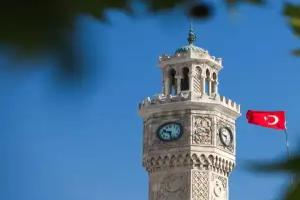
İzmir Clock Tower (1901)One of the more pronounced elements of İzmir's harbor is the Clock Tower, a beautiful marble tower in the middle of the Konak district, standing 25 m (82 ft) in height. It was designed by Levantine French architect Raymond Charles Père in 1901 to commemorate the 25th anniversary of the ascension of Abdülhamid II to the Ottoman throne in 1876. The clock's workings were given as a gift by the German Kaiser Wilhelm II, a political ally of Abdülhamid II. The tower features four fountains placed around the base in a circular pattern, and the columns are inspired by North African themes.
The Kemeraltı bazaar zone set up by the Ottomans, combined with the Agora, rests near the slopes of Kadifekale. İzmir has had three castles historically – Kadifekale (Pagos), the portuary Ok Kalesi (Neon Kastron, St. Peter), and Sancakkale, which remained vital to İzmir's security for centuries. Sancakkale is situated in the present-day İnciraltı quarter between the Balçova and Narlıdere districts, on the southern shore of the Gulf of İzmir. It is at a key point where the strait allows entry into the innermost tip of the Gulf at its narrowest, and due to shallow waters through a large part of this strait, ships have sailed close to the castle.
There are nine synagogues in İzmir, concentrated either in the traditional Jewish quarter of Karataş or in Havra Sokak (Synagogue street) in Kemeraltı, and they all bear the signature of the 19th century when they were built or re-constructed in depth on the basis of former buildings.
The İzmir Bird Paradise (Kuş Cenneti) in Çiğli, a bird sanctuary near Karşıyaka, has recorded 205 species of birds, including 63 species that are resident year-round, 54 species of summer migratory birds, 43 species of winter migratory birds, and 30 transient species. 56 species of birds have bred in the park. The sanctuary, which covers 80 square kilometres, was registered as "the protected area for water birds and for their breeding" by the Turkish Ministry of Forestry in 1982. A large open-air zoo was established in the same district of Çiğli in 2008 under the name Sasalı Park of Natural Life.
A seaside view from the İnciraltı quarter, with the Crowne Plaza Hotel at left.Culture
İzmir International Fair
İzmir prides itself with its busy schedule of trade fairs, exhibitions and congresses. The fair and the festival are held in the compound of İzmir's vast inner city park named Kültürpark in the first days of September, and organized by İZFAŞ, a depending company of İzmir Metropolitan Municipality.
İzmir was a candidate to host Expo 2015, however Milan won the bid in an 86 to 65 vote. İzmir is currently among the candidate cities bidding to host Expo 2020.
Festivals
Ahmet Adnan Saygun Art CenterThe annual International İzmir Festival, which begins in mid-June and continues until mid-July, has been organized since 1987. During the festival, many world-class performers such as soloists and virtuosi, orchestras, dance companies, rock and jazz groups have given recitals and performances at various venues in the city and its surrounding areas; including the ancient theatres at Ephesus (near Selçuk) and Metropolis (an ancient Ionian city situated near the town of Torbalı.) The festival is a member of the European Festivals Association since 2003.
The İzmir European Jazz Festival is among the numerous events organized every year by the İKSEV (İzmir Foundation for Culture, Arts and Education) since 1994. The festival aims to bring together masters and lovers of jazz with the aim to generate feelings of love, friendship and peace.
The International İzmir Short Film Festival is organized since 1999 and is a member of the European Coordination of Film Festivals.
İzmir Metropolitan Municipality has built the Ahmet Adnan Saygun Art Center on a 21,000 m2 land plot in the Güzelyalı district, in order to contribute to the city's culture and art life. The acoustics of the center have been prepared by ARUP which is a world famous company in this field.
Cuisine
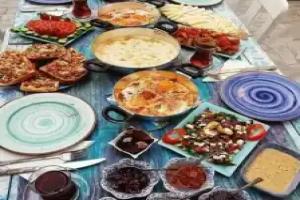
İzmir's cuisine has largely been affected by its multicultural history, hence the large variety of food originating from the Aegean and Mediterranean regions. Population movement from Eastern and South East Anatolia regions has enriched the local cuisine. Another factor is the large and fertile area of land surrounding the region which grows a rich selection of vegetables. There is considerable culinary usage of green leaf vegetables and wild plants amongst the residents, especially those with insular heritage, such as the immigrants from Crete. Some of the common dishes found here are the tarhana soup (made from dried yoghurt and tomatoes), "İzmir" köfte, sulu köfte, keşkek (boiled wheat with meat), zerde (sweetened rice with saffron) and mücver (made from zucchine and eggs). A Sephardic contribution to the Turkish cuisine, boyoz and lokma are pastries associated with İzmir. Kumru is a special kind of sandwich that is associated particularly with the Çeşme district and features cheese and tomato in its basics, with sucuk also added sometimes.
Transport
İzmir is served by national and international flights through the Adnan Menderes International Airport and there is a modern rapid transit line running from the southwest to the northeast. The city is trying to attract investors through its strategic location and its relatively new and highly developed technological infrastructure in transportation, telecommunications and energy.
Connection with other cities and countries
.
Air The Adnan Menderes International Airport (ADB) is well served with connections to Turkish and international destinations. It is located in the Gaziemir district of İzmir. Bus A recently built large bus terminal, the Otogar in the Pınarbaşı suburb on the outskirts of the city, has intercity buses to destinations across Turkey. It is quite easy to reach the bus terminal, since bus companies' shuttle services pick up customers from each of their branch offices scattered across the city at regular intervals, free of charge. Rail İzmir has two historical rail terminals in the city centre. Alsancak Terminal, built in 1858 and Basmane Terminal, built in 1866 are the two main railway stations of the city. The Turkish State Railways operates regional service to Ödemiş, Tire, Selçuk, Aydın, Söke, Nazilli and Uşak, as well as inter city service to Ankara, Afyon and Bandırma (İstanbul via İDO connection).Transport within the city
Co-ordinated transport was introduced to İzmir in 1999, the first place in Turkey to apply the lessons of integration. A body known as UKOME gives strategic direction to the Metro, the ESHOT bus division, ferry operations, utilities and road developments. İzmir has an integrated pre-pay ticket, the Kentkart (Citycard). The card is valid on metro (subway), buses, ferries and certain other municipal facilities. The Kentkart allows use of multiple forms of transport within a 90-minute window for the price of a single fare.
BusAll major districts are covered by a dense municipal bus network under the name ESHOT. The acronym stands for "E elektrik (electricity); S su (water); H havagazı (gas); O otobüs (bus) and T troleybüs (trolleybus)." Electricity, water and gas are now supplied by separate undertakings, and İzmir's trolleybus system ceased to operate in 1992. However, the bus company has inherited the original name. ESHOT operates about 1,500 buses with a staff of 2,700. It has five garages at Karataş, Gümrük, Basmane, Yeşilyurt and Konak. A privately owned company, İzulaş, operates 400 buses from two garages, running services under contract for ESHOT. These scheduled services are supplemented by the privately owned minibus or dolmuş services.Alternatively, you may prefer Izmir Adnan Menderes airport car rental companies on.
Urban ferriesTaken over by İzmir Metropolitan Municipality since 2000 and operated within the structure of a private company (İzdeniz), İzmir's urban ferry services for passengers and vehicles are very much a part of the life of the inhabitants of the city, which is located along the deep end of a large gulf. 24 ferries shuttle between 8 quays (clockwise Bostanlı, Karşıyaka, Bayraklı, Alsancak, Pasaport, Konak, Göztepe and Üçkuyular.) Special lines to points further out in the gulf are also put in service during summer, transporting excursion or holiday makers. These services are cheap and it is not unusual to see natives or visitors taking a ferry ride simply as a pastime.
Metroİzmir has a metro network that is constantly being extended with new stations being put in service. The network "İzmir Metrosu", consisting of one line, starts from the Fahrettin Altay station in Balçova in the southern portion of the metropolitan area and runs towards northeast to end in Bornova. The line is 20 km (12.4 mi) long. The stations are Fahrettin Altay, Poligon, Göztepe, Hatay, İzmirspor, Üçyol, Konak, Çankaya, Basmane, Hilal, Halkapınar, Stadyum, Sanayi, Bölge, Bornova, Ege University, Evka 3.
A more ambitious venture named İZBAN has begun involves the construction of a new 80 km (50 mi) line between the Aliağa district in the north, where an oil refinery and its port are and the Menderes district in the south, to reach and serve the Adnan Menderes International Airport. The line comprises 31 stations and the full ride between the two ends takes 86 minutes.
Light MetroİZBAN, sometimes referred to as Egeray, is a commuter rail system serving İzmir and its metropolitan area. It is the busiest commuter railway in Turkey, serving about 150,000 passengers daily. İZBAN is a portmanteau of the words "İzmir" and "Banliyö".
Established in 2006 and began operations in 2010, İZBAN was formed to revive commuter rail in İzmir. Currently, İZBAN operates a 80 km (50 mi) long system, with 31 stations, consisting of two lines: the Southern Line and the Northern Line.
İZBAN A.Ş. operates the railway and is owned 50% by the Turkish State Railways and 50% by the İzmir Metropolitan Municipality. İZBAN is a part of the municipality's Egeray project.