Brittany
Description
Brittany ); is one of the 27 regions of France. It is named after the historic and geographic region of Brittany, of which it constitutes 80%. The regional capital is Rennes.
Territory
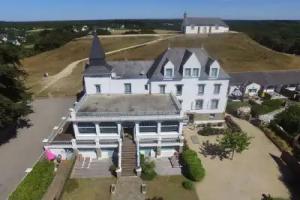
Le Diben harbour - Plougasnou (Brittany) House in Brittany at the Channel Coast (north of Morlaix)The region of Brittany was created in 1941 on 80% of the territory of traditional Brittany. The remaining 20% is now called the Loire-Atlantique department which is included in the Pays de la Loire region, whose capital, Nantes, was the historical capital of the Duchy of Brittany.
Part of the reason why Brittany was split between two present-day regions was to avoid the rivalry between Rennes and Nantes. Although Nantes was the principal capital of the Duchy of Brittany until the sixteenth century, Rennes had been the seat of the Duchy's supreme court of justice between 1560 and 1789. Rennes had also been the administrative capital of the Intendant of Brittany between 1689 and 1789, and Intendances were the most important administrative units of the kingdom of France in the seventeenth and eighteenth centuries. As for the provincial States of Brittany, a legislative body which had originally met every two years in a different city of Brittany, that had met in Rennes only between 1728 and 1789, although not in the years 1730, 1758, and 1760. Despite that, the Chambre des comptes had remained in Nantes until 1789. However, from 1381 until the end of the fifteenth century Vannes (Gwened in Breton) had served as the administrative capital of the Duchy, remaining the seat of its Chambre des comptes until the 1490s, and also the seat of the its Parlement until 1553 and then again between 1675 and 1689.
Although there were previous plans to create Régions out of the Départements, like the Clémentel plan (1919) or the Vichy regionalisation programme (1941), these plans had no effect or else were abolished in 1945. The current French Regions date from 1956 and were created by gathering Departements together. In Brittany, this led to the creation of the new Region of Brittany, which included only four out of the five historical Breton départements. The term region was officially created by the Law of Decentralisation (2 March 1982), which also gave regions their legal status. The first direct elections for regional representatives took place on 16 March 1986.
A majority of the population in administrative Brittany and in Nantes continue to protest against the division of the traditional territory of Brittany, hoping to see the Loire-Atlantique department reunited with the administrative region of Brittany. However, such a reunification raises other questions: first, what to do with the remainder of the present Pays de la Loire region, and second, which city should be chosen as the capital of such a reunified Brittany.
History
- See History of Brittany
Language and culture
The name of Brittany derives from settlers from Great Britain, who fled that island in the wake of the Anglo-Saxon conquest of England between the fifth and seventh centuries. Unlike the rest of France and Brittany, Lower Brittany (roughly, west of a boundary from Saint Brieuc to Vannes) has maintained a distinctly Celtic language, Breton, which is related to Cornish and Welsh. It was the dominant language in Lower, or western, Brittany until the mid-20th century. It has been granted regional language status and revival efforts are underway. In Upper, or eastern, Brittany, the traditional language is Gallo, an Oïl language, which has also received regional recognition and is in the process of being revived.
The French administration now allows for some Breton or Gallo to be used by the region and its communes, in road signs and names of towns and cities, alongside the official French version. The two regional languages are also taught in some schools, and many folklore associations and clubs are trying to revive them.
Brittany has historically been a stronghold of the Roman Catholic Church, and its rates of church attendance have tended to be considerably higher than the national average. However, in recent years the influence of the church has declined.
Transportation
There are several airports in Brittany serving destinations in Europe. TGV train services link the region with cities such as Paris, Lyon, Marseille, and Lille in other regions of France. In addition there are ferry services that take passengers, vehicles and freight to the Republic of Ireland, the United Kingdom, and the Channel Islands.
Major communities
The following table is the list of towns in Brittany with a population over 15,000 inhabitants. Rennes is situated in the east of Brittany, being the capital of the region, the capital of the Ille-et-Vilaine department, as well as the most populous metropolitan area in Brittany with 700 000 inhabitants (2013).
Town Breton name Population(2007) Department Rennes Roazhon 207,922 Ille-et-Vilaine Brest Brest 142,722 Finistère Quimper Kemper 63,961 Finistère Lorient An Oriant 58,135 Morbihan Vannes Gwened 52,984 Morbihan Saint-Malo Sant-Maloù 48,563 Ille-et-Vilaine Saint-Brieuc Sant-Brieg 46,178 Côtes-d'Armor Lanester Lannarstêr 22,598 Morbihan Fougères Felger 20,678 Ille-et-Vilaine Concarneau Konk Kerne 20,280 Finistère Lannion Lannuon 19,773 Côtes-d'Armor Plœmeur Plañvour 18,509 Morbihan Vitré Gwitreg 16,691 Ille-et-Vilaine Morlaix Montroulez 15,605 Finistère Douarnenez Douarnenez 15,436 Finistère Cesson-Sévigné Saozon-Sevigneg 15,261 Ille-et-Vilaine Bruz Bruz 15,031 Ille-et-Vilaine