Fuerteventura
Description
Fuerteventura is one of the Canary Islands, in the Atlantic Ocean off the coast of Africa, politically part of Spain. At 1,660 square kilometres (641 square miles), it is the second largest of the Canary Islands, after Tenerife. It was declared a biosphere reserve by UNESCO in May 2009. Its capital is Puerto del Rosario.
History
[[File:Flag of brazil .svg|thumb|right|Flag of Fuerteventura]]
Precolonial history
The first settlers are believed to have arrived here from North Africa - the word Mahorero (Majorero) or Maho is still used today to describe the people of Fuerteventura and comes from the ancient word 'mahos' meaning a type of goatskin shoe worn by the original inhabitants. They lived in caves and semi-subterranean dwellings, a few of which have been discovered and excavated revealing relics of early tools and pottery. In antiquity, the island was known as Planaria, among other names, in reference to the flatness of most of its landscape.
In the 11th century BC, the Phoenician settlers arrived in Fuerteventura and Lanzarote. Several Spanish and Portuguese expeditions occurred in about 1340 around the island and the island were inhabited by Moors and were afflicted with European slave holders. By the time of the conquest, the island was divided into two Guanches kingdoms, one following the king Guize and the other Ayoze. The territories of these tribes were called Maxorata (in the north) and Jandía (in the south). The kingdoms were separated by a wall whose remains are still preserved today. The wall crossed the La Pared isthmus. The ancient name for the island, Erbania, refers to that wall.
The conquest
The conquest began in 1402, commanded by Jean de Béthencourt and Gadifer de la Salle. They arrived with only 63 sailors out of the original 283 as so many had deserted. After arriving and settling in Lanzarote, the invaders made their first excursions to the neighbouring islands. In 1404, Bethencourt and Gadifer founded Betancuria, the first settlement on the island. After numerous difficulties, Gadifer took charge of the invasion, while Bethencourt went to the Spanish peninsula to seek the recognition and support of the Castilian king.
In 1405, the French conqueror Jean de Béthencourt completed his conquest of the island and gave his name to the former capital, Betancuria, on the west coast (Puerto Rosario took over the mantle as island capital in 1835). The name of the island itself comes from fuerte (strong) and ventura (wind) as mentioned by mallorcan navigator Angelino Dulcert in 1339.
In 1424 Pope Martin V erected in Betancuria brief Bishopric of Fuerteventura, which encompassed all the Canary Islands except the island of Lanzarote. The origin of this bishopric is directly related to the events that occurred after the Great Schism (1378-1417). This was due to the fact that the bishop of San Marcial del Rubicón in Lanzarote (only diocese at the time of the Canary Islands) did not recognize the papacy of Martin V, as this bishop was a supporter of anti-Pope Benedict XIII. The Bishopric of Fuerteventura was based in Parish of Santa María de Betancuria, for it to rank high cathedral. After the reintegration of the Diocese of San Marcial del Rubicón in the papacy of Martin V, the Bishopric of Fuerteventura was abolished only seven years after it was created in 1431.
The first census showed a population of 1,200 inhabitants. Following that, the population increased gradually. In 1476 the territory became the Señorío Territorial de Fuerteventura, a subject of the Catholic Monarchs. Over the years, the island has been invaded by the Spanish, French and the English.
Colonial Fuerteventura
The island suffered from various pirate incursions. A Berber expedition invaded in 1593, sweeping as far as the capital. Various castles were built to protect against this type of attack. The castles were built all along the coast. The population all moved inland as a second protective measure. Because of the invasions, the first Captain General was sent to Fuerteventura, charged with defending the island in the name of the crown. With him came a number of Sergeant Majors. Betancuria became the religious capital of the island
Two pirate attacks took place in 1740, when, within a month of one another, two bands of English privateers attempted to loot the town of Tuineje. These Pirate attacks on Fuerteventura in 1740 were ruthlessly put down by the local population and the island's militia.
The military regiment was created in 1708. Its colonel assumed the title of Governor at Arms, a hereditary lifetime appointment which stayed in the hands of the Sánchez-Dumpiérrez family. Over time they acquired more power in the other islands through the family of Arias de Saavedra, the Lady of Fuerteventura. The same year, the religious leader created the Assistant Parish of La Oliva and Pájara, to launch in 1711. On 17 December 1790 he created the Assistant Parish of Tuineje, which became a new parish division on 23 June 1792 under the bishop Tavira with lands including part of the Jandía peninsular with a population of 1,670 inhabitants. In 1780 the barrilla growing economy began.
In 1852, the free trade zone was extended by Isabella II to the Canary Islands. The military rule over the island which began from 1708 dissolved in 1859 and Puerto de Cabras (now Puerto del Rosario) became entirely the new capital.
The Canary Islands obtained the right to self-govern in 1912.
In 1927, Fuerteventura and Lanzarote became part of the province of Gran Canaria.
By the 1940s the island had an airport (just west of Puerto del Rosario on the road to Tindaya, still visible today).
Tourism arrived in the mid-1960s with the building of the present airport at El Matorral and the first tourist hotels.
The seat of the island government (cabildo insular) is in Puerto del Rosario. A total of 74,983 people (2003) live on the island.
Since the island is close to Africa, many undocumented immigrants try to enter the European Union through it, by a dangerous boat trip from Morocco.
Environment
Geography
The elongated island has an area of 1,660 km2 (641 sq mi). The island is 100 kilometres (62 miles) long and 31 kilometres (19 miles) wide. It is part of the province of Las Palmas. It is divided into six municipalities:
- Antigua
- Betancuria
- La Oliva
- Pájara
- Puerto del Rosario
- Tuineje
100 individual settlements are distributed through these municipalities. A nearby islet, Islote de Lobos, is part of the municipality of La Oliva.
Located just 100 km (62 mi) off the coast of north Africa, it is the second biggest of the islands, after Tenerife, and has the longest beaches in the archipelago. The island is a destination for sun, beach and watersports enthusiasts. It lies on the same latitude as Florida and Mexico and temperatures here rarely fall below 18 °C (64 °F) or rise above 32 °C (90 °F). There are no fewer than 152 beaches along its coastline — 50 km (31 mi) of fine, white sand and 25 km (16 mi) of black volcanic shingle.
Geology
Fuerteventura is the oldest island in the Canary Islands dating back 20 million years to a volcanic eruption from the Canary hotspot. The majority of the island was created about 5 million years ago and since then has been eroded by wind and other weather. On the seabed off the west coast of the island rests a block of rock 22 km (14 mi) long and 11 km (7 mi) wide, which appears to have slid off the island largely intact at some point in prehistory, similar to the predicted future collapse of Cumbre Vieja, a geological fault on the neighboring island, La Palma. The last volcanic activity in Fuerteventura was between 4,000 and 5,000 years ago.
The highest point in Fuerteventura is Mount Jandía (807 m) in the southwestern part of the island. Geographical features include Istmo de la Pared which is 5 km (3 mi) wide and is the narrowest part of Fuerteventura. The island is divided into two parts, the northern portion which is Maxorata and the southwestern part called the Jandía peninsula.
Beaches
Fuerteventura was chosen among 500 European destinations by the Quality Coast International Certification Program of the European Coastal and Marine Union as one of the most attractive tourist destinations for visitors interested in cultural heritage, environment and sustainability.
Wildlife
The island is home to one of the two surviving populations of the threatened Canarian Egyptian vulture. It is also inhabited by many wild dogs and cats. On the barren, rocky land there are Barbary ground squirrels and geckos. Fuerteventura also hosts several migratory and nesting birds. The island has significant populations of the collared dove, common swifts and several finch species especially in the vicinity of holiday developments.
Despite its arid climate, the island is also home to a surprisingly large insect fauna. Butterflies which commonly occur on the island include the clouded yellow (Colias hyale) and the bath white (Pontia daplidice) which feeds on xerophytic cruciferae. The island is also home the monarch butterfly (Danaus plexippus) and its close African relative Danaus chrysippus. Around holiday developments such as Caleta de Fuste, water is relatively abundant, and dragonfly species including the blue emperor, Anax imperator and the scarlet darter, Crocothemis erythraea can be found. The islands sand dunes and shoreline are home to a number of bee and wasp species including the large Eumenid caterpillar hunting wasp, Delta dimidiatipenne and the striking blue banded bee, (Amegilla canifrons).
Hawkmoths also occur on the island. One of the more notable species is Hyles tithymali which feeds on endemic spurges such as Euphorbia regis-jubae. Acherontia atropos, the deaths-head hawkmoth also occurs on the island presumably feeding on members of the Solanaceae, for example, Datura innoxia and Nicotiana glauca which are common weeds in the vicinity of human habitation.
Tourism
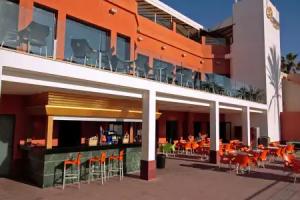
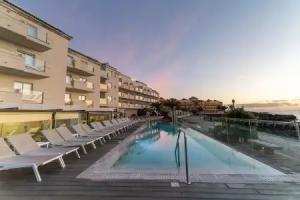
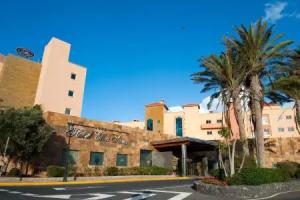
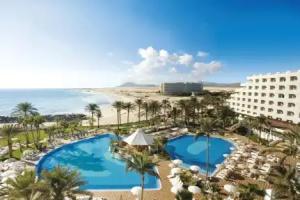
The first tourist hotel was built in 1965 followed by the construction of Fuerteventura Airport at El Matorral, heralding the dawn of a new era for the island. Fuerteventura, with its 3,000 sunshine hours a year, was placed firmly on the world stage as a major European holiday destination. While having fully developed tourist facilities, the island has not experienced the overdevelopment found on some other islands and consequently caters for visitors attracted by its rugged natural beauty.
The summer Trade Winds and winter swells of the Atlantic make this a year-round surfers' paradise, with more exposed areas on the north and west shores such as Corralejo and El Cotillo proving most popular. Wind surfing takes places at locations around the island. Sailors, scuba divers and big-game fishermen are all drawn to these clear blue Atlantic waters where whales, dolphins, marlin and turtles are all common sights. With many hills present throughout the Island, hikers are also attracted to this Island.
Excellent sandy beaches are found in many locations. Western beaches, such as those around El Cotillo, can experience strong surf. The beaches adjoining the extensive sand dunes east of Corralejo are popular, as are the more protected extensive sandy shores of the Playa de Sotavento de Jandia on the southeastern coast between Costa Calma and the Morro Jable. Naked sun bathing and swimming are the norm almost on all beaches.
Much of the interior, with its large plains, lavascapes and volcanic mountains, consists of protected areas, although there are organised tours and vehicular access across them.
Art and culture
Traditional holidays
Like the rest of the Canaries, Carnival is traditionally one of the biggest festivals celebrated on the island. It is celebrated in different ways in all the towns during February and March. These festivities have a different theme each year. They include activities such as parades and galas to choose the Carnival King.
Concerts and festivals
There are many concerts and festivals held in the auditoriums, such as the Festival of Canarian Music. They are also held in smaller venues across the island, featuring bands such as Estopa, Van Gogh's Ear, and King Afrhica.
- Lebrancho Rock: in 2004, the Town Hall of Puerto del Rosario started this initiative for the growing number of local bands who had been performing in the area for years but had not had the chance to play at the same event.
- Fuertemusica: like Lebrancho Rock, this festival aims to encourage the local or emerging groups. It started in the same year. This festival is mainly for groups that are already known in the music world. It takes place in El Cotillo.
- In the municipality of Betancuria (more specifically in the village of Vega de Rio Palmas) held every year the festivities in honor of the Virgen de la Peña, patron saint of the island of Fuerteventura, the most representative is the pilgrimage in which are involved people from all corners of the island. The holiday is celebrated on the third Saturday of September.
Festival Internacional de Cometas/International Kite Festival is held on the second week of November each year centering on the Corralejo Beaches. It attracts kitefliers and kite surfers from all over Europe. It is popular because the winds are warm and constant and the beaches become filled with hundreds of colourful kites of all shapes and sizes.
Auditoriums
Fuerteventura has three auditoriums. These are used for all types of performing art. They are also used for non-artistic purposes, such as conferences, charity galas and political meetings.
- The Isle of Fuerteventura Auditorium
- Gran Tarajal Auditorium
- Corralejo Auditorium
Central library
The Central Library of the Island is located in Antigua's city centre, in the public university. In addition to providing the traditional library services, it has an 180-seat multipurpose room, air conditioning, a wifi zone, and a multimedia room used for seminars, presentations, film festivals etc.
Museums and exhibition spaces
The island has several museums with different themes and plenty of exhibition spaces, both public and private. These include:
- The Antigua Windmill Craft Centre
- The Salt Museum
- The Atalayita Archeological Interpretation Centre
Sculpture park
In addition to the museums, the capital Puerto del Rosario has an open-air sculpture park consisting of around 100 sculptures by different artists scattered across the city. Most of them were created for the International Symposium of Sculpture celebrated annually since 2001. During the festival, artists come from all over the world to erect their sculptures in the open air, in full view of passers by.
Main sights
Sites of interest include Corralejo and El Jable to the north which are made up of fine sand dunes whilst the south is filled with long beaches and remote bays. The constant winds blowing onto the beaches provide a paradise for windsurfing. Surfing is common on the west and north coasts where there are large waves. Windsurfing is common around Corralejo and Playas de Sotavento and wave sailing (windsurfing on the waves) on the coast along the northern half of the island. El Cotillo is a small fishing village in the north-west of the Island famous for a very long beach to the south of the village and few very calm beaches to the north. The northern beaches frequented by snorkeling enthusiasts and sun worshippers alike are referred to as lakes by the locals.
At Cofete on the western side of Jandía a remote and imposing house - Villa Winter - looks out to sea across wide and generally empty beaches. It was reputedly built by a Mr Winter on land given by Generalisimo Franco. Despite being one of the most beautiful part of Fuerteventura Cofete has very little touristic facilities.
For a time, the beaches were home to a popular accidental attraction. On 18 January 1994 the once-beautiful and proud United States Lines ocean liner SS American Star (former America, USS West Point, Australis) was beached in Playa de Garcey during a severe storm. Within a year, she broke in two and later lost her stern. By 2007 the rest of the severely deteriorated ship had collapsed onto her port side, gradually keeling over further and almost completely submerged. By 2008-2012, most of the remains finally slipped below the surface.
Food
The cuisine is fairly basic due to the customs and climate conditions. They share this simplicity with the other Canary islands, and similarly to them, they use a large quantity of fish. They also use whatever they can grow in the near-barren land. This includes papas arrugadas, a dish of wrinkled potatoes usually served with mojo, which is a hot pepper sauce or with puchero canario, a meat stew.
Seafood is prepared in many ways traditionally, such as pejines (salted fish), jareas, or sancocho (a type of stew) made from fish, generally the grouper, corvina or sama, boiled after salting, and served with mojo, potatoes, or gofio (a type of grain). People are also very keen on the mussels and limpets collected on the island's coasts.
They also use meat such as beef and pork to make different dishes or simply to for braising, but their main meat is goat, both from the kids and from the older animals. They eat the goat roasted or stewed. Goats are not only useful for their meat - the Fuerteventurans also use the milk to make the cheese majorero, which has won many prizes. The majorero is mostly made of goats milk, and occasionally it is up to 15% ewes milk. It is cured in pimento oil or gofio meal. Majorero and palmero cheese are the only two Canarian cheeses with protected denomination of origin.