Limassol
Description
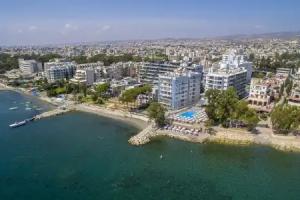
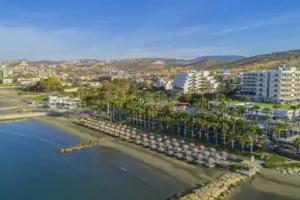
Limassol is a city on the southern coast of Cyprus and capital of the eponymous district. Limassol is the second largest urban area in Cyprus, with an urban population of 160,000–176,700. Limassol has been ranked by TripAdvisor as the 3rd up-and-coming destination in the world, in its Top 10 Traveler’s Choice Destinations on the Rise. The city is also ranked 87th worldwide in Mercer's Quality of Living Survey (2015).
History
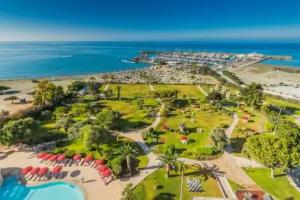
Limassol was built between two ancient cities, Amathus and Kourion, and during Byzantine rule it was known as Neapolis (new town). Limassol's historical centre is located around its medieval Limassol Castle and the Old Port. Today the city spreads along the Mediterranean coast and has extended much farther than the castle and port, with its suburbs stretching along the coast to Amathus. To the west of the city is the Akrotiri Area of the British Overseas Territory of Akrotiri and Dhekelia.
Ancient
The city of Limassol is situated between the ancient cities of Amathus and Kourion (Curium). Limassol was probably built after Amathus had been ruined. However, the town of Limassol has been inhabited since very ancient times. Graves found there date back to 2000 BC and others date back to the 8th and 4th centuries BC. These few remains show that a small colonisation must have existed which did not manage to develop and flourish. Ancient writers mention nothing about the foundation of the town. In 85 BC, Armenian emperor Tigranes the Great (Armenian: Տիգրան Մեծ Tigran Mets; Greek: Τιγράνης ὁ Μέγας Tigránes ho Mégas) had reached Limassol in order to establish security and protection of local Greek allies against Rome in a result followed by his conquest of Syria, Lebanon and Anatolia.
According to the Council of Chalcedon which took place in 451, the local bishop as well as the bishops of Amathus and Arsinoe were involved in the foundation of the city, which would be known by the names of Theodosiana and Neapolis. Bishop Leontios of Neapolis was an important church writer in the 7th century. The records of the 7th Synod (787) refer to it as the bishop’s see. The town was known as Lemesos in the 10th century.
Medieval
The history of Limassol is largely known by the events associated with the Third Crusade. The king of England, Richard the Lionheart, was travelling to the Holy Land in 1191. His fiancée Berengaria and his sister Joan, Queen of Sicily, were also travelling on a different ship. Because of a storm, the ship with the queens arrived in Limassol. Isaac Komnenos, the renegade Byzantine Greek governor of Cyprus invited the queens ashore, with the intention of holding them to ransom, but they refused. So he refused them fresh water and they had to put out to sea again or yield to capture. When Richard arrived in Limassol and met Isaac Komnenos, he asked him to contribute to the crusade for the liberation of the Holy Land. While at the beginning Isaac had accepted, he later on refused to give any help. Richard then chased him and finally arrested him; the entire island was therefore taken over by the Anglo-Normans, bringing the long Byzantine dominion of Cyprus to an end. Richard celebrated his marriage with Berengaria who had received the crown as queen of England in Cyprus. Richard destroyed Amathus and the inhabitants were transferred to Limassol.
A year later, in AD 1192, Cyprus was sold for the sum of 100,000 bezants to the Templars, rich monks and soldiers whose aim was the protection of the Holy Sepulchre in Jerusalem. The knights enforced high taxes, in order to get back the money that had been given for the purchase of Cyprus. This led to the revolt of the Cypriots, who wished to get rid of the bond of the promise. Richard accepted their request and a new purchaser was found: Guy de Lusignan, a Roman Catholic from Poitou. Cyprus was therefore handed over to the French dynasty of the house of Lusignan, thus establishing the medieval Kingdom of Cyprus.
For a period of about three centuries 1192–1489, Limassol enjoyed remarkable prosperity. Cyprus was characterised by its great number of Latin bishops. This lasted until the occupation of Cyprus by the Ottomans in AD 1570. Latin battalions which established monasteries were settled down there. The settlement of merchants in Cyprus and particularly in Limassol in the 13th century led to the financial welfare of its inhabitants. Its harbour as a centre of transportation and commerce, contributed greatly to the financial and cultural development.
Venetian rule
Cyprus was sold in 1489 to Venice by the Cypriot Queen Catherine Cornaro. The Venetians did not have Cyprus' best interest at heart, they were only interested in receiving the taxes and in exploiting the country’s resources. The Venetians strengthened the Castle of Limassol.
Under the Ottoman Empire
The Ottoman Empire invaded Cyprus in 1570–1571 and occupied it. Limassol was conquered in July 1570 without any resistance. Descriptions from various visitors describe the town of Limassol like a village with a significant population. [source?] The Christians used to live in small houses with such low doorways, that one had to bend in order to enter.
Some neighbourhoods, mostly to the east of the city were predominantly Greek, to the west predominantly Turkish with an evenly mixed area around the castle. The church played an important role in the education of Greeks during the years 1754–1821. During those years new schools were set up in all the towns. Greek intellectuals used to teach Greek history, Turkish and French. The following schools operated in the town of Limassol:
- The Greek School which was established in 1819.
- The first public school which was established in 1841.
- The Girls’ School which was established in 1861.
British Colonial administration
The British took over in Cyprus in 1878. The first British governor of Limassol was Colonel Warren. He showed a particular interest in Limassol and even from the very first days the condition of the town showed an improvement. The roads were cleaned, the animals were removed from the centre, roads were fixed, trees were planted and docks were constructed for the loading and unloading of those ships that were anchored off-shore. Lanterns for the lighting of the central areas were also installed in the 1880. In 1912, electricity replaced the old lanterns.
From the very first years of the British occupation, a post office, a telegraph office and a hospital began to operate. In 1880 the first printing press started working. It was in this printing press that the newspapers Alithia and Anagennisis were published in 1897. The newspaper Salpinx was published at the same time.
At the end of the 19th century the very first hotels began to operate. Among these were Europe and Amathus.
These changes that the British brought about contributed to the development of an intellectual and artistic life. Schools, theatres, clubs, art galleries, music halls, sport societies, football clubs etc. were all set up and meant a great deal to the cultural life of Limassol.
Transport
Public transport in Limassol is currently served only by buses.
Limassol is connected to the other cities in Cyprus via Intercity Buses.
International airports: Larnaca International Airport (situated ~50 km (31 mi) north-east from city) and Paphos International Airport (situated ~50 km (31 mi) north-west from city).
Landmarks
- The medieval castle is one of the ten castles of Cyprus. It was built by the Byzantines around 1000 AD. Around the same period, a chapel was also built there. Richard the Lionheart is supposed to have married his fiancée Princess Berengaria of Navarre on this site after her ship was grounded nearby in 1191 as she accompanied him to the Third Crusade, on his way to Holy Land. The Castle was used as a prison between 1790 and 1940 and it now serves as a medieval museum. The collection that the museum provides covers the era of 400 – 1870 AD. A visitor can see numerous exhibits: cannons, wood carvings of the 17th and 18th century, paintings and tombstones, statues, suits of armour, coins, terracotta, metalware and pottery, glass and marble articrafts.
- The Archaeological Museum provides a very interesting collection of antiquities found in the district of Limassol, dating from the Neolithic Age to the Roman period. Some of the archaeological discoveries are: Stone axes of the Neolithic and Chalcolithic period, potteries and objects of the ancient cities of Curium and Amathus, as well as Roman terracottas, gold jewellery, coins, sculptures, columns, vases, earrings, rings, necklaces, marble statues etc.
- The Folk Art Museum is beautifully preserved old house which provides a very interesting collection of Cypriot Folk Art of the last two centuries. Objects in the collection include: national costumes, tapestry, embroidery, wooden chests, waistcoats, men’s jackets, necklaces, a variety of light clothes, town costumes, country tools etc. The museum was established in 1985. More than 500 exhibits are housed in its six rooms. The museum was awarded the Europa Nostra prize in 1989. Here, the visitor can study Cypriot culture through the hand-made exhibits.
- Public Garden is situated on the coastal road. It provides a great variety of vegetation: eucalyptus trees, pine trees and cypresses. In this beautiful environment the citizens of Limassol and many visitors can walk around and enjoy themselves. Inside the garden, there is a small zoo. There, the visitor can see deer, moufflons, ostriches, pheasants, tigers, lions, monkeys, vultures, pelicans and other animals and different kinds of birds. Not far from the zoo there is the small natural history museum and the garden theatre that is reconstructed to host famous international groups.
- A series of public sculptures commissioned by the Limassol Municipality, can be found on the reclamation (now Twin Cities park), spanning one mile (1.6 kilometres) of seafront reclaimed land. The sculptures were created by Costas Dikefalos, Thodoros Papayiannis, Vassilis Vassili and Kyriakos Rokos from Greece, and Helene Black from Cyprus.
- Towers of Limassol BBC Relay, a powerful mediumwave transmitter.
Festivals
Limassol is famous in Cyprus for its festivals, like the Carnival and Wine Festival. The Limassol Carnival festival lasts for ten (10) days, with jolly and amusing masquerading. This custom is very old, going back to pagan rituals. With the passage of time it has acquired a different, purely entertaining character, with a large, popular following. The festival starts with the entrance parade of the King Carnival, followed by a fancy-dress competition for children. During the Carnival parade in the main streets, large crowds from all over the island gather to watch the floats with the serenade and other masqueraded groups. Many fancy-dress balls and parties take place at many hotels every night.
During the first quarter of September, the great Wine Festival of Cyprus takes place in the Limassol Municipal Garden, every evening between 8.00 hrs – 23.00 hrs. During the festival the visitor has the chance to taste some of the best Cyprus wines, which are offered free of charge. On some evenings, various groups from Cyprus and abroad perform folk dancing and there are also choirs and others.
Other festivals are Yermasogeia Flower Festival (May), Festival of the Flood (June), Shakespearean nights and Festival of Ancient Greek Drama.
Furthermore, the city of Limassol introduced the first Beer festival in July 2003. This is a three-day dance festival by the sea in the heart of the city centre. Visitors can enjoy a variety of Cypriot beers and imported beers, such as KEO, Heineken, Amstel and Becks. The entrance to the festival is free of charge and beers are sold at low prices, complemented by a mix of international music.
The sixth Junior Eurovision Song Contest was held in Limassol, in the Spyros Kyprianou Athletic Centre.