Ras al-Khaimah
Description
Ras al-Khaimah is one of the seven emirates that make up the United Arab Emirates (UAE). Its name could be taken to mean "headland of the small huts", which can be attributed to the indigenous buildings that existed along the coast. The emirate is in the northern part of the UAE, bordering Oman's exclave of Musandam. It covers an area of 1,684 square km. The capital city and home of most residents is also called Ras Al Khaimah. The emirate had a population of 210,063 at the 2005 Census, of which 41.82 percent or 87,848 were Emirati citizens. Latest estimates put the total population at between 250,000 and 300,000. Locals accounted for 97,529 in the population estimate for 2010.
The city has two main sections, Old Ras Al Khaimah and Nakheel, on either side of a creek. It is served by the Ras Al Khaimah International Airport. It consists of a northern part (where the city of Ras al-Khaimah is situated), and a large inland exclave in the south (near Hatta), and a few small islands in the Persian Gulf. Ras al-Khaimah has the most fertile soil in the country, due to a larger share in rainfall and underground water streams from Omani mountains.
History
Ras al-Khaimah has been the site of human habitation for several millennia and there are many historical and archaeological sites throughout the emirate - local sources cite 1,000 - dating from different time periods, including remnants of the Umm an-Nar Culture (3rd millennium BC). Ancient graves were found in the Emirate in October 2012.
The city was historically known as Julfar.
According to Sheikh Sultan bin Muhammad Al-Qasimi, ruler of Sharjah Emirate, the city of Ras al-Khaimah was historically known as Julfar and was founded by Armenians who escaped Persia during the Mongol invasion. During a televised broadcast Sultan bin Muhammad revealed that: “The Armenian Christians fled from Persia to that place called Bgelovar which is now located in Ras Al Khaimah, and was founded by Armenians” He then added that Julfar was an Armenian and not an Arab name. The ruler also asked the educational authorities to change the textbooks accordingly. The statement was published on his personal website (in Arabic) : www.sheikhdrsultan.ae
Further, archaeological evidence has demonstrated that the settlement known as Julfar shifted location over time as harbour channels silted up. Excavations of a sizable tell, which revealed remnants of a Sassanid era fortification, indicate that early Julfar was located in the north of Ras Al-Khaimah, not far from other sites of historical/archaeological interest such as 'Sheba's Palace' and the largest Umm an-Nar tombs found on the Arabian Peninsula. Sources say that Julfar was inhabited by the Azd (a branch of the Kahlan tribe) during the eighth and ninth centuries AD, and that the houses of the Azd were built of wood.
There is considerable debate locally regarding the 18th-century charge of maritime piracy, attracting the British label 'The Pirate Coast' to the Eastern Gulf before a series of treaties in 1820, 1853 and, in 1892, the Perpetual Maritime Truce led to it being known as the 'Trucial Coast'.
In the early 18th century, the Al Qasimi dynasty established itself in Ras Al Khaimah and Sharjah on the Arabian Peninsula, growing to become a significant maritime force with holdings on both the Persian and Arabian coasts. In 1809, a British naval force was sent from Bombay in order to suppress alleged piracy - actions of the Al Qasimi fleet against British flagged shipping that affected trade routes in the Strait of Hormuz, along the Persian Gulf coast, and the Indian Ocean.
In the Battle of Ras Al Khaimah of 1809, the Al Qasimi fleet was largely destroyed. The British operation continued to Linga on the Persian coast which was, like the Greater and Lesser Tunbs islands, administered by the Al Qasimi. The attack on Ras Al Khaimah resulted in the destruction of the tower of the 16th century Dhayah Fort whose remains can be seen at Rams in northern Ras Al Khaimah. In January 1820, the British imposed the General Maritime Treaty of 1820 signed by Sheikh Sultan Bin Saqr Al Qasimi who was reinstated by the British in Ras Al Khaimah after the deposition of Hasan Bin Rahma. The treaty stipulated the end of piracy and slavery, and laid the foundation for the British protectorate over the Trucial States that lasted until 1971. In 1869, Ras Al Khaimah became fully independent from neighbouring Sharjah. However, from September 1900 to 7 July 1921, it was re-incorporated into Sharjah; the last governor became its next independent ruler.
On 10 February 1972, Ras al-Khaimah, under the leadership of Sheikh Saqr bin Mohammad al-Qasimi, joined the United Arab Emirates.
List of rulers
Its rulers were:
- 1708–1731: Sheikh Rahma Al Qasimi
- 1731–1749: Sheikh Matar bin Butti Al Qasimi
- 1749–1777: Sheikh Rashid bin Matar Al Qasimi
- 1777–1803: Sheikh Saqr bin Rashid Al Qasimi
- 1803–1808: Sheikh Sultan Bin Saqr Al Qasimi (died 1866) (1st time)
- 1808–1814: Sheikh Hasan bin `Ali Al Anezi
- 1814–1820: Sheikh Hasan bin Rahma
- 1820–1866: Sheikh Sultan Bin Saqr Al Qasimi (2nd time)
- 1866 – May 1867: Sheikh Ibrahim bin Sultan Al Qasimi
- May 1867 – 14 April 1868: Sheikh Khalid bin Sultan Al Qasimi (died 1868)
- 14 April 1868 – 1869: Sheikh Salim bin Sultan Al Qasimi (18??–1919)
- 1869 – August 1900: Sheikh Humayd bin Abdullah Al Qasimi (died 1900)
- September 1900 – 1909: Currently Unknown
- 1909 – August 1919: Sheikh Salim bin Sultan Al Qasimi
- August 1919 – 10 July 1921: Sheikh Sultan bin Salim Al Qasimi (1891–19??), who stayed on as the first of its own rulers:
- 10 July 1921 – Feb 1948: Sheikh Sultan bin Salim Al Qasimi
- 17 July 1948 – 27 October 2010: Sheikh Saqr bin Mohammad al-Qassimi (1918–2010)
- 27 October 2010 – current: Sheikh Saud bin Saqr al Qasimi
- The appointed heir presumptive is currently Muhammad bin Saud al Qasimi, son of the current Ruler of the Emirate.
Population
In 1975, the total population of Ras Al Khaimah was 43,845 of which 29,613 were nationals and 14,232 were foreigners. This figure increased to 73,918 (39,148 locals; 34,770 foreigners) in 1980, 96,578 in 1985, 143,334 in 1995, and 210,063 in 2005. The current total population is estimated to be between 250,000 and 300,000 people, nationals and foreigners.
Towns and settlements
Important towns, settlements and areas include:
- Al Jazirah Al Hamra – an old coastal town with numerous real estate projects and industrial zone
- Ar-Rams – a coastal town; in the past, a typical fishing and pearl-diving village
- Khawr Khuwayr – an industrial zone, with the largest port in Ras al-Khaimah and numerous companies such as a cement factory
- Diqdaqah – a village known for agriculture activities
- Khatt – a village surrounded by mountains, famous for its thermal springs and palm gardens
- Masafi – a town in the south, on the border with Fujairah; well known for drinking water
- Huwaylat – a central village in the south
Culture
The UAE culture mainly revolves around the religion of Islam and traditional Arab culture. The influence of Islamic and Arab culture on its architecture, music, attire, cuisine and lifestyle are very prominent as well. Five times every day, Muslims are called to prayer from the minarets of mosques which are scattered around the country. Since 2006, the weekend has been Friday-Saturday, as a compromise between Friday's holiness to Muslims and the Western weekend of Saturday-Sunday.
Community
The majority of mosques are Hanbali, Muwahhid Muslim or Salafi oriented.
Events
The annual Ras al-Khaimah Half Marathon, first held in 2007, has called the attention of the world's sporting media to the region. The organisers invest much in the IAAF-labeled race in order to attract the world's top athletes, resulting in a world record from Samuel Wanjiru in 2007 and the second fastest run of all-time from Patrick Makau Musyoki in 2009.
UAE Awafi Festival – a yearly festival in the Ras al-Khaimah desert, focusing mainly on the Arabic public[clarification needed]. It is a three-week event, held in December or January, the main attraction being a dramatic sand dune race by the strongest 4-wheel drivers of the UAE. There is a heritage village with traditional food and dance, as well as shops for food and souvenirs. There is also a petting zoo and lots of games for children. The entry is free of charge, and many families bring picnics to enjoy whilst watching the cars battling it out over the sand dunes.
Terry Fox Run RAK – a yearly charity run organized in Ras al-Khaimah to support cancer research in the UAE. The first event was organized in 2010 (short movie from 1st RAKTFR event).
Landmarks
Notable landmarks in Ras al-Khaimah include:
- The National Museum of Ras al-Khaimah: housed in the former palace of the ruling Al Qasimi family, with exhibits on natural history, arts and crafts of previous centuries, and archaeology
- Dhayah Fort: the only surviving hilltop fort in the UAE
- Sheba's Palace: ruins of a medieval palace
- Al Falayah: the former summer residence of the ruling Al Qawasim family
- Al Jazirah Al Hamra: an abandoned "ghost town" showing the preserved architecture of an early 20th-century pearling port
- The Old City and Souq: both traditional and modern shops as well as artisans' workshops
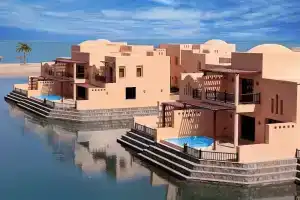
- Bab Al Bahr: Pyramid inspired buildings along Ras Al Khaimah's coastal line
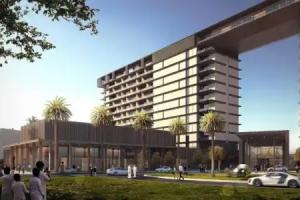
- Waldorf Astoria - Ras Al Khaimah: The Middle Eastern venture of the legendary Waldorf Astoria of New York.
- Bu Shaqq tower 25°01′N 55°47′E / 25.017°N 55.783°E / 25.017; 55.783
- Al Hayl Fort: One of the robust forts that occupies an important strategic location and oversees a vast area, all leading to the road of Fujairah
Dunes and landforms
- Al-Khushaym 25°26′N 55°58′E / 25.433°N 55.967°E / 25.433; 55.967
- Bani Fasan 23°53′N 52°09′E / 23.883°N 52.150°E / 23.883; 52.150
- Jabal Jais, on the city's outskirts