Basque Country
Description
The Basque Country is an autonomous community of northern Spain. It includes the Basque provinces of Álava, Biscay and Gipuzkoa.
The Basque Country or Basque Autonomous Community was granted the status of nationality within Spain, attributed by the Spanish Constitution of 1978. The autonomous community is based on the Statute of Autonomy of the Basque Country, a foundational legal document providing the framework for the development of the Basque people on Spanish soil, although the territory of Navarre was left out and made into a separate autonomous community.
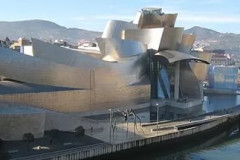
Currently there is no official capital in the autonomous community, but the city that holds the Basque Parliament, the headquarters of the Basque Government and the Basque Autonomous Community's President's residency (Ajuria Enea Palace) is Vitoria-Gasteiz, located in the province of Álava. Whilst Vitoria-Gasteiz is the largest municipality in area, with 277 km2 (107 sq mi), Bilbao (or Bilbo in Basque) is the largest in population, with 353,187 people, located in the province of Biscay within a conurbation of 875,552 people.
The term Basque Country may also refer to the larger cultural region (Basque: Euskal Herria), the home of the Basque people, which includes the autonomous community.
Geography
The following provinces make up the autonomous community:
- Álava (Basque Araba), capital Vitoria-Gasteiz
- Biscay (Spanish Vizcaya, Basque Bizkaia), capital Bilbao-Bilbo
- Gipuzkoa (Spanish Guipúzcoa), capital Donostia-San Sebastián
Features
The Basque Country borders Cantabria and the Burgos province to the west, the Bay of Biscay to the north, France and Navarre to the east and La Rioja (the Ebro River) to the south. The territory has three distinct areas, which are defined by the two parallel ranges of the Basque Mountains. The main range of mountains forms the watershed between the Atlantic and Mediterranean basins. The highest point of the range is in the Aizkorri massif (1551 m). The three areas are:
Atlantic BasinFormed by many valleys with short rivers that flow from the mountains to the Bay of Biscay, like the Nervión, Urola or Oria. The coast is rough, with high cliffs and small inlets. The main features of the coast are the Bilbao Abra Bay and the Estuary of Bilbao, the Urdaibai estuary and the Bidasoa-Txingudi Bay that forms the border with France.
Middle sectionBetween the two mountain ranges, the area is occupied mainly by a high plateau called Llanada Alavesa (the Álava Plains), where the capital Gasteiz is located. The rivers flow south from the mountains to the Ebro River. The main rivers are the Zadorra River and Bayas River.
Ebro ValleyFrom the southern mountains to the Ebro is the so-called Rioja Alavesa, which shares the Mediterranean characteristics of other Ebro Valley zones. Some of Spain's production of Rioja wine takes place here.
History
This section is about the history of the Autonomous Community since 1978.The forerunner of the Gernika Statute was the short-lived Statute of Autonomy for Álava, Gipuzkoa and Biscay, which came to be enforced in October 1936 just in Biscay, with the Spanish Civil War already raging, and which was automatically abolished when the Spanish Nationalist troops occupied the territory.
Before the Spanish Constitution of 1978 and its system of autonomous communities, these three provinces were known in Spanish as the Provincias Vascongadas since 1833. The political structure of the new autonomous community is defined in the Gernika Statute, which was approved by a majority in a referendum held on 25 October 1979. Nowadays it is one of the most decentralized regions in the world; in this regard it has been described as having "more autonomy than just about any other in Europe" by The Economist.
As regards the bounds to the Spanish Constitution, Basque nationalists cite the fact that in the 1978 Spanish Constitution referendum, which was passed with a majority of votes and a poor turnout in this area, the Basque Country had the highest abstention (the Basque Nationalist Party had endorsed abstention on the grounds that the Constitution was being forced upon them without any Basque input). To this, the "NO" vote in this referendum was also higher in the Basque Country than in the rest of the state. All in all, many Basques believe that they are not bound to a constitution that they never endorsed.
The Statute of Autonomy of the Basque Country is an organic law but powers have been devolved gradually during decades according to re-negotiations between the Spanish and the consecutive Basque regional governments to reach an effective implementation, while the transfer of many powers are still due and has always been a matter of heated political discussion. Basque nationalists often put down this limitation in the devolution of powers to concessions made to appease the military involved in the 23-F coup d'état attempt (1981).
In 2003, the governing Basque Nationalist Party (PNV) proposed to alter this statute through the Ibarretxe Plan. The Ibarretxe bill was approved by absolute majority in the Basque Parliament after much discussion, as it was subject to lengthy legal objections—on the grounds that it contradicts the Spanish Constitution—that were ultimately overcome. Despite its mandate of the majority of the autonomous Parliament, the main two parties in Spain (PSOE, PP) imposed a blockade on a discussion of the Plan in the Spanish Parliament (Madrid Cortes Generales), resulting in its rejection for debate by a large majority of that Parliament in January 2005.
Since the first autonomic cabinet, the Basque Nationalist Party has held office in the Basque Autonomous Community except for a 2009-2012 term, led by Patxi Lopez (PSE-PSOE). The current Basque prime minister is Iñigo Urkullu, also a member of the Basque Nationalist Party.
Cuisine
Basque cuisine is an important part of Basque culture. According to the chef Ferran Adrià, San Sebastián "in terms of the average quality of the food, in terms of what you can get at any place you happen to walk into, maybe it is - probably it is, yes - the best in the world." The most popular dishes are seafood, fish (for example Marmitako) and "Pintxos", bar finger food.
Basque food is one of the reasons for tourism to the Basque Country, especially the pintxos. A popular way to socialize is "ir de pintxos" or txikiteo, a Basque version of a pub crawl, albeit generally more civilized.