Bangalore

Description

Bangalore /bæŋɡəˈlɔːr/, officially known as Bengaluru ([ˈbeŋɡəɭuːɾu] ), is the capital of the Indian state of Karnataka. It has a population of about 8.42 million and a metropolitan population of about 8.52 million, making it the third most populous city and fifth most populous urban agglomeration in India. Located in southern India on the Deccan Plateau, at a height of over 900 m (3,000 ft) above sea level, Bangalore is known for its pleasant climate throughout the year. Its elevation is the highest among the major cities of India.

A succession of South Indian dynasties, the Western Gangas, the Cholas and the Hoysalas, ruled the present region of Bangalore until in 1537 CE, Kempé Gowdā – a feudal ruler under the Vijayanagara Empire – established a mud fort considered to be the foundation of modern Bangalore. In 1638, the Marāthās conquered and ruled Bangalore for almost 50 years, after which the Mughals captured and sold the city to the Mysore Kingdom of the Wadiyar dynasty. It was captured by the British after victory in the Fourth Anglo-Mysore War (1799), who returned administrative control of the city to the Maharaja of Mysore. The old city developed in the dominions of the Maharaja of Mysore and was made capital of the Princely State of Mysore, which existed as a nominally sovereign entity of the British Raj. In 1809, the British shifted their cantonment to Bangalore, outside the old city, and a town grew up around it, which was governed as part of British India. Following India's independence in 1947, Bangalore became the capital of Mysore State, and remained capital when the new Indian state of Karnataka was formed in 1956. The two urban settlements of Bangalore – city and cantonment – which had developed as independent entities merged into a single urban centre in 1949. The existing Kannada name, Bengalūru, was declared the official name of the city in 2006.

Bangalore is sometimes referred to as the "Silicon Valley of India" (or "IT capital of India") because of its role as the nation's leading information technology (IT) exporter. Indian technological organisations ISRO, Infosys, Wipro and HAL are headquartered in the city. A demographically diverse city, Bangalore is the second fastest-growing major metropolis in India. It is home to many educational and research institutions in India, such as Indian Institute of Science (IISc), Indian Institute of Management (Bangalore) (IIMB), National Institute of Fashion Technology, Bangalore, National Institute of Design, Bangalore (NID R&D Campus), National Law School of India University (NLSIU) and National Institute of Mental Health and Neurosciences (NIMHANS). Numerous state-owned aerospace and defence organisations, such as Bharat Electronics, Hindustan Aeronautics and National Aerospace Laboratories are located in the city. The city also houses the Kannada film industry. With a gross domestic product (GDP) of $83 billion, Bangalore is ranked fourth in India by overall GDP contribution, after only Mumbai, Delhi and Kolkata.

Etymology

The name "Bangalore" represents an anglicised version of the Kannada language name, "Bengalūru" ಬೆಂಗಳೂರು [ˈbeŋɡəɭuːru] . The earliest reference to the name "Bengalūru" was found in a ninth-century Western Ganga Dynasty stone inscription on a "vīra gallu" (ವೀರಗಲ್ಲು) (literally, "hero stone", a rock edict extolling the virtues of a warrior). In this inscription found in Begur, "Bengalūrū" is referred to as a place in which a battle was fought in 890 CE. It states that the place was part of the Ganga Kingdom until 1004 and was known as "Bengaval-uru", the "City of Guards" in Halegannada (Old Kannada).

An apocryphal story recounts that the 12th century Hoysala king Veera Ballala II, while on a hunting expedition, lost his way in the forest. Tired and hungry, he came across a poor old woman who served him boiled beans. The grateful king named the place "benda-kaal-uru" (literally, "town of boiled beans"), which eventually evolved into "Bengalūru". Suryanath Kamath has put forward an explanation of a possible floral origin of the name, being derived from benga, the Kannada term for Pterocarpus marsupium (also known as the Indian Kino Tree), a species of dry and moist deciduous trees, that grew abundantly in the region.

On 11 December 2005, the Government of Karnataka announced that it had accepted a proposal by Jnanpith Award winner U. R. Ananthamurthy to rename Bangalore to Bengalūru. On 27 September 2006, the Bruhat Bangalore Mahanagara Palike (BBMP) passed a resolution to implement the proposed name change. The government of Karnataka accepted the proposal, and it was decided to officially implement the name change from 1 November 2006. The Union government have approved (along with other 12 cities) this request in October 2014 and Bangalore was renamed to "Bengaluru" on 1 November 2014.

History

Early and medieval history

The Begur Nageshwara Temple was built in Bangalore around c. 860, during the reign of the Western Ganga Dynasty. Someshwara Temple dates from the Chola era

A discovery of Stone Age artefacts during the 2001 census of India at Jalahalli, Sidhapura and Jadigenahalli, all of which are located on Bangalore's outskirts today, suggest probable human settlement around 4,000 BCE. Around 1,000 BCE (Iron Age), burial grounds were established at Koramangala and Chikkajala on the outskirts of Bangalore. Coins of the Roman emperors Augustus, Tiberius, and Claudius found at Yeswanthpur and HAL indicate that Bangalore was involved in trans-oceanic trade with ancient civilisations in 27 BCE.

The region of modern-day Bangalore was part of several successive South Indian kingdoms. Between the fourth and the tenth centuries, the Bangalore region was ruled by the Western Ganga Dynasty of Karnataka, the first dynasty to set up effective control over the region. According to Edgar Thurston there were twenty eight kings who ruled Gangavadi from the start of the Christian era till its conquest by the Cholas. These kings belonged to two distinct dynasties: the earlier line of the Solar race which had a succession of seven kings of the Ratti or Reddi tribe, and the later line of the Ganga race. The Western Gangas ruled the region initially as a sovereign power (350 – 550), and later as feudatories of the Chalukyas of Badami, followed by the Rashtrakutas till the tenth century. The Begur Nageshwara Temple was commissioned around 860, during the reign of the Western Ganga King Ereganga Nitimarga I and extended by his successor Nitimarga II. Around 1004, during the reign of Raja Raja Chola I, the Cholas defeated the Western Gangas under the command of the crown prince Rajendra Chola I, and captured Bangalore. During this period, the Bangalore region witnessed the migration of many groups — warriors, administrators, traders, artisans, pastorals, cultivators, and religious personnel from Tamil Nadu and other Kannada speaking regions. The Chokkanathaswamy temple at Domlur, the Aigandapura complex near Hesaraghatta, Mukthi Natheshwara Temple at Binnamangala, Choleshwara Temple at Begur, Someshwara Temple at Madiwala, date from the Chola era.

In 1117, the Hoysala king Vishnuvardhana defeated the Cholas in the Battle of Talakad in south Karnataka, and extended its rule over the region. Vishnuvardhana expelled the Cholas from all parts of Mysore state. By the end of the 13th century, Bangalore became a source of contention between two warring cousins, the Hoysala ruler Veera Ballala III of Halebidu and Ramanatha, who administered from the Hoysala held territory in Tamil Nadu. Veera Ballala III had appointed a civic head at Hudi (now within Bangalore Municipal Corporation limits), thus promoting the village to the status of a town. After Veera Ballala III's death in 1343, the next empire to rule the region was the Vijayanagara Empire, which itself saw the rise of four dynasties, the Sangamas (1336 – 1485), the Saluvas (1485 – 1491), the Tuluvas (1491 – 1565), and the Aravidu (1565 – 1646). During the reign of the Vijayanagara Empire, Achyuta Deva Raya of the Tuluva Dynasty raised the Shivasamudra Dam across the Arkavati river at Hesaraghatta, whose reservoir is the present city's supply of regular piped water.

Foundation and early modern history

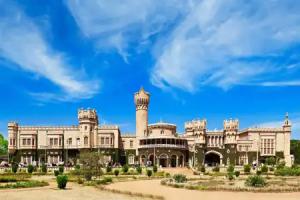
Bangalore Fort in 1860 showing fortifications and barracks. The fort was originally built by Kempe Gowda I as a mud fort in 1537. Bangalore Palace, built in 1887 in Tudor architectural style was modelled on the Windsor Castle in England.

Modern Bangalore was begun in 1537 by a vassal of the Vijayanagara Empire, Kempe Gowda I, who aligned with the Vijayanagara empire to campaign against Gangaraja (whom he defeated and expelled to Kanchi), and who built a mud-brick fort for the people at the site that would become the central part of modern Bangalore. Kempe Gowda was restricted by rules made by Achuta Deva Raya, who feared the potential power of Kempe Gowda and did not allow a formidable stone fort. Kempe Gowda referred to the new town as his "gandubhūmi" or "Land of Heroes". Within the fort, the town was divided into smaller divisions—each called a "pete" (IPA: [peːteː]). The town had two main streets—Chikkapeté Street, which ran east-west, and Doddapeté Street, which ran north-south. Their intersection formed the Doddapeté Square—the heart of Bangalore. Kempe Gowda I's successor, Kempe Gowda II, built four towers that marked Bangalore's boundary. During the Vijayanagara rule, many saints and poets referred to Bangalore as "Devarāyanagara" and "Kalyānapura" or "Kalyānapuri" ("Auspicious City").

After the fall of the Vijayanagara Empire in 1565 in the Battle of Talikota, Bangalore's rule changed hands several times. Kempe Gowda declared independence, then in 1638, a large Adil Shahi Bijapur army led by Ranadulla Khan and accompanied by his second in command Shāhji Bhōnslé defeated Kempe Gowda III, and Bangalore was given to Shāhji as a jagir (feudal estate). In 1687, the Mughal general Kasim Khan, under orders from Aurangzeb, defeated Ekoji I, son of Shāhji, and sold Bangalore to Chikkadevaraja Wodeyar (1673–1704), the then ruler of the Kingdom of Mysore for three lakh rupees. After the death of Krishnaraja Wodeyar II in 1759, Hyder Ali, Commander-in-Chief of the Mysore Army, proclaimed himself the de facto ruler of the Kingdom of Mysore. Hyder Ali is credited with building the Delhi and Mysore gates at the northern and southern ends of the city in 1760. The kingdom later passed to Hyder Ali's son Tipu Sultan. Hyder and Tipu contributed towards the beautification of the city by building Lal Bagh Botanical Gardens in 1760. Under them, Bangalore developed into a commercial and military centre of strategic importance.

The Bangalore fort was captured by the British armies under Lord Cornwallis on 21 March 1791 during the Third Anglo-Mysore War and formed a centre for British resistance against Tipu Sultan. Following Tipu's death in the Fourth Anglo-Mysore War (1799), the British returned administrative control of the Bangalore "pētē" to the Maharaja of Mysore and was incorporated into the Princely State of Mysore, which existed as a nominally sovereign entity of the British Raj. The old city ("pētē") developed in the dominions of the Maharaja of Mysore. The Residency of Mysore State was first established in Mysore City in 1799 and later shifted to Bangalore in 1804. It was abolished in 1843 only to be revived in 1881 at Bangalore and to be closed down permanently in 1947, with Indian independence. The British found Bangalore to be a pleasant and appropriate place to station their garrison and therefore moved their cantonment to Bangalore from Seringapatam in 1809 near Halsur, about 6 kilometres (4 mi) north-east of the city. A town grew up around the cantonment, by absorbing several villages in the area. The new centre had its own municipal and administrative apparatus, though technically it was a British enclave within the territory of the Wodeyar Kings of the Princely State of Mysore. Two important developments which contributed to the rapid growth of the city, include the introduction of telegraph connections to all major Indian cities in 1853 and a rail connection to Madras, in 1864.

Later modern and contemporary history

A view of Bangalore Pete during the 1890s A view of Bangalore Cantonment (c. 1895) The Bangalore torpedo was invented in Bangalore in 1922.

In the 19th century, Bangalore essentially became a twin city, with the "pētē", whose residents were predominantly Kannadigas and the cantonment created by the British. Throughout the 19th century, the Cantonment gradually expanded and acquired a distinct cultural and political salience as it was governed directly by the British and was known as the Civil and Military Station of Bangalore. While it remained in the princely territory of Mysore, Cantonment had a large military presence and a cosmopolitan civilian population that came from outside the princely state of Mysore, including British and Anglo-Indians army officers.

Bangalore was hit by a plague epidemic in 1898 that claimed nearly 3,500 lives. The crisis caused by the outbreak catalysed the city's sanitation process. Telephone lines were laid to help co-ordinate anti-plague operations. Regulations for building new houses with proper sanitation facilities came into effect. A health officer was appointed and the city divided into four wards for better co-ordination. Victoria Hospital was inaugurated in 1900 by Lord Curzon, the then Governor-General of British India. New extensions in Malleswaram and Basavanagudi were developed in the north and south of the pētē. In 1903, motor vehicles came to be introduced in Bangalore. In 1906, Bangalore became one of the first cities in India to have electricity from hydro power, powered by the hydroelectric plant situated in Shivanasamudra. The Indian Institute of Science was established in 1909, which subsequently played a major role in developing the city as a science research hub. In 1912, the Bangalore torpedo, a defensive explosive weapon widely used in World War I and World War II, was devised in Bangalore by British army officer Captain McClintock of the Madras Sappers and Miners.

Bangalore's reputation as the "Garden City of India" began in 1927 with the Silver Jubilee celebrations of the rule of Krishnaraja Wodeyar IV. Several projects such as the construction of parks, public buildings and hospitals were instituted to improve the city. Bangalore played an important role during the Indian independence movement. Mahatma Gandhi visited the city in 1927 and 1934 and addressed public meetings here. In 1926, the labour unrest in Binny Mills due to demand by textile workers for payment of bonus resulted in lathi charging and police firing, resulting in the death of four workers, and several injuries. In July 1928, there were notable communal disturbances in Bangalore, when a Ganesh idol was removed from a school compound in the Sultanpet area of Bangalore. In 1940, the first flight between Bangalore and Bombay took off, which placed the city on India's urban map.

After India's independence in August 1947, Bangalore remained in the newly carved Mysore State of which the Maharaja of Mysore was the Rajapramukh (appointed governor). The "City Improvement Trust" was formed in 1945, and in 1949, the "City" and the "Cantonment" merged to form the Bangalore City Corporation. The Government of Karnataka later constituted the Bangalore Development Authority in 1976 to co-ordinate the activities of these two bodies. Public sector employment and education provided opportunities for Kannadigas from the rest of the state to migrate to the city. Bangalore experienced rapid growth in the decades 1941–51 and 1971–81, which saw the arrival of many immigrants from northern Karnataka. By 1961, Bangalore had become the sixth largest city in India, with a population of 1,207,000. In the decades that followed, Bangalore's manufacturing base continued to expand with the establishment of private companies such as MICO (Motor Industries Company), which set up its manufacturing plant in the city.

By the 1980s, it was clear that urbanisation had spilled over the current boundaries, and in 1986, the Bangalore Metropolitan Region Development Authority, was established to co-ordinate the development of the entire region as a single unit. On 8 February 1981, a major fire broke out at Venus Circus in Bangalore, where more than 92 lives were lost, the majority of them being children. Bangalore experienced a growth in its real estate market in the 1980s and 1990s, spurred by capital investors from other parts of the country who converted Bangalore's large plots and colonial bungalows into multi-storied apartments. In 1985, Texas Instruments became the first multinational corporation to set up base in Bangalore. Other information technology companies followed suit and by the end of the 20th century, Bangalore had established itself as the Silicon Valley of India. Today, Bangalore is India's third most populous city. During the 21st century, Bangalore has suffered terrorist attacks in 2008, 2010, and 2013.

Geography

Bangalore lies in the southeast of the South Indian state of Karnataka. It is in the heart of the Mysore Plateau (a region of the larger Precambrian Deccan Plateau) at an average elevation of 900 m (2,953 ft).:8 It is located at 12°58′N 77°34′E / 12.97°N 77.56°E / 12.97; 77.56 and covers an area of 741 km2 (286 sq mi). The majority of the city of Bangalore lies in the Bangalore Urban district of Karnataka and the surrounding rural areas are a part of the Bangalore Rural district. The Government of Karnataka has carved out the new district of Ramanagara from the old Bangalore Rural district.

The topology of Bangalore is generally flat, though the western parts of the city are hilly. The highest point is Vidyaranyapura Doddabettahalli, which is 962 metres (3,156 feet) and is situated to the north-west of the city. No major rivers run through the city, although the Arkavathi and South Pennar cross paths at the Nandi Hills, 60 kilometres (37 miles) to the north. River Vrishabhavathi, a minor tributary of the Arkavathi, arises within the city at Basavanagudi and flows through the city. The rivers Arkavathi and Vrishabhavathi together carry much of Bangalore's sewage. A sewerage system, constructed in 1922, covers 215 km2 (83 sq mi) of the city and connects with five sewage treatment centres located in the periphery of Bangalore.

In the 16th century, Kempe Gowda I constructed many lakes to meet the town's water requirements. The Kempambudhi Kere, since overrun by modern development, was prominent among those lakes. In the earlier half of 20th century, the Nandi Hills waterworks was commissioned by Sir Mirza Ismail (Diwan of Mysore, 1926–41 CE) to provide a water supply to the city. Currently, the river Kaveri provides around 80% of the total water supply to the city with the remaining 20% being obtained from the Thippagondanahalli and Hesaraghatta reservoirs of the Arkavathi river. Bangalore receives 800 million litres (211 million US gallons) of water a day, more than any other Indian city. However, Bangalore sometimes does face water shortages, especially during summer- more so in the years of low rainfall. A random sampling study of the Air Quality Index (AQI) of twenty stations within the city indicated scores that ranged from 76 to 314, suggesting heavy to severe air pollution around areas of traffic concentration.

Bangalore has a handful of freshwater lakes and water tanks, the largest of which are Madivala tank, Hebbal lake, Ulsoor lake, Yediyur Lake and Sankey Tank. Groundwater occurs in silty to sandy layers of the alluvial sediments. The Peninsular Gneissic Complex (PGC) is the most dominant rock unit in the area and includes granites, gneisses and migmatites, while the soils of Bangalore consist of red laterite and red, fine loamy to clayey soils.

Vegetation in the city is primarily in the form of large deciduous canopy and minority coconut trees. Though Bangalore has been classified as a part of the seismic zone II (a stable zone), it has experienced quakes of magnitude as high as 4.5.

Civic administration

The Karnataka High Court is the supreme judicial body in Karnataka and is located in Bangalore. The Vikasa Soudha, situated adjacent to the Vidhana Soudha, houses many state ministries. A typical traffic speed interceptor used by the Bangalore City Traffic Police

The Bruhat Bangalore Mahanagara Palike (BBMP, Greater Bangalore Municipal Corporation) is in charge of the civic administration of the city. It was formed in 2007 by merging 100 wards of the erstwhile Bangalore Mahanagara Palike, with seven neighbouring City Municipal Councils, one Town Municipal Council and 110 villages around Bangalore. The number of wards increased to 198 in 2009. The BBMP is run by a city council composed of 250 members, including 198 corporators representing each of the wards of the city and 52 other elected representatives, consisting of members of Parliament and the state legislature. Elections to the council are held once every five years, with results being decided by popular vote. Members contesting elections to the council usually represent one or more of the state's political parties. A mayor and deputy mayor are also elected from among the elected members of the council. Elections to the BBMP were held on 28 March 2010, after a gap of three and a half years since the expiry of the previous elected body's term, and the Bharatiya Janata Party was voted into power – the first time it had ever won a civic poll in the city.

Bangalore's rapid growth has created several problems relating to traffic congestion and infrastructural obsolescence that the Bangalore Mahanagara Palike has found challenging to address. The unplanned nature of growth in the city resulted in massive traffic gridlocks that the municipality attempted to ease by constructing a flyover system and by imposing one-way traffic systems. Some of the flyovers and one-ways mitigated the traffic situation moderately but were unable to adequately address the disproportionate growth of city traffic. A 2003 Battelle Environmental Evaluation System (BEES) evaluation of Bangalore's physical, biological and socioeconomic parameters indicated that Bangalore's water quality and terrestrial and aquatic ecosystems were close to ideal, while the city's socioeconomic parameters (traffic, quality of life) aire quality and noise pollution scored poorly. The BBMP works in conjunction with the Bangalore Development Authority (BDA) and the Agenda for Bangalore's Infrastructure and Development Task Force (ABIDe) to design and implement civic and infrastructural projects.

The Bangalore City Police (BCP) has seven geographic zones, includes the Traffic Police, the City Armed Reserve, the Central Crime Branch and the City Crime Record Bureau and runs 86 police stations, including two all-women police stations. As capital of the state of Karnataka, Bangalore houses important state government facilities such as the Karnataka High Court, the Vidhana Soudha (the home of the Karnataka state legislature) and Raj Bhavan (the residence of the Governor of Karnataka). Bangalore contributes four members to the lower house of the Indian Parliament, the Lok Sabha, from its four constituencies: Bangalore Rural, Bangalore Central, Bangalore North, and Bangalore South, and 28 members to the Karnataka Legislative Assembly.

Electricity in Bangalore is regulated through the Bangalore Electricity Supply Company (BESCOM), while water supply and sanitation facilities are provided by the Bangalore Water Supply and Sewerage Board (BWSSB).

The city has offices of the Consulate General of Germany, France, Japan Israel, British Deputy High Commission, along with honorary consulates of Ireland, Finland, Switzerland, Maldives, Mongolia, Sri Lanka and Peru. It also has a trade office of Canada and a virtual Consulate of the United States.

Pollution control

Bangalore generates about 3,000 tonnes of solid waste per day, of which about 1,139 tonnes are collected and sent to composting units such as the Karnataka Composting Development Corporation. The remaining solid waste collected by the municipality is dumped in open spaces or on roadsides outside the city. In 2008, Bangalore produced around 2,500 metric tonnes of solid waste, and increased to 5000 metric tonnes in 2012, which is transported from collection units located near Hesaraghatta Lake, to the garbage dumping sites. The city suffers significantly with dust pollution, hazardous waste disposal, and disorganised, unscientific waste retrievals. The IT hub, Whitefield region is the most polluted area in Bangalore. Recently a study found that over 36% of diesel vehicles in the city exceed the national limit for emissions.

Slums

According to a 2012 report submitted to the World Bank by Karnataka Slum Clearance Board, Bangalore has 862 slums from total of around 2000 slums in Karnataka. The families living in the slum are not ready to move into the temporary shelters. 42% of the households migrated from different parts of India like Chennai, Hyderabad and most of North India, and 43% of the households had remained in the slums for over 10 years. The Karnataka Municipality, works to shift 300 families annually to newly constructed buildings. One third of these slum clearance projects lack basic service connections, 60% of slum dwellers lack complete water supply lines and share BWSSB water supply.

Waste management

Ιn 2012 Bangalore generated 2.1 million tonnes of Municipal Solid Waste (195.4 kg/cap/yr). The waste management scenario in the state of Karnataka is regulated by the Karnataka State Pollution Control Board (KSPCB) under the aegis of the Central Pollution Control Board (CPCB) which is a Central Government entity. As part of their Waste Management Guidelines the Government of Karnataka through the Karnataka State Pollution Control Board (KSPCB) has authorised a few well-established companies to manage the bio-medical waste and hazardous waste in the state of Karnataka.

Transport

Air

Bangalore is served by Kempegowda International Airport (IATA: BLR, ICAO: VOBL), located at Devanahalli, about 40 kilometres (25 miles) from the city centre. It was formerly called Bengaluru International Airport. The airport started operations from 24 May 2008 and is a private airport managed by a consortium led by the GVK Group. The city was earlier served by the HAL Airport at Vimanapura, a residential locality in the eastern part of the city. The airport is third busiest in India after Delhi and Mumbai in terms of passenger traffic and the number of air traffic movements (ATMs). Taxis and air conditioned Volvo buses operated by BMTC connect the airport with the city.

Rail

A rapid transit system called the Namma Metro is built. A 7 km (4.3 mi) stretch from Bayappanahalli to MG Road was opened to public on 20 October 2011, while another 10 km (6.2 mi) stretch from Malleswaram to Peenya was opened on 1 March 2014. Once completed, this will encompass a 42.3 km (26.3 mi) elevated and underground rail network comprising 41 stations. It is expected to connect central locations in Bangalore to the airport near Devanahalli as well as the Chikballapur regions. This much delayed project is the city's primary response to the worsening city transport infrastructure which has become a major deterrent to continued business growth.

Bangalore is a divisional headquarters in the South Western Railway zone of the Indian Railways. There are four major railway stations in the city: Krantiveer Sangolli Rayanna Railway Station, Bangalore Cantonment railway station, Yeshwantapur junction and Krishnarajapuram railway station, with railway lines towards Jolarpettai in the east, Chikballapur in the north-east, Guntakal in the north, Tumkur in the northwest, Nelamangala in the west, Mysore in the southwest and Salem in the south.

The Rail Wheel Factory is Asia's second largest manufacturer of wheel and axle for railways and is headquartered in Yelahanka, Bangalore.

Road

Buses operated by Bangalore Metropolitan Transport Corporation (BMTC) are an important and reliable means of public transport available in the city. While commuters can buy tickets on boarding these buses, BMTC also provides an option of a bus pass to frequent users. BMTC runs air-conditioned luxury buses on major routes, and also operates shuttle services from various parts of the city to Kempegowda International Airport . The BMTC also has a mobile app that provides real-time location of a bus using the global positioning system of the user's mobile device. The Karnataka State Road Transport Corporation operates 6,918 buses on 6,352 schedules, connecting Bangalore with other parts of Karnataka as well as other neighbouring states. The main bus depots that KSRTC maintains are the Kempegowda Bus Station, locally known as "Majestic bus stand", where most of the out station buses ply from. Some of the KSRTC buses to Tamil Nadu, Telangana and Andhra Pradesh ply from Shantinagar Bus Station, Satellite Bus Station at Mysore road and Baiyappanahalli satellite bus station. BMTC and KSRTC were the first operators in India to introduce Volvo city buses and intracity coaches in India.

Three-wheeled, yellow and black or yellow and green auto-rickshaws, referred to as autos, are a popular form of transport. They are metered and can accommodate up to three passengers. Taxis, commonly called City Taxis, are usually available too, but they are only available on call or by online based services. Taxis are metered and are generally more expensive than auto-rickshaws.

There are currently 1,250 vehicles being registered daily on an average in Bangalore RTOs. The total number of vehicles as on date are 44 lakh vehicles, with a road length of 11,000 kilometres (6,835 miles).

Culture

Bangalore Karaga, one of the oldest and most important festivals in Bangalore Yakshagana – a theatre art of coastal Karnataka is often played in town hall

Bangalore is known as the "Garden City of India" because of its gentle climate, broad streets, greenery and the presence of many public parks, such as Lal Bagh and Cubbon Park. Bangalore is sometimes called as the "Pub Capital of India" and the "Rock/Metal Capital of India" because of its underground music scene and it is one of the premier places to hold international rock concerts. In May 2012, Lonely Planet ranked Bangalore 3rd among the world's top 10 cities to visit.

Bangalore is also home to many vegan-friendly restaurants and vegan activism groups due it which it has been named as India's most vegan-friendly city by PETA India.

Biannual flower shows are held at the Lal Bagh Gardens during the week of Republic Day (26 January) and Independence Day (15 August). Bangalore Karaga or "Karaga Shaktyotsava" is one of the most important and oldest festivals of Bangalore dedicated to the Hindu Goddess Draupadi. It is celebrated annually by the Thigala community, over a period of nine days in the month of March or April. The Someshwara Car festival is an annual procession of the idol of the Halasuru Someshwara Temple (Ulsoor) led by the Vokkaligas, a farming community in southern Karnataka, occurring in April. Karnataka Rajyotsava is widely celebrated on 1 November and is a public holiday in the city, to mark the formation of Karnataka state on 1 November 1956. Other popular festivals in Bangalore are Ugadi, Ram Navami, Eid ul-Fitr, Ganesh Chaturthi, St. Mary's feast, Dasara, Deepawali and Christmas.

The diversity of cuisine is reflective of the social and economic diversity of Bangalore. Bangalore has a wide and varied mix of restaurant types and cuisines and Bangaloreans deem eating out as an intrinsic part of their culture. Roadside vendors, tea stalls, and South Indian, North Indian, Chinese and Western fast food are all very popular in the city. Udupi restaurants are very popular and serve predominantly vegetarian, regional cuisine.

Art and literature

Bangalore did not have an effective contemporary art representation, as compared to Delhi and Mumbai, until recently during the 1990s, several art galleries sprang up, notable being the government established National Gallery of Modern Art. Bangalore's international art festival, Art Bangalore, was established in 2010, and is South India's only art festival.

Kannada literature appears to have flourished in Bangalore even before Kempe Gowda laid the foundations of the city. During the 18th and 19th centuries, Kannada literature was enriched by the Vachanas (a form of rhythmic writing) composed by the heads of the Veerashaiva Mathas (monastery) in Bangalore. As a cosmopolitan city, Bangalore has also encouraged the growth of Telugu, Urdu, and English literatures. The headquarters of the Kannada Sahitya Parishat, a nonprofit organisation that promotes the Kannada language, is located in Bangalore. The city has its own literary festival, known as the "Bangalore Literature Festival", which was inaugurated in 2012.

Theatre, music, and dance

Bangalore is home to the Kannada film industry, which churns out about 80 Kannada movies each year. Bangalore also has a very active and vibrant theatre culture with popular theatres being Ravindra Kalakshetra and the more recently opened Ranga Shankara The city has a vibrant English and foreign language theatre scene with places like Ranga Shankara and Chowdiah Memorial Hall leading the way in hosting performances leading to the establishment of the Amateur film industry. Kannada theatre is very popular in Bangalore, and consists mostly of political satire and light comedy. Plays are organised mostly by community organisations, but there are some amateur groups which stage plays in Kannada. Drama companies touring India under the auspicies of the British Council and Max Müller Bhavan also stage performances in the city frequently. The Alliance Française de Bangalore also hosts numerous plays through the year.

Bangalore is also a major centre of Indian classical music and dance. The cultural scene is very diverse due to Bangalore's mixed ethnic groups, which is reflected in its music concerts, dance performances and plays. Performances of Carnatic (South Indian) and Hindustani (North Indian) classical music, and dance forms like Bharat Natyam, Kuchipudi, Kathakali, Kathak, and Odissi are very popular. Yakshagana, a theatre art indigenous to coastal Karnataka is often played in town halls. The two main music seasons in Bangalore are in April–May during the Ram Navami festival, and in September–October during the Dusshera festival, when music activities by cultural organisations are at their peak. Though both classical and contemporary music are played in Bangalore, the dominant music genre in urban Bangalore is rock music. Bangalore has its own subgenre of music, "Bangalore Rock", which is an amalgamation of classic rock, hard rock and heavy metal, with a bit of jazz and blues in it. Notable bands from Bangalore include Raghu Dixit Project, Kryptos, Inner Sanctum, Agam, All the fat children, and Swaratma.

Location

Street view

Hotels

2 guests
Adults2+
Children under 170+
Age7+
Age7+
Age7+
Age7+
Age7+
Age7+
Age7+
Age7+
Age7+
Age7+
Search hotel

Reviews

Share your experiences, help others make the right choice!
Think about what you would like to know if you were looking for a review about a place to relax. Please describe in detail what you liked and what you didn't. What would you advise to other guests and to the hotel owner. The more fully you tell about the hotel, the easier it will be for other people to make a choice and they will be very grateful to you!

Map

X