Thessaloniki
Description
Thessaloniki is the second-largest city in Greece and the capital of Greek Macedonia, the administrative region of Central Macedonia and the Decentralized Administration of Macedonia and Thrace. Its nickname is η Συμπρωτεύουσα (Symprotévousa), literally "the co-capital", a reference to its historical status as the Συμβασιλεύουσα (Symvasilévousa) or "co-reigning" city of the Eastern Roman (Byzantine) Empire, alongside Constantinople.
The municipality of Thessaloniki, the historical center, had a population of 325,182 in 2011, while the Thessaloniki Urban Area had a population of 788,952. and the Thessaloniki Metropolitan Area had 1,012,297 inhabitants in 2011.
Thessaloniki is Greece's second major economic, industrial, commercial and political centre, and a major transportation hub for the rest of southeastern Europe; its commercial port is also of great importance for Greece and the southeastern European hinterland. The city is renowned for its festivals, events and vibrant cultural life in general, and is considered to be Greece's cultural capital. Events such as the Thessaloniki International Trade Fair, the Thessaloniki International Film Festival, and the Thessaloniki Song Festival are held annually, while the city also hosts the largest bi-annual meeting of the Greek diaspora. Thessaloniki was the 2014 European Youth Capital.
The city of Thessaloniki was founded in 315 BC by Cassander of Macedon. An important metropolis by the Roman period, Thessaloniki was the second largest and wealthiest city of the Byzantine Empire. It was conquered by the Ottomans in 1430, and passed from the Ottoman Empire to modern Greece on 8 November 1912.
Thessaloniki is home to numerous notable Byzantine monuments, including the Paleochristian and Byzantine monuments of Thessaloniki, a UNESCO World Heritage Site, as well as several Roman, Ottoman and Sephardic Jewish structures. The city's main university, Aristotle University, is the largest in Greece and the Balkans.
Thessaloniki is a popular tourist destination in Greece. For 2013, National Geographic Magazine included Thessaloniki in its top tourist destinations worldwide, while in 2014 Financial Times FDI magazine (Foreign Direct Investments) declared Thessaloniki as the best mid-sized European city of the future for human capital and lifestyle. Among street photographers, the center of Thessaloniki is also considered the most popular destination for street photography in Greece.
Etymology
All variations of the city's name derive from the original (and current) appellation in Ancient Greek, i.e. Θεσσαλονίκη (IPA: [tʰes.sa.lo.nǐː.kɛː]; from Θεσσαλός, Thessalos, and Νίκη, Nikē), literally translating to "Thessalian Victory". The name of the city came from the name of a princess, Thessalonike of Macedon, half sister of Alexander the Great, so named because of her birth on the day of the Macedonian victory at the Battle of Crocus Field (353/352 BCE).
The alternative name Salonica (also Thessalonica or Salonika) derives from the variant form Σαλονίκη (Saloníki) in colloquial Greek speech, and has given rise to the form of the city's name in several languages. Names in other languages prominent in the city's history include Солѹнь (Solun) in Old Church Slavonic, סלוניקה (Salonika) in Ladino, Selanik (also Selânik) in Turkish (سلانیك in Ottoman Turkish), Solun (also written as Солун) in the local and neighboring South Slavic languages, Салоники (Saloníki) in Russian, and Sãrunã in Aromanian. In local speech, the city's name is typically pronounced with a dark and deep L characteristic of Macedonian Greek accent.
The name often appears in writing in the abbreviated form Θεσ/νίκη.
History
From antiquity to the Roman Empire
The city was founded around 315 BC by the King Cassander of Macedon, on or near the site of the ancient town of Therma and 26 other local villages. He named it after his wife Thessalonike, a half-sister of Alexander the Great and princess of Macedon as daughter of Philip II. Under the kingdom of Macedon the city retained its own autonomy and parliament and evolved to become the most important city in Macedon.
After the fall of the kingdom of Macedon in 168 BC, Thessalonica became a free city of the Roman Republic under Mark Antony in 41 BC. It grew to be an important trade-hub located on the Via Egnatia, the road connecting Dyrrhachium with Byzantium, which facilitated trade between Thessaloniki and great centers of commerce such as Rome and Byzantium. Thessaloniki also lay at the southern end of the main north-south route through the Balkans along the valleys of the Morava and Axios river valleys, thereby linking the Balkans with the rest of Greece. The city later became the capital of one of the four Roman districts of Macedonia. Later it became the capital of all the Greek provinces of the Roman Empire because of the city's importance in the Balkan peninsula.
At the time of the Roman Empire, about 50 A.D., Thessaloniki was also an important center for the spread of Christianity; while on his second missionary journey, Paul the Apostle visited this city's chief synagogue on three Sabbaths and sowed the seeds for Thessaloniki's first Christian church. Later, Paul wrote two letters to the new church at Thessaloniki, preserved in the Bible canon as First and Second Thessalonians. Some scholars hold that the First Epistle to the Thessalonians is the first written book of the New Testament.
In 306 AD, Thessaloníki acquired a patron saint, St. Demetrius, a native of Thessalonica whom Galerius put to death. A basilical church was first built in the 5th century AD dedicated to St.Demetrius.
When the Roman Empire was divided into the tetrarchy, Thessaloniki became the administrative capital of one of the four portions of the Empire under Galerius Maximianus Caesar, where Galerius commissioned an imperial palace, a new hippodrome, a triumphal arch and a mausoleum among others.
In 379, when the Roman Prefecture of Illyricum was divided between the East and West Roman Empires, Thessaloniki became the capital of the new Prefecture of Illyricum. In 390, Gothic troops under the Roman Emperor Theodosius I, led a massacre against the inhabitants of Thessalonica, who had risen in revolt against the Gothic soldiers. With the Fall of Rome in 476, Thessaloniki became the second-largest city of the Eastern Roman Empire.
Byzantine era and Middle Ages
From the first years of the Byzantine Empire, Thessaloniki was considered the second city in the Empire after Constantinople, both in terms of wealth and size. with a population of 150,000 in the mid-12th century. The city held this status until it was transferred to Venice in 1423. In the 14th century, the city's population exceeded 100,000 to 150,000, making it larger than London at the time.
During the 6th and 7th centuries, the area around Thessaloniki was invaded by Avars and Slavs, who unsuccessfully laid siege to the city several times, as narrated in the Miracles of Saint Demetrius. Traditional historiography stipulates that many Slavs settled in the hinterland of Thessaloniki; however, this migration was allegedly on a much smaller scale than previously thought. In the 9th century, the Byzantine Greek missionaries Cyril and Methodius, both natives of the city, created the first literary language of the Slavs, the Glagolic alphabet, most likely based on the Slavic dialect used in the hinterland of their hometown.
An Arab naval attack in 904 resulted in the sack of the city. The economic expansion of the city continued through the 12th century as the rule of the Komnenoi emperors expanded Byzantine control to the north. Thessaloniki passed out of Byzantine hands in 1204, when Constantinople was captured by the forces of the Fourth Crusade and incorporated the city and its surrounding territories in the Kingdom of Thessalonica — which then became the largest vassal of the Latin Empire. In 1224, the Kingdom of Thessalonica was overrun by the Despotate of Epirus, a remnant of the former Byzantine Empire, under Theodore Komnenos Doukas who crowned himself Emperor, and the city became the Despotate's capital. This era of the Despotate of Epirus is also known as the Empire of Thessalonica. Following his defeat at Klokotnitsa however in 1230, the Empire of Thessalonica became a vassal state of the Second Bulgarian Empire until it was recovered again in 1246, this time by the Nicaean Empire.
In 1330, on the emperor Andronikos III Palaiologos, founded in the city the "School of Thessaloniki" an institute of higher education, which operated for almost a century, since after the Ottoman conquest in 1430, served as "Greek school of Thessaloniki", as a secondary school to meet the needs of the new era. In the mid Ottoman period it upgraded as "Higher School" and to 1873 served as "Central Urban School of Thessaloniki". Then with the title "Gymnasium of Thessaloniki" functioned until the liberation in 1912. Since then, it operates as " 1st High School of Thessaloniki" and having a continuous operating history of nearly 700 years is one of the oldest educational institutions of Europe, and the oldest of Greek education. In 1342, the city saw the rise of the Commune of the Zealots, an anti-aristocratic party formed of sailors and the poor, which is nowadays described as social-revolutionary. The city was practically independent of the rest of the Empire, as it had its own government, a form of republic. The zealot movement was overthrown in 1350 and the city was reunited with the rest of the Empire.
In 1423, Despot Andronicus, who was in charge of the city, ceded it to the Republic of Venice with the hope that it could be protected from the Ottomans who were besieging the city (there is no evidence to support the oft-repeated story that he sold the city to them). The Venetians held Thessaloniki until it was captured by the Ottoman Sultan Murad II on 29 March 1430.
Ottoman period
When Sultan Murad II captured Thessaloniki and sacked it in 1430, contemporary reports estimated that about one-fifth of the city's population was enslaved. Upon the conquest of Thessaloniki, some of its inhabitants escaped, including intellectuals such as Theodorus Gaza "Thessalonicensis" and Andronicus Callistus. However, the change of sovereignty from the Byzantine Empire to the Ottoman one did not affect the city's prestige as a major imperial city and trading hub. Thessaloniki and Smyrna, although smaller in size than Constantinople, were the Ottoman Empire's most important trading hubs. Thessaloniki's importance was mostly in the field of shipping, but also in manufacturing, while most of the city's trade was controlled by ethnic Greeks.
During the Ottoman period, the city's population of mainly Greek Jews, then as now called Romaniotes, and Ottoman Muslims (including those of Turkish and Albanian origin, as well as Bulgarian Muslim and Greek Muslim convert origin) grew substantially. According to the 1478 census Selânik (سلانیك), as the city came to be known in Ottoman Turkish, had a population of 4,320 Muslims, 6,094 Greek Orthodox and some Catholics. No Jews were recorded in the census. Soon after the turn of the 15th to 16th century, however, nearly 20,000 Sephardic Jews immigrated to Greece from the Iberian Peninsula following their expulsion from Spain by the 1492 Alhambra Decree. By c. 1500, the numbers had grown to 7,986 Greeks, 8,575 Muslims, and 3,770 Jews. By 1519, Sephardic Jews numbered 15,715, 54% of the city's population. Some historians consider the Ottoman regime's invitation to Jewish settlement was a strategy to prevent the ethnic Greek population (Eastern Orthodox Christians) from dominating the city.
Thessaloniki was the capital of the Sanjak of Selanik within the wider Rumeli Eyalet (Balkans) until 1826, and subsequently the capital of Selanik Eyalet (after 1867, the Selanik Vilayet). This consisted of the sanjaks of Selanik, Serres and Drama between 1826 and 1912. Thessaloniki was also a Janissary stronghold where novice Janissaries were trained. In June 1826, regular Ottoman soldiers attacked and destroyed the Janissary base in Thessaloniki while also killing over 10,000 Janissaries, an event known as The Auspicious Incident in Ottoman history. From 1870, driven by economic growth, the city's population expanded by 70%, reaching 135,000 in 1917.
The last few decades of Ottoman control over the city were an era of revival, particularly in terms of the city's infrastructure. It was at that time that the Ottoman administration of the city acquired an "official" face with the creation of the Command Post while a number of new public buildings were built in the eclectic style in order to project the European face both of Thessaloniki and the Ottoman Empire. The city walls were torn down between 1869 and 1889, efforts for a planned expansion of the city are evident as early as 1879, the first tram service started in 1888 and the city streets were illuminated with electric lamp posts in 1908. In 1888 Thessaloniki was connected to Central Europe via rail through Belgrade, Monastir in 1893 and Constantinople in 1896.
20th century and since
The seafront of Thessaloniki, as it was in 1917.In the early 20th century, Thessaloniki was in the center of radical activities by various groups; the Internal Macedonian Revolutionary Organization, founded in 1897, and the Greek Macedonian Committee, founded in 1903. In 1903 an anarchist group known as the Boatmen of Thessaloniki planted bombs in several buildings in Thessaloniki, including the Ottoman Bank, with some assistance from the IMRO. The Greek consulate in Ottoman Thessaloniki (now the Museum of the Macedonian Struggle) served as the center of operations for the Greek guerillas. In 1908 the Young Turks movement broke out in the city, sparking the Young Turk Revolution.
As the First Balkan War broke out, Greece declared war on the Ottoman Empire and expanded its borders. When Eleftherios Venizelos, Prime Minister at the time, was asked if the Greek army should move towards Thessaloniki or Monastir (now Bitola, Republic of Macedonia), Venizelos replied "Θεσσαλονίκη με κάθε κόστος!" (Thessaloniki, at all costs!). As both Greece and Bulgaria wanted Thessaloniki, the Ottoman garrison of the city entered negotiations with both armies. On 8 November 1912 (26 October Old Style), the feast day of the city's patron saint, Saint Demetrius, the Greek Army accepted the surrender of the Ottoman garrison at Thessaloniki. The Bulgarian army arrived one day after the surrender of the city to Greece and Tahsin Pasha, ruler of the city, told the Bulgarian officials that "I have only one Thessaloniki, which I have surrendered". After the Second Balkan War, Thessaloniki and the rest of the Greek portion of Macedonia were officially annexed to Greece by the Treaty of Bucharest in 1913. On 18 March 1913 George I of Greece was assassinated in the city by Alexandros Schinas.
In 1915, during World War I, a large Allied expeditionary force established a base at Thessaloniki for operations against pro-German Bulgaria. This culminated in the establishment of the Macedonian Front, also known as the Salonika Front. In 1916, pro-Venizelist Greek army officers and civilians, with the support of the Allies, launched an uprising, creating a pro-Allied temporary government by the name of the "Provisional Government of National Defence" that controlled the "New Lands" (lands that were gained by Greece in the Balkan Wars, most of Northern Greece including Greek Macedonia, the North Aegean as well as the island of Crete); the official government of the King in Athens, the "State of Athens", controlled "Old Greece" which were traditionally monarchist. The State of Thessaloniki was disestablished with the unification of the two opposing Greek governments under Venizelos, following the abdication of King Constantine in 1917.
On 30 December 1915 an Austrian air raid on Thessaloniki alarmed many town civilians and killed at least one person, and in response the Allied troops based there arrested the German and Austrian and Bulgarian and Turkish vice-consuls and their families and dependents and put them on a battleship, and billeted troops in their consulate buildings in Thessaloniki.
Most of the old center of the city was destroyed by the Great Thessaloniki Fire of 1917, which was started accidentally by an unattended kitchen fire on 18 August 1917. The fire swept through the centre of the city, leaving 72,000 people homeless; according to the Pallis Report, most of them were Jewish (50,000). Many businesses were destroyed, as a result, 70% of the population were unemployed. Two churches and many synagogues and mosques were lost. Nearly one-quarter of the total population of approximately 271,157 became homeless. Following the fire the government prohibited quick rebuilding, so it could implement the new redesign of the city according to the European-style urban plan prepared by a group of architects, including the Briton Thomas Mawson, and headed by French architect Ernest Hébrard. Property values fell from 6.5 million Greek drachmas to 750,000.
After the defeat of Greece in the Greco-Turkish War and during the break-up of the Ottoman Empire, a population exchange took place between Greece and Turkey. Over 160,000 ethnic Greeks deported from the former Ottoman Empire - particularly Greeks from western Asia Minor and Pontic Greeks as well as Caucasus Greeks from various parts of Eastern Anatolia and the South Caucasus - were resettled in the city, changing its demographics. Additionally many of the city's Muslims, including Ottoman Greek Muslims, were deported to Turkey, ranging at about 20,000 people.
During World War II Thessaloniki was heavily bombarded by Fascist Italy (with 232 people dead, 871 wounded and over 800 buildings damaged or destroyed in November 1940 alone), and, the Italians having failed in their invasion of Greece, it fell to the forces of Nazi Germany on 8 April 1941 and remained under German occupation until 30 October 1944 when it was liberated by the Greek People's Liberation Army. The Nazis soon forced the Jewish residents into a ghetto near the railroads and on 15 March 1943 began the deportation process of the city's 56,000 Jews to its Nazi concentration camps. They deported over 43,000 of the city's Jews in concentration camps, where most were killed in gas chambers. The Germans also deported 11,000 Jews to forced labor camps, where most perished. Only 1,200 Jews live in the city today.
The importance of Thessaloniki to Nazi Germany can be demonstrated by the fact that, initially, Hitler had planned to incorporate it directly in the Third Reich (that is, make it part of Germany) and not have it controlled by a puppet state such as the Hellenic State or an ally of Germany (Thessaloniki had been promised to Yugoslavia as a reward for joining the Axis on 25 March 1941). Having been the first major city in Greece to fall to the occupying forces just two days after the German invasion, it was in Thessaloniki that the first Greek resistance group was formed (under the name Ελευθερία, Eleutheria, "Freedom") as well as the first anti-Nazi newspaper in an occupied territory anywhere in Europe, also by the name Eleutheria. Thessaloniki was also home to a military camp-converted-concentration camp, known in German as "Konzentrationslager Pavlo Mela" (Pavlos Melas Concentration Camp), where members of the resistance and other non-favourable people towards the German occupation from all over Greece were held either to be killed or sent to concentration camps elsewhere in Europe. In the 1946 monarchy referendum, the majority of the locals voted in favour of a republic, contrary to the rest of Greece.
After the war, Thessaloniki was rebuilt with large-scale development of new infrastructure and industry throughout the 1950s, 1960s and 1970s. Many of its architectural treasures still remain, adding value to the city as a tourist destination, while several early Christian and Byzantine monuments of Thessaloniki were added to the UNESCO World Heritage list in 1988. In 1997, Thessaloniki was celebrated as the European Capital of Culture, sponsoring events across the city and the region. Agency established to oversee the cultural activities of that year 1997 was still in existence by 2010. In 2004 the city hosted a number of the football events as part of the 2004 Summer Olympics.
Today, Thessaloniki has become one of the most important trade and business hubs in Southeastern Europe, with its port, the Port of Thessaloniki being one of the largest in the Aegean and facilitating trade throughout the Balkan hinterland. On 26 October 2012 the city celebrated its centennial since its incorporation into Greece. The city also forms one of the largest student centres in Southeastern Europe, is host to the largest student population in Greece and was the European Youth Capital in 2014.
Geography
Panoramic view of the city with Mount Olympus in the background.Geology
Thessaloniki lies on the northern fringe of the Thermaic Gulf on its eastern coast and is bound by Mount Chortiatis on its southeast. Its proximity to imposing mountain ranges, hills and fault lines, especially towards its southeast have historically made the city prone to geological changes.
Since medieval times, Thessaloniki was hit by strong earthquakes, notably in 1759, 1902, 1978 and 1995. On 19–20 June 1978, the city suffered a series of powerful earthquakes, registering 5.5 and 6.5 on the Richter scale. The tremors caused considerable damage to a number of buildings and ancient monuments, but the city withstood the catastrophe without any major problems. One apartment building in central Thessaloniki collapsed during the second earthquake, killing many, raising the final death toll to 51.
Culture
Leisure and entertainment
Thessaloniki is not only regarded as the cultural and entertainment capital of northern Greece but also the cultural capital of the country. The city's main theaters, run by the National Theatre of Northern Greece (Greek: Κρατικό Θέατρο Βορείου Ελλάδος) which was established in 1961, include the Theater of the Society of Macedonian Studies, where the National Theater is based, the Royal Theater (Vasiliko Theatro) -the first base of the National Theater-, Moni Lazariston, and the Earth Theater and Forest Theater, both amphitheatrical open-air theatres overlooking the city.
The title of the European Capital of Culture in 1997 saw the birth of the city's first opera and today forms an independent section of the National Theatre of Northern Greece. The opera is based at the Thessaloniki Concert Hall, one of the largest concert halls in Greece. Recently a second building was also constructed and designed by Japanese architect Arata Isozaki. Thessaloniki is also the seat of two symphony orchestras, the Thessaloniki State Symphony Orchestra and the Symphony Orchestra of the Municipality of Thessaloniki. Olympion Theater, the site of the Thessaloniki International Film Festival and the Plateia Assos Odeon multiplex are the two major cinemas in downtown Thessaloniki. The city also has a number of multiplex cinemas in major shopping malls in the suburbs, most notably in Mediterranean Cosmos, the largest retail and entertainment development in the Balkans.
Thessaloniki is renowned for its major shopping streets and lively laneways. Tsimiski Street and Proxenou Koromila avenue are the city's most famous shopping streets and are among Greece's most expensive and exclusive high streets. The city is also home to one of Greece's most famous and prestigious hotels, Makedonia Palace hotel, the Hyatt Regency Casino and hotel (the biggest casino in Greece and one of the biggest in Europe) and Waterland, the largest water park in southeastern Europe.
The city has long been known in Greece for its vibrant city culture, including having the most cafes and bars per capita of any city in Europe; and as having some of the best nightlife and entertainment in the country, thanks to its large young population and multicultural feel. Lonely Planet listed Thessaloniki among the world's "ultimate party cities".
Parks and recreation
Although Thessaloniki is not renowned for its parks and greenery throughout its urban area, where green spaces are few, it has several large open spaces around its waterfront, namely the central city gardens of Palios Zoologikos Kipos (which is recently being redeveloped to also include rock climbing facilities, a new skatepark and paintball range), the park of Pedio tou Areos, which also holds the city's annual floral expo; and the parks of the Nea Paralia (waterfront) that span for 3 km (2 mi) along the coast, from the White Tower to the concert hall.
The Nea Paralia parks are used throughout the year for a variety of events, while they open up to the Thessaloniki waterfront, which is lined up with several cafés and bars; and during summer is full of Thessalonians enjoying their long evening walks (referred to as "the volta" and is embedded into the culture of the city). Having undergone an extensive revitalization, the city's waterfront today features a total of 12 thematic gardens/parks.
Thessaloniki's proximity to places such as the national parks of Pieria and beaches of Chalkidiki often allow its residents to easily have access to some of the best outdoor recreation in Europe; however, the city is also right next to the Seich Sou forest national park, just 3.5 km (2 mi) away from Thessaloniki's city center; and offers residents and visitors alike, quiet viewpoints towards the city, mountain bike trails and landscaped hiking paths. The city's zoo, which is operated by the municipality of Thessaloniki, is also located nearby the national park.
Other recreation spaces throughout the Thessaloniki Metropolitan Area include the Fragma Thermis, a landscaped parkland near Thermi and the Delta wetlands west of the city center; while urban beaches that have continuously been awarded the blue flags, are located along the 10 km (6 mi) coastline of Thessaloniki's southeastern suburbs of Thermaikos, about 20 km (12 mi) away from the city center.
Museums and galleries
Because of the city's rich and diverse history, Thessaloniki houses many museums dealing with many different eras in history. Two of the city's most famous museums include the Archaeological Museum of Thessaloniki and the Museum of Byzantine Culture.
The Archaeological Museum of Thessaloniki was established in 1962 and houses some of the most important ancient Macedonian artifacts, including an extensive collection of golden artwork from the royal palaces of Aigai and Pella. It also houses exhibits from Macedon's prehistoric past, dating from the Neolithic to the Bronze age. The Prehistoric Antiquities Museum of Thessaloniki has exhibits from those periods as well.
The Museum of Byzantine Culture is one of the city's most famous museums, showcasing the city's glorious Byzantine past. The museum was also awarded Council of Europe's museum prize in 2005. The museum of the White Tower of Thessaloniki houses a series of galleries relating to the city's past, from the creation of the White Tower until recent years.
One of the most modern museums in the city is the Thessaloniki Science Center and Technology Museum and is one of the most high-tech museums in Greece and southeastern Europe. It features the largest planetarium in Greece, a cosmotheater with the largest flat screen in Greece, an amphitheater, a motion simulator with 3D projection and 6-axis movement and exhibition spaces. Other industrial and technological museums in the city include the Railway Museum of Thessaloniki, which houses an original Orient Express train, the War Museum of Thessaloniki and others. The city also has a number of educational and sports museums, including the Thessaloniki Olympic Museum.
The Atatürk Museum in Thessaloniki is the historic house where Mustafa Kemal Atatürk, founder of modern-day Turkey, was born. The house is now part of the Turkish consulate complex, but admission to the museum is free. The museum contains historic information about Mustafa Kemal Atatürk and his life, especially while he was in Thessaloniki. Other ethnological museums of the sort include the Historical Museum of the Balkan Wars, the Jewish Museum of Thessaloniki and the Museum of the Macedonian Struggle, containing information about the freedom fighters in Macedonia and their struggle to liberate the region from the Ottoman yoke.
The city also has a number of important art galleries. Such include the Macedonian Museum of Contemporary Art, housing exhibitions from a number of well-known Greek and foreign artists. The Teloglion Foundation of Art is part of Aristotle University of Thessaloniki and includes an extensive collection of works by important artists of the 19th and 20th centuries, including works by prominent Greeks and native Thessalonians. The Thessaloniki Museum of Photography also houses a number of important exhibitions, and is located within the old port of Thessaloniki.
Archaeological sites
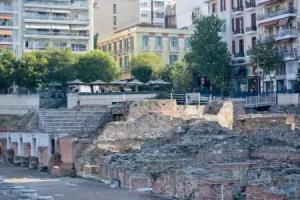
Thessaloniki is home to a number of prominent archaeological sites. Apart from its recognized UNESCO World Heritage Sites, Thessaloniki features a large two-terraced Roman forum featuring two-storey stoas, dug up by accident in the 1960s. The forum complex also boasts two Roman baths, one of which has been excavated while the other is buried underneath the city. The forum also features a small theater, which was also used for gladiatorial games. Although the initial complex was not built in Roman times, it was largely refurbished in the 2nd century. It is believed that the forum and the theater continued to be used until at least the 6th century.
Another important archaeological site is the imperial palace complex which Roman emperor Galerius, located at Navarinou Square, commissioned when he made Thessaloniki the capital of his portion of the Roman Empire. The large octagonal portion of the complex, most of which survives to this day, is believed to have been an imperial throne room. Various mosaics from the palatial complex have also survived. Some historians believe that the complex must have been in use as an imperial residence until the 11th century.
Not far from the palace itself is the Arch of Galerius, known colloquially as the Kamara. The arch was built to commemorate the emperor's campaigns against the Persians. The original structure featured three arches; however, only two full arches and part of the third survive to this day. Many of the arches' marble parts survive as well, although it is mostly the brick interior that can be seen today.
Other monuments of the city's past, such as the Incantadas, a Caryatid portico from the ancient forum, have been removed or destroyed over the years. The Incantadas in particular are on display at the Louvre. Thanks to a private donation of €180,000, it was announced on 6 December 2011 that a replica of the Incantadas would be commissioned and later put on display in Thessaloniki.
Festivals
Thessaloniki is home of a number of festivals and events. The Thessaloniki International Trade Fair is the most important event to be hosted in the city annually, by means of economic development. It was first established in 1926 and takes place every year at the 180,000 m2 (1,937,503.88 sq ft) Thessaloniki International Exhibition Center. The event attracts major political attention and it is customary for the Prime Minister of Greece to outline his administration's policies for the next year, during event. Over 250,000 visitors attended the exposition in 2010. The new Art Thessaloniki, is starting first time 29.10. - 1 November 2015 as an international contemporary art fair. The Thessaloniki International Film Festival is established as one of the most important film festivals in Southern Europe, with a number of notable film makers such as Francis Ford Coppola, Faye Dunaway, Catherine Deneuve, Irene Papas and Fatih Akın taking part, and was established in 1960. The Documentary Festival, founded in 1999, has focused on documentaries that explore global social and cultural developments, with many of the films presented being candidates for FIPRESCI and Audience Awards.
The Dimitria festival, founded in 1966 and named after the city's patron saint of St. Demetrius, has focused on a wide range of events including music, theatre, dance, local happenings, and exhibitions. The "DMC DJ Championship" has been hosted at the International Trade Fair of Thessaloniki, has become a worldwide event for aspiring DJs and turntablists. The "International Festival of Photography" has taken place every February to mid-April. Exhibitions for the event are sited in museums, heritage landmarks, galleries, bookshops and cafés. Thessaloniki also holds an annual International Book Fair.
Between 1962–1997 and 2005–2008 the city also hosted the Thessaloniki Song Festival, Greece's most important music festival, at Alexandreio Melathron.
In 2012, the city hosted its first gay parade, namely the Thessaloniki Pride which took place between 22 and 23 June. In 2013, the second Thessaloniki Pride was hosted between 14 and 15 June. However, in 2013, Transgender people in Thessaloniki became victims of police violence. The issue was soon settled by the government. The third Thessaloniki Pride took place in 2014, between 20 and 21 June, concentrating more people than any past year.
Notable Thessalonians
Throughout its history, Thessaloniki has been home to a number of well-known figures like Nikolaos Polychronakos. It is also the birthplace of various Saints and other religious figures, such as Cyril and Methodius, creators of the first Slavic alphabet, Saint Mitre, Patriarch Philotheus I of Constantinople and Archbishop Demetrios of America. Many of Greece's most celebrated musicians and movie stars were born in Thessaloniki, such as Zoe Laskari, Costas Hajihristos, Antonis Remos, Paschalis Terzis, Natassa Theodoridou, Katia Zygouli, Kostas Voutsas, Marios Iliopoulos and Marinella. Additionally, there have been a number of political leaders born in the city Evangelos Venizelos, the former Minister of Finance of Greece, Haris Kastanidis, Christos Sartzetakis, fourth President of Greece, Kostas Zouraris and Ioannis Passalidis. Sports personalities from the city include Angelos Charisteas, Eleni Daniilidou, Dimitris Salpingidis, Traianos Dellas, Kleanthis Vikelidis and Ioannis Tamouridis. Ioannis Papafis and Elias Petropoulos were also born in Thessaloniki.
The city is also the birthplace of a number of important international personalities, which include Bulgarians (Atanas Dalchev), Jews (Moshe Levy, Daniel Zion, Samuel ben Joseph Uziel, Shlomo Halevi Alkabetz), Slav Macedonians (Dimo Todorovski) and Turks (Mustafa Kemal Atatürk, Nâzım Hikmet, Afet İnan, Cahit Arf, Mehmet Cavit Bey, Salih Omurtak, Sabiha Sertel, Halil Rifat Pasha).
Cuisine
Because Thessaloniki remained under Ottoman rule for about 100 years more than southern Greece, it has retained a lot of its Eastern character, including its culinary tastes. Spices in particular play an important role in the cuisine of Thessaloniki, something which is not true to the same degree about Greece's southern regions. Thessaloniki's Ladadika borough is a particularly busy area in regards to Thessalonian cuisine, with most tavernas serving traditional meze and other such culinary delights.
Bougatsa, a breakfast pastry, is very popular throughout the city and has spread around other parts of Greece and the Balkans as well. Another popular snack is koulouri.
Notable sweets of the city are Trigona, Roxakia and Armenovil. A stereotypical Thessalonian coffee drink is Frappé coffee. Frappé was invented in the Thessaloniki International Trade Fair in 1957 and has since spread throughout Greece and Cyprus to become a hallmark of the Greek coffee culture.
Music
The city is viewed as a romantic one in Greece, and as such Thessaloniki is commonly featured in Greek songs. There are a number of famous songs that go by the name 'Thessaloniki' (rebetiko, laïko etc.) or include the name in their title.
During the 1930s and 40s the city became a center of the Rebetiko music, partly because of the Metaxas censorship, which was stricter in Athens. Vassilis Tsitsanis wrote some of his best songs in Thessaloniki.
The city is the birthplace of significant composers in the Greek music scene, such as Manolis Chiotis, Stavros Kouyioumtzis and Dionysis Savvopoulos. It is also notable for its rock music scene and its many rock groups; some became famous such as Xylina Spathia, Trypes or the pop rock Onirama.
Between 1962–1997 and 2005–2008 the city also hosted the Thessaloniki Song Festival. In the Eurovision Song Contest 2013 Greece was represented by Koza Mostra and Agathonas Iakovidis, both from Thessaloniki.
Another important musical genre of the city's heritage is the Sephardic music of the Jewish community.
In popular culture
- On May 1936, a massive strike by tobacco workers led to general anarchy in the city and Ioannis Metaxas (future dictator, then PM) ordered its repression. The events and the deaths of the protesters inspired Yiannis Ritsos to write the Epitafios.
- On 22 May 1963, Grigoris Lambrakis, pacifist and MP, was assassinated by two far-right extremists driving a three-wheeled vehicle. The event led to political crisis. Costa Gavras directed Z (1969 film) based on it, two years after the military junta had ceized power in Greece.
- Notable films set in Thessaloniki among others include Mademoiselle Docteur (1937) by Georg Wilhelm Pabst, The Barefooted Battalion (1954) by Greg Tallas (Gregory Thalassinos), O Atsidas (1961) by Giannis Dalianidis, Parenthesis (1968) by Takis Kanellopoulos and Triumph of the Spirit (1989) by Robert M. Young.
Transport
Bus transport
Public transport in Thessaloniki is served by buses. The bus company operating in the city is the Thessaloniki Urban Transport Organization (OASTH) and is the only public means of transport in Thessaloniki at the moment. It operates a fleet of 604 vehicles on 75 routes throughout the Thessaloniki Metropolitan Area. International and regional bus links are provided by KTEL at its Macedonia InterCity Bus Terminal, located to the west of the city centre.
Metro
The construction of the Thessaloniki Metropolitan Railway began in 2006 and is scheduled for completion in 2018, where it is set to become the city's most vital public transport service. The line of Phase 1 is set to extend over 9.6 kilometres (6.0 mi), include 13 stations and it is expected to eventually serve 250,000 passengers daily. Some stations of the Thessaloniki Metro will house a number of archaeological finds.
Discussions are already underway for future expansions, in order for the metro network to also serve major transport hubs of the city, notably the Macedonia InterCity Bus Terminal (KTEL) and Macedonia International Airport. For the expansion towards the airport, the Attiko Metro company is considering the construction of an overground network or a monorail. The expansion to Kalamaria, a southeast borough of Thessaloniki, has already become part of the initial construction phase, while future expansions are considered and planned for Efkarpia to the north and Evosmos to the west. The strategic plan for the construction of the Thessaloniki Metro envisions that the city will have a system of 3 lines by 2018 or 2020 at the latest.
Commuter/suburban rail (Proastiakos)
Commuter rail services have recently been established between Thessaloniki and the city of Larissa (the service is known in Greek as the "Proastiakos", meaning "Suburban Railway"). The service is operated using Siemens Desiro EMU trains on a modernised electrified double track and stops at 11 refurbished stations, covering the journey in 1 hour and 33 minutes. Furthermore, an additional line has also been established, although with the use of regional trains, between Thessaloniki and the city of Edessa.
Macedonia International Airport
Air traffic to and from the city is served by Macedonia International Airport for international and domestic flights. The short length of the airport's two runways means that it does not currently support intercontinental flights, although a major extension – lengthening one of its runways into the Thermaic Gulf – is under construction, despite considerable opposition from local environmental groups. Following the completion of the runway works, the airport will be able to serve intercontinental flights and cater for larger aircraft in the future. A master-plan, with designs for a new terminal building and apron has also been released, and is seeking for funding.
Railways and ferry connections
Because of the Greek economic crisis, all international train links from the city were suspended in February 2011. Until then, the city was a major railway hub for the Balkans, with direct connections to Sofia, Skopje, Belgrade, Moscow, Vienna, Budapest, Bucharest and Istanbul, alongside Athens and other destinations in Greece. Daily through trains to Sofia and Belgrade were restarted in May 2014. Thessaloniki remains one of Greece's most important railway hubs and has the biggest marshalling yard in the country.
Regional train services within Greece (operated by TrainOSE, the Hellenic Railways Organization's train operating company), link the city with other parts of the country, from its central railway passenger station, called the "New Railway Station" located at the western end of Thessaloniki's city center.
The Port of Thessaloniki connects the city with seasonal ferries to the Sporades and other north Aegean islands, with its passenger terminal, being one of the largest in the Aegean Sea basin; having handled around 162,731 passengers in 2007. Meanwhile, ongoing actions have been going on for more connections and the port is recently being upgraded, as Thessaloniki is also slowly turning into a major tourist port for cruising in the eastern Mediterranean.
Motorways
Further information: Highways in GreeceThessaloniki lies on the crossroads of the A1/E75, A2/E90 and A25 motorways; which connect the city with other parts of the country, as well as the Republic of Macedonia, Bulgaria and Turkey.
The city itself is bypassed by the C-shaped Thessaloniki Inner Ring Road (Esoteriki Peripheriaki Odos, Greek: Εσωτερική Περιφεριακή Οδός), which all of the above motorways connect onto it. The western end of the route begins at the junction with the A1/A2 motorways in Lachanagora District. Clockwise it heads northeast around the city, passing through the northwestern suburbs, the forest of Seich Sou and through to the southeast suburb/borough of Kalamaria. The ring road ends at a large junction with the A25 motorway, which then continues south to Chalkidiki, passing through Thessaloniki's outer southeast suburbs.
The speed limit on this motorway is 90 kilometres per hour (56 mph), it currently has three traffic lanes for each direction and forms the city's most vital road link; handling more than 120,000 vehicles daily, instead of 30,000 as it was meant to handle when designed in 1975. An outer ring road known as Eksoteriki Peripheriaki Odos (Greek: Εξωτερική Περιφεριακή Οδός, outer ring road) carries all traffic that completely bypasses the city. It is Part of Motorway 2
FutureDespite the large effort that was made in 2004 to improve the motorway features of the Thessaloniki ring road, the motorway is still insufficient to tackle Thessaloniki's increasing traffic and metropolitan population. To tackle this problem, the government has introduced large scale redevelopment plans throughout 2011 with tenders expected to be announced within early 2012; that include the total restructuring of the A16 in the western side of the city, with new junctions and new emergency lanes throughout the whole length of the motorway. In the eastern side an even larger scale project has been announced, for the construction of a new elevated motorway section above the existing, which would allow faster travel for drivers heading through to the airport and Chalkidiki that do not wish to exit into the city, and will decongest the existing motorway for city commuters. The plans also include adding one more lane in each direction on the existing A16 ring road and on the A25 passing through Thessaloniki's southeast suburbs, from its junction with the A16 in Kalamaria, up to the airport exit (ΕΟ67); which will make it an 8 lane highway.
Additional long term plans further include the extension of the planned outer ring road known as Eksoteriki Peripheriaki Odos (Greek: Εξωτερική Περιφεριακή Οδός, outer ring road) to circle around the entire Thessaloniki Metropolitan Area, crossing over the Thermaic Gulf from the east, to join with the A1/E75 motorway. Preliminary plans have been announced which include a 4.5 km (3 mi) bridge over the gulf, as part of the southern bypass of the city; to cater for the large number of commuters from Macedonia and the rest of Greece heading to the airport, and to the increasingly popular tourist region of Chalkidiki.
- Motorways:
- A1/E75 W (Republic of Macedonia, Larissa, Athens)
- A2/E90 W (Kozani, Ioannina, Igoumenitsa) N (Kavala, Xanthi, Alexandroupolis, Turkey)
- A25 (ΕΟ12)/Ε79 Ν (Serres, Bulgaria)
- A25 (ΕΟ67) S (Airport, Nea Moudania)
- National Roads:
- ΕΟ2/Ε86 W (Edessa, Giannitsa)
- ΕΟ12/Ε79 Ν (Serres, Drama)
- ΕΟ16, SW (Polygyros, Ouranopolis)
- ΕΟ65, Ν (Kilkis, Doirani)