Boston
Description
Boston is the capital and largest city of the Commonwealth of Massachusetts in the United States. Boston also served as the county seat of Suffolk County until Massachusetts disbanded county government in 1999. The city proper covers 48 square miles (124 km2) with an estimated population of 667,137 in 2015, making it the largest city in New England and the 23rd largest city in the United States. The city is the economic and cultural anchor of a substantially larger metropolitan area called Greater Boston, home to 4.7 million people and the tenth-largest metropolitan statistical area in the country. Greater Boston as a commuting region is home to 8.1 million people, making it the sixth-largest combined statistical area in the United States.
One of the oldest cities in the United States, Boston was founded on the Shawmut Peninsula in 1630 by Puritan settlers from England. It was the scene of several key events of the American Revolution, such as the Boston Massacre, the Boston Tea Party, the Battle of Bunker Hill, and the Siege of Boston. Upon U.S. independence from Great Britain, the city continued to be an important port and manufacturing hub, as well as a center for education and culture. Through land reclamation and municipal annexation, Boston has expanded beyond the original peninsula. Its rich history attracts many tourists, with Faneuil Hall alone drawing over 20 million visitors per year. Boston's many firsts include the United States' first public school, Boston Latin School (1635), first subway system (1897), and first public park (1634).
The area's many colleges and universities make Boston an international center of higher education, including law, medicine, engineering, and business, and the city is considered to be a world leader in innovation and entrepreneurship. Boston's economic base also includes finance, professional and business services, biotechnology, information technology, and government activities. Households in the city claim the highest average rate of philanthropy in the United States; businesses and institutions rank among the top in the country for environmental sustainability and investment. The city has one of the highest costs of living in the United States, though it remains high on world livability rankings.
History
Boston's early European settlers had first called the area Trimountaine (after its "three mountains"—only traces of which remain today) but later renamed it Boston after Boston, Lincolnshire, England, the origin of several prominent colonists. The renaming, on September 7, 1630 (Old Style), was by Puritan colonists from England, who had moved over from Charlestown earlier that year in quest of fresh water. Their settlement was initially limited to the Shawmut Peninsula, at that time surrounded by the Massachusetts Bay and Charles River and connected to the mainland by a narrow isthmus. The peninsula is known to have been inhabited as early as 5000 BC.
In 1629, the Massachusetts Bay Colony's first governor, John Winthrop, led the signing of the Cambridge Agreement, a key founding document of the city. Puritan ethics and their focus on education influenced its early history; America's first public school was founded in Boston in 1635. Over the next 130 years, the city participated in four French and Indian Wars, until the British defeated the French and their native allies in North America. Boston was the largest town in British North America until Philadelphia grew larger in the mid 18th century.
Many of the crucial events of the American Revolution—the Boston Massacre, the Boston Tea Party, Paul Revere's midnight ride, the battles of Lexington and Concord and Bunker Hill, the Siege of Boston, and many others—occurred in or near Boston. After the Revolution, Boston's long seafaring tradition helped make it one of the world's wealthiest international ports, with the slave trade, rum, fish, salt, and tobacco being particularly important.
The Embargo Act of 1807, adopted during the Napoleonic Wars, and the War of 1812 significantly curtailed Boston's harbor activity. Although foreign trade returned after these hostilities, Boston's merchants had found alternatives for their capital investments in the interim. Manufacturing became an important component of the city's economy, and by the mid-19th century, the city's industrial manufacturing overtook international trade in economic importance. Until the early 20th century, Boston remained one of the nation's largest manufacturing centers and was notable for its garment production and leather-goods industries. A network of small rivers bordering the city and connecting it to the surrounding region facilitated shipment of goods and led to a proliferation of mills and factories. Later, a dense network of railroads furthered the region's industry and commerce.
During this period, Boston flourished culturally as well, admired for its rarefied literary life and generous artistic patronage, with members of old Boston families—eventually dubbed Boston Brahmins—coming to be regarded as the nation's social and cultural elites.
Boston was an early port of the Atlantic triangular slave trade in the New England colonies, but was soon overtaken by Salem, Massachusetts and Newport, Rhode Island. Eventually Boston became a center of the abolitionist movement. The city reacted strongly to the Fugitive Slave Law of 1850, contributing to President Franklin Pierce's attempt to make an example of Boston after the Anthony Burns Fugitive Slave Case.
In 1822, the citizens of Boston voted to change the official name from the "Town of Boston" to the "City of Boston", and on March 4, 1822, the people of Boston accepted the charter incorporating the City. At the time Boston was chartered as a city, the population was about 46,226, while the area of the city was only 4.7 square miles (12 km2).
In the 1820s, Boston's population grew rapidly, and the city's ethnic composition changed dramatically with the first wave of European immigrants. Irish immigrants dominated the first wave of newcomers during this period, especially following the Irish Potato Famine; by 1850, about 35,000 Irish lived in Boston. In the latter half of the 19th century, the city saw increasing numbers of Irish, Germans, Lebanese, Syrians, French Canadians, and Russian and Polish Jews settled in the city. By the end of the 19th century, Boston's core neighborhoods had become enclaves of ethnically distinct immigrants—Italians inhabited the North End, Irish dominated South Boston and Charlestown, and Russian Jews lived in the West End. Irish and Italian immigrants brought with them Roman Catholicism. Currently, Catholics make up Boston's largest religious community, and since the early 20th century, the Irish have played a major role in Boston politics—prominent figures include the Kennedys, Tip O'Neill, and John F. Fitzgerald.
Between 1631 and 1890, the city tripled its area through land reclamation by filling in marshes, mud flats, and gaps between wharves along the waterfront. The largest reclamation efforts took place during the 19th century; beginning in 1807, the crown of Beacon Hill was used to fill in a 50-acre (20 ha) mill pond that later became the Haymarket Square area. The present-day State House sits atop this lowered Beacon Hill. Reclamation projects in the middle of the century created significant parts of the South End, the West End, the Financial District, and Chinatown.
After The Great Boston Fire of 1872, workers used building rubble as landfill along the downtown waterfront. During the mid-to-late 19th century, workers filled almost 600 acres (2.4 km2) of brackish Charles River marshlands west of Boston Common with gravel brought by rail from the hills of Needham Heights. The city annexed the adjacent towns of South Boston (1804), East Boston (1836), Roxbury (1868), Dorchester (including present day Mattapan and a portion of South Boston) (1870), Brighton (including present day Allston) (1874), West Roxbury (including present day Jamaica Plain and Roslindale) (1874), Charlestown (1874), and Hyde Park (1912). Other proposals, for the annexation of Brookline, Cambridge, and Chelsea, were unsuccessful.
By the early and mid-20th century, the city was in decline as factories became old and obsolete, and businesses moved out of the region for cheaper labor elsewhere. Boston responded by initiating various urban renewal projects under the direction of the Boston Redevelopment Authority (BRA), which was established in 1957. In 1958, BRA initiated a project to improve the historic West End neighborhood. Extensive demolition was met with strong public opposition.
The BRA subsequently reevaluated its approach to urban renewal in its future projects, including the construction of Government Center. In 1965, the first Community Health Center in the United States opened, the Columbia Point Health Center, in the Dorchester neighborhood. It mostly served the massive Columbia Point public housing complex adjoining it, which was built in 1953. The health center is still in operation and was rededicated in 1990 as the Geiger-Gibson Community Health Center. The Columbia Point complex itself was redeveloped and revitalized into a mixed-income community called Harbor Point Apartments from 1984 to 1990.
By the 1970s, the city's economy had recovered after 30 years of economic downturn. A large number of high rises were constructed in the Financial District and in Boston's Back Bay during this time period. This boom continued into the mid-1980s and resumed after a few pauses. Hospitals such as Massachusetts General Hospital, Beth Israel Deaconess Medical Center, and Brigham and Women's Hospital lead the nation in medical innovation and patient care. Schools such as Boston College, Boston University, the Harvard Medical School, Northeastern University, Wentworth Institute of Technology, Berklee College of Music and Boston Conservatory attract students to the area. Nevertheless, the city experienced conflict starting in 1974 over desegregation busing, which resulted in unrest and violence around public schools throughout the mid-1970s.
Boston is an intellectual, technological, and political center but has lost some important regional institutions, including the loss to mergers and acquisitions of local financial institutions such as FleetBoston Financial, which was acquired by Charlotte-based Bank of America in 2004. Boston-based department stores Jordan Marsh and Filene's have both been merged into the Cincinnati–based Macy's. The 1993 acquisition of The Boston Globe by The New York Times was reversed in 2013 when it was re-sold to Boston businessman John W. Henry. In 2016, it was announced that General Electric would be moving its corporate headquarters from Connecticut to the Innovation District in South Boston, joining many other companies in this rapidly developing neighborhood.
Boston has experienced gentrification in the latter half of the 20th century, with housing prices increasing sharply since the 1990s. Living expenses have risen, and Boston has one of the highest costs of living in the United States, and was ranked the 129th most expensive major city in the world in a 2011 survey of 214 cities. Despite cost of living issues, Boston ranks high on livability ratings, ranking 36th worldwide in quality of living in 2011 in a survey of 221 major cities.
On April 15, 2013, two Chechen Islamist brothers detonated a pair of bombs near the finish line of the Boston Marathon, killing three people and injuring roughly 264.
Geography
Boston has an area of 89.6 square miles (232.1 km2)—48.4 square miles (125.4 km2) (54.0%) of land and 41.2 square miles (106.7 km2) (46.0%) of water. The city's official elevation, as measured at Logan International Airport, is 19 ft (5.8 m) above sea level. The highest point in Boston is Bellevue Hill at 330 feet (100 m) above sea level, and the lowest point is at sea level. Situated onshore of the Atlantic Ocean, Boston is the only state capital in the contiguous United States with an oceanic coastline.
The geographical center of Boston is in Roxbury. Due north of the center we find the South End. This is not to be confused with South Boston which lies directly east from the South End. North of the South End is East Boston and southwest of East Boston is the North End.
— Author, Unknown – A common local colloquialismBoston is surrounded by the "Greater Boston" region and is contiguously bordered by the cities and towns of Winthrop, Revere, Chelsea, Everett, Somerville, Cambridge, Newton, Brookline, Needham, Dedham, Canton, Milton, and Quincy. The Charles River separates Boston from Watertown and the majority of Cambridge, and the mass of Boston from its own Charlestown neighborhood. To the east lie Boston Harbor and the Boston Harbor Islands National Recreation Area (which includes part of the city's territory, specifically Calf Island, Gallops Island, Great Brewster Island, Green Island, Little Brewster Island, Little Calf Island, Long Island, Lovells Island, Middle Brewster Island, Nixes Mate, Outer Brewster Island, Rainsford Island, Shag Rocks, Spectacle Island, The Graves, and Thompson Island). The Neponset River forms the boundary between Boston's southern neighborhoods and the city of Quincy and the town of Milton. The Mystic River separates Charlestown from Chelsea and Everett, and Chelsea Creek and Boston Harbor separate East Boston from Boston proper.
Cityscapes
Neighborhoods
Boston is sometimes called a "city of neighborhoods" because of the profusion of diverse subsections; the city government's Office of Neighborhood Services has officially designated 23 neighborhoods. More than two-thirds of inner Boston's modern land area did not exist when the city was founded, but was created via the gradual filling in of the surrounding tidal areas over the centuries, notably with earth from the leveling or lowering of Boston's three original hills (the "Trimountain", after which Tremont Street is named), and with gravel brought by train from Needham to fill the Back Bay.
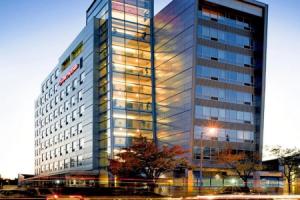
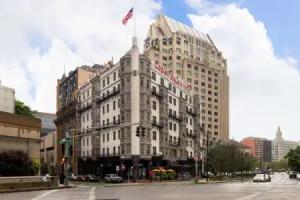
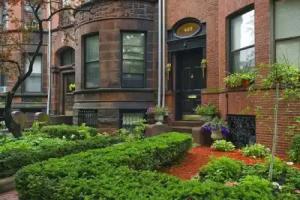
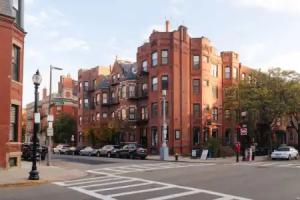
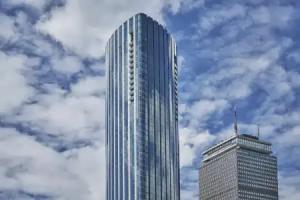
Downtown and its immediate surroundings consist largely of low-rise (often Federal style and Greek Revival) masonry buildings, interspersed with modern highrises, notably in the Financial District, Government Center, and South Boston. Back Bay includes many prominent landmarks, such as the Boston Public Library, Christian Science Center, Copley Square, Newbury Street, and New England's two tallest buildings—the John Hancock Tower and the Prudential Center. Near the John Hancock Tower is the old John Hancock Building with its prominent illuminated beacon, the color of which forecasts the weather. Smaller commercial areas are interspersed among areas of single-family homes and wooden/brick multi-family row houses. The South End Historic District is the largest surviving contiguous Victorian-era neighborhood in the US. The geography of downtown and South Boston was particularly impacted by the Central Artery/Tunnel Project (known unofficially as the "Big Dig"), which allowed for the removal of the unsightly elevated Central Artery and the incorporation of new green spaces and open areas.
Public safety
Like many major American cities, Boston has seen a great reduction in violent crime since the early 1990s. Boston's low crime rate since the 1990s has been credited to the Boston Police Department's collaboration with neighborhood groups and church parishes to prevent youths from joining gangs, as well as involvement from the United States Attorney and District Attorney's offices. This helped lead in part to what has been touted as the "Boston Miracle". Murders in the city dropped from 152 in 1990 (for a murder rate of 26.5 per 100,000 people) to just 31—not one of them a juvenile—in 1999 (for a murder rate of 5.26 per 100,000).
In 2008, there were 62 reported homicides. Through December 20 each of 2014 and 2015, the Boston Police Department reported 52 and 39 homicides, respectively.
Culture
Boston shares many cultural roots with greater New England, including a dialect of the non-rhotic Eastern New England accent known as Boston English, and a regional cuisine with a large emphasis on seafood, salt, and dairy products. Boston also has its own collection of neologisms known as Boston slang.
Boston has been called the "Athens of America" for its literary culture, earning a reputation as "the intellectual capital of the United States." In the nineteenth century, Ralph Waldo Emerson, Henry David Thoreau, Nathaniel Hawthorne, Margaret Fuller, James Russell Lowell, and Henry Wadsworth Longfellow wrote in Boston. Some consider the Old Corner Bookstore, where these writers met and where The Atlantic Monthly was first published, to be "cradle of American literature. In 1852, the Boston Public Library was founded as the first free library in the United States. Boston's literary culture continues today thanks to the city's many universities and the Boston Book Festival.
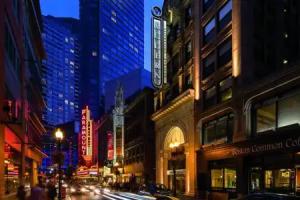
Music is afforded a high degree of civic support in Boston. The Boston Symphony Orchestra is one of the "Big Five," a group of the greatest American orchestras, and the classical music magazine Gramophone called it one of the "world's best" orchestras. Symphony Hall (located west of Back Bay) is home to the Boston Symphony Orchestra, (and the related Boston Youth Symphony Orchestra, which is the largest youth orchestra in the nation) and the Boston Pops Orchestra. The British newspaper The Guardian called Boston Symphony Hall "one of the top venues for classical music in the world," adding that "Symphony Hall in Boston was where science became an essential part of concert hall design." Other concerts are held at the New England Conservatory's Jordan Hall. The Boston Ballet performs at the Boston Opera House. Other performing-arts organizations located in the city include the Boston Lyric Opera Company, Opera Boston, Boston Baroque (the first permanent Baroque orchestra in the US), and the Handel and Haydn Society (one of the oldest choral companies in the United States). The city is a center for contemporary classical music with a number of performing groups, several of which are associated with the city's conservatories and universities. These include the Boston Modern Orchestra Project and Boston Musica Viva. Several theaters are located in or near the Theater District south of Boston Common, including the Cutler Majestic Theatre, Citi Performing Arts Center, the Colonial Theater, and the Orpheum Theatre.
There are several major annual events such as First Night, which occurs on New Year's Eve, the Boston Early Music Festival, the annual Boston Arts Festival at Christopher Columbus Waterfront Park, and Italian summer feasts in the North End honoring Catholic saints. The city is the site of several events during the Fourth of July period. They include the week-long Harborfest festivities and a Boston Pops concert accompanied by fireworks on the banks of the Charles River.
Because of the city's prominent role in the American Revolution, several historic sites relating to that period are preserved as part of the Boston National Historical Park. Many are found along the Freedom Trail, which is marked by a red line of bricks embedded in the ground. The city is also home to several art museums, including the Museum of Fine Arts and the Isabella Stewart Gardner Museum. The Institute of Contemporary Art is housed in a contemporary building designed by Diller Scofidio + Renfro in the Seaport District. Columbia Point is the location of the University of Massachusetts Boston, the Edward M. Kennedy Institute for the United States Senate, the John F. Kennedy Presidential Library and Museum, and the Massachusetts Archives and Commonwealth Museum. The Boston Athenæum (one of the oldest independent libraries in the United States), Boston Children's Museum, Bull & Finch Pub (whose building is known from the television show Cheers), Museum of Science, and the New England Aquarium are within the city.
Boston has been a noted religious center from its earliest days. The Roman Catholic Archdiocese of Boston serves nearly 300 parishes and is based in the Cathedral of the Holy Cross (1875) in the South End, while the Episcopal Diocese of Massachusetts, with the Cathedral Church of St. Paul (1819) as its episcopal seat, serves just under 200 congregations. Unitarian Universalism has its headquarters on Beacon Hill. The Christian Scientists are headquartered in Back Bay at the Mother Church (1894). The oldest church in Boston is First Church in Boston, founded in 1630. King's Chapel, the city's first Anglican church, was founded in 1686 and converted to Unitarianism in 1785. Other churches include Christ Church (better known as Old North Church, 1723), the oldest church building in the city, Trinity Church (1733), Park Street Church (1809), Old South Church (1874), Jubilee Christian Church and Basilica and Shrine of Our Lady of Perpetual Help on Mission Hill (1878).
Environment
Pollution control
Air quality in Boston is generally very good: during the ten-year period 2004–2013, there were only 4 days in which the air was unhealthy for the general public, according to the EPA.
Some of the cleaner energy facilities in Boston include the Allston green district, with three ecologically compatible housing facilities. Boston is also breaking ground on multiple green affordable housing facilities to help reduce the carbon footprint of the city while simultaneously making these initiatives financially available to a greater population. Boston's climate plan is updated every three years and was most recently modified in 2013. This legislature includes the Building Energy Reporting and Disclosure Ordinance, which requires the city's larger buildings to disclose their yearly energy and water use statistics and partake in an energy assessment every five years. These statistics are made public by the city, thereby increasing incentives for buildings to be more environmentally conscious.
Another initiative, presented by the late Mayor Thomas Menino, is the Renew Boston Whole Building Incentive, which reduces the cost of living in buildings that are deemed energy efficient. This, much like the green housing developments, gives people of low socioeconomic status an opportunity to find housing in communities that support the environment. The ultimate goal of this initiative is to enlist 500 Bostonians to participate in a free, in-home energy assessment.
Water purity and availability
Many older buildings in certain areas of Boston are supported by wooden piles driven into the area's fill; these piles remain sound if submerged in water, but are subject to dry rot if exposed to air for long periods. Groundwater levels have been dropping, to varying degrees, in many areas of the city, due in part to an increase in the amount of rainwater discharged directly into sewers rather than absorbed by the ground. A city agency, the Boston Groundwater Trust, coordinates monitoring of groundwater levels throughout the city via a network of public and private monitoring wells. However, Boston's drinking water supply, from the Quabbin and Wachusett Reservoirs to the west, is one of the very few in the country so pure as to satisfy federal water quality standards without filtration.
Parks and recreation
Boston Common, located near the Financial District and Beacon Hill, is the oldest public park in the United States. Along with the adjacent Boston Public Garden, it is part of the Emerald Necklace, a string of parks designed by Frederick Law Olmsted to encircle the city. The Emerald Necklace includes Jamaica Pond, Boston's largest body of freshwater, and Franklin Park, the city's largest park and home of the Franklin Park Zoo. Another major park is the Esplanade, located along the banks of the Charles River. The Hatch Shell, an outdoor concert venue, is located adjacent to the Charles River Esplanade. Other parks are scattered throughout the city, with the major parks and beaches located near Castle Island; in Charlestown; and along the Dorchester, South Boston, and East Boston shorelines.
Boston's park system is well-reputed nationally. In its 2013 ParkScore ranking, The Trust for Public Land reported that Boston was tied with Sacramento and San Francisco for having the third-best park system among the 50 most populous US cities. ParkScore ranks city park systems by a formula that analyzes the city's median park size, park acres as percent of city area, the percent of residents within a half-mile of a park, spending of park services per resident, and the number of playgrounds per 10,000 residents.
Healthcare
The Longwood Medical and Academic Area, adjacent to the Fenway district, is home to a large number of medical and research facilities, including Beth Israel Deaconess Medical Center, Brigham and Women's Hospital, Children's Hospital Boston, Dana-Farber Cancer Institute, Harvard Medical School, Joslin Diabetes Center, and the Massachusetts College of Pharmacy and Health Sciences. Prominent medical facilities, including Massachusetts General Hospital, Massachusetts Eye and Ear Infirmary and Spaulding Rehabilitation Hospital are located in the Beacon Hill area. St. Elizabeth's Medical Center is in Brighton Center of the city's Brighton neighborhood. New England Baptist Hospital is in Mission Hill. The city has Veterans Affairs medical centers in the Jamaica Plain and West Roxbury neighborhoods. The Boston Public Health Commission, an agency of the Massachusetts government, oversees health concerns for city residents. Boston EMS provides pre-hospital emergency medical services to residents and visitors.
Many of Boston's medical facilities are associated with universities. The facilities in the Longwood Medical and Academic Area and in Massachusetts General Hospital are affiliated with Harvard Medical School. Tufts Medical Center (formerly Tufts-New England Medical Center), located in the southern portion of the Chinatown neighborhood, is affiliated with Tufts University School of Medicine. Boston Medical Center, located in the South End neighborhood, is the primary teaching facility for the Boston University School of Medicine as well as the largest trauma center in the Boston area; it was formed by the merger of Boston University Hospital and Boston City Hospital, which was the first municipal hospital in the United States.