Jaipur
Description
Jaipur is the capital and largest city (in term of size) of the Indian state of Rajasthan in Northern India. It was founded on 18 November 1726 by Maharaja Jai Singh II, the ruler of Amer after whom the city is named. As of 2011, the city has a population of 3.1 million, making it the tenth most populous city in the country. Jaipur is also known as the Pink City of India.
Located 260 km (162 miles) from the Indian capital New Delhi, Jaipur forms a part of the west Golden Triangle tourist circuit along with Agra (240 km, 149 mi). Jaipur is a popular tourist destination in India and serves as a gateway to other tourist destinations in Rajasthan such as Jodhpur (348 km, 216 mi), Jaisalmer (571 km, 355 mi) and Udaipur (421 km, 262 mi).
History
The city of Jaipur was founded in 1726 by Jai Singh II, the Raja of Amer who ruled from 1688 to 1758. He planned to shift his capital from Amer, 11 km (7 miles) from Jaipur to accommodate the growing population and increasing scarcity of water. Jai Singh consulted several books on architecture and architects while planning the layout of Jaipur. Under the architectural guidance of Vidyadhar Bhattacharya, Jaipur was planned based on the principles of Vastu shastra and Shilpa Shastra. The construction of the city began in 1726 and took four years to complete the major roads, offices and palaces. The city was divided into nine blocks, two of which contained the state buildings and palaces, with the remaining seven allotted to the public. Huge ramparts were built, pierced by seven fortified gates.
During the rule of Sawai Ram Singh, the city was painted pink to welcome the Prince of Wales, later Edward VII, in 1876. Many of the avenues remained painted in pink, giving Jaipur a distinctive appearance and the epithet Pink city. In the 19th century, the city grew rapidly and by 1900 it had a population of 160,000. The wide boulevards were paved and its chief industries were the working of metals and marble, fostered by a school of art founded in 1868. The city had three colleges, including a Sanskrit college (1865) and a girls' school (1867) opened during the reign of the Maharaja Ram Singh II.
Architecture
The city was planned according to Indian Vastu shastra by Vidyadhar Bhattacharya in 1727. There are three gates facing east, west, and north. The eastern gate is called Suraj pol (sun gate), the western gate is called Chand pol (moon gate) and the northern gate faces the ancestral capital of Amer.
The city is unusual among pre-modern Indian cities in the regularity of its streets, and the division of the city into six sectors by broad streets 34 m (111 ft) wide. The urban quarters are further divided by networks of gridded streets. Five quarters wrap around the east, south, and west sides of a central palace quarter, with a sixth quarter immediately to the east. The Palace quarter encloses the Hawa Mahal palace complex, formal gardens, and a small lake. Nahargarh Fort, which was the residence of the King Sawai Jai Singh II, crowns the hill in the northwest corner of the old city.
Culture
Jaipur has many cultural sites like Jawahar Kala Kendra formed by Architect Charles Correa and Ravindra Manch. Government Central Museum hosts several arts and antiquities. There is a government museum at Hawa Mahal and an art gallery at Viratnagar. There are statues depicting Rajasthani culture around the city. Jaipur has many traditional shops selling antiques and handicrafts. The prior rulers of Jaipur patronised a number of arts and crafts. They invited skilled artisans, artists and craftsmen from India and abroad who settled in the city. Some of the crafts include bandhani, block printing, stone carving and sculpture, tarkashi, zari, gota-patti, kinari and zardozi, silver jewellery, gems, kundan, meenakari and jewellery, Lakh ki Chudiya, miniature paintings, blue pottery, ivory carving, shellac work and leather ware.
Jaipur has its own performing arts. The Jaipur Gharana for Kathak and Ghoomar are popular folk dance styles. Tamasha is an art form where Kathputli puppet dance is shown in play form. Jaipur has four majors fairs and festivals namely Elephant Festival, Gangaur, Kite Festival Jaipur and Teej. Jaipur is also famous for the Jaipur Literature Festival, the world's largest free literature festival in which country-wide authors, writers and literature lovers participate.
Cuisine
Typical dishes include Dal Baati Churma, Missi Roti, Gatte ki Sabzi, Ker Sangri, and Bajre ki Roti. Sweet dishes include Ghevar, Feeni, Mawa Kachori, Gajak, Chauguni ke laddu, and Moong Thal.
Languages
The main language of Jaipur is Rajasthani. Dhundhari, Marwari, Hindi and English are also spoken in the city.
Places of interest
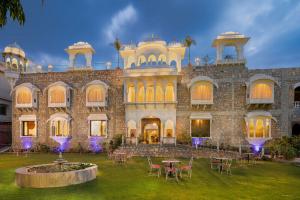
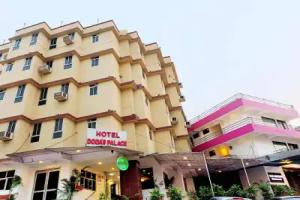
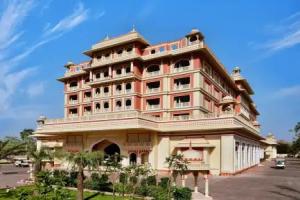
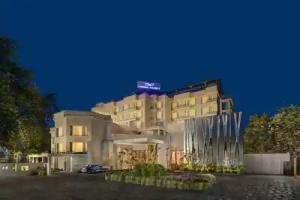
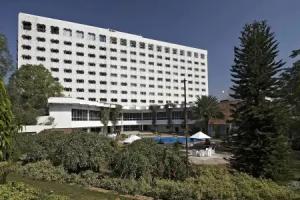
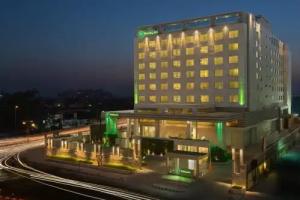
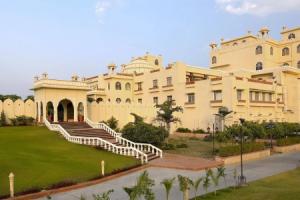
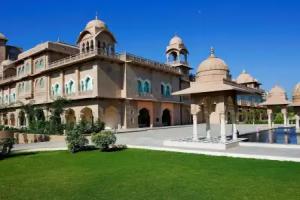
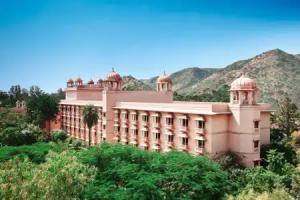
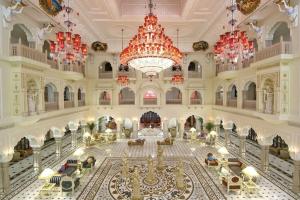
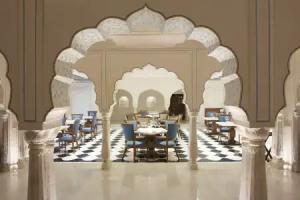
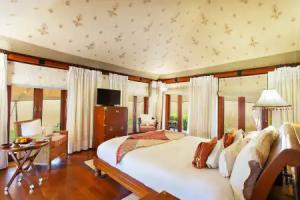
Jaipur is a major tourist destination in India forming a part of the Golden Triangle. In the 2008 Conde Nast Traveller Readers Choice Survey, Jaipur was ranked the 7th best place to visit in Asia. According to TripAdvisor's 2015 Traveller's Choice Awards for Destination, Jaipur ranked 1st among the Indian destination for the year. The Presidential Suite at the Raj Palace Hotel, billed at US$45,000 per night, was listed in second place on CNN's World's 15 most expensive hotel suites in 2012.
Jaipur Exhibition & Convention Centre (JECC) is Rajasthan’s biggest convention and exhibition centre. It is famous for organising events such as Vastara, Jaipur Jewellery Show, Stonemart 2015 and Resurgent Rajasthan Partnership Summit 2015.
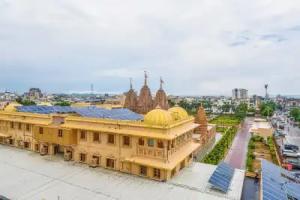
Visitor attractions include the Hawa Mahal, Jal Mahal, City Palace, Amer Fort, Jantar Mantar, Nahargarh Fort, Jaigarh Fort, Galtaji, Govind Dev Ji Temple, Garh Ganesh Temple, Sri Kali Temple, Birla Mandir, Sanganeri Gate and the Jaipur Zoo. The Jantar Mantar observatory and Amer Fort are one of the World Heritage Sites. Hawa Mahal is a five-storey pyramidal shaped monument with 953 windows that rises 15 metres (50 ft) from its high base. Sisodiya Rani Bagh and Kanak Vrindavan are the major parks in Jaipur.
-
Birla Mandir, Jaipur
-
Amer Fort
-
Gardens at Amer Fort
-
Ganesh Pol of Amer Fort
-
Jantar Mantar
Transport
Road
Jaipur is located on National Highway No.8 connecting Delhi and Mumbai. National Highway 12 links Jaipur with Kota and National Highway 11 links Bikaner with Agra passing through Jaipur. RSRTC operates bus service to major cities in Rajasthan, New Delhi, Uttar Pradesh, Haryana, Madhya Pradesh, Maharashtra, Punjab and Gujarat. City buses are operated by Jaipur City Transport Services Limited (JCTSL) of RSRTC. The service operates more than 400 regular and low-floor buses. Major bus depots are located at Vaishali Nagar, Vidyadhar Nagar and Sanganer.
Jaipur BRTS was approved by the government in August 2006. Jaipur BRTS is managed by JCSTL, a special purpose vehicle formed by Jaipur Development Authority and Jaipur Nagar Nigam. In Phase I, two corridors have been proposed: a "North-South Corridor" from Sikar Road to Tonk Road and an "East-West Corridor" from Ajmer Road to Delhi Road. A section of the North-South Corridor from bypass near Harmada to Pani Pech became operational in 2010.
Rail
Jaipur is the headquarters of North Western Zone of Indian Railways. Jaipur Railway Station is well connected to all major cities of India like Delhi, Mumbai, Kolkata, Chennai, Bengaluru, Hyderabad, and Ahmedabad. Other stations include Gandhinagar, Durgapura, Jagatpura, Ninad Benad and Sanganer.
Jaipur Metro commenced commercial operation on 3 June 2015. Phase-1A is operational between Mansarovar and Chandpole consisting of 9 stations namely Mansarovar, New Aatish Market, Vivek Vihar, Shayam Nagar, Ram Nagar, Civil Line, Railway Station, Sindhi Camp and Chandpole. Phase-1B is under construction. The estimated cost of the project is ₹550 crore (US$82 million) and it is expected to be completed by 2018.
Air
Jaipur International Airport is in Sanganer, 10 km (6 miles) from the centre. The airport handled 363,899 international and 2,540,451 domestic passengers in 2015–2016. Jaipur Airport also provides air cargo services. During winter, flights towards Indira Gandhi International Airport are diverted to Jaipur Airport due to heavy fog in Delhi. The airport operates regular domestic services to major Indian cities including Ahmedabad, Bengaluru, Chennai, Coimbatore, Delhi, Hyderabad, Kolkata, Mumbai, Pune and Udaipur. International destinations served include Abu Dhabi, Dubai, Muscat, Singapore, Bangkok and Sharjah.
Communication
Jaipur has companies like Airtel, Vodafone, Reliance, BSNL & Tata who are providing Mobile Telephony and also various internet service providers. Govt. of Rajasthan has started Free WiFi at various public places like Central Park, Jantar Mantar etc.