Kusadasi

Description

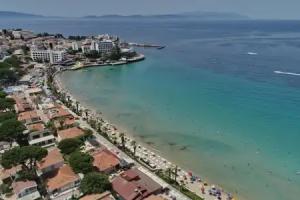
Kuşadası is a resort town on Turkey's Aegean coast, and the center of the seaside district of the same name within Aydın Province. Kuşadası is 95 km (59 mi) south of İzmir, and 71 km (44 mi) from Aydın. The municipality's primary industry is tourism.

Geography

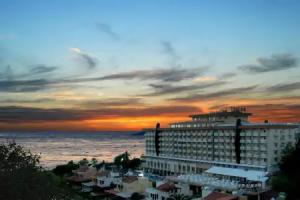
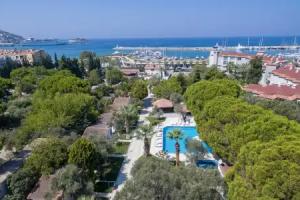
The city is situated along a gulf of the same name in the Aegean, with the island of Güvercin Ada connected to the mainland by a narrow passage on one end, and the mountain of Pilav Dağı behind.

It is located 95 km (59 mi) south of İzmir, the area's metropolitan center, and 71 km (44 mi) from the provincial seat of Aydın.

History

Etymology

The name comes from 'kuş' (bird) and 'ada' (island), as the island has the shape of a bird's head (as seen from the sea). It was known as Ephesus Neopolis, in Greek (Ἔφεσος Νεόπολις), during the Byzantine era, and later as Scala Nova or Scala Nuova under the Genovese and Venetians. Kuş Adası was adopted in its place at the beginning of the 20th century. Today, citizens of Kuşadası often shorten the name to Ada.

Antiquity

The clock tower located in central Kuşadası

The area has been a centre of art and culture since some of the earliest recorded history, and has been settled by many civilizations since being founded by the Leleges people in 3000 BC. Later settlers include the Aeolians in the 11th century BC and Ionians in the 9th. Originally, seamen and traders built a number of settlements along the coastline, including Neopolis.

An outpost of Ephesus in ancient Ionia, known as Pygela (Πύγελα), the area between the Büyük Menderes (Maeander) and Gediz (Hermos) rivers, the original Neopolis, is thought to have been founded on the nearby point of Yılancı Burnu. Later settlements were probably built on the hillside of Pilavtepe, in the district called Andızkulesi today. Kuşadası was a minor port frequented by vessels trading along the Aegean coast. In antiquity it was overshadowed by Ephesus, until Ephesus' harbor silted up. From the 7th century BC onwards the coast was ruled by Lydians from their capital at Sardis, then from 546 BC the Persians, and from 334 BC, along with all of Anatolia, the coast was conquered by Alexander the Great. From that point on the coastal cities in Anatolia became a centre of Hellenistic culture.

Rome and Christianity

The Roman Empire took possession of the coast in the 2nd century BC and made it their provincial capital in the early years of Christianity. Saint John the Evangelist and (according to Roman Catholic sacred tradition) the Virgin Mary both came to live in the area, which in the Christian era became known as "Ania".

As Byzantine, Venetian and Genoese shippers began to trade along the coast, the port was re-founded (by the name of Scala Nuova or Scala Nova - "new port"), a garrison was placed on the island, and the town centre shifted from the hillside to the coast.

The Turkish era

Long afterwards, in 1834, the castle and garrison on the island were rebuilt and expanded, becoming the focus of the town. This was to such an extent that people began to refer to the whole town as Kuşadası (bird island). However, in the 19th century, trade began to decline in favor of other nearby cities with the opening of the İzmir-Selçuk-Aydın railway, which forewent Kuşadası.

During the Turkish War of Independence, Kuşadası was occupied from 1919-1922, first by Italian troops until 1921, and then by Greek troops. The Turkish forces eventually gained control of the city on September 7, 1922.

Under the Republic of Turkey, the Greek population was exchanged for Turkish people as part of the population exchange between Greece and Turkey in 1922.

Transportation

A Kuşadası-Davutlar dolmuş arriving at a stop

There is public transport within the town and to nearby locations via shuttle minibuses (dolmuş). There are bus and taxi services going to the nearby airports in İzmir and in Bodrum, Muğla Province. Day trips are available by boat from Kuşadası and Güzelçamlı.

The city is a port of call for several cruise ships.

The port is linked by a six-lane highway to İzmir's Adnan Menderes Airport.

Several state roads connect the city to its surrounding districts, such as Germencik and Aydın.

There are daily ferry services to the nearby Greek island of Samos.

Kuşadası's bus station is a transport hub. Coach buses connect the city to various parts of the country.

Places of interest

  • The city walls – There were once three gates; one remains.
  • Kaleiçi Camii – The mosque built in 1618 for Grand Vizier Öküz Kara Mehmed Pasha.
  • The Öküz Mehmed Pasha Caravanserai is near the docks. It was built in 1618 as a strong-room for the goods of seamen.
  • Güvercin Adası ("Pigeon Island" in English) – The peninsula/island at the end of the bay, which has a castle and swimming beaches, including a private beach and cafe with a view back across the bay to the harbour of Kuşadası. Public beaches are located at the back of the peninsula, towards the open sea.
  • Kirazli – Traditional Turkish village 12 kilometres (7.5 mi) from Kuşadası.
  • Yılancı Burnu – A second peninsula beyond Güvercin Ada. Possibly the location of the original settlement of Neopolis. Some walls are visible. There are beaches and beach clubs here.
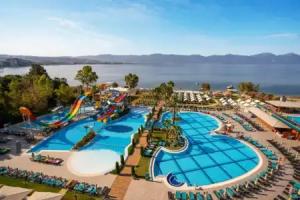
  • Several aqua-parks with wave-pools and white-water slides are located near the town.
  • Ladies Beach – Very close to the town center, one of the primary tourist attractions.
  • Kadıkalesi – Venetian/Byzantine castle, 10 kilometres (6.2 mi) along the Kuşadası-Davutlar road.
  • Panionium - 25 km (16 mi) south of Kuşadası, situated along the Davutlar-Güzelçamlı road. Once the central meeting place of the Ionian League. The ruins are in poor condition and their authenticity is disputed.
  • Dilek Peninsula-Büyük Menderes Delta National Park - About 30 kilometres (19 mi) south of the city center, the national park is adjacent to the town of Güzelçamlı. It has several coves, beaches, canyons, and a sink cave. It is one of the most diverse and protected national parks in Turkey.

Culture

  • An annual song contest has been held here. It was once won by Cem Karaca.
  • The annual Fanta Gençlik Festivali (Fanta Youth Festival), hosted by the Turkish franchise of Fanta (see International availability of Fanta), travels across the country on specific dates, holding concerts at each location. On July 17, 2010, the festival hosted one of the concerts of this festival in Kuşadası.

Street view

Hotels

2 guests
Adults2+
Children under 170+
Age7+
Age7+
Age7+
Age7+
Age7+
Age7+
Age7+
Age7+
Age7+
Age7+
Search hotel

Reviews

Share your experiences, help others make the right choice!
Think about what you would like to know if you were looking for a review about a place to relax. Please describe in detail what you liked and what you didn't. What would you advise to other guests and to the hotel owner. The more fully you tell about the hotel, the easier it will be for other people to make a choice and they will be very grateful to you!

Map

X