Rethymno

Description

Rethymno is a city of approximately 40,000 people in Greece, the capital of Rethymno regional unit on the island of Crete. It was originally built during the Minoan civilization (ancient Rhithymna and Arsinoe), but was never a competitive Minoan centre. It was, however, strong enough to mint its own coins and maintain urban growth. One of these coins is today depicted as the crest of the town: two dolphins in a circle.

Geography

History

This region as a whole is rich with ancient history, most notably through the Minoan civilisation centred at Kydonia east of Rethymno. Rethymno itself began a period of growth when the Venetian conquerors of the island decided to put an intermediate commercial station between Heraklion and Chania, acquiring its own bishop and nobility in the process. Today's old town (palia poli) is almost entirely built by the Republic of Venice. It is one of the best-preserved old towns in Crete.

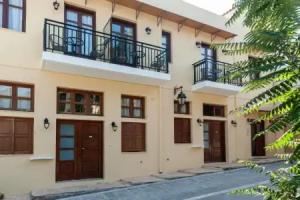
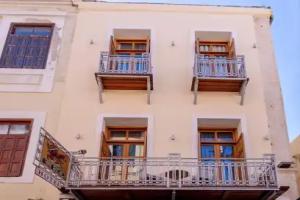
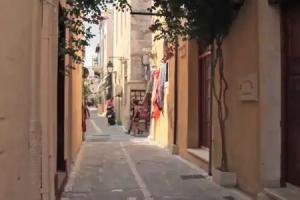
The town still maintains its old aristocratic appearance, with its buildings dating from the 16th century, arched doorways, stone staircases, Byzantine and Hellenic-Roman remains, the small Venetian harbour and narrow streets. The Venetian Loggia houses the information office of the Ministry of Culture and Sports. A Wine Festival is held there annually at the beginning of July. Another festival, in memory of the destruction of the Arkadi Monastery, is held on 7–8 November.

The city's Venetian-era citadel, the Fortezza of Rethymno, is one of the best-preserved castles in Crete. Other monuments include the Neratze mosque (the Municipal Odeon arts centre), the Great Gate (Μεγάλη Πόρτα or "Porta Guora"), the Piazza Rimondi and the Loggia.

The town was captured by the Ottoman Empire in 1646 during the Cretan War (1645–69) and they ruled it for almost three centuries. The town, called Resmo in Turkish, was the centre of a sanjak during Ottoman rule.

During the Battle of Crete (20–30 May 1941), the Battle of Rethymno was fought between German paratroopers and the Second Australian Imperial Force and Hellenic Army. Although initially unsuccessful, the Germans won the battle after receiving reinforcements from Maleme in the Northwestern part of the island

Today the city's main income is from tourism, many new facilities having been built in the past 20 years. Agriculture is also notable, especially for olive oil and other Mediterranean products.

Municipality

The municipality Rethymno was formed at the 2011 local government reform by the merger of the following 4 former municipalities, that became municipal units:

  • Arkadi
  • Lappa
  • Nikiforos Fokas
  • Rethymno
Population of Rethymno Settlements 1940 1951 1961 1971 1981 1991 2001 2001 Rethymno 8,648 11,057 14,999 14,969 17,136 23,355 28,987 32,468 Agia Eirini 96 88 63 47 34 63 49 75 Agios Markos - - - - 18 65 - - Anogeia 50 25 25 21 13 15 89 131 Gallos 315 274 252 180 146 205 430 922 Giannoudi 92 82 78 30 22 23 96 116 Kastellakia - 45 27 36 105 - - - Koumpes - 106 - - - - - - Metochi Albani 67 79 31 - - - - - Megalo Metochi (Risvan) - 33 25 - 6 28 29 46 Mikro Metochi - - - - 29 91 188 149 Misiria 294 212 - - - - - - Xiro Chorio 214 219 132 90 - 114 131 221 Perivolia 853 805 - - - - - - Planates 343 488 - - - - - - Tria Monastiria - - - - 18 105 107 172 Total 10,972 13,513 15,632 15,373 18,190 24,064 31,687 34,300

Culture

Rethymno is home to the following museums:

  • Archaeological Museum of Rethymno
  • Historical and Folklore Museum of Rethymno
  • Municipal Gallery "L. Kanakakis"
  • The Frantzeskaki Collection
  • Museum of Sea Life at Rethymno

Tourist attractions

Street view

Reviews

Share your experiences, help others make the right choice!
Think about what you would like to know if you were looking for a review about a place to relax. Please describe in detail what you liked and what you didn't. What would you advise to other guests and to the hotel owner. The more fully you tell about the hotel, the easier it will be for other people to make a choice and they will be very grateful to you!

Map

X