Honolulu

Description

Honolulu is the state capital and the most populous city of the U.S. state of Hawaii. It is the county seat of the City and County of Honolulu on the island of Oahu. Honolulu is the main gateway to Hawaii and a major portal into the United States. The city is also a major hub for international business, military defense, as well as famously being host to a diverse variety of east-west and Pacific culture, cuisine, and traditions.

Honolulu is the most remote city of its size in the world and is both the westernmost and the southernmost major U.S. city. For statistical purposes, the U.S. Census Bureau recognizes the approximate area commonly referred to as "City of Honolulu" (not to be confused with the "City and County") as a census county division (CCD). Honolulu is a major financial center of the islands and of the Pacific Ocean. The population of the city of Honolulu was 337,256 as of the 2010 census, while the Honolulu CCD was 390,738 and the population of the consolidated city and county was 953,207.

Honolulu means "sheltered harbor" or "calm port". The old name is said to be Kou, a district roughly encompassing the area from Nuuanu Avenue to Alakea Street and from Hotel Street to Queen Street which is the heart of the present downtown district. The city has been the capital of the Hawaiian Islands since 1845 and gained historical recognition following the attack on Pearl Harbor by Japan near the city on December 7, 1941.

As of 2015, Honolulu was ranked high on world livability rankings, and was also ranked as the 2nd safest city in the U.S. It is also the most populated Oceanian city outside Australasia and ranks second only to Auckland as the most populous city in Polynesia.

History

Evidence of the first settlement of Honolulu by the original Polynesian migrants to the archipelago comes from oral histories and artifacts. These indicate that there was a settlement where Honolulu now stands in the 11th century. However, after Kamehameha I conquered Oʻahu in the Battle of Nuʻuanu at Nuʻuanu Pali, he moved his royal court from the Island of Hawaiʻi to Waikīkī in 1804. His court relocated in 1809 to what is now downtown Honolulu. The capital was moved back to Kailua-Kona in 1812.

In 1794, Captain William Brown of Great Britain was the first foreigner to sail into what is now Honolulu Harbor. More foreign ships followed, making the port of Honolulu a focal point for merchant ships traveling between North America and Asia.

In 1845, Kamehameha III moved the permanent capital of the Hawaiian Kingdom from Lahaina on Maui to Honolulu. He and the kings that followed him transformed Honolulu into a modern capital, erecting buildings such as St. Andrew's Cathedral, ʻIolani Palace, and Aliʻiōlani Hale. At the same time, Honolulu became the center of commerce in the islands, with descendants of American missionaries establishing major businesses in downtown Honolulu.

Despite the turbulent history of the late 19th century and early 20th century, such as the overthrow of the Hawaiian monarchy in 1893, Hawaiʻi's subsequent annexation by the United States in 1898, followed by a large fire in 1900, and the Japanese attack on Pearl Harbor in 1941, Honolulu remained the capital, largest city, and main airport and seaport of the Hawaiian Islands.

An economic and tourism boom following statehood brought rapid economic growth to Honolulu and Hawaiʻi. Modern air travel brings, as of 2007, 7.6 million visitors annually to the islands, with 62.3% entering at Honolulu International Airport. Today, Honolulu is a modern city with numerous high-rise buildings, and Waikīkī is the center of the tourism industry in Hawaiʻi, with thousands of hotel rooms. The UK consulting firm Mercer, in a 2009 assessment "conducted to help governments and major companies place employees on international assignments", ranked Honolulu 29th worldwide in quality of living; the survey factored in political stability, personal freedom, sanitation, crime, housing, the natural environment, recreation, banking facilities, availability of consumer goods, education, and public services including transportation.

Geography

According to the United States Census Bureau, the CDP has a total area of 68.4 square miles (177.2 km2). 60.5 square miles (156.7 km2) of it (88.44%) is land, and 7.9 square miles (20.5 km2) of it (11.56%) is water.

Honolulu is the most remote major city in the world. The closest location on the mainland to Honolulu is the Point Arena Lighthouse in California, at 2,045 nautical miles (3,787 km). (Nautical vessels require some additional distance to circumnavigate Makapuʻu Point.) However, part of the Aleutian Islands of Alaska are slightly closer to Honolulu than the mainland.

Neighborhoods, boroughs, and districts

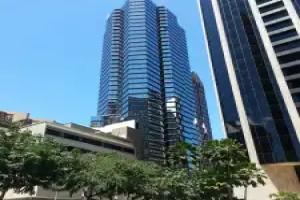
  • Downtown Honolulu is the financial, commercial, and governmental center of Hawaii. On the waterfront is Aloha Tower, which for many years was the tallest building in Hawaii. Currently the tallest building is the 438-foot (134 m) tall First Hawaiian Center, located on King and Bishop Streets. The downtown campus of Hawaii Pacific University is also located there.
  • The Arts District Honolulu in downtown/Chinatown is on the eastern edge of Chinatown. It is a 12-block area bounded by Bethel & Smith Streets and Nimitz Highway and Beretania Street – home to numerous arts and cultural institutions. It is located within the Chinatown Historic District, which includes the former Hotel Street Vice District.
  • The Capitol District is the eastern part of Downtown Honolulu. It is the current and historic center of Hawaii's state government, incorporating the Hawaii State Capitol, ʻIolani Palace, Honolulu Hale (City Hall), State Library, and the statue of King Kamehameha I, along with numerous government buildings.
  • Kakaʻako is a light-industrial district between Downtown and Waikīkī that has seen a large-scale redevelopment effort in the past decade. It is home to two major shopping areas, Ward Warehouse and Ward Centre. The Howard Hughes Corporation plans to transform Ward Centers into Ward Village over the next decade. The John A. Burns School of Medicine, part of the University of Hawaiʻi at Manoa, is also located there. A Memorial to the Ehime Maru Incident victims is built at the Kaka'ako Waterfront Park.
  • Ala Moana is a district between Kakaʻako and Waikīkī and the home of Ala Moana Center, the "World's largest open air shopping center" and the largest shopping mall in Hawaii. Ala Moana Center boasts over 300 tenants and is a very popular location among tourists. Also in Ala Moana is the Honolulu Design Center and Ala Moana Beach Park, the second largest park in Honolulu.
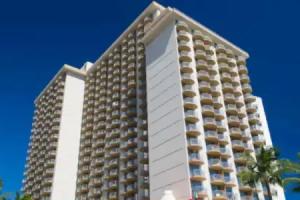
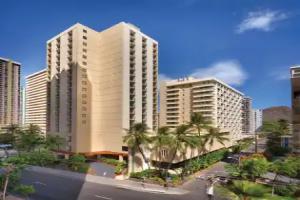
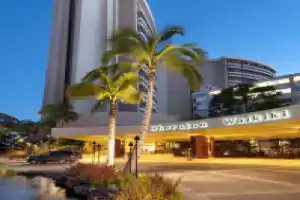
  • Waikīkī is the tourist district of Honolulu, located between the Ala Wai Canal and the Pacific Ocean next to Diamond Head. Numerous hotels, shops, and nightlife opportunities are located along Kalakaua and Kuhio Avenues. It is a popular location for visitors and locals alike and attracts millions of visitors every year. A majority of the hotel rooms on Oahu are located in Waikīkī.
  • Manoa and Makiki are residential neighborhoods located in adjacent valleys just inland of downtown and Waikīkī. Manoa Valley is home to the main campus of the University of Hawaiʻi.
  • Nuʻuanu and Pauoa are upper-middle-class residential districts located inland of downtown Honolulu. The National Memorial Cemetery of the Pacific is located in Punchbowl Crater fronting Pauoa Valley.
  • Palolo and Kaimuki are neighborhoods east of Manoa and Makiki, inland from Diamond Head. Palolo Valley parallels Manoa and is a residential neighborhood. Kaimuki is primarily a residential neighborhood with a commercial strip centered on Waialae Avenue running behind Diamond Head. Chaminade University is located in Kaimuki.
  • Waialae and Kahala are upper-class districts of Honolulu located directly east of Diamond Head, where there are many high-priced homes. Also found in these neighborhoods are the Waialae Country Club and the five-star Kahala Hotel & Resort.
  • East Honolulu includes the residential communities of ʻĀina Haina, Niu Valley, and Hawaiʻi Kai. These are considered upper-middle-class neighborhoods. The upscale gated communities of Waiʻalae ʻiki and Hawaiʻi Loa Ridge are also located here.
  • Kalihi and Palama are working-class neighborhoods with a number of government housing developments. Lower Kalihi, toward the ocean, is a light-industrial district.
  • Salt Lake and Aliamanu are (mostly) residential areas built in extinct tuff cones along the western end of the Honolulu District, not far from the Honolulu International Airport.
  • Moanalua is two neighborhoods and a valley at the western end of Honolulu, and home to Tripler Army Medical Center.

Cultural institutions

Natural museums

The Bishop Museum is the largest of Honolulu's museums. It is endowed with the state's largest collection of natural history specimens and the world's largest collection of Hawaiiana and Pacific culture artifacts. The Honolulu Zoo is the main zoological institution in Hawaii while the Waikiki Aquarium is a working marine biology laboratory. The Waikiki Aquarium is partnered with the University of Hawaii and other universities worldwide. Established for appreciation and botany, Honolulu is home to several gardens: Foster Botanical Garden, Liliʻuokalani Botanical Garden, Walker Estate, among others.

Performing arts

Established in 1900, the Honolulu Symphony is the second oldest US symphony orchestra west of the Rocky Mountains. Other classical music ensembles include the Hawaii Opera Theatre. Honolulu is also a center for Hawaiian music. The main music venues include the Hawaii Theatre, the Neal Blaisdell Center Concert Hall and Arena, and the Waikiki Shell.

Honolulu also includes several venues for live theater, including the Diamond Head Theatre.

Visual arts

Various institutions for the visual arts are located in Honolulu.

The Honolulu Museum of Art is endowed with the largest collection of Asian and Western art in Hawaii. It also has the largest collection of Islamic art, housed at the Shangri La estate. Since the merger of the Honolulu Academy of Arts and The Contemporary Museum, Honolulu (now called the Honolulu Museum of Art Spalding House) in 2011, the museum is also the only contemporary art museum in the state. The contemporary collections are housed at main campus (Spalding House) in Makiki and a multi-level gallery in downtown Honolulu at the First Hawaiian Center. The museum hosts a film and video program dedicated to arthouse and world cinema in the museum's Doris Duke Theatre, named for the museum's historic patroness Doris Duke.

The Hawaii State Art Museum (also downtown) boasts pieces by local artists as well as traditional Hawaiian art. The museum is administered by the Hawaii State Foundation on Culture and the Arts.

Honolulu also annually holds the Hawaii International Film Festival (HIFF). It showcases some of the best films from producers all across the Pacific Rim and is the largest "East meets West" style film festival of its sort in the United States.

Tourist attractions

  • Ala Moana Center
  • Aloha Tower
  • Bishop Museum
  • Diamond Head
  • Hanauma Bay
  • Honolulu Museum of Art
  • Honolulu Zoo
  • ʻIolani Palace
  • Lyon Arboretum
  • National Memorial Cemetery of the Pacific
  • USS Arizona Memorial
  • Waikiki Aquarium
  • Waikiki Beach
  • Waikiki Trolley

Transportation

Air

Located at the western end of the CDP, Honolulu International Airport (HNL) is the principal aviation gateway to the state of Hawaii. Kalaeloa Airport is primarily a commuter facility used by unscheduled air taxis, general aviation and transient and locally based military aircraft.

Public transport

Honolulu Authority for Rapid Transportation

In November 2010, voters approved a charter amendment to create a public transit authority to oversee the planning, construction, operation and future extensions to Honolulu's future rail system. The Honolulu Authority for Rapid Transportation (HART) currently includes a 10-member board of directors; three members appointed by the mayor, three members selected by the Honolulu City Council, and the city and state transportation directors. The opening of the Honolulu Rail Transit is delayed until approximately 2018, as HART canceled the initial bids for the first nine stations and intends to rebid the work as three packages of three stations each, and allow more time for construction in the hope that increased competition on smaller contracts will drive down costs; initial bids ranged from $294.5 million to $320.8 million, far surpassing HART's budget of $184 million.

Bus

Established by former Mayor Frank F. Fasi as the replacement for the Honolulu Rapid Transit Company (HRT), Honolulu's TheBus system was honored in 1994–1995 and 2000–2001 by the American Public Transportation Association as "America's Best Transit System". TheBus operates 107 routes serving Honolulu and most major cities and towns on Oahu. TheBus comprises a fleet of 531 buses, and is run by the non-profit corporation Oahu Transit Services in conjunction with the city Department of Transportation Services. Honolulu is ranked 4th for highest per-capita use of mass transit in the United States.

Rail

Currently, there is no urban rail transit system in Honolulu, although electric street railways were operated in Honolulu by the now-defunct Honolulu Rapid Transit Company prior to World War II. Predecessors to the Honolulu Rapid Transit Company were the Honolulu Rapid Transit and Land Company (began 1903) and Hawaiian Tramways (began 1888).

The City and County of Honolulu is currently constructing a 20-mile (32 km) rail transit line that will connect Honolulu with cities and suburban areas near Pearl Harbor and in the Leeward and West Oahu regions. The Honolulu High-Capacity Transit Corridor Project is aimed at alleviating traffic congestion for West Oahu commuters while being integral in the westward expansion of the metropolitan area. The project, however, has been criticized by opponents of rail for its cost, delays, and potential environmental impacts, but the line is expected to have large ridership.

Street view

Hotels

2 guests
Adults2+
Children under 170+
Age7+
Age7+
Age7+
Age7+
Age7+
Age7+
Age7+
Age7+
Age7+
Age7+
Search hotel

Reviews

Share your experiences, help others make the right choice!
Think about what you would like to know if you were looking for a review about a place to relax. Please describe in detail what you liked and what you didn't. What would you advise to other guests and to the hotel owner. The more fully you tell about the hotel, the easier it will be for other people to make a choice and they will be very grateful to you!

Map

X