San Diego
Description
San Diego /ˌsæn diːˈeɪɡoʊ/ (Spanish for "Saint Didacus") is a major city in California, in San Diego County, on the coast of the Pacific Ocean in Southern California, approximately 120 miles (190 km) south of Los Angeles and immediately adjacent to the border with Mexico.
With an estimated population of 1,394,928 as of July 1, 2015, San Diego is the eighth-largest city in the United States and second-largest in California. It is part of the San Diego–Tijuana conurbation, the second-largest transborder agglomeration between the US and a bordering country after Detroit–Windsor, with a population of 4,922,723 people. San Diego is the birthplace of California and is known for its mild year-round climate, natural deep-water harbor, extensive beaches, long association with the United States Navy and recent emergence as a healthcare and biotechnology development center.
Historically home to the Kumeyaay people, San Diego was the first site visited by Europeans on what is now the West Coast of the United States. Upon landing in San Diego Bay in 1542, Juan Rodríguez Cabrillo claimed the entire area for Spain, forming the basis for the settlement of Alta California 200 years later. The Presidio and Mission San Diego de Alcalá, founded in 1769, formed the first European settlement in what is now California. In 1821, San Diego became part of the newly-independent Mexico, which reformed as the First Mexican Republic two years later. In 1850, it became part of the United States following the Mexican–American War and the admission of California to the union.
The city is the seat of San Diego County and is the economic center of the region as well as the San Diego–Tijuana metropolitan area. San Diego's main economic engines are military and defense-related activities, tourism, international trade, and manufacturing. The presence of the University of California, San Diego (UCSD), with the affiliated UCSD Medical Center, has helped make the area a center of research in biotechnology.
History
Historical affiliationsSpanish Empire 1769–1821
First Mexican Empire 1821–1823
United Mexican States 1823–1848
United States 1848–present
Pre-colonial period
The original inhabitants of the region are now known as the San Dieguito and La Jolla people. The area of San Diego has been inhabited by the Kumeyaay people.
Spanish period
The first European to visit the region was Portuguese-born explorer Juan Rodríguez Cabrillo sailing under the flag of Castile. Sailing his flagship San Salvador from Navidad, New Spain, Cabrillo claimed the bay for the Spanish Empire in 1542, and named the site 'San Miguel'. In November 1602, Sebastián Vizcaíno was sent to map the California coast. Arriving on his flagship San Diego, Vizcaíno surveyed the harbor and what are now Mission Bay and Point Loma and named the area for the Catholic Saint Didacus, a Spaniard more commonly known as San Diego de Alcalá. On November 12, 1602, the first Christian religious service of record in Alta California was conducted by Friar Antonio de la Ascensión, a member of Vizcaíno's expedition, to celebrate the feast day of San Diego.
In May 1769, Gaspar de Portolà established the Fort Presidio of San Diego on a hill near the San Diego River. It was the first settlement by Europeans in what is now the state of California. In July of the same year, Mission San Diego de Alcalá was founded by Franciscan friars under Junípero Serra. By 1797, the mission boasted the largest native population in Alta California, with over 1,400 neophytes living in and around the mission proper. Mission San Diego was the southern anchor in California of the historic mission trail El Camino Real. Both the Presidio and the Mission are National Historic Landmarks.
Mexican period
In 1821, Mexico won its independence from Spain, and San Diego became part of the Mexican territory of Alta California. In 1822, Mexico began attempting to extend its authority over the coastal territory of Alta California. The fort on Presidio Hill was gradually abandoned, while the town of San Diego grew up on the level land below Presidio Hill. The Mission was secularized by the Mexican government in 1833, and most of the Mission lands were sold to wealthy Californio settlers. The 432 residents of the town petitioned the governor to form a pueblo, and Juan María Osuna was elected the first alcalde ("municipal magistrate"), defeating Pío Pico in the vote. (See, List of pre-statehood mayors of San Diego.) However, San Diego had been losing population throughout the 1830s and in 1838 the town lost its pueblo status because its size dropped to an estimated 100 to 150 residents. Beyond town Mexican land grants expanded the number of California ranchos that modestly added to the local economy.
In 1846, the United States went to war against Mexico and sent a naval and land expedition to conquer Alta California. At first they had an easy time of it capturing the major ports including San Diego, but the Californios in southern Alta California struck back. Following the successful revolt in Los Angeles, the American garrison at San Diego was driven out without firing a shot in early October 1846. Mexican partisans held San Diego for three weeks until October 24, 1846, when the Americans recaptured it. For the next several months the Americans were blockaded inside the pueblo. Skirmishes occurred daily and snipers shot into the town every night. The Californios drove cattle away from the pueblo hoping to starve the Americans and their Californio supporters out. On December 1 the Americans garrison learned that the dragoons of General Stephen W. Kearney were at Warner's Ranch. Commodore Robert F. Stockton sent a mounted force of fifty under Captain Archibald Gillespie to march north to meet him. Their joint command of 150 men, returning to San Diego, encountered about 93 Californios under Andrés Pico. In the ensuing Battle of San Pasqual, fought in the San Pasqual Valley which is now part of the city of San Diego, the Americans suffered their worst losses in the campaign. Subsequently a column led by Lieutenant Gray arrived from San Diego, rescuing Kearny's battered and blockaded command.
Stockton and Kearny went on to recover Los Angeles and force the capitulation of Alta California with the "Treaty of Cahuenga" on January 13, 1847. As a result of the Mexican–American War of 1846–48, the territory of Alta California, including San Diego, was ceded to the United States by Mexico, under the terms of the Treaty of Guadalupe Hidalgo in 1848. The Mexican negotiators of that treaty tried to retain San Diego as part of Mexico, but the Americans insisted that San Diego was "for every commercial purpose of nearly equal importance to us with that of San Francisco," and the Mexican-American border was eventually established to be one league south of the southernmost point of San Diego Bay, so as to include the entire bay within the United States.
American period
The state of California was admitted to the United States in 1850. That same year San Diego was designated the seat of the newly established San Diego County and was incorporated as a city. Joshua H. Bean, the last alcalde of San Diego, was elected the first mayor. Two years later the city was bankrupt; the California legislature revoked the city's charter and placed it under control of a board of trustees, where it remained until 1889. A city charter was re-established in 1889 and today's city charter was adopted in 1931.
The original town of San Diego was located at the foot of Presidio Hill, in the area which is now Old Town San Diego State Historic Park. The location was not ideal, being several miles away from navigable water. In 1850, William Heath Davis promoted a new development by the Bay shore called "New San Diego", several miles south of the original settlement; however, for several decades the new development consisted only a few houses, a pier and an Army depot. In the late 1860s, Alonzo Horton promoted a move to the bayside area, which he called "New Town" and which became Downtown San Diego. Horton promoted the area heavily, and people and businesses began to relocate to New Town because of its location on San Diego Bay convenient to shipping. New Town soon eclipsed the original settlement, known to this day as Old Town, and became the economic and governmental heart of the city. Still, San Diego remained a relative backwater town until the arrival of a railroad connection in 1878.
In the early part of the 20th century, San Diego hosted two World's Fairs: the Panama-California Exposition in 1915 and the California Pacific International Exposition in 1935. Both expositions were held in Balboa Park, and many of the Spanish/Baroque-style buildings that were built for those expositions remain to this day as central features of the park. The buildings were intended to be temporary structures, but most remained in continuous use until they progressively fell into disrepair. Most were eventually rebuilt, using castings of the original façades to retain the architectural style. The menagerie of exotic animals featured at the 1915 exposition provided the basis for the San Diego Zoo. During the 1950s there was a citywide festival called Fiesta del Pacifico highlighting the area's Spanish and Mexican past. In the 2010s there was a proposal for a large-scale celebration of the 100th anniversary of Balboa Park, but the plans were abandoned when the organization tasked with putting on the celebration went out of business.
The southern portion of the Point Loma peninsula was set aside for military purposes as early as 1852. Over the next several decades the Army set up a series of coastal artillery batteries and named the area Fort Rosecrans. Significant U.S. Navy presence began in 1901 with the establishment of the Navy Coaling Station in Point Loma, and expanded greatly during the 1920s. By 1930, the city was host to Naval Base San Diego, Naval Training Center San Diego, San Diego Naval Hospital, Camp Matthews, and Camp Kearny (now Marine Corps Air Station Miramar). The city was also an early center for aviation: as early as World War I, San Diego was proclaiming itself "The Air Capital of the West". The city was home to important airplane developers and manufacturers like Ryan Airlines (later Ryan Aeronautical), founded in 1925, and Consolidated Aircraft (later Convair), founded in 1923. Charles A. Lindbergh's plane The Spirit of St. Louis was built in San Diego in 1927 by Ryan Airlines.
During World War II, San Diego became a major hub of military and defense activity, due to the presence of so many military installations and defense manufacturers. The city's population grew rapidly during and after World War II, more than doubling between 1930 (147,995) and 1950 (333,865). During the final months of the war, the Japanese had a plan to target multiple U.S. cities for biological attack, starting with San Diego. The plan was called "Operation Cherry Blossoms at Night" and called for kamikaze planes filled with fleas infected with plague (Yersinia pestis) to crash into civilian population centers in the city, hoping to spread plague in the city and effectively kill tens of thousands of civilians. The plan was scheduled to launch on September 22, 1945, but was not carried out because Japan surrendered five weeks earlier.
After World War II, the military continued to play a major role in the local economy, but post-Cold War cutbacks took a heavy toll on the local defense and aerospace industries. The resulting downturn led San Diego leaders to seek to diversify the city's economy by focusing on research and science, as well as tourism.
From the start of the 20th century through the 1970s, the American tuna fishing fleet and tuna canning industry were based in San Diego, "the tuna capital of the world". San Diego's first tuna cannery was founded in 1911, and by the mid-1930s the canneries employed more than 1,000 people. A large fishing fleet supported the canneries, mostly staffed by immigrant fishermen from Japan, and later from the Portuguese Azores and Italy whose influence is still felt in neighborhoods like Little Italy and Point Loma. Due to rising costs and foreign competition, the last of the canneries closed in the early 1980s.
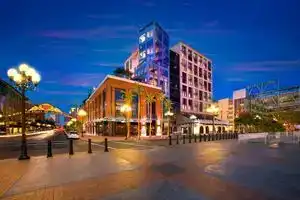
Downtown San Diego was in decline in the 1960s and 1970s, but experienced some urban renewal since the early 1980s, including the opening of Horton Plaza, the revival of the Gaslamp Quarter, and the construction of the San Diego Convention Center; Petco Park opened in 2004.
Geography
According to SDSU professor emeritus Monte Marshall, San Diego Bay is "the surface expression of a north-south-trending, nested graben". The Rose Canyon and Point Loma fault zones are part of the San Andreas Fault system. About 15 miles (24 km) east of the bay are the Laguna Mountains in the Peninsular Ranges, which are part of the backbone of the American continents.
The city lies on approximately 200 deep canyons and hills separating its mesas, creating small pockets of natural open space scattered throughout the city and giving it a hilly geography. Traditionally, San Diegans have built their homes and businesses on the mesas, while leaving the urban canyons relatively wild. Thus, the canyons give parts of the city a segmented feel, creating gaps between otherwise proximate neighborhoods and contributing to a low-density, car-centered environment. The San Diego River runs through the middle of San Diego from east to west, creating a river valley which serves to divide the city into northern and southern segments. The river used to flow into San Diego Bay and its fresh water was the focus of the earliest Spanish explorers. Several reservoirs and Mission Trails Regional Park also lie between and separate developed areas of the city.
Notable peaks within the city limits include Cowles Mountain, the highest point in the city at 1,591 feet (485 m); Black Mountain at 1,558 feet (475 m); and Mount Soledad at 824 feet (251 m). The Cuyamaca Mountains and Laguna Mountains rise to the east of the city, and beyond the mountains are desert areas. The Cleveland National Forest is a half-hour drive from downtown San Diego. Numerous farms are found in the valleys northeast and southeast of the city.
In its 2013 ParkScore ranking, The Trust for Public Land reported that San Diego had the 9th-best park system among the 50 most populous U.S. cities. ParkScore ranks city park systems by a formula that analyzes acreage, access, and service and investment.
Communities and neighborhoods
The city of San Diego recognizes 52 individual areas as Community Planning Areas. Within a given planning area there may be several distinct neighborhoods. Altogether the city contains more than 100 identified neighborhoods.
Downtown San Diego is located on San Diego Bay. Balboa Park encompasses several mesas and canyons to the northeast, surrounded by older, dense urban communities including Hillcrest and North Park. To the east and southeast lie City Heights, the College Area, and Southeast San Diego. To the north lies Mission Valley and Interstate 8. The communities north of the valley and freeway, and south of Marine Corps Air Station Miramar, include Clairemont, Kearny Mesa, Tierrasanta, and Navajo. Stretching north from Miramar are the northern suburbs of Mira Mesa, Scripps Ranch, Rancho Peñasquitos, and Rancho Bernardo. The far northeast portion of the city encompasses Lake Hodges and the San Pasqual Valley, which holds an agricultural preserve. Carmel Valley and Del Mar Heights occupy the northwest corner of the city. To their south are Torrey Pines State Reserve and the business center of the Golden Triangle. Further south are the beach and coastal communities of La Jolla, Pacific Beach, Mission Beach, and Ocean Beach. Point Loma occupies the peninsula across San Diego Bay from downtown. The communities of South San Diego, such as San Ysidro and Otay Mesa, are located next to the Mexico–United States border, and are physically separated from the rest of the city by the cities of National City and Chula Vista. A narrow strip of land at the bottom of San Diego Bay connects these southern neighborhoods with the rest of the city.
For the most part, San Diego neighborhood boundaries tend to be understood by its residents based on geographical boundaries like canyons and street patterns. The city recognized the importance of its neighborhoods when it organized its 2008 General Plan around the concept of a "City of Villages".
Ecology
Like most of southern California, the majority of San Diego's current area was originally occupied by chaparral, a plant community made up mostly of drought-resistant shrubs. The endangered Torrey pine has the bulk of its population in San Diego in a stretch of protected chaparral along the coast. The steep and varied topography and proximity to the ocean create a number of different habitats within the city limits, including tidal marsh and canyons. The chaparral and coastal sage scrub habitats in low elevations along the coast are prone to wildfire, and the rates of fire have increased in the 20th century, due primarily to fires starting near the borders of urban and wild areas.
San Diego's broad city limits encompass a number of large nature preserves, including Torrey Pines State Reserve, Los Peñasquitos Canyon Preserve, and Mission Trails Regional Park. Torrey Pines State Reserve and a coastal strip continuing to the north constitute the only location where the rare species of Torrey Pine, P. torreyana torreyana, is found.
Due to the steep topography that prevents or discourages building, along with some efforts for preservation, there are also a large number of canyons within the city limits that serve as nature preserves, including Switzer Canyon, Tecolote Canyon Natural Park, and Marian Bear Memorial Park in the San Clemente Canyon, as well as a number of small parks and preserves.
San Diego County has one of the highest counts of animal and plant species that appear on the endangered species list among counties in the United States. Because of its diversity of habitat and its position on the Pacific Flyway, San Diego County has recorded the presence of 492 bird species, more than any other region in the country. San Diego always scores very high in the number of bird species observed in the annual Christmas Bird Count, sponsored by the Audubon Society, and it is known as one of the "birdiest" areas in the United States.
San Diego and its backcountry are subject to periodic wildfires. In October 2003, San Diego was the site of the Cedar Fire, which has been called the largest wildfire in California over the past century. The fire burned 280,000 acres (1,100 km2), killed 15 people, and destroyed more than 2,200 homes. In addition to damage caused by the fire, smoke resulted in a significant increase in emergency room visits due to asthma, respiratory problems, eye irritation, and smoke inhalation; the poor air quality caused San Diego County schools to close for a week. Wildfires four years later destroyed some areas, particularly within the communities of Rancho Bernardo, Rancho Santa Fe, and Ramona.
Culture
Many popular museums, such as the San Diego Museum of Art, the San Diego Natural History Museum, the San Diego Museum of Man, the Museum of Photographic Arts, and the San Diego Air & Space Museum are located in Balboa Park, which is also the location of the San Diego Zoo. The Museum of Contemporary Art San Diego (MCASD) is located in La Jolla and has a branch located at the Santa Fe Depot downtown. The downtown branch consists of two building on two opposite streets. The Columbia district downtown is home to historic ship exhibits belonging to the San Diego Maritime Museum, headlined by the Star of India, as well as the unrelated San Diego Aircraft Carrier Museum featuring the USS Midway aircraft carrier.
The San Diego Symphony at Symphony Towers performs on a regular basis and is directed by Jahja Ling. The San Diego Opera at Civic Center Plaza, directed by Ian Campbell, was ranked by Opera America as one of the top 10 opera companies in the United States. Old Globe Theatre at Balboa Park produces about 15 plays and musicals annually. The La Jolla Playhouse at UCSD is directed by Christopher Ashley. Both the Old Globe Theatre and the La Jolla Playhouse have produced the world premieres of plays and musicals that have gone on to win Tony Awards or nominations on Broadway. The Joan B. Kroc Theatre at Kroc Center's Performing Arts Center is a 600-seat state-of-the-art theatre that hosts music, dance, and theatre performances. The San Diego Repertory Theatre at the Lyceum Theatres in Horton Plaza produces a variety of plays and musicals. Hundreds of movies and a dozen TV shows have been filmed in San Diego, a tradition going back as far as 1898.