Kolkata
Description
Kolkata /koʊlˈkɑːtɑː/ (also known as Calcutta /kælˈkʌtə/, the official name until 2001) is the capital of the Indian state of West Bengal. Located on the east bank of the Hooghly River, it is the principal commercial, cultural, and educational centre of East India, while the Port of Kolkata is India's oldest operating port and its sole major riverine port. In 2011, the city had population of 4.5 million, while the population of the city and its suburbs was 14.1 million, making it the third-most populous metropolitan area in India. In 2008 its gross domestic product (adjusted for purchasing power parity) was estimated to be US$104 billion, which was the third highest among Indian cities, behind Mumbai and Delhi.
In the late 17th century, the three villages that predated Calcutta were ruled by the Nawab of Bengal under Mughal suzerainty. After the Nawab granted the East India Company a trading licence in 1690, the area was developed by the Company into an increasingly fortified trading post. Nawab Siraj ud-Daulah occupied Calcutta in 1756, and the East India Company retook it the following year. In 1793 the East India company was strong enough to abolish Nizamat (local rule), and assumed full sovereignty of the region. Under the company rule, and later under the British Raj, Calcutta served as the capital of British-held territories in India until 1911, when its perceived geographical disadvantages, combined with growing nationalism in Bengal, led to a shift of the capital to New Delhi. Calcutta was the centre for the Indian independence movement; it remains a hotbed of contemporary state politics. Following Indian independence in 1947, Kolkata, which was once the centre of modern Indian education, science, culture, and politics, suffered several decades of economic stagnation.
As a nucleus of the 19th- and early 20th-century Bengal Renaissance and a religiously and ethnically diverse centre of culture in Bengal and India, Kolkata has local traditions in drama, art, film, theatre, and literature. Many people from Kolkata—among them several Nobel laureates—have contributed to the arts, the sciences, and other areas. Kolkata culture features idiosyncrasies that include distinctively close-knit neighbourhoods (paras) and freestyle intellectual exchanges (adda). West Bengal's share of the Bengali film industry is based in the city, which also hosts venerable cultural institutions of national importance, such as the Academy of Fine Arts, the Victoria Memorial, the Asiatic Society, the Indian Museum and the National Library of India. Among professional scientific institutions, Kolkata hosts the Agri Horticultural Society of India, the Geological Survey of India, the Botanical Survey of India, the Calcutta Mathematical Society, the Indian Science Congress Association, the Zoological Survey of India, the Institution of Engineers, the Anthropological Survey of India and the Indian Public Health Association. Though home to major cricketing venues and franchises, Kolkata differs from other Indian cities by giving importance to association football and other sports.
Etymology
The word Kolkata derives from the Bengali term Kôlikata (Bengali: কলিকাতা) [ˈkɔlikat̪a], the name of one of three villages that predated the arrival of the British, in the area where the city eventually was to be established; the other two villages were Sutanuti and Govindapur.
There are several explanations about the etymology of this name:
- The term Kolikata is thought to be a variation of Kalikkhetrô [ˈkalikʰːet̪rɔ] (Bengali: কালীক্ষেত্র), meaning "Field of [the goddess] Kali". Similarly, it can be a variation of 'Kalikshetra' (Sanskrit: कालीक्षेत्र, lit. area of Goddess Kali").
- Alternatively, the name may have been derived from the Bengali term kilkila (Bengali: কিলকিলা), or "flat area".
- The name may have its origin in the words khal [ˈkʰal] (Bengali: খাল) meaning "canal", followed by kaṭa [ˈkata] (Bengali: কাটা), which may mean "dug".
- According to another theory, the area specialised in the production of quicklime or koli chun [ˈkɔlitɕun] (Bengali: কলি চুন) and coir or kata [ˈkat̪a] (Bengali: কাতা); hence, it was called Kolikata [ˈkɔlikat̪a] (Bengali: কলিকাতা).
Although the city's name has always been pronounced Kolkata [ˈkolkat̪a] (Bengali: কলকাতা) or Kôlikata [ˈkɔlikat̪a] (Bengali: কলিকাতা) in Bengali, the anglicised form Calcutta was the official name until 2001, when it was changed to Kolkata in order to match Bengali pronunciation.
History
The discovery and archaeological study of Chandraketugarh, 35 kilometres (22 mi) north of Kolkata, provide evidence that the region in which the city stands has been inhabited for over two millennia. Kolkata's recorded history began in 1690 with the arrival of the English East India Company, which was consolidating its trade business in Bengal. Job Charnock, an administrator who worked for the company, was formerly credited as the founder of the city; In response to a public petition, the Calcutta High Court ruled in 2003 that the city does not have a founder. The area occupied by the present-day city encompassed three villages: Kalikata, Gobindapur, and Sutanuti. Kalikata was a fishing village; Sutanuti was a riverside weavers' village. They were part of an estate belonging to the Mughal emperor; the jagirdari (a land grant bestowed by a king on his noblemen) taxation rights to the villages were held by the Sabarna Roy Choudhury family of landowners, or zamindars. These rights were transferred to the East India Company in 1698.:1
In 1712, the British completed the construction of Fort William, located on the east bank of the Hooghly River to protect their trading factory. Facing frequent skirmishes with French forces, the British began to upgrade their fortifications in 1756. The Nawab of Bengal, Siraj ud-Daulah, condemned the militarisation and tax evasion by the company. His warning went unheeded, and the Nawab attacked; he captured Fort William which led to the killings of several East India company officials in the Black Hole of Calcutta. A force of Company soldiers (sepoys) and British troops led by Robert Clive recaptured the city the following year. Per the 1765 Treaty of Allahabad following the battle of Buxar, East India company was appointed imperial tax collector of the Mughal emperor in the province of Bengal, Bihar and Orissa, while Mughal-appointed Nawabs continued to rule the province. Declared a presidency city, Calcutta became the headquarters of the East India Company by 1772. In 1793, ruling power of the Nawabs were abolished and East India company took complete control of the city and the province. In the early 19th century, the marshes surrounding the city were drained; the government area was laid out along the banks of the Hooghly River. Richard Wellesley, Governor-General of the Presidency of Fort William between 1797 and 1805, was largely responsible for the development of the city and its public architecture. Throughout the late 18th and 19th century, the city was a centre of the East India Company's opium trade.
By the 1850s, Calcutta had two areas: White Town, which was primarily British and centred on Chowringhee and Dalhousie Square; and Black Town, mainly Indian and centred on North Calcutta. The city underwent rapid industrial growth starting in the early 1850s, especially in the textile and jute industries; this encouraged British companies to massively invest in infrastructure projects, which included telegraph connections and Howrah railway station. The coalescence of British and Indian culture resulted in the emergence of a new babu class of urbane Indians, whose members were often bureaucrats, professionals, newspaper readers, and Anglophiles; they usually belonged to upper-caste Hindu communities. In the 19th century, the Bengal Renaissance brought about an increased sociocultural sophistication among city denizens. In 1883, Calcutta was host to the first national conference of the Indian National Association, the first avowed nationalist organisation in India.
The British moved the capital to New Delhi in 1911. Calcutta continued to be a centre for revolutionary organisations associated with the Indian independence movement. The city and its port were bombed several times by the Japanese between 1942 and 1944, during World War II. Coinciding with the war, millions starved to death during the Bengal famine of 1943 due to a combination of military, administrative, and natural factors. Demands for the creation of a Muslim state led in 1946 to an episode of communal violence that killed over 4,000. The partition of India led to further clashes and a demographic shift—many Muslims left for East Pakistan (present day Bangladesh), while hundreds of thousands of Hindus fled into the city.
During the 1960s and 1970s, severe power shortages, strikes, and a violent Marxist–Maoist movement by groups known as the Naxalites damaged much of the city's infrastructure, resulting in economic stagnation. The Bangladesh Liberation War of 1971 led to a massive influx of thousands of refugees, many of them penniless, that strained Kolkata's infrastructure. During the mid-1980s, Mumbai (then called Bombay) overtook Kolkata as India's most populous city. In 1985, prime minister Rajiv Gandhi dubbed Kolkata a "dying city" in light of its socio-political woes. In the period 1977–2011, West Bengal was governed from Kolkata by the Left Front, which was dominated by the Communist Party of India (CPM). It was the world's longest-serving democratically elected communist government, during which Kolkata was a key base for Indian communism. In the West Bengal Legislative Assembly election, 2011, Left Front was defeated by the Trinamool Congress. The city's economic recovery gathered momentum after the 1990s, when India began to institute pro-market reforms. Since 2000, the information technology (IT) services sector has revitalised Kolkata's stagnant economy. The city is also experiencing marked growth in its manufacturing base.
Geography
Spread roughly north–south along the east bank of the Hooghly River, Kolkata sits within the lower Ganges Delta of eastern India; the city's elevation is 1.5–9 m (5–30 ft). Much of the city was originally a wetland that was reclaimed over the decades to accommodate a burgeoning population. The remaining undeveloped areas, known as the East Kolkata Wetlands, were designated a "wetland of international importance" by the Ramsar Convention (1975). As with most of the Indo-Gangetic Plain, the soil and water are predominantly alluvial in origin. Kolkata is located over the "Bengal basin", a pericratonic tertiary basin. Bengal basin comprises three structural units: shelf or platform in the west; central hinge or shelf/slope break; and deep basinal part in the east and southeast. Kolkata is located atop the western part of the hinge zone which is about 25 km (16 mi) wide at a depth of about 45,000 m (148,000 ft) below the surface. The shelf and hinge zones have many faults, among them some are active. Total thickness of sediment below Kolkata is nearly 7,500 m (24,600 ft) above the crystalline basement; of these the top 350–450 m (1,150–1,480 ft) is quaternary, followed by 4,500–5,500 m (14,760–18,040 ft) of tertiary sediments, 500–700 m (1,640–2,300 ft) trap wash of cretaceous trap and 600–800 m (1,970–2,620 ft) permian-carboniferous Gondwana rocks. The quaternary sediments consist of clay, silt, and several grades of sand and gravel. These sediments are sandwiched between two clay beds: the lower one at a depth of 250–650 m (820–2,130 ft); the upper one 10–40 m (30–130 ft) in thickness. According to the Bureau of Indian Standards, on a scale ranging from I to V in order of increasing susceptibility to earthquakes, the city lies inside seismic zone III.
Urban structure
The Kolkata metropolitan area is spread over 1,886.67 km2 (728.45 sq mi):7 and comprises 3 municipal corporations (including Kolkata Municipal Corporation), 39 local municipalities and 24 panchayat samitis, as of 2011.:7 The urban agglomeration encompassed 72 cities and 527 towns and villages, as of 2006. Suburban areas in the Kolkata metropolitan area incorporate parts of the following districts: North 24 Parganas, South 24 Parganas, Howrah, Hooghly, and Nadia.:15 Kolkata, which is under the jurisdiction of the Kolkata Municipal Corporation (KMC), has an area of 185 km2 (71 sq mi). The east–west dimension of the city is comparatively narrow, stretching from the Hooghly River in the west to roughly the Eastern Metropolitan Bypass in the east—a span of 9–10 km (5.6–6.2 mi). The north–south distance is greater, and its axis is used to section the city into North, Central, and South Kolkata.
North Kolkata is the oldest part of the city. Characterised by 19th-century architecture, dilapidated buildings, overpopulated slums, crowded bazaars and narrow alleyways, it includes areas such as Shyambazar, Hatibagan, Maniktala, Kankurgachi, Rajabazar, Shobhabazar, Shyampukur, Sonagachi, Kumortuli, Bagbazar, Jorasanko, Chitpur, Pathuriaghata, Cossipore, Sinthee, Belgachia, Jorabagan, and Dum Dum.:65–66 The northern suburban areas like Baranagar, Noapara, Dunlop, Dakshineswar, Nagerbazar, Belghoria, Sodepur, Madhyamgram, Kestopur, Birati, Khardah up to Barrackpur are also within the city of Kolkata (as a metropolitan structure).
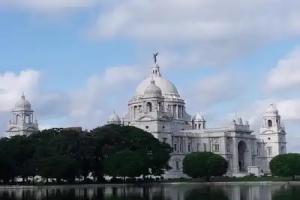
Central Kolkata hosts the central business district. It contains B. B. D. Bagh, formerly known as Dalhousie Square, and the Esplanade on its east; Strand Road is on its west. The West Bengal Secretariat, General Post Office, Reserve Bank of India, High Court, Lalbazar Police Headquarters, and several other government and private offices are located there. Another business hub is the area south of Park Street, which comprises thoroughfares such as Jawaharlal Nehru Road, Camac Street, Wood Street, Loudon Street, Shakespeare Sarani, and A. J. C. Bose Road. The Maidan is a large open field in the heart of the city that has been called the "lungs of Kolkata" and accommodates sporting events and public meetings. The Victoria Memorial and Kolkata Race Course are located at the southern end of the Maidan. Other important areas of Central Kolkata are Burrabazar, College Street, Sealdah, Taltala, Janbazar, Bowbazar, Entally, Chandni Chowk, Lalbazar, Chowringhee, Dharmatala, Tiretta Bazar, Bow Barracks, Mullick Bazar, Park Circus, Babughat etc. Among the other parks are Central Park in Bidhannagar and Millennium Park on Strand Road, along the Hooghly River.
East Kolkata is largely composed of newly developed areas and neighbourhoods of Saltlake, Rajarhat, Tangra, Beliaghata, Ultadanga, Phoolbagan etc. Two planned townships in the greater Kolkata region are Bidhannagar, also known as Salt Lake City and located north-east of the city; and Rajarhat, also called New Town and sited east of Bidhannagar. In the 2000s, Sector V in Bidhannagar developed into a business hub for information technology and telecommunication companies. Both Bidhannagar and New Town are situated outside the Kolkata Municipal Corporation limits, in their own municipalities.
South Kolkata developed after India gained independence in 1947; it includes upscale neighbourhoods such as Ballygunge, Alipore, New Alipore, Lansdowne, Bhowanipore, Kalighat, Dhakuria, Gariahat, Tollygunge, Naktala, Jodhpur Park, Lake Gardens, Golf Green, Jadavpur, Haltu, Nandi Bagan, Picnic Garden, Topsia, Santoshpur and Kasba. Outlying areas of South Kolkata include Garden Reach, Khidirpur, Metiabruz, Taratala, Maheshtala, Budge Budge, Behala, Sarsuna, Barisha, Parnasree Pally, Thakurpukur, Kudghat, Ranikuthi, Bansdroni, Baghajatin, Tiljala and Garia. The southern suburban areas like Narendrapur, Sonarpur, Baruipur are also within the city of Kolkata (as metropolitan structure). Fort William, on the western part of the city, houses the headquarters of the Eastern Command of the Indian Army; its premises are under the jurisdiction of the army.
Transport
Public transport is provided by the Kolkata Suburban Railway, the Kolkata Metro, trams, and buses. The suburban rail network reaches the city's distant suburbs. According to a 2013 survey conducted by International Association of Public Transport, Kolkata ranks the top among the six cities surveyed in India, in terms of public transport system. The Kolkata Metro, in operation since 1984, is the oldest underground mass transit system in India. It spans the north–south length of the city and covers a distance of 25.1 km (16 mi). As of 2009, five Metro rail lines were under construction. Kolkata has four long-distance railway stations, located at Howrah (the largest railway complex in India), Sealdah, Chitpur and Shalimar, which connect Kolkata by rail to most cities in West Bengal and to other major cities in India. The city serves as the headquarters of three railway Zone out of Seventeen of the Indian Railways regional divisions—the Kolkata Metro Railways, Eastern Railway and the South-Eastern Railway. Kolkata has rail and road connectivity with Dhaka, capital of Bangladesh.
Buses, which are the most commonly used mode of transport, are run by government agencies and private operators. Kolkata is the only Indian city with a tram network, which is operated by the Calcutta Tramways Company. The slow-moving tram services are restricted to certain areas of the city. Water-logging, caused by heavy rains that fall during the summer monsoon, can interrupt transportation networks. Hired public conveyances include auto rickshaws, which often ply specific routes, and yellow metered taxis. Almost all of Kolkata's taxis are antiquated Hindustan Ambassadors by make; newer air-conditioned radio taxis are also in service. In parts of the city, cycle rickshaws and hand-pulled rickshaws are patronised by the public for short trips.
Due to its diverse and abundant public transportation, privately owned vehicles are not as common in Kolkata as in other major Indian cities. The city has witnessed a steady increase in the number of registered vehicles; 2002 data showed an increase of 44% over a period of seven years. As of 2004, after adjusting for population density, the city's "road space" was only 6% compared to 23% in Delhi and 17% in Mumbai. The Kolkata Metro has somewhat eased traffic congestion, as has the addition of new roads and flyovers. Agencies operating long-distance bus services include Calcutta State Transport Corporation, South Bengal State Transport Corporation, North Bengal State Transport Corporation, and various private operators. The city's main bus terminals are located at Esplanade and Babughat. The Kolkata–Delhi and Kolkata–Chennai prongs of the Golden Quadrilateral, and National Highway 34 start from the city.
Netaji Subhas Chandra Bose International Airport, located in Dum Dum some 16 km (9.9 mi) north-east of the city centre, operates domestic and international flights. In 2013, the airport was upgraded to handle increased air traffic. The Port of Kolkata, established in 1870, is India's oldest and the only major river port. The Kolkata Port Trust manages docks in Kolkata and Haldia. The port hosts passenger services to Port Blair, capital of the Andaman and Nicobar Islands; freighter service to ports throughout India and around the world is operated by the Shipping Corporation of India. Ferry services connect Kolkata with its twin city of Howrah, located across the Hooghly River.
Healthcare
As of 2011, the health care system in Kolkata consists of 48 government hospitals, mostly under the Department of Health & Family Welfare, Government of West Bengal, and 366 private medical establishments; these establishments provide the city with 27,687 hospital beds. For every 10,000 people in the city, there are 61.7 hospital beds, which is higher than the national average of 9 hospital beds per 10,000. Ten medical and dental colleges are located in the Kolkata metropolitan area which act as tertiary referral hospitals in the state. Calcutta Medical College, founded in 1835, was the first institution in Asia to teach modern medicine. These facilities are inadequate to meet the healthcare needs of the city. More than 78% in Kolkata prefer the private medical sector over the public medical sector,:109 due to the poor quality of care, the lack of a nearby facility, and excessive waiting times at government facilities.:61
According to the 2005 National Family Health Survey, only a small proportion of Kolkata households were covered under any health scheme or health insurance.:41 The total fertility rate in Kolkata was 1.4, which was the lowest among the eight cities surveyed.:45 In Kolkata, 77% of the married women used contraceptives, which was the highest among the cities surveyed, but use of modern contraceptive methods was the lowest (46%).:47 The infant mortality rate in Kolkata was 41 per 1,000 live births, and the mortality rate for children under five was 49 per 1,000 live births.:48
Among the surveyed cities, Kolkata stood second (5%) for children who had not had any vaccinations under the Universal Immunization Programme as of 2005.:48 Kolkata ranked second among the surveyed cities, with access to an anganwadi centre under the Integrated Child Development Services (ICDS) programme for 57% of the children between 0 and 71 months.:51 The proportion of malnourished, anaemic and underweight children in Kolkata was less in comparison to other surveyed cities.:54–55
About 18% of the men and 30% of the women in Kolkata are obese—the majority of them belonging to the non-poor strata of society.:105 In 2005, Kolkata had the highest percentage (55%) among the surveyed cities of anaemic woman, while 20% of the men in Kolkata were anaemic.:56–57 Diseases like diabetes, asthma, goitre and other thyroid disorders were found in large numbers of people.:57–59 Tropical diseases like malaria, dengue and chikungunya are prevalent in Kolkata, though their incidence is decreasing. Kolkata is one of the districts in India with a high number of people with AIDS; it has been designated a district prone to high risk.
Because of higher air pollution, the life expectancy of a person born in the city in 2014, is four years fewer than in the suburbs.
Culture
Kolkata is known for its literary, artistic, and revolutionary heritage; as the former capital of India, it was the birthplace of modern Indian literary and artistic thought. Kolkata has been called the "City of Furious, Creative Energy" as well as the "cultural [or literary] capital of India". The presence of paras, which are neighbourhoods that possess a strong sense of community, is characteristic of the city. Typically, each para has its own community club and, on occasion, a playing field. Residents engage in addas, or leisurely chats, that often take the form of freestyle intellectual conversation. The city has a tradition of political graffiti depicting everything from outrageous slander to witty banter and limericks, caricatures, and propaganda.
Kolkata has many buildings adorned with Indo-Islamic and Indo-Saracenic architectural motifs. Several well-maintained major buildings from the colonial period have been declared "heritage structures"; others are in various stages of decay. Established in 1814 as the nation's oldest museum, the Indian Museum houses large collections that showcase Indian natural history and Indian art. Marble Palace is a classic example of a European mansion that was built in the city. The Victoria Memorial, a place of interest in Kolkata, has a museum documenting the city's history. The National Library of India is the leading public library in the country while Science City is the largest science centre in the Indian subcontinent.
The popularity of commercial theatres in the city has declined since the 1980s.:99 Group theatres of Kolkata, a cultural movement that started in the 1940s contrasting with the then-popular commercial theatres, are theatres that are not professional or commercial, and are centres of various experiments in theme, content, and production; group theatres use the proscenium stage to highlight socially relevant messages.:99 Chitpur locality of the city houses multiple production companies of jatra, a tradition of folk drama popular in rural Bengal. Kolkata is the home of the Bengali cinema industry, dubbed "Tollywood" for Tollygunj, where most of the state's film studios are located. Its long tradition of art films includes globally acclaimed film directors such as Academy Award-winning director Satyajit Ray, Ritwik Ghatak, Mrinal Sen, Tapan Sinha, and contemporary directors such as Aparna Sen, Buddhadeb Dasgupta, Goutam Ghose and Rituparno Ghosh.
During the 19th and 20th centuries, Bengali literature was modernised through the works of authors such as Ishwar Chandra Vidyasagar, Bankim Chandra Chattopadhyay, Michael Madhusudan Dutt, Rabindranath Tagore, Kazi Nazrul Islam, and Sarat Chandra Chattopadhyay. Coupled with social reforms led by Ram Mohan Roy, Swami Vivekananda, and others, this constituted a major part of the Bengal Renaissance. The middle and latter parts of the 20th century witnessed the arrival of post-modernism, as well as literary movements such as those espoused by the Kallol movement, hungryalists and the little magazines. Large majority of publishers of the city is concentrated in and around College Street, "... a half-mile of bookshops and bookstalls spilling over onto the pavement", selling new and used books.
Kalighat painting originated in 19th century Kolkata as a local style that reflected a variety of themes including mythology and quotidian life. The Government College of Art and Craft, founded in 1864, has been the cradle as well as workplace of eminent artists including Abanindranath Tagore, Jamini Roy, and Nandalal Bose. The art college was the birthplace of the Bengal school of art that arose as an avant garde and nationalist movement reacting against the prevalent academic art styles in the early 20th century. The Academy of Fine Arts and other art galleries hold regular art exhibitions. The city is recognised for its appreciation of Rabindra sangeet (songs written by Rabindranath Tagore) and Indian classical music, with important concerts and recitals, such as Dover Lane Music Conference, being held throughout the year; Bengali popular music, including baul folk ballads, kirtans, and Gajan festival music; and modern music, including Bengali-language adhunik songs. Since the early 1990s, new genres have emerged, including one comprising alternative folk–rock Bengali bands. Another new style, jibonmukhi gaan ("songs about life"), is based on realism.:105 Key elements of Kolkata's cuisine include rice and a fish curry known as machher jhol, which can be accompanied by desserts such as roshogolla, sandesh, and a sweet yoghurt known as mishti dohi. Bengal's large repertoire of seafood dishes includes various preparations of ilish, a fish that is a favourite among Calcuttans. Street foods such as beguni (fried battered eggplant slices), kati roll (flatbread roll with vegetable or chicken, mutton, or egg stuffing), phuchka (a deep-fried crêpe with tamarind sauce) and Indian Chinese cuisine from Chinatown are popular.
Though Bengali women traditionally wear the sari, the shalwar kameez and Western attire is gaining acceptance among younger women. Western-style dress has greater acceptance among men, although the traditional dhoti and kurta are seen during festivals. Durga Puja, held in September–October, is Kolkata's most important and largest festival; it is an occasion for glamorous celebrations and artistic decorations. The Bengali New Year, known as Poila Boishak, as well as the harvest festival of Poush Parbon are among the city's other festivals; also celebrated are Kali Puja, Diwali, Holi, Jagaddhatri Puja, Saraswati Puja, Rathayatra, Janmashtami, Maha Shivratri, Vishwakarma Puja, Lakshmi Puja, Ganesh Chathurthi, Makar Sankranti, Gajan, Kalpataru Day, Bhai Phonta, Maghotsab, Eid, Muharram, Christmas, Buddha Purnima and Mahavir Jayanti. Cultural events include the Rabindra Jayanti, Independence Day(15 August), Republic Day(26 January), Kolkata Book Fair, the Dover Lane Music Festival, the Kolkata Film Festival, Nandikar's National Theatre Festival, Statesman Vintage & Classic Car Rally and Gandhi Jayanti.
-
Dance accompanied by Rabindra Sangeet, a music genre started by Rabindranath Tagore
-
Sandesh, a typical Bengali sweet
-
A murti, or representation, of the goddess Durga shown during the Durga Puja festival
-
Durga Idol of Bagbazar Sarbojanin-- first public puja of Kolkata, that would celebrate its 100 th year in 2018