Washington

Description

"United States capital" redirects here. For the capitol building, see United States Capitol.

Washington, D.C., formally the District of Columbia and commonly referred to as "Washington", "the District", or simply "D.C.", is the capital of the United States. The signing of the Residence Act on July 16, 1790, approved the creation of a capital district located along the Potomac River on the country's East Coast. The U.S. Constitution provided for a federal district under the exclusive jurisdiction of the Congress and the District is therefore not a part of any state.

The states of Maryland and Virginia each donated land to form the federal district, which included the pre-existing settlements of Georgetown and Alexandria. Named in honor of President George Washington, the City of Washington was founded in 1791 to serve as the new national capital. In 1846, Congress returned the land originally ceded by Virginia; in 1871, it created a single municipal government for the remaining portion of the District.

Washington had an estimated population of 672,228 as of July 2015. Commuters from the surrounding Maryland and Virginia suburbs raise the city's population to more than one million during the workweek. The Washington metropolitan area, of which the District is a part, has a population of over 6 million, the sixth-largest metropolitan statistical area in the country.

The centers of all three branches of the federal government of the United States are in the District, including the Congress, President, and Supreme Court. Washington is home to many national monuments and museums, which are primarily situated on or around the National Mall. The city hosts 176 foreign embassies as well as the headquarters of many international organizations, trade unions, non-profit organizations, lobbying groups, and professional associations.

A locally elected mayor and a 13‑member council have governed the District since 1973. However, the Congress maintains supreme authority over the city and may overturn local laws. D.C. residents elect a non-voting, at-large congressional delegate to the House of Representatives, but the District has no representation in the Senate. The District receives three electoral votes in presidential elections as permitted by the Twenty-third Amendment to the United States Constitution, ratified in 1961.

History

Various tribes of the Algonquian-speaking Piscataway people (also known as the Conoy) inhabited the lands around the Potomac River when Europeans first visited the area in the early 17th century. One group known as the Nacotchtank (also called the Nacostines by Catholic missionaries) maintained settlements around the Anacostia River within the present-day District of Columbia. Conflicts with European colonists and neighboring tribes forced the relocation of the Piscataway people, some of whom established a new settlement in 1699 near Point of Rocks, Maryland.

In his Federalist No. 43, published January 23, 1788, James Madison argued that the new federal government would need authority over a national capital to provide for its own maintenance and safety. Five years earlier, a band of unpaid soldiers besieged Congress while its members were meeting in Philadelphia. Known as the Pennsylvania Mutiny of 1783, the event emphasized the need for the national government not to rely on any state for its own security.

Article One, Section Eight, of the Constitution permits the establishment of a "District (not exceeding ten miles square) as may, by cession of particular states, and the acceptance of Congress, become the seat of the government of the United States". However, the Constitution does not specify a location for the capital. In what is now known as the Compromise of 1790, Madison, Alexander Hamilton, and Thomas Jefferson came to an agreement that the federal government would pay each state's remaining Revolutionary War debts in exchange for establishing the new national capital in the Southern United States.

Foundation

On July 9, 1790, Congress passed the Residence Act, which approved the creation of a national capital on the Potomac River. The exact location was to be selected by President George Washington, who signed the bill into law on July 16. Formed from land donated by the states of Maryland and Virginia, the initial shape of the federal district was a square measuring 10 miles (16 km) on each side, totaling 100 square miles (259 km2).

Two pre-existing settlements were included in the territory: the port of Georgetown, Maryland, founded in 1751, and the city of Alexandria, Virginia, founded in 1749. During 1791–92, Andrew Ellicott and several assistants, including a free African American astronomer named Benjamin Banneker, surveyed the borders of the federal district and placed boundary stones at every mile point. Many of the stones are still standing.

A new federal city was then constructed on the north bank of the Potomac, to the east of Georgetown. On September 9, 1791, the three commissioners overseeing the capital's construction named the city in honor of President Washington. The federal district was named Columbia, which was a poetic name for the United States commonly in use at that time. Congress held its first session in Washington on November 17, 1800.

Congress passed the Organic Act of 1801, which officially organized the District and placed the entire territory under the exclusive control of the federal government. Further, the unincorporated area within the District was organized into two counties: the County of Washington to the east of the Potomac and the County of Alexandria to the west. After the passage of this Act, citizens living in the District were no longer considered residents of Maryland or Virginia, which therefore ended their representation in Congress.

On August 24–25, 1814, in a raid known as the Burning of Washington, British forces invaded the capital during the War of 1812. The Capitol, Treasury, and White House were burned and gutted during the attack. Most government buildings were repaired quickly; however, the Capitol was largely under construction at the time and was not completed in its current form until 1868.

Retrocession and the Civil War

In the 1830s, the District's southern territory of Alexandria went into economic decline partly due to neglect by Congress. The city of Alexandria was a major market in the American slave trade, and pro-slavery residents feared that abolitionists in Congress would end slavery in the District, further depressing the economy. Alexandria's citizens petitioned Virginia to take back the land it had donated to form the District, through a process known as retrocession.

The Virginia General Assembly voted in February 1846 to accept the return of Alexandria and on July 9, 1846, Congress agreed to return all the territory that had been ceded by Virginia. Therefore, the District's current area consists only of the land originally donated by Maryland. Confirming the fears of pro-slavery Alexandrians, the Compromise of 1850 outlawed the slave trade in the District, although not slavery itself.

The outbreak of the American Civil War in 1861 led to expansion of the federal government and notable growth in the District's population, including a large influx of freed slaves. President Abraham Lincoln signed the Compensated Emancipation Act in 1862, which ended slavery in the District of Columbia and freed about 3,100 enslaved persons, nine months prior to the Emancipation Proclamation. In 1868, Congress granted the District's African American male residents the right to vote in municipal elections.

Growth and redevelopment

By 1870, the District's population had grown 75% from the previous census to nearly 132,000 residents. Despite the city's growth, Washington still had dirt roads and lacked basic sanitation. Some members of Congress suggested moving the capital further west, but President Ulysses S. Grant refused to consider such a proposal.

Congress passed the Organic Act of 1871, which repealed the individual charters of the cities of Washington and Georgetown, and created a new territorial government for the whole District of Columbia. President Grant appointed Alexander Robey Shepherd to the position of governor in 1873. Shepherd authorized large-scale projects that greatly modernized Washington, but ultimately bankrupted the District government. In 1874, Congress replaced the territorial government with an appointed three-member Board of Commissioners.

The city's first motorized streetcars began service in 1888 and generated growth in areas of the District beyond the City of Washington's original boundaries. Washington's urban plan was expanded throughout the District in the following decades. Georgetown was formally annexed by the City of Washington in 1895. However, the city had poor housing conditions and strained public works. Washington was the first city in the nation to undergo urban renewal projects as part of the "City Beautiful movement" in the early 1900s.

Increased federal spending as a result of the New Deal in the 1930s led to the construction of new government buildings, memorials, and museums in Washington. World War II further increased government activity, adding to the number of federal employees in the capital; by 1950, the District's population reached its peak of 802,178 residents.

Civil rights and home rule era

The Twenty-third Amendment to the United States Constitution was ratified in 1961, granting the District three votes in the Electoral College for the election of president and vice president, but still no voting representation in Congress.

After the assassination of civil rights leader Dr. Martin Luther King, Jr., on April 4, 1968, riots broke out in the District, primarily in the U Street, 14th Street, 7th Street, and H Street corridors, centers of black residential and commercial areas. The riots raged for three days until more than 13,600 federal troops stopped the violence. Many stores and other buildings were burned; rebuilding was not completed until the late 1990s.

In 1973, Congress enacted the District of Columbia Home Rule Act, providing for an elected mayor and 13-member council for the District. In 1975, Walter Washington became the first elected and first black mayor of the District.

On September 11, 2001, terrorists hijacked American Airlines Flight 77 and deliberately crashed the plane into the Pentagon in nearby Arlington, Virginia. United Airlines Flight 93, believed to be destined for Washington, D.C., crashed in Pennsylvania when passengers tried to recover control of the plane from hijackers.

Geography

Washington, D.C., is located in the mid-Atlantic region of the U.S. East Coast. Due to the District of Columbia retrocession, the city has a total area of 68.34 square miles (177.0 km2), of which 61.05 square miles (158.1 km2) is land and 7.29 square miles (18.9 km2) (10.67%) is water. The District is bordered by Montgomery County, Maryland, to the northwest; Prince George's County, Maryland, to the east; and Arlington and Alexandria, Virginia, to the south and west.

The south bank of the Potomac River forms the District's border with Virginia and has two major tributaries: the Anacostia River and Rock Creek. Tiber Creek, a natural watercourse that once passed through the National Mall, was fully enclosed underground during the 1870s. The creek also formed a portion of the now-filled Washington City Canal, which allowed passage through the city to the Anacostia River from 1815 until the 1850s. The Chesapeake and Ohio Canal starts in Georgetown and was used during the 19th century to bypass the Little Falls of the Potomac River, located at the northwest edge of Washington at the Atlantic Seaboard fall line.

The highest natural elevation in the District is 409 feet (125 m) above sea level at Fort Reno Park in upper northwest Washington. The lowest point is sea level at the Potomac River. The geographic center of Washington is near the intersection of 4th and L Streets NW. Contrary to the urban legend, Washington was not built on a reclaimed swamp, but wetlands did cover areas along the water.

The District has 7,464 acres (30.21 km2) of parkland, about 19% of the city's total area and the second-highest percentage among high-density U.S. cities. The National Park Service manages most of the 9,122 acres (36.92 km2) of city land owned by the U.S. government. Rock Creek Park is a 1,754-acre (7.10 km2) urban forest in Northwest Washington, which extends 9.3 miles (15.0 km) through a stream valley that bisects the city. Established in 1890, it is the country's fourth-oldest national park and is home to a variety of plant and animal species including raccoon, deer, owls, and coyotes. Other National Park Service properties include the C&O Canal National Historical Park, the National Mall and Memorial Parks, Theodore Roosevelt Island, Columbia Island, Fort Dupont Park, Meridian Hill Park, Kenilworth Park and Aquatic Gardens, and Anacostia Park. The D.C. Department of Parks and Recreation maintains the city's 900 acres (3.6 km2) of athletic fields and playgrounds, 40 swimming pools, and 68 recreation centers. The U.S. Department of Agriculture operates the 446-acre (1.80 km2) U.S. National Arboretum in Northeast Washington.

Culture

Historic sites and museums

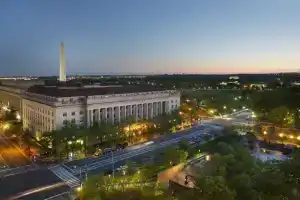
The National Mall is a large, open park in downtown Washington between the Lincoln Memorial and the United States Capitol. Given its prominence, the mall is often the location of political protests, concerts, festivals, and presidential inaugurations. The Washington Monument and the Jefferson Pier are near the center of the mall, south of the White House. Also on the mall are the National World War II Memorial at the east end of the Lincoln Memorial Reflecting Pool, the Korean War Veterans Memorial, and the Vietnam Veterans Memorial.

Directly south of the mall, the Tidal Basin features rows of Japanese cherry blossom trees that originated as gifts from the nation of Japan. The Franklin Delano Roosevelt Memorial, George Mason Memorial, Jefferson Memorial, Martin Luther King Jr. Memorial, and the District of Columbia War Memorial are around the Tidal Basin.

The National Archives houses thousands of documents important to American history including the Declaration of Independence, the United States Constitution, and the Bill of Rights. Located in three buildings on Capitol Hill, the Library of Congress is the largest library complex in the world with a collection of over 147 million books, manuscripts, and other materials. The United States Supreme Court Building was completed in 1935; before then, the court held sessions in the Old Senate Chamber of the Capitol.

The Smithsonian Institution is an educational foundation chartered by Congress in 1846 that maintains most of the nation's official museums and galleries in Washington, D.C. The U.S. government partially funds the Smithsonian and its collections open to the public free of charge. The Smithsonian's locations had a combined total of 30 million visits in 2013. The most visited museum is the National Museum of Natural History on the National Mall. Other Smithsonian Institution museums and galleries on the mall are: the National Air and Space Museum; the National Museum of African Art; the National Museum of American History; the National Museum of the American Indian; the Sackler and Freer galleries, which both focus on Asian art and culture; the Hirshhorn Museum and Sculpture Garden; the Arts and Industries Building; the S. Dillon Ripley Center; and the Smithsonian Institution Building (also known as "The Castle"), which serves as the institution's headquarters.

The Smithsonian American Art Museum and the National Portrait Gallery are housed in the Old Patent Office Building, near Washington's Chinatown. The Renwick Gallery is officially part of the Smithsonian American Art Museum but is in a separate building near the White House. Other Smithsonian museums and galleries include: the Anacostia Community Museum in Southeast Washington; the National Postal Museum near Union Station; and the National Zoo in Woodley Park.

The National Gallery of Art is on the National Mall near the Capitol and features works of American and European art. The gallery and its collections are owned by the U.S. government but are not a part of the Smithsonian Institution. The National Building Museum, which occupies the former Pension Building near Judiciary Square, was chartered by Congress and hosts exhibits on architecture, urban planning, and design.

There are many private art museums in the District of Columbia, which house major collections and exhibits open to the public such as the National Museum of Women in the Arts; the Corcoran Gallery of Art, the largest private museum in Washington; and The Phillips Collection in Dupont Circle, the first museum of modern art in the United States. Other private museums in Washington include the Newseum, the O Street Museum Foundation, the International Spy Museum, the National Geographic Society Museum, and the Marian Koshland Science Museum. The United States Holocaust Memorial Museum near the National Mall maintains exhibits, documentation, and artifacts related to the Holocaust.

Arts

Washington, D.C., is a national center for the arts. The John F. Kennedy Center for the Performing Arts is home to the National Symphony Orchestra, the Washington National Opera, and the Washington Ballet. The Kennedy Center Honors are awarded each year to those in the performing arts who have contributed greatly to the cultural life of the United States. The historic Ford's Theatre, site of the assassination of President Abraham Lincoln, continues to operate as a functioning performance space as well as museum.

The Marine Barracks near Capitol Hill houses the United States Marine Band; founded in 1798, it is the country's oldest professional musical organization. American march composer and Washington-native John Philip Sousa led the Marine Band from 1880 until 1892. Founded in 1925, the United States Navy Band has its headquarters at the Washington Navy Yard and performs at official events and public concerts around the city.

Washington has a strong local theater tradition. Founded in 1950, Arena Stage achieved national attention and spurred growth in the city's independent theater movement that now includes organizations such as the Shakespeare Theatre Company, Woolly Mammoth Theatre Company, and the Studio Theatre. Arena Stage opened its newly renovated home in the city's emerging Southwest waterfront area in 2010. The GALA Hispanic Theatre, now housed in the historic Tivoli Theatre in Columbia Heights, was founded in 1976 and is a National Center for the Latino Performing Arts.

The U Street Corridor in Northwest D.C., known as "Washington's Black Broadway", is home to institutions like the Howard Theatre, Bohemian Caverns, and the Lincoln Theatre, which hosted music legends such as Washington-native Duke Ellington, John Coltrane, and Miles Davis. Washington has its own native music genre called go-go; a post-funk, percussion-driven flavor of rhythm and blues that was popularized in the late 1970s by D.C. band leader Chuck Brown.

The District is an important center for indie culture and music in the United States. The label Dischord Records, formed by Ian MacKaye, was one of the most crucial independent labels in the genesis of 1980s punk and eventually indie rock in the 1990s. Modern alternative and indie music venues like The Black Cat and the 9:30 Club bring popular acts to the U Street area.

Street view

Hotels

2 guests
Adults2+
Children under 170+
Age7+
Age7+
Age7+
Age7+
Age7+
Age7+
Age7+
Age7+
Age7+
Age7+
Search hotel

Reviews

Share your experiences, help others make the right choice!
Think about what you would like to know if you were looking for a review about a place to relax. Please describe in detail what you liked and what you didn't. What would you advise to other guests and to the hotel owner. The more fully you tell about the hotel, the easier it will be for other people to make a choice and they will be very grateful to you!

Map

X